What Is a Gyroscope and How Does It Work
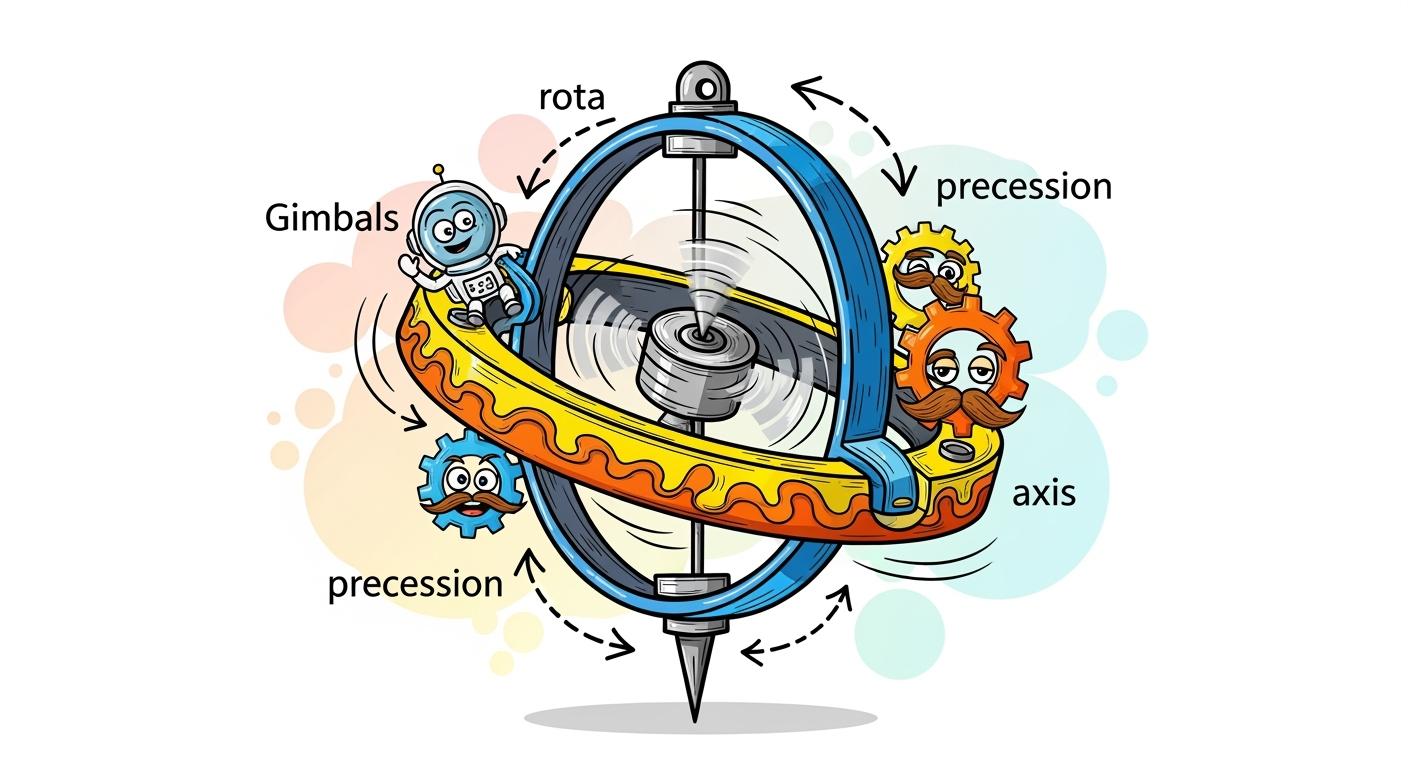
Have you ever wondered how your phone screen rotates perfectly when you turn it? You can thank a gyroscope for that magic. So, what is a gyroscope? It is a special device that uses the principle of angular momentum to measure orientation and rotation. A modern gyroscope sensor helps a drone stay perfectly level in the air. This amazing gyroscope is a key part of our daily technology.
💡 Did You Know? The global gyroscope sensor market was valued at $3.8 billion in 2023. Experts project it will grow to $6.5 billion by 2032, showing how vital this gyroscope is.
Key Takeaways
A gyroscope measures how things turn or rotate. It uses a spinning part or a vibrating piece to do this.
Old gyroscopes were big and mechanical. Modern ones, called MEMS gyroscopes, are tiny chips found in phones and smart devices.
Gyroscopes help your phone screen rotate. They also keep drones steady and cars from skidding.
Advanced gyroscopes use light for super precise navigation. Airplanes and space telescopes use these.
Gyroscopes are important for future tech. They will help self-driving cars and robots move accurately.
What Is a Gyroscope and Its Core Principle
To truly understand what is a gyroscope, you must look at its classic mechanical form. The story of this device takes us to the 19th century with a French physicist named Léon Foucault. He wanted a way to demonstrate the Earth's rotation in his laboratory. In 1852, he perfected and named the gyroscope. Foucault combined the Greek words gyros ('ring' or 'circle') and skopein ('to look at'), creating a name that literally means "to see the turning."
Gyroscopic Inertia and Angular Momentum
At the heart of every gyroscope is a physical principle called angular momentum. You can think of angular momentum as the rotational version of regular momentum. An object moving in a straight line has momentum that keeps it going. A spinning object has angular momentum that wants to keep it spinning in the same orientation.
Physics in Action: Angular Momentum In physics, angular momentum (L) is the product of an object's moment of inertia (I) and its angular velocity (ω).
L = I * ω
Moment of Inertia (I): This measures an object's resistance to rotational changes. Think of it like mass for a spinning object.
Angular Velocity (ω): This is simply how fast the object is spinning.
A spinning top is a perfect example. When you spin a top, you give it a large amount of angular momentum. This momentum creates gyroscopic stability, which is a powerful resistance to any force trying to tilt it. Gravity pulls down on the top, but instead of falling over, it just wobbles. This resistance is a key part of what is a gyroscope.
Understanding How the Gyroscope Works
Now, let's look at how the gyroscope works by examining its parts. A traditional mechanical gyroscope has a simple but brilliant design.
Rotor: A heavy wheel or disc that spins at a very high speed.
Gimbals: A set of pivoted rings. Each ring allows the rotor to tilt freely on a different axis.
Frame: The outer support structure that holds the gimbals.
You mount the rotor inside the gimbals. The gimbals then connect to the frame. This setup isolates the spinning rotor from outside movements. If you tilt the frame, the gimbals pivot, but the rotor's spin axis remains fixed in space. This property makes the gyroscope an excellent inertial reference tool.
This leads to a fascinating phenomenon called the gyroscopic effect, or precession. Imagine you hold a spinning bicycle wheel by its axle and try to tilt it left. Instead of tilting left, the wheel will strangely swerve to the right, moving at a right angle to your push. This is precession. A force trying to change the spin axis of a gyroscope results in a motion perpendicular to that force. This effect explains why a spinning top precesses (wobbles in a slow circle) instead of just toppling over. Understanding this effect is central to knowing what is a gyroscope and its function in technology.
The Modern Gyroscope Sensor

The spinning wheel gyroscope is a classic, but it is too large for your phone. Technology needed a smaller solution. This led to the creation of the modern gyroscope sensor. These tiny chips power the devices you use every day. They are a marvel of micro-engineering. The most common type is the MEMS gyroscope. MEMS stands for Micro-Electro-Mechanical Systems. This tiny gyroscope sensor makes modern electronics possible.
MEMS Gyroscopes in Electronics
You can find a MEMS gyroscope sensor in almost any smart device. These sensors are incredibly small. Many are just 1 to 4 millimeters wide, smaller than a grain of rice. This small size is a huge advantage over old mechanical gyroscopes. You can see a direct comparison below.
Feature | MEMS Gyroscopes | Mechanical Gyroscopes |
|---|---|---|
Size | Small size, light weight | Large volume, heavy weight |
Cost | Low cost | High cost |
Power Consumption | Low power consumption | High power consumption |
Structure | Integrable, simple design | Complex structure |
The low power use of a MEMS gyroscope is vital. Your phone and smartwatch rely on batteries. A low-power gyroscope sensor helps them last longer. Manufacturers create these chips using a process called photolithography. This process allows them to mass-produce millions of sensors cheaply.
How They're Made: Photolithography 🔬 Photolithography works like photographic printing.
It uses light to etch microscopic patterns onto a silicon wafer.
This process can pattern an entire wafer at once, making it fast and cost-effective.
It allows for extremely high integration, placing the gyroscope and other electronics on the same chip.
This technology enables companies to produce a powerful gyroscope sensor for just a few dollars. Key manufacturers leading this market include:
Kionix (a Rohm Semiconductor company)
How Vibrating Structures Sense Rotation
A MEMS gyroscope sensor does not have a large spinning wheel. Instead, it uses a tiny vibrating structure to detect rotation. This structure is often shaped like a tuning fork or a small ring. The gyroscope works based on a physical law called the Coriolis effect.
You can understand the process in three simple steps:
An electric current makes a tiny mass inside the gyroscope sensor vibrate back and forth along one direction.
You rotate your device. This rotation creates a Coriolis force that pushes on the vibrating mass.
This force causes the mass to start vibrating in a new, perpendicular direction. The gyroscope sensor measures this second vibration to calculate how fast and in what direction you are turning.
These vibrating structures are one of the most common types of gyroscopes today. Their clever design allows a tiny chip to do the same job as a much larger mechanical gyroscope.
Advanced Gyroscope Technology: Light and Lasers
Some applications need extreme precision. Aerospace and deep-space navigation demand a more advanced gyroscope. These situations use optical gyroscopes, which are another one of the major types of gyroscopes. These devices use light instead of moving parts. The two main kinds are the Ring Laser Gyroscope (RLG) and the Fiber Optic Gyroscope (FOG).
These types of gyroscopes operate on a principle called the Sagnac effect.
Physics in Action: The Sagnac Effect Imagine splitting a beam of light into two. You send both beams in opposite directions around a closed loop of fiber optic cable. If the loop is still, the beams arrive back at the start at the exact same time. If the loop rotates, one beam has a slightly shorter path, and the other has a slightly longer one. The gyroscope measures this tiny time difference to calculate the rotation with incredible accuracy.
This technology is essential for high-stakes tasks where GPS is unavailable or not precise enough. Key applications include:
Aerospace & Defense: Guiding aircraft, missiles, and submarines.
Space: Aiming the Hubble Space Telescope and navigating planetary rovers.
Industry: Steering advanced drilling tools deep underground for oil and gas exploration.
This advanced gyroscope sensor provides the ultimate stability and directional awareness for our most critical technologies.
Essential Gyroscope Applications
The gyroscope is a hidden hero in countless technologies. You interact with its work every day, from the phone in your pocket to the vehicles that move you. These diverse gyroscope uses show how essential this technology has become.
Motion Sensing in Everyday Devices
Your daily gadgets rely heavily on the gyroscope. Think about your smartphone's camera. A tiny gyroscope sensor detects your hand shaking. The camera system then moves the lens in the opposite direction. This process, called Optical Image Stabilization (OIS), helps you take clear, blur-free photos. This is one of the most common gyroscope uses in consumer electronics.
Gaming controllers also use this technology for exciting, interactive experiences. The Nintendo Switch Joy-Con controllers contain an Inertial Measurement Unit (IMU).
What is an IMU? 🕹️ An IMU is a small chip that combines sensors.
A gyroscope measures rotational motion (turning and twisting).
An accelerometer measures linear motion (moving up, down, left, or right). A processor uses data from both to understand movement in 3D space.
This combination allows you to control game actions by simply moving the controller. The gyroscope is the key to many modern motion tracking applications, including virtual reality (VR) headsets and fitness wearables.
Navigation and Vehicle Stability
The gyroscope plays a critical role in keeping vehicles safe and on course. Your car may have an Electronic Stability Control (ESC) system. This system uses a gyroscope sensor to feel if the car is turning more than you intend, which can lead to a skid. The ESC then applies brakes to specific wheels to keep you in control.
Drones need constant adjustments to fly. A gyroscope sensor inside the drone measures any unwanted tilting or rolling. The flight controller instantly corrects the drone's position, giving it excellent gyroscopic stability. This allows a drone to hover perfectly still. For larger vehicles like aircraft and submarines, a gyroscope is vital for navigation where GPS might fail. An Inertial Navigation System (INS) uses a gyroscope and accelerometer to track a vehicle's position from a known starting point. This allows a submarine to navigate deep underwater. The most precise gyroscope of all helps aim the Hubble Space Telescope, allowing it to lock onto distant stars with incredible accuracy.
So, what is a gyroscope? It is a special sensor that measures rotation using the physics of angular momentum. This gyroscope has evolved from large mechanical wheels to the tiny gyroscope sensor inside your phone. The modern gyroscope makes your digital life more interactive and stable. The gyroscope will continue to be vital for future technology. The gyroscope enables precise navigation in autonomous cars and immersive head tracking in augmented reality. The gyroscope sensor is a key part of our technological future.
The gyroscope is truly an amazing device. The gyroscope is everywhere.
FAQ
What is the difference between a gyroscope and an accelerometer?
You can think of them as a team. They measure different types of motion.
A gyroscope measures rotational motion (turning or twisting).
An accelerometer measures linear motion (moving up, down, left, or right). Your phone uses both to understand its exact position.
Why does my phone need a gyroscope?
Your phone uses a gyroscope for many cool features. It helps your screen rotate when you turn it. The gyroscope also enables motion controls in games and keeps your photos from looking blurry by stabilizing the camera.
Are gyroscopes expensive?
Mechanical gyroscopes can be very expensive. However, modern MEMS gyroscopes are very cheap. Mass production makes them cost only a few dollars. This low cost allows companies to put them in almost every smart device you own.
What is the future of the gyroscope? 🤖
Gyroscopes are key to future technology. You will see them become even more important for:
Self-driving cars
Advanced robotics
Augmented reality (AR) headsets They will help these devices navigate and interact with the world precisely.
See Also
Steering Angle Sensors: Your Vehicle's Unseen Protector on Every Journey
Understanding Knock Sensors: Identifying Critical Signs of Impending Engine Failure
A4988 Driver Direction Issues: Troubleshooting Solutions to Keep You Moving
Solenoid Switches: Unveiling Their Indispensable Role in Contemporary Automotive Systems
Enhancing Road Safety: The Crucial Impact of Steering Angle Sensors