XOR vs XNOR Gates An Essential Guide for Beginners
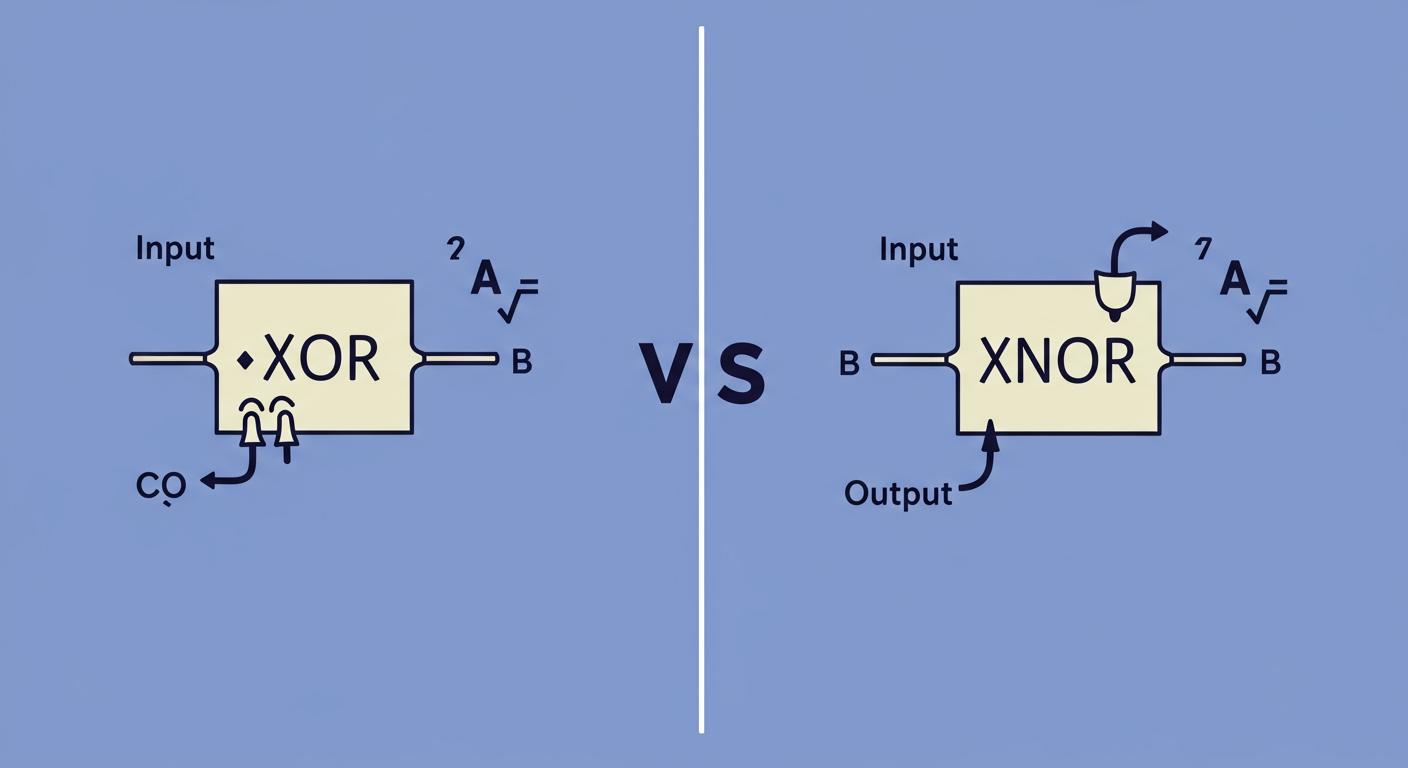
Have you ever needed to check if two things are exactly the same or completely different? Digital logic uses specific electronic tools for this job. The most important takeaway for a beginner is the core function of each component.
An XOR gate is a “difference detector.” It outputs a '1' when its inputs are different. An XNOR gate is an “equality detector.” It outputs a '1' when its inputs are the same.
These simple gates are the foundation of modern electronics. A consumer CPU contains hundreds of millions of logic gates, from a simple XOR circuit to more complex arrangements. Understanding the XOR gate and XNOR gate is essential in a field with significant projected growth.
| Metric | Value |
|---|---|
| Market Size in 2024 | USD 140.7 billion |
| Market Size in 2034 | USD 290.9 billion |
| CAGR (2025-2034) | 7.5% |
Key Takeaways
- An XOR gate finds differences. It gives a '1' when its inputs are not the same.
- An XNOR gate finds matches. It gives a '1' when its inputs are the same.
- XOR gates help with math in computers, like adding numbers. They also check for errors in data.
- XNOR gates are good for comparing things. They check if two numbers or signals are equal.
- XNOR is the opposite of XOR. If XOR gives a '1', XNOR gives a '0' for the same inputs.
Understanding the XOR Gate:
The Exclusive OR gate, often shortened to XOR gate, is a fundamental digital logic component. It acts as a "difference detector." Its output is HIGH (1) only when its inputs are different. This behavior is similar to a two-way light switch in a hallway. Flipping either switch changes the light's state, but flipping both keeps it the same. The XOR gate is also known as an "odd detector" because its output is '1' only when there is an odd number of true inputs. This makes the exclusive or gate a versatile tool in digital systems.
Logic Symbol and Expression:
The standard symbol for an exclusive or gate resembles an OR gate with an additional curved line at the input. In Boolean algebra, the logic is represented by a specific formula. The Boolean expression for XOR with inputs A and B and output X is X = A'B + AB'. This Boolean expression for XOR shows that the output is true if A is false AND B is true, OR if A is true AND B is false.
The Truth Table of XOR Gate:
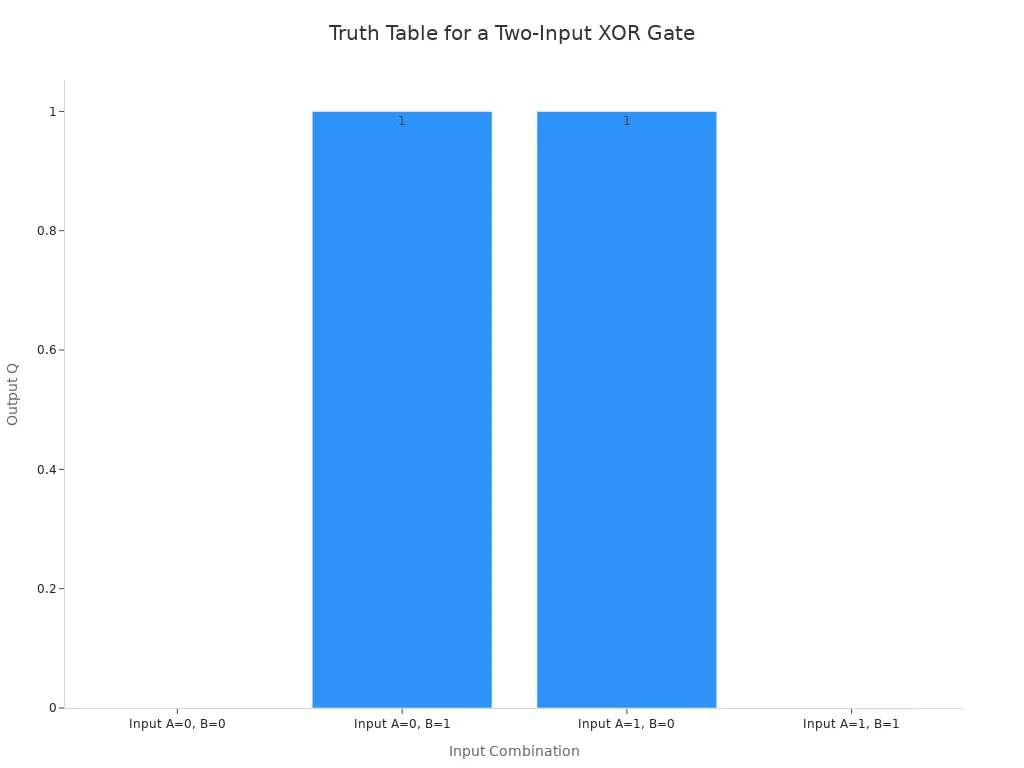
A truth table lists all possible input combinations and their resulting outputs. The truth table of xor gate clearly demonstrates its function. The output is '1' only when the two inputs are at different logic levels.
| Input A | Input B | Output Q |
|---|---|---|
| 0 | 0 | 0 |
| 0 | 1 | 1 |
| 1 | 0 | 1 |
| 1 | 1 | 0 |
This truth table confirms the exclusive or nature of the gate. The following chart visualizes this behavior, showing a HIGH output only for the (0,1) and (1,0) input pairs.
The XOR Circuit in Arithmetic:
The XOR circuit is a cornerstone for performing arithmetic operations in digital electronics. Its unique properties make it perfect for binary addition.
Note: A simple half-adder, which adds two single binary digits, uses one XOR circuit and one AND gate. The XOR circuit calculates the 'Sum' bit, while the AND gate determines the 'Carry' bit.
A full-adder circuit, which adds three binary digits, also relies heavily on these gates. The final 'Sum' is calculated by connecting two XOR gates in series. The first XOR circuit combines inputs A and B. The second takes that result and combines it with the carry-in bit. This simple circuit of xor gate is essential for performing arithmetic operations. The circuit of xor gate is a building block for more complex processors that handle all binary math. These gates are fundamental.
Exploring the XNOR Gate:
The Exclusive NOR gate, or XNOR gate, functions as the logical opposite of the XOR gate. Its primary role is to act as an "equality detector." The gate produces a HIGH (1) output when its inputs are the same. This makes the exclusive nor gate a fundamental component for comparison tasks. It is also known as an "even detector." The output is '1' when an even number of inputs are true, which includes the case where zero inputs are true. These logic gates are essential for building complex digital systems.
Logic Symbol and Expression:
The logic symbol for an XNOR gate is easy to recognize. It looks just like an XOR gate symbol but includes a small circle, called an inverter bubble, on the output line. This bubble signifies that the output is inverted.
The boolean expression for XNOR with inputs A and B is
X = AB + A'B'. This formula shows the output is true if A AND B are both true, OR if A AND B are both false. The boolean expression for XNOR perfectly captures its equality-checking function.
The Truth Table of XNOR Gate:
A truth table provides a clear map of a gate's behavior. The truth table of xnor gate shows a HIGH output only when the inputs are identical. This confirms its role as an equality detector.
| Input A | Input B | Output Q |
|---|---|---|
| 0 | 0 | 1 |
| 0 | 1 | 0 |
| 1 | 0 | 0 |
| 1 | 1 | 1 |
This truth table demonstrates the exclusive nor logic. The output is '1' for the (0,0) and (1,1) input pairs, showing that the inputs match.
Use in Digital Comparators:
The circuit of xnor gate is a key element in digital comparators. These circuits check if two binary numbers are equal. For example, a 4-bit equality comparator uses multiple XNOR gates to compare two 4-bit binary numbers. Each xnor gate compares a corresponding bit from the two binary inputs. The circuit of xnor gate outputs a '1' if its two input bits are the same. For the two 4-bit numbers to be equal, all individual bit comparisons must result in '1'. The outputs of the four XNOR gates are then connected to a single AND gate. The final output is '1' only if all four pairs of bits are equal, confirming the numbers are identical.
Key Differences: XOR vs. XNOR:
Understanding the core distinctions between XOR and XNOR gates is crucial for mastering digital logic. While they seem similar, their outputs are exact opposites, giving them unique roles in electronic circuits. This section breaks down their key differences, from basic logic to more complex behaviors.
Output Logic: Difference vs. Equality
The most fundamental difference lies in what each gate is designed to detect. Their names give a clue to their function.
- An XOR gate is a difference detector. It produces a HIGH (1) output only when its inputs are different from each other.
- An XNOR gate is an equality detector. It produces a HIGH (1) output only when its inputs are the same.
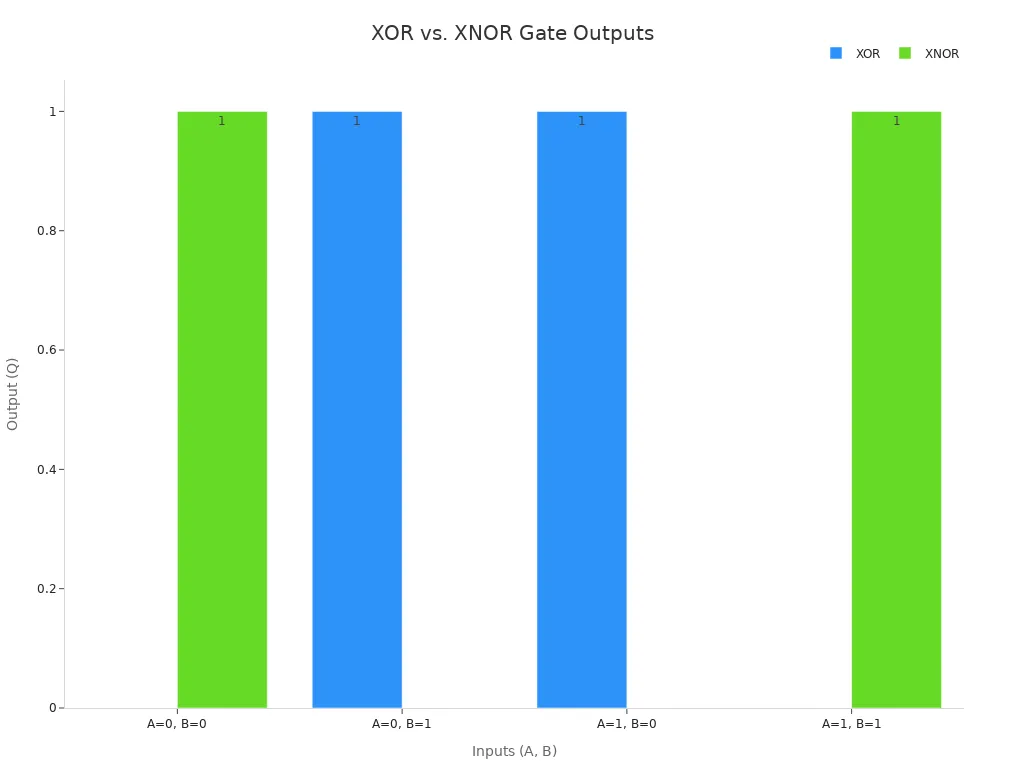
| Input A | Input B | XOR Output (Difference) | XNOR Output (Equality) |
|---|---|---|---|
| 0 | 0 | 0 | 1 |
| 0 | 1 | 1 | 0 |
| 1 | 0 | 1 | 0 |
| 1 | 1 | 0 | 1 |

The Inverting Relationship
The XNOR gate is the logical inverse of the XOR gate. This means its output is always the opposite of what an xor gate would produce for the same inputs. The "N" in XNOR stands for "NOT," signifying this inversion.
Think of it this way: An XNOR gate performs the same logic as an XOR gate followed immediately by a NOT (inverter) gate.
The truth tables for these gates confirm this relationship. The output column for the xnor gate is a direct inversion of the output column for the XOR gate. Where one is '1', the other is '0'. This complementary nature makes these two gates powerful tools for digital designers.
Multi-Input Behavior
The behavior of these gates becomes even more distinct when more than two inputs are involved. Their function extends beyond simple comparison to counting the number of HIGH inputs.
- Multi-Input XOR Gate: A multi-input XOR gate acts as an odd detector. It produces a HIGH (1) output only when there is an odd number of HIGH inputs (1, 3, 5, etc.).
- Multi-Input XNOR Gate: A multi-input XNOR gate acts as an even detector. It produces a HIGH (1) output only when there is an even number of HIGH inputs (0, 2, 4, etc.).
This property is essential in applications like parity generation and error checking for data transmission. Understanding how these gates scale with more inputs unlocks their use in more advanced digital systems. These two gates provide foundational logic for many complex operations.
Real-World Gate Applications:
XOR and XNOR gates are not just theoretical concepts; they are essential components in many real-world devices. These gates perform critical functions in data transmission, security, and system control. The practical applications of these gates show their importance in modern electronics.
XOR in Parity Checking:
One of the main applications of xor gate logic is in parity checking. A parity generator circuit uses XOR gates to create a special bit, called a parity bit. This bit helps check for errors in transmitted binary data. The gates effectively count the number of '1's in a binary number. For a 4-bit number (A, B, C, D), the even parity bit is found with the expression P = A ⊕ B ⊕ C ⊕ D. This setup allows systems to check the parity of binary numbers and ensure data integrity. These applications make the XOR gate a vital tool.
XOR in Data Encryption:
The XOR gate is fundamental to simple and fast encryption methods. The XOR operation provides a reversible way to hide information. If you combine a message with a key using XOR, you can get the original message back by performing the same operation with the same key.
(Message XOR Key) XOR Key = Original Message
This property is the basis of the XOR cipher. The process is straightforward:
- Plain Message:
1001 - Key:
1010 - Encrypt (XOR):
1001 ⊕ 1010 = 0011(Ciphertext) - Decrypt (XOR):
0011 ⊕ 1010 = 1001(Original Message)
This is one of the most important applications of xor gate logic in security.
XNOR in Error-Detection:
The XNOR gate also plays a role in error detection. Designers use the XNOR gate to check the parity of binary numbers. A multi-input XNOR gate acts as an even parity detector. It outputs a '1' only when an even number of its binary inputs are '1'. This makes the XNOR gate a natural choice for circuits that need to confirm even parity without extra components. These gates are useful in many data-checking applications.
XNOR in Control Logic:
An XNOR gate is often called a "coincidence gate." It produces a HIGH output only when its inputs are identical. This makes it perfect for control logic applications where a system needs to know if two signals match. For example, in signal processing, these gates can detect when two separate binary signals coincide, or arrive at the same time with the same value. This simple comparison is one of the key applications for these powerful gates.
XOR and XNOR gates form a foundational pair in digital electronics. The XOR gate serves as a difference detector, while the XNOR gate acts as an equality detector. These distinct functions make them essential for specific tasks. XOR gates are crucial for arithmetic and parity checking, and XNOR gates are perfect for comparison and control logic.
Understanding these components is a significant step toward analyzing more advanced digital systems. For instance, complex Arithmetic Logic Units (ALUs) are built using fundamental gates like XOR and implemented on modern hardware like FPGAs. Mastering these two gates empowers any beginner to tackle more complex circuit designs. 🚀
FAQ
Why is XOR called an 'odd detector'?
💡 An XOR gate with multiple inputs is called an "odd detector." It produces a HIGH (1) output only when an odd number of its inputs are HIGH. For example, it outputs '1' if one or three inputs are '1', but not two.
How are XOR and XNOR gates related?
An XNOR gate is the logical inverse of an XOR gate. Its output is always the opposite of an XOR gate for the same inputs. An XNOR gate performs the same function as an XOR gate followed by a NOT (inverter) gate.
Which gate checks if two bits are the same?
⚙️ The XNOR gate is the ideal choice for this task. It functions as an "equality detector." The gate's output is HIGH (1) only when both of its inputs are identical, either 0 and 0 or 1 and 1.
What is the main difference in their Boolean expressions?
The Boolean expressions show their opposite logic.
XOR:
X = A'B + AB'checks for different inputs. XNOR:X = AB + A'B'checks for identical inputs. Each formula mathematically defines the gate's unique function in a digital circuit.