What You Need to Know About Nanofarad and Capacitance
You often see the term nanofarad, written as nF, when working with a capacitor in electronics. The nanofarad is one billionth (10⁻⁹) of a farad, the standard unit of electrical capacitance. You use this unit of capacitance because most capacitors in circuits store much less charge than a full farad. When you ask what is nanofarad, you find it fits between microfarad (µF) and picofarad (pF) in the hierarchy. The nF value helps you pick the right capacitor for audio, timing, and filtering tasks.
| Capacitance Unit | Equivalent Farads | Typical Range in Circuits | Common Applications |
|---|---|---|---|
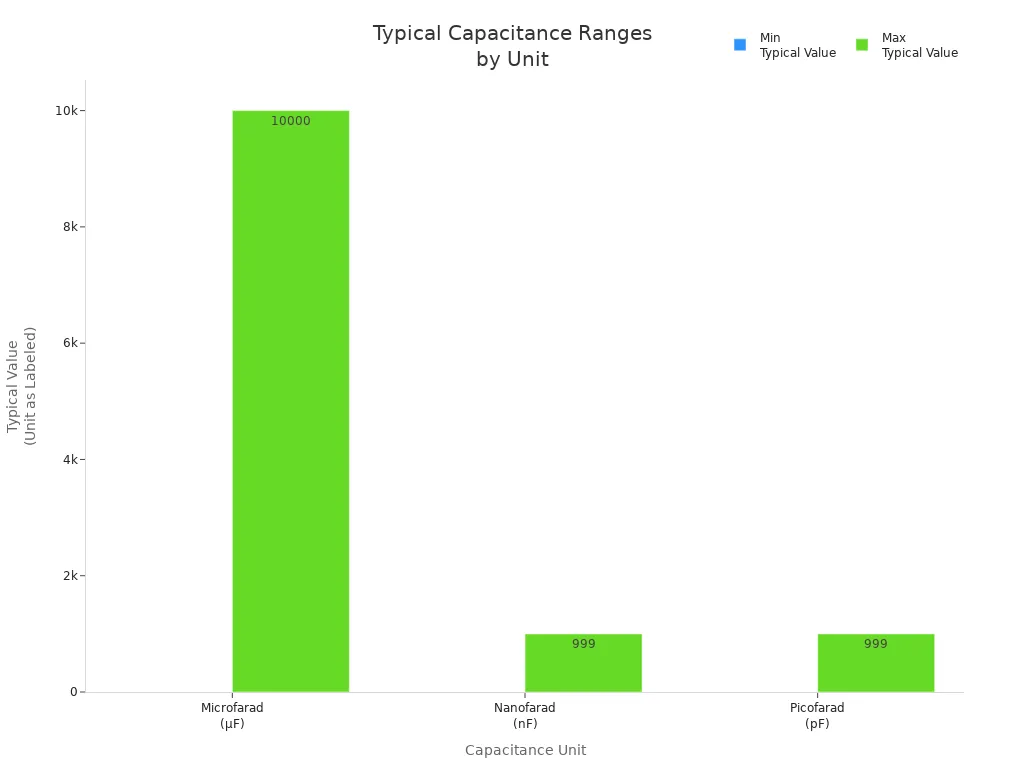
| Microfarad (µF) | 10⁻⁶ F | 1 µF to 10,000+ µF | Power supply filtering, audio circuits, timing, energy storage |
| Nanofarad (nF) | 10⁻⁹ F | 1 nF to 999 nF | High-frequency filtering, signal coupling, audio frequency filtering, timing in kHz range |
| Picofarad (pF) | 10⁻¹² F | 1 pF to 999 pF | RF circuits, crystal oscillators, high-frequency filters |
Key Takeaways
- Nanofarad (nF) is a unit of capacitance equal to one billionth of a farad, used to measure small capacitor values common in electronics.
- You use nF capacitors for high-frequency filtering, timing, and noise reduction in devices like radios, computers, and audio circuits.
- Converting between microfarads, nanofarads, and picofarads helps you select the right capacitor and avoid mistakes in your circuit.
- Check capacitor markings and codes carefully to read nF values, and always verify voltage rating, size, and temperature tolerance before use.
- Replacing aging nF capacitors and choosing the correct type improves circuit reliability, signal quality, and device performance.
What Is Nanofarad
Definition of Nanofarad
You often ask what is nanofarad when you see the abbreviation nF on a capacitor. The nanofarad is a unit of capacitance. It is part of the SI system. You use it to measure very small amounts of capacitance in electronic circuits. One nanofarad equals one billionth of a farad. Mathematically, you write this as 1 nF = 10⁻⁹ F. The farad is the main unit of capacitance, but it is too large for most electronic uses. You need smaller units like nF to describe the values you see in real circuits.
Tip: You can remember that a nanofarad is much smaller than a microfarad or millifarad. This helps you choose the right capacitor for your project.
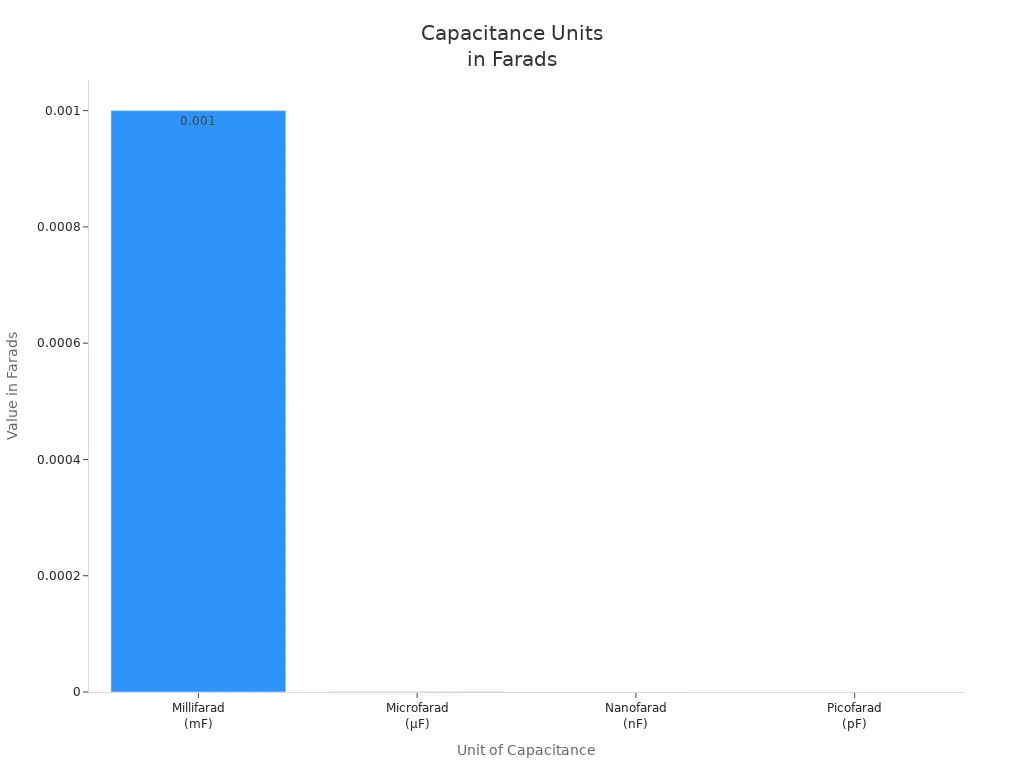
Here is a table that shows how the unit of capacitance changes:
| Unit of Capacitance | Mathematical Expression in Farads |
|---|---|
| Microfarad (µF) | 1 µF = 10⁻⁶ F |
| Nanofarad (nF) | 1 nF = 10⁻⁹ F |
| Picofarad (pF) | 1 pF = 10⁻¹² F |
| Millifarad (mF) | 1 mF = 10⁻³ F |
When you use a capacitor, you want to know how much charge it can store. Capacitance tells you this. The formula for capacitance is C = Q/V. Here, C is the capacitance, Q is the charge in coulombs, and V is the voltage. If you use a nanofarad capacitor, you store an electrical charge that is much less than a farad. This is perfect for circuits that need quick changes and small energy storage.
nF in Electronics
You see nF on many capacitors in electronic devices. You use nF because the farad is too big for most circuits. Most capacitors in radios, computers, and phones have values in the nF range. You pick nF capacitors for high-frequency circuits, signal processing, and timing tasks. These capacitors help you fine-tune signals and filter out noise.
- You use nF capacitors to:
- Improve signal quality in audio and RF circuits
- Suppress electrical noise
- Stabilize voltage in sensitive parts of a circuit
- Match impedance and shift phase in AC circuits
- Filter frequencies in oscillators and timers
You choose nF capacitors because they are small, precise, and efficient. They fit well in compact devices. You can easily identify and select the right nF value for your needs. This makes your circuit work better and reduces mistakes.
Note: When you select a capacitor, always check the nF value. This helps you avoid errors and keeps your circuit running smoothly.
Nanofarad capacitors store an electrical charge quickly and respond fast to changes. They do not hold as much energy as microfarad capacitors, but they work better for high-frequency signals. You use them when you need speed and accuracy, not just energy storage. This makes nF capacitors essential for modern electronics.
You now know what is nanofarad and why you use nF in electronics. You see how the unit of capacitance helps you pick the right capacitor for your project. You understand that nF values let you control signals, filter noise, and keep your devices working well.
Capacitance Units and Conversion
Farad, Microfarad, Nanofarad, Picofarad
When you work with a capacitor, you need to understand the different units of capacitance. The farad is the main unit of capacitance, but you rarely use it for most electronic circuits. You see microfarad, nanofarad, and picofarad much more often. Each unit helps you measure how much charge a capacitor can store. The farad is very large, so you use smaller units for practical work.
You use microfarad (µF) for many capacitors in audio and power supply circuits. Nanofarad (nF) is common for timing, filtering, and signal processing. Picofarad (pF) is useful for radio frequency circuits and very small capacitors. You see the unit of capacitance written as F, µF, nF, or pF on the capacitor label. You need to know how these units relate to each other.
Tip: You can remember that 1 farad equals 1,000,000 microfarads, 1,000,000,000 nanofarads, or 1,000,000,000,000 picofarads. This helps you convert values quickly when you select a capacitor.
Here is a table that shows the definitions and relationships:
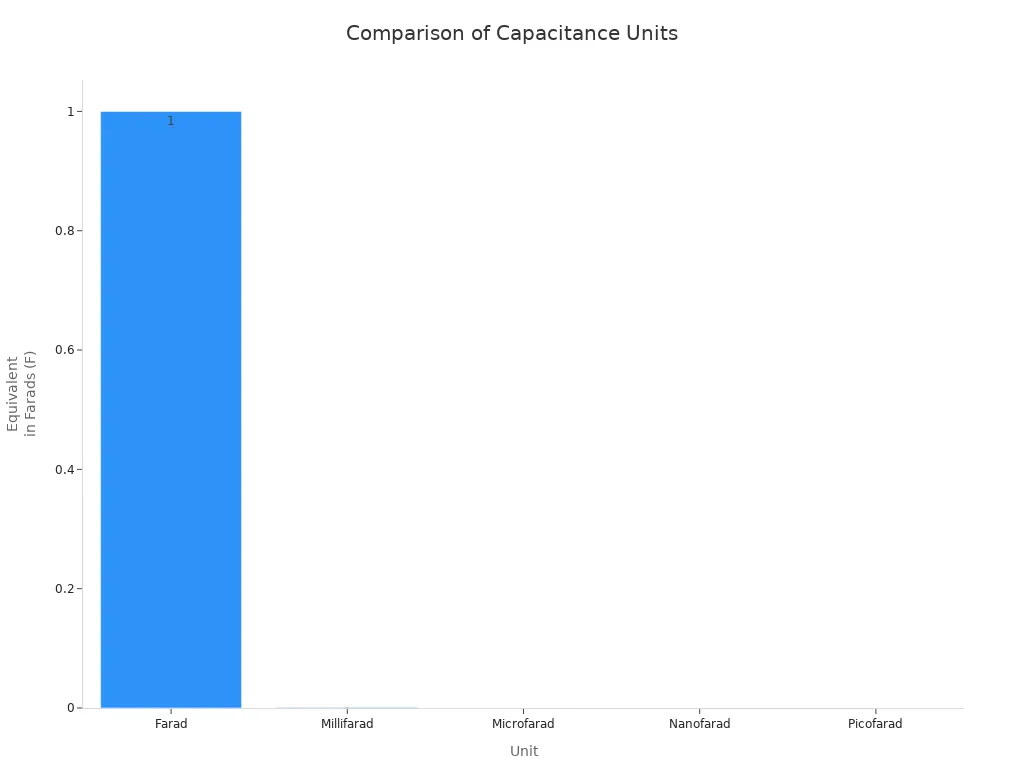
| Unit | Symbol | Equivalent in Farads (F) | Description |
|---|---|---|---|
| Farad | F | 1 F | SI unit of capacitance; used for high-farad value supercapacitors |
| Microfarad | µF | 10⁻⁶ F | One millionth of a farad; common in capacitors |
| Nanofarad | nF | 10⁻⁹ F | One billionth of a farad; used for smaller capacitors |
| Picofarad | pF | 10⁻¹² F | One trillionth of a farad; used for very small capacitance |
| Millifarad | mF | 10⁻³ F | Rarely used; one thousandth of a farad |
You see that the farad is the largest unit. You use microfarad, nanofarad, and picofarad for most capacitors in electronics. You choose the right unit of capacitance based on your circuit needs.
Conversion Table
You often need to convert between farad, microfarad, nanofarad, and picofarad when you select a capacitor. You use simple formulas to change one unit to another. For example, you convert microfarad to nanofarad by multiplying by 1,000. You convert nanofarad to microfarad by dividing by 1,000. You use these conversions to match the capacitor value to your circuit.
Here are some useful conversion formulas:
- 1 microfarad (µF) = 1,000 nanofarads (nF)
- 1 nanofarad (nF) = 0.001 microfarads (µF)
- 1 microfarad (µF) = 1,000,000 picofarads (pF)
- 1 farad (F) = 1,000,000 microfarads (µF) = 1,000,000,000 nanofarads (nF) = 1,000,000,000,000 picofarads (pF)
You can use this quick reference table to help you convert values:
| Microfarads (µF) | Nanofarads (nF) | Picofarads (pF) |
|---|---|---|
| 0.001 µF | 1 nF | 1,000 pF |
| 0.01 µF | 10 nF | 10,000 pF |
| 0.1 µF | 100 nF | 100,000 pF |
| 1 µF | 1,000 nF | 1,000,000 pF |
| 0.000001 µF | 0.001 nF | 1 pF |
| 0.00001 µF | 0.01 nF | 10 pF |
| 0.0001 µF | 0.1 nF | 100 pF |
You see that converting between units helps you pick the right capacitor for your project. You use nanofarad and nF values for many timing and filtering circuits. You use microfarad for larger capacitors. You use picofarad for very small capacitance needs.
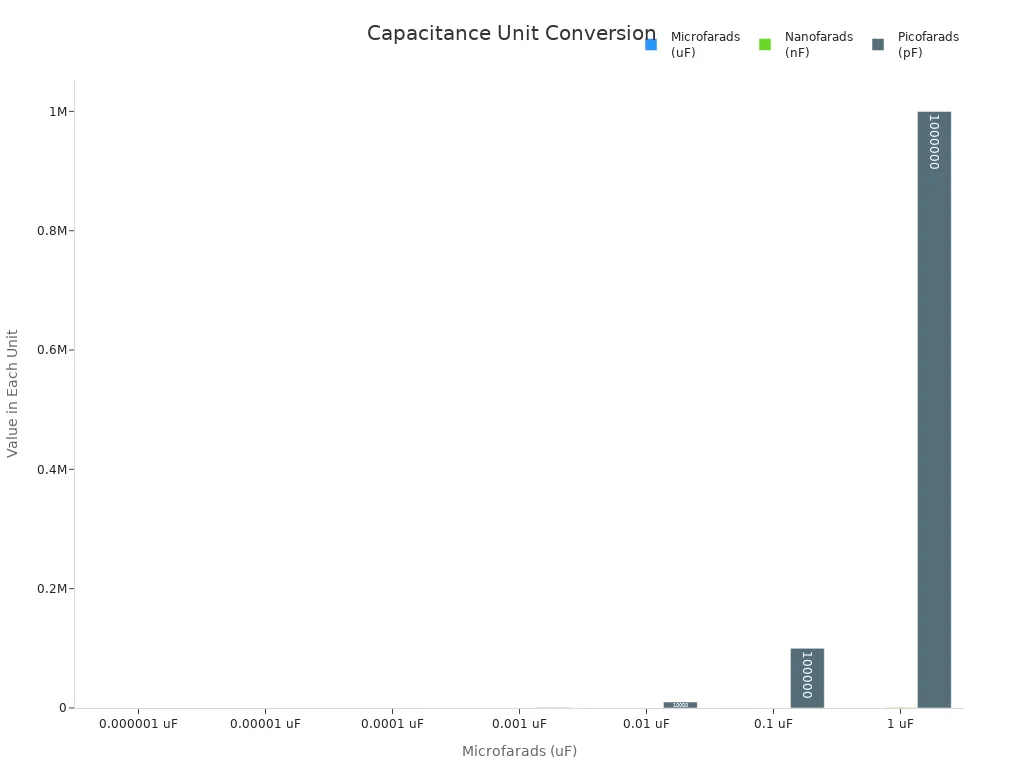
Note: Always check the unit of capacitance before you install a capacitor. This helps you avoid mistakes and keeps your circuit working well.
Nanofarad Capacitor Applications
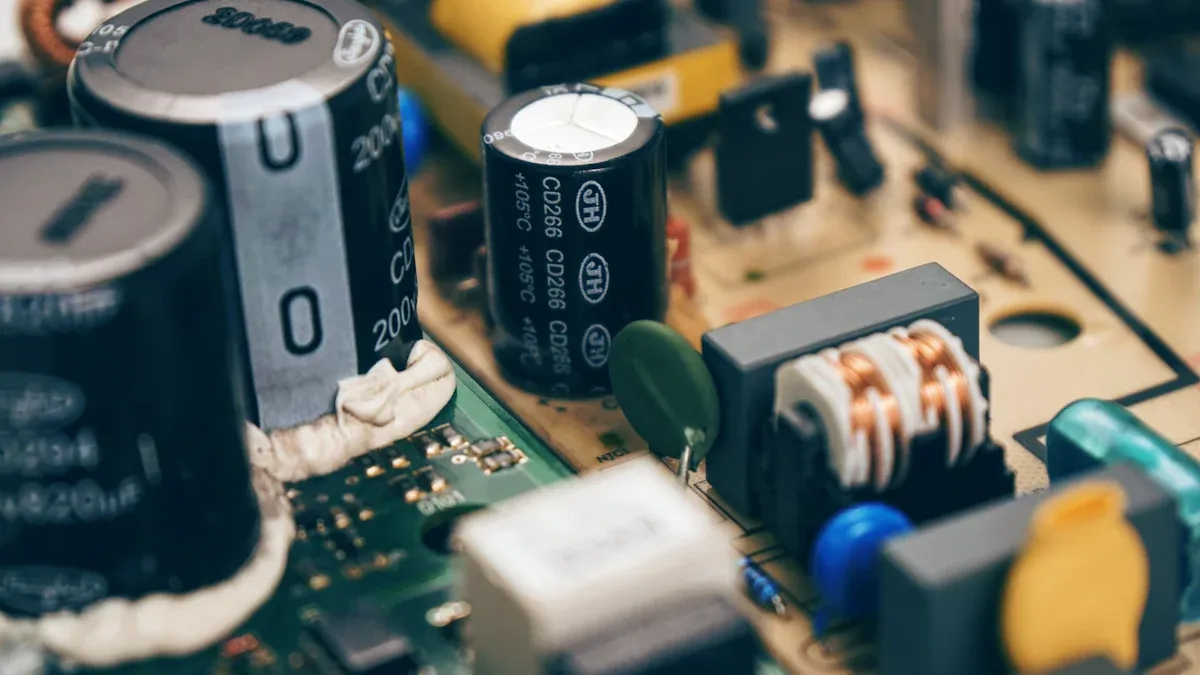
Common Uses of nF Capacitors
You find nF capacitors in many electronic circuits. These capacitors play a key role in applications that require short-term energy storage and fast response. You often use nanofarad capacitors for:
- Timing circuits, such as oscillators and pulse generators, where precise capacitance controls the timing.
- Filtering circuits that remove unwanted high-frequency noise from signals.
- Decoupling circuits and bypass circuits near integrated circuits to stabilize voltage and reduce electrical noise.
- Signal coupling, where you transfer AC signals between amplifier stages while blocking DC voltage.
- Audio frequency filtering and signal processing tasks.
For example, you might place a 100 nF ceramic capacitor close to a microcontroller’s power pins. This helps dampen noise and keeps the device running smoothly. You also combine electrolytic and ceramic capacitors to cover a wide range of frequencies for better noise reduction and filtering. In high-frequency circuits, smaller nF values like 1 nF work well for filtering and timing, while larger values like 100 nF are best for decoupling and noise suppression.
Tip: Always check the nF value when you select a capacitor for timing or filtering. This ensures your circuit performs as expected.
Why Choose Nanofarad Values
You select nanofarad values for applications where precise control of capacitance is important. In timing circuits and oscillators, even a small change in capacitance can shift the frequency and affect performance. Using the correct nF capacitor helps you keep signals stable and accurate.
Nanofarad capacitors respond quickly to changes in voltage. This makes them ideal for decoupling circuits and bypass circuits, where you need to suppress noise and stabilize voltage. The nF range allows you to fine-tune filters and match impedance in AC circuits, which improves signal quality and reduces energy loss.
You also benefit from standardized nF values, which follow the E-series system. This makes it easy to find the right capacitor for your design. Electrical capacitors in the nanofarad range help you achieve reliable operation in applications that require fast response and moderate energy storage. You use nF capacitors to maintain signal integrity, reduce interference, and ensure your circuits work efficiently.
Identifying and Selecting nF Capacitors
Reading nF Values
You often see different codes and markings on a capacitor. To read the value of nF capacitors, you need to understand these codes. Many small capacitors use a three-digit code. The first two digits show the significant numbers, and the third digit is the multiplier. For example, a code of "104" means 10 × 10⁴, which equals 100,000 pF or 100 nF. Some capacitors use color bands, where each color stands for a number. You can use a table or calculator to help decode these markings.
| Code | Microfarad (μF) | Nanofarad (nF) | Picofarad (pF) |
|---|---|---|---|
| 102 | 0.001 | 1.0 | 1000 |
| 103 | 0.01 | 10 | 10000 |
| 104 | 0.1 | 100 | 100000 |
| 105 | 1.0 | 1000 | 1000000 |
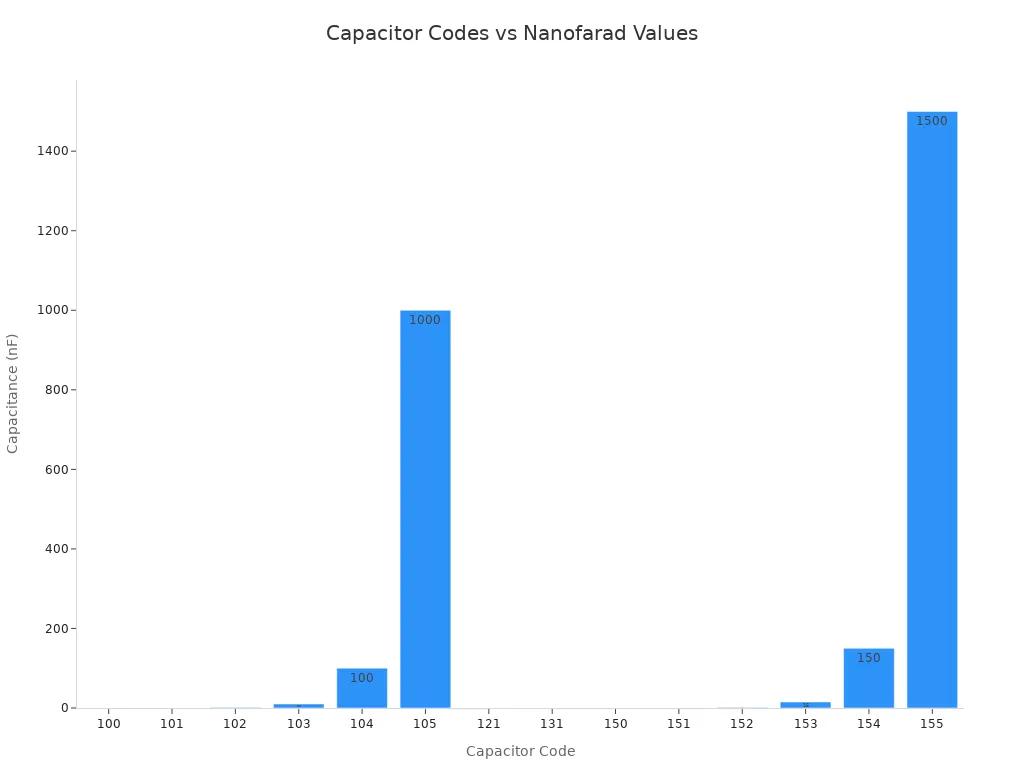
You may also find the value printed directly, such as "100 nF" or "0.1 μF." Always check the voltage rating and tolerance, which are often printed next to the capacitance value.
Tip: Use a reference table or online calculator to quickly convert codes to nF values.
Selection Criteria
When you choose nF capacitors, you must consider several important factors. The voltage rating should always be higher than the highest voltage in your circuit. For safety, select a capacitor with a voltage rating at least 20% above your circuit voltage. The physical size of the capacitor matters, especially if you have limited space on your circuit board. Higher voltage and higher capacitance mean a larger size.
Temperature stability is also key. Some nF capacitors work better in hot or cold environments. Look for capacitors with a temperature rating above your circuit’s highest temperature. For precise circuits, choose capacitors with low tolerance, such as ±5% or ±10%. Tighter tolerance gives you more accurate capacitance and better performance.
You should also check the type of capacitor. Ceramic nF capacitors are common for decoupling and filtering. Film capacitors are best for audio circuits because they have low ESR and stable capacitance. Always match the capacitor type to your application.
| Parameter | What to Check | Why It Matters |
|---|---|---|
| Voltage Rating | At least 20% above circuit voltage | Prevents failure and increases lifespan |
| Size | Fits your PCB layout | Ensures easy assembly |
| Temperature | Above max circuit temperature | Maintains stable capacitance |
| Tolerance | ±5% or ±10% for precision | Improves accuracy |
| Type | Ceramic, film, or other | Matches application needs |
Note: Always select nF capacitors with the right voltage, size, and temperature rating for your project.
Failure Modes
You need to know how nF capacitors can fail. The most common failure modes include open circuit, short circuit, and loss of capacitance. An open circuit means the capacitor no longer passes energy, breaking the circuit. A short circuit happens when the dielectric breaks down, causing too much current and possible damage. Loss of capacitance can result from aging, cracks, or high temperature, making the capacitor store less energy.
| Failure Mode | Cause | Effect on Circuit |
|---|---|---|
| Open Circuit | Mechanical stress, broken leads | Circuit stops working |
| Short Circuit | Voltage surge, dielectric breakdown | Overheating, possible damage |
| Loss of Capacitance | Aging, cracks, high temperature | Reduced energy storage, poor function |
| Increased Leakage | High voltage, aging | Overheating, malfunction |
| Dielectric Breakdown | Excessive voltage, contamination | Sudden failure, circuit malfunction |
Humidity and temperature extremes can speed up these failures. Always store capacitors in sealed packaging and avoid mechanical stress during installation. Regular testing helps you find problems early.
Tip: Replace aging nF capacitors in critical circuits to prevent sudden failure and keep your devices safe.
Understanding nanofarad and its place in electronics helps you measure and select the right capacitor for your project. You use the correct nf value to keep circuits accurate and reliable. Always check the capacitance, voltage rating, and type before choosing a capacitor. Remember, converting between nf, microfarads, and picofarads prevents mistakes. For more learning, explore books, online courses, and simulation tools.
Mastering nf capacitors improves your troubleshooting and design skills.
- Books: "The Art of Electronics," "Electrical Engineering 101"
- Online courses: Khan Academy, edX Circuits and Electronics
- Simulation tools: LTspice, Tinkercad Circuits
FAQ
What does nF mean on a capacitor?
You see "nF" on a capacitor label. This stands for nanofarad, which measures how much charge the capacitor can store. One nanofarad equals one billionth of a farad.
How do you convert microfarads (μF) to nanofarads (nF)?
You multiply the microfarad value by 1,000 to get nanofarads. For example, 0.1 μF equals 100 nF.
Tip: Use a calculator for quick conversions.
Why do you use nF capacitors in audio circuits?
You use nF capacitors to filter signals and reduce noise in audio circuits. These values help you control sound quality and keep signals clear.
How do you read capacitor codes like "104"?
You read "104" as 10 × 10⁴, which equals 100,000 pF or 100 nF.
Check a reference table if you see other codes.
What happens if you use the wrong nF value?
You may see poor performance or noise in your circuit. Using the wrong value can cause timing errors or signal loss.
Always match the nF value to your circuit needs.