Programmed I/O vs DMA Understanding the Trade-offs
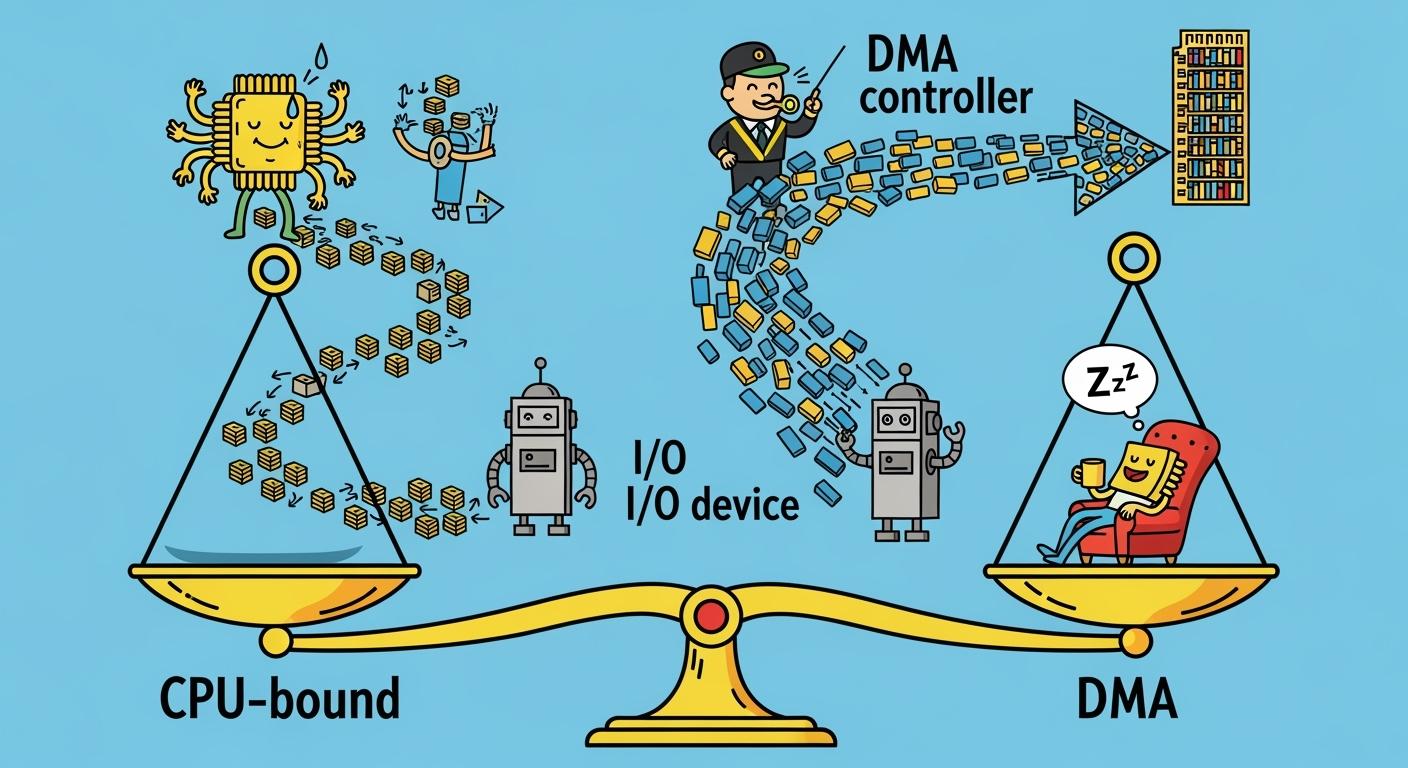
Choosing a data transfer method is about picking the right tool. Programmed I/O (PIO) offers a simple approach for small, low-speed I/O tasks. Understanding what is dma memory access reveals its strength in high-volume data transfer. The core difference impacts data transfer speed.
The CPU controls PIO, transferring I/O data byte by byte.
This trade-off makes PIO a straightforward option, while DMA is essential for freeing the CPU during intensive operations.
Key Takeaways
Programmed I/O (PIO) is simple. The CPU does all the work to move data. It is good for slow devices like keyboards.
Direct Memory Access (DMA) is faster. A special chip moves data. The CPU can do other tasks. It is good for fast devices like SSDs.
PIO costs less money. It needs less hardware. DMA costs more money. It needs a special controller.
PIO makes the CPU very busy. It checks the device often. DMA frees up the CPU. The CPU can work on other things.
Computers use both PIO and DMA. They pick the best method for each device. This makes the computer work well.
Core Concepts: PIO vs. DMA
What is Programmed I/O (PIO)?
Programmed Input/Output (PIO) is a straightforward data transfer method. The CPU directly manages every aspect of the data transfer. In a PIO system, the CPU must constantly check the status of an I/O device. This process is called polling. The CPU waits until the device is ready before it can send or receive data. This programmed approach makes PIO simple to implement.
A typical PIO read operation shows the CPU's heavy workload:
The CPU checks the I/O device's status bit repeatedly.
It waits for the bit to show the device is ready.
The CPU then sends a read command to the I/O device.
The device performs the read and places the data in its register.
The CPU retrieves the data from the register to complete the data transfer.
This constant monitoring makes PIO inefficient for large tasks. The CPU cannot perform other duties during the I/O operation.
What is DMA Memory Access?
Direct Memory Access (DMA) offers a more advanced solution. It allows certain hardware to access main memory independently of the CPU. This answers the question of what is dma memory access. A special component called a DMA controller manages the entire data transfer process. The CPU initiates the transfer, then moves on to other tasks. The DMA controller handles the I/O details.
💡 Did You Know? DMA controllers can use different strategies to manage the system bus and complete a data transfer. Understanding what is dma memory access involves knowing these modes.
Burst Mode: The DMA controller takes full control of the bus. It transfers an entire block of data at once. This is the fastest data transfer method for DMA, but it temporarily halts the CPU.
Cycle Stealing Mode: The controller transfers one byte of data. It then returns bus control to the CPU. This allows the CPU and I/O device to share the bus.
Transparent Mode: The DMA controller only transfers data when the CPU is not using the bus. This mode has no impact on CPU performance but is the slowest option.
Understanding Programmed I/O (PIO)
Programmed I/O (PIO) is a fundamental method for data transfer. Its design makes it a practical choice for specific applications. The PIO method has clear strengths and weaknesses. Understanding these helps engineers build efficient systems.
Best Use: Low-Speed Devices
The PIO method works best with low-speed or low-throughput devices. Keyboards, mice, and simple sensors are excellent examples. These devices transfer small amounts of data infrequently. The CPU can easily manage their simple I/O needs without a major performance loss. The PIO approach is not suitable for devices requiring high bandwidth. Legacy hard drive standards show the data rate limits of PIO.
Maximum Transfer Rate (MB/s) | |
|---|---|
0 | 3.3 |
1 | 5.2 |
2 | 8.3 |
3 | 11.1 |
4 | 16.7 |
Advantage: Simplicity and Low Cost
Simplicity is the main advantage of PIO. This method does not require a dedicated hardware controller. The CPU manages the entire I/O operation using software. This design reduces hardware complexity and lowers manufacturing costs.
💡 Key Takeaway: Engineers can implement PIO with minimal hardware. The system relies on software for I/O control, making it a cost-effective solution for simple or budget-constrained devices.
This simplicity also makes firmware development more straightforward. The code for a programmed I/O transfer is direct and easier to debug than a complex DMA setup.
Drawback: High CPU Overhead
The biggest drawback of PIO is its high CPU overhead. The CPU must dedicate its full attention to the I/O task. It constantly polls the device to check its status. During this time, the CPU cannot perform other computations. This process wastes valuable processing cycles. For a system that needs to multitask, this overhead makes PIO an inefficient choice for any significant data transfer.
Understanding Direct Memory Access (DMA)
Direct Memory Access (DMA) is a powerful technique for systems that handle significant data loads. It provides a specialized path for data movement, which makes it superior to PIO in certain scenarios. Understanding what is dma memory access helps clarify its role in modern computing.
Best Use: High-Volume Data Transfers
DMA excels in high-speed data transfer applications. Devices like modern NVMe SSDs rely on it for transferring large amounts of data. An NVMe drive using a PCIe 3.0 interface can achieve a theoretical data transfer speed of 4,000 MB/s. Some high-end drives, like the Samsung PM9A3, reach sequential read speeds of 6,900 MB/s. This level of data transfer is impossible with PIO. Graphics cards also use DMA for texture streaming. This process allows a game to render graphics using one texture while DMA loads the next one into memory, overlapping operations for maximum efficiency.
Advantage: Improved System Performance
The primary advantage of direct memory access is the boost to overall system performance. DMA offloads the work of data transfer from the CPU. A dedicated DMA controller manages the entire operation. This frees the CPU to execute other complex tasks.
By delegating transfers to a DMA controller, the CPU can run critical processes in parallel. This is especially beneficial in server environments where concurrency is a key performance driver.
This efficiency leads to several key benefits:
Reduced CPU Overhead: The CPU wastes fewer cycles on routine data movement.
Lower Latency: Operations complete faster without CPU intervention.
Enhanced Parallelism: The CPU and DMA controller work simultaneously, improving system throughput.
Ultimately, what is dma memory access about is achieving better system performance.
Drawback: Higher Complexity and Cost
DMA is not without its trade-offs. The method introduces both hardware and software complexity. A system needs a dedicated DMA controller, which adds to the silicon die area and manufacturing cost. This hardware overhead can range from a minimal 1% to nearly 3% of the total system area. On the software side, developers must manage potential issues like cache coherency. The CPU's cache can become out of sync with the main memory that the DMA controller is using. This requires careful software management to "clean" or "invalidate" the cache before and after a data transfer, adding another layer of complexity to firmware development. Understanding what is dma memory access includes acknowledging these challenges.
PIO vs. DMA: A Direct Comparison
Choosing the right data transfer method comes down to balancing performance, cost, and complexity. Programmed I/O (pio) and Direct Memory Access (DMA) offer different solutions for moving data between memory and I/O devices. A direct comparison highlights their distinct trade-offs. The pio approach prioritizes simplicity, while DMA focuses on efficiency for large data transfer tasks. This table provides a clear summary of their core differences.
Factor | Programmed I/O (PIO) | Direct Memory Access (DMA) |
|---|---|---|
CPU Involvement | The CPU manages the entire data transfer. It is 100% involved, polling the I/O device and moving data byte by byte. | The CPU only initiates the transfer. A dedicated DMA controller handles the entire I/O operation, freeing the CPU. |
Performance | Performance is low. The pio method is limited by the CPU's speed and its need to manage the I/O task directly. It is suitable for low-speed devices. | Performance is high. DMA enables fast, large-volume data transfer. It is essential for high-throughput devices like SSDs and network cards. |
System Complexity | The pio system is simple. It requires no extra hardware, reducing design complexity and cost. Software directly controls the I/O. | The system is more complex. It needs a dedicated DMA controller. Software must manage the controller and handle issues like cache coherency. |
Cost | The pio model is very low-cost. The absence of a dedicated controller makes it ideal for budget-conscious or simple embedded systems. | The cost is higher. The inclusion of a DMA controller adds to the hardware and manufacturing expenses of the system. |
A key challenge in a DMA system is managing access to the memory bus. Both the CPU and the DMA controller may need to use it at the same time. This conflict is resolved through a process called bus arbitration.
💡 How it Works: Bus arbitration logic acts like a traffic controller for the memory bus. It ensures only one device, called the bus master, uses the bus at any given moment.
The process generally follows these steps:
A device, like a DMA controller, signals its need for the bus by asserting its bus request line.
The bus arbitrator checks the request.
The arbitrator grants access by asserting the bus grant line.
The device then takes control of the bus to perform its read or write operation.
This arbitration allows for techniques like 'cycle stealing,' where the DMA controller temporarily uses the bus for a quick data transfer. The controller then returns control to the CPU. This sharing mechanism is fundamental to how DMA achieves high-speed data transfer without completely halting the processor. The pio data transfer method does not face this issue because the CPU is always in control of the i/o process. The simplicity of pio avoids the need for complex arbitration logic. However, this simplicity is also what limits pio from handling demanding i/o workloads.
Choosing a data transfer method is a core engineering trade-off. The pio method is a practical choice for simple systems with low-speed i/o needs. In contrast, DMA is an essential investment for performance-critical applications that require high throughput.
Storage Devices (SSDs)
Network Cards
Graphics Processing
The historical shift from pio in older hard drives highlights this point. Understanding this i/o trade-off is key to designing an efficient system that can handle its specific i/o workload.
FAQ
Why not always use DMA if it's faster?
DMA adds hardware complexity and cost. It requires a dedicated controller chip. PIO is a simpler, cheaper solution for devices that do not need high speed. Engineers choose the method that best fits the device's specific needs and the system's budget.
What is "polling" in PIO?
Polling is a process where the CPU repeatedly checks an I/O device's status. The CPU must wait until the device is ready to send or receive data. This constant checking uses valuable CPU time that could be used for other tasks.
Can a system use both PIO and DMA?
Yes, modern systems use both methods to balance performance and cost.
A computer often uses DMA for a high-speed SSD and PIO for a low-speed keyboard. This hybrid approach allows the system to operate efficiently by matching the right transfer method to the right device.
What is a real-world example of PIO? ⌨️
A computer keyboard is a classic example. It sends very small amounts of data infrequently. The CPU can easily manage these simple data transfers using PIO without affecting overall system performance. This makes PIO a perfect fit for such devices.