The Ultimate Guide to Proximity Sensors in 2025

A proximity sensor is a non-contact device. It detects an object's presence or absence. The sensor emits a field or a beam of energy, like light or sound. It then converts the object's presence into an electrical signal. This high-speed response makes them essential for modern automation.
The Future is Now In 2025, the market for proximity sensors is booming, driven by advancements in AI and IoT integration. Key industries like aerospace and defense lead this adoption, relying on the sensors' increasing accuracy and smaller sizes for critical applications.
Key Takeaways
- Proximity sensors detect objects without touching them. They turn an object's presence into an electrical signal for machines.
- There are four main types of proximity sensors: inductive for metal, capacitive for many materials, photoelectric for light-based detection, and ultrasonic for sound-based detection.
- Choosing the right sensor means looking at what material it needs to sense, how far it needs to reach, and if it can handle the environment.
- Sensors have different output types like PNP or NPN and switching states like Normally Open (NO) or Normally Closed (NC). These choices depend on how the sensor connects to other equipment.
- Proximity sensors are important in factories, phones, and cars. They help with tasks like counting items, making phones smarter, and assisting drivers.
How Proximity Sensors Work
Understanding how proximity sensors operate is the first step to choosing the right one. Each type uses a unique physical principle to detect objects without physical contact. The four main technologies are inductive, capacitive, photoelectric, and ultrasonic.
| Sensor Type | Fundamental Physical Principle |
|---|---|
| Inductive | Electromagnetic induction |
| Capacitive | Changes in capacitance |
| Photoelectric | Photoelectric effect (light blocked/reflected) |
| Ultrasonic | Time-of-flight (sound echo) |
Inductive: Metal Detection
Inductive sensors specialize in detecting metal objects. They are robust and widely used in industrial environments.
- An inductive sensor generates a high-frequency oscillating magnetic field around its sensing face.
- A metal object entering this field induces small electrical currents, called eddy currents, on its surface.
- These eddy currents alter the sensor's internal coil impedance.
- The sensor's circuit detects this impedance change and converts it into an output signal.
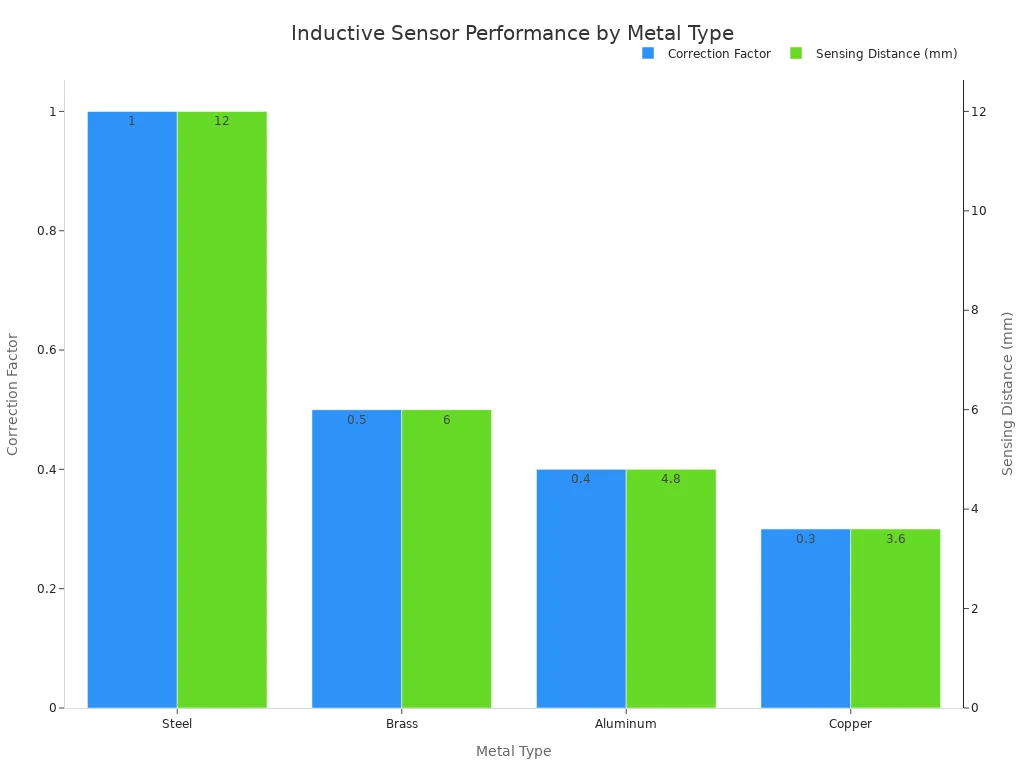
The type of metal significantly affects the detection distance. Ferrous metals like iron and steel have high magnetic permeability. They allow for the longest sensing distances. Non-ferrous metals like aluminum or copper have lower conductivity and reduce the sensing range. Manufacturers provide a correction factor to calculate the effective range for different materials.
| Metal Type | Correction Factor | Example Sensing Distance (12mm Base) |
|---|---|---|
| Steel | 1.0 | 12 mm |
| Brass | 0.5 | 6 mm |
| Aluminum | 0.4 | 4.8 mm |
| Copper | 0.3 | 3.6 mm |
Capacitive: Metal and Non-Metal Detection
Capacitive sensors are highly versatile. They detect both metallic and non-metallic objects, including liquids, powders, and plastics.
A capacitive sensor operates by generating a stable electrostatic field.
- The sensor's internal electrode plate creates this field around the sensing face.
- A target object entering the field acts like a second capacitor plate.
- This action changes the overall capacitance of the system.
- An internal oscillator circuit detects this change in capacitance.
- The sensor triggers an output signal when the capacitance crosses a set threshold.
The target material's composition greatly influences detection. An object's ability to alter the electric field is measured by its dielectric constant. Materials with a dielectric constant greater than 2 can be reliably detected. Objects with higher conductivity or a higher dielectric constant, like metals and water, cause a larger change and are easier to detect from farther away. However, factors like high humidity or dust buildup can affect accuracy, as contaminants on the sensor face can cause false readings.
Photoelectric: Light-Based Detection
Photoelectric sensors use a focused beam of light to detect objects. They consist of an emitter that sends the light and a receiver that detects it. An object is detected when it interrupts or reflects this light beam. There are three primary modes of operation.
| Sensor Type | Operation | Advantages | Disadvantages |
|---|---|---|---|
| Through-Beam | Emitter and receiver are in separate housings. An object is detected when it breaks the beam between them. | Longest range and highest accuracy. Unaffected by target color. | Requires two devices and careful alignment. |
| Retroreflective | Emitter and receiver are in one housing. The beam bounces off a special reflector. An object is detected when it breaks the beam. | Good range and easier alignment than through-beam. | Reflector can get dirty. Shiny objects can cause false signals. |
| Diffuse | Emitter and receiver are in one housing. The sensor detects light that reflects directly off the target object. | Simple, single-unit installation. Inexpensive. | Shorter range. Performance depends on target color and reflectivity. |
Tip: Use Lasers for Precision 💡 For detecting very small objects or for applications requiring high precision, laser-based photoelectric sensors are an excellent choice. A laser's tightly focused beam maintains its intensity over long distances. This allows it to detect tiny features and even clear objects that a standard LED beam might pass through.
Ultrasonic: Sound-Based Detection
Ultrasonic sensors use high-frequency sound waves to measure distance and detect objects. They work much like a bat's echolocation.
It calculates the distance to the object using this simple formula:
Distance = (Speed of Sound * Time of Flight) / 2
The division by two accounts for the sound's round-trip journey. This method makes ultrasonic sensors excellent for detecting targets regardless of their color, transparency, or shininess.
However, they have limitations.
- Soft Materials: Materials like foam, fabric, or thick carpet absorb sound waves. This weakens the returning echo, making detection difficult or unreliable.
- Environmental Factors: Air temperature and humidity directly affect the speed of sound. A 10°C change in temperature can cause a measurement error of up to 0.5%. Many modern sensors include built-in temperature compensation to maintain accuracy.
How to Choose a Proximity Sensor
Selecting the right sensor is critical for the success of any automation project. The choice depends on several key technical specifications. A careful review of application requirements ensures optimal performance, reliability, and cost-effectiveness. Before deciding, an engineer should evaluate several parameters.
- Material to be Sensed: The target's composition is the first consideration. Inductive sensors work for metals, while capacitive sensors detect a wider range of dielectric materials.
- Working Distance: This is the required range for effective data gathering. Some technologies offer very short ranges, while others, like lasers, can work over 100 meters.
- Performance Metrics: Key performance indicators define a sensor's suitability.
- Switching Frequency: This measures how fast the sensor can respond, which is vital for high-speed applications.
- Repeatability: This shows the consistency of measurements under the same conditions.
- Accuracy: This is the closeness of a measurement to the true value.
- Environmental Durability: The sensor must withstand its operating environment. This includes resilience to temperature, vibration, moisture, and chemicals.
- Connectivity and Power: The sensor must be compatible with the existing control system. This involves matching voltage requirements and communication protocols like Modbus or CAN bus.
Sensing Range
The nominal sensing distance (Sn) is a key specification found on a sensor's datasheet. Manufacturers define this as the maximum distance at which the sensor can reliably detect a standard target. This measurement is taken under ideal lab conditions. The real-world operating distance is often shorter due to several factors.
Pro Tip: Apply a Safety Margin ⚠️ For reliable operation, engineers typically use an operating distance of 50% to 80% of the nominal sensing range (Sn). This practice accounts for variations in temperature, target material, and sensor tolerances.
The target's material and size significantly affect the sensing distance. For inductive sensors, manufacturers provide a material correction factor, or k-factor, to adjust the nominal range.
| Material | Correction Factor (k) | Example Sensing Distance (10mm Base) |
|---|---|---|
| Mild Steel | 1.0 | 10 mm |
| Aluminum | 0.5 | 5 mm |
| Copper | 0.3 | 3 mm |
Some modern proximity sensors, known as "Factor 1" sensors, eliminate this issue. They offer a constant sensing range regardless of the metal type, simplifying design and installation.
Output Type: PNP vs. NPN
The sensor's output type determines how it connects to a control device like a PLC (Programmable Logic Controller). The two main types are PNP and NPN.
- PNP (Sourcing): A PNP sensor "sources" or provides a positive voltage to the output when activated. The load is connected between the output and ground (0V).
- NPN (Sinking): An NPN sensor "sinks" or provides a path to ground when activated. The load is connected between the output and a positive voltage supply.
Choosing between them depends on the PLC's input type and regional standards. A PNP sensor requires a sinking PLC input, while an NPN sensor needs a sourcing PLC input.
| Feature | PNP (Sourcing) | NPN (Sinking) |
|---|---|---|
| Switched Output | Connects +VDC when active | Connects 0V (Ground) when active |
| PLC Input Type | Requires Sinking Input | Requires Sourcing Input |
| Regional Preference | North America | Asia, Europe |
| Short Circuit Risk | A short to ground can damage the sensor. | A short to ground can cause a false signal. |
Switching State: NO vs. NC
The switching state defines the sensor's default output condition when no object is present.
- Normally Open (NO): The output circuit is open by default. It closes and sends a signal only when the sensor detects an object. This configuration is ideal for applications like counting items on a conveyor belt. The sensor energizes an output each time an object passes.
- Normally Closed (NC): The output circuit is closed by default. It maintains a continuous signal. The circuit opens and interrupts the signal when the sensor detects an object.
NC sensors are often preferred for safety-critical or fail-safe applications. For example, an NC sensor on a safety guard door ensures the machine can only run when the door is closed and the circuit is complete. If a wire breaks, the signal is lost, and the control system can trigger a safe shutdown. This prevents the machine from operating in an unsafe condition.
Mounting Style
The sensor's mounting style affects both its physical protection and its sensing range. The two main styles are shielded and unshielded.
- Shielded (Flush): These sensors have a metal ring that shields the internal coil. This design allows them to be mounted flush, or level, with a metal surface without interference. The shielding focuses the magnetic field forward but reduces the overall sensing distance.
- Unshielded (Non-Flush): These sensors have an exposed sensing face that projects beyond the sensor body. This design creates a wider, less focused sensing field, resulting in a significantly longer sensing range. However, they cannot be mounted flush in metal and are more vulnerable to physical damage.
| Feature | Shielded (Flush) | Unshielded (Non-Flush) |
|---|---|---|
| Sensing Range | Shorter | Longer |
| Mounting | Can be embedded flush in metal | Must project beyond any surrounding metal |
| Protection | Better protected from physical impact | More exposed and vulnerable to damage |
| Best For | Tight spaces, high-risk impact areas | Applications needing maximum range |
Finally, check the sensor's environmental protection rating. These ratings, defined by international standards, indicate durability.
- IP (Ingress Protection) Ratings: An international standard (IEC 60529) using two digits. The first digit (0-6) rates protection against solids like dust. The second digit (0-9) rates protection against liquids like water. An IP67 rating means the sensor is dust-tight and protected against temporary immersion in water.
- NEMA Ratings: A North American standard that covers ingress protection plus other factors like corrosion resistance and performance in hazardous locations.
Practical Applications in 2025

Proximity sensors are vital components in many modern technologies. They drive efficiency and safety across various industries. From factory floors to personal gadgets, their applications continue to expand in 2025.
Industrial Automation
Factories and warehouses rely heavily on sensors for streamlined operations. In assembly and packaging lines, these devices perform critical tasks with high precision.
- Object Detection: Inductive sensors confirm metal parts are in place before a machine drills or welds. Capacitive sensors detect non-metal items like plastic trays.
- Counting and Sorting: Photoelectric sensors count boxes on high-speed conveyor belts, helping manage inventory in logistics hubs.
- Quality Control: Sensors verify that a bottle has a cap or that a label is correctly aligned, reducing errors and waste.
- Safety: Light curtains create invisible safety barriers around dangerous machinery. They stop the machine instantly if a person crosses the line.
Consumer Electronics
Modern consumer devices use proximity sensors to create smarter, more intuitive user experiences. These tiny components are found in smartphones, wearables, and smart home products. In smartphones, a sensor detects when the user holds the phone to their ear. This action dims the screen to save battery and prevent accidental touches.
Advanced sensors now enable gesture control, allowing users to interact with devices without touching them. In smart homes, they detect a person's presence to automatically adjust lighting or temperature, improving convenience and energy efficiency.
Automotive Systems
In 2025, vehicles use sensor data to make driving safer and easier. These sensors are the foundation of Advanced Driver-Assistance Systems (ADAS). They provide 360-degree awareness around the car. Ultrasonic sensors in bumpers help with parking by alerting the driver to nearby obstacles. Radar-based systems enhance blind-spot detection, warning of vehicles hidden from view.
| ADAS Feature | Sensor Function |
|---|---|
| Parking Assist | Alerts the driver when bumpers are near an object. |
| Blind-Spot Detection | Warns of approaching vehicles in the driver's blind spot. |
| Cross-Traffic Avoidance | Detects oncoming traffic when backing out of a space. |
Automakers like Hyundai and Continental integrate these systems to meet new safety standards. This technology helps reduce driver stress and prevent accidents in busy urban environments.
Proximity sensors are essential non-contact tools that drive modern automation. They convert an object's presence into a crucial electrical signal. A successful selection depends on understanding the four core technologies: Inductive, Capacitive, Photoelectric, and Ultrasonic. Engineers must also evaluate key specifications like output type and switching state.
Use this guide to confidently select the best sensor. Boost the efficiency and reliability of your 2025 applications. 🚀
FAQ
What is the simplest way to choose a sensor?
Start with the target material. An inductive sensor works for metal. A capacitive sensor detects almost any material. A photoelectric sensor uses light for longer ranges. An ultrasonic sensor is great for clear or shiny objects. Choose the technology that fits your target first.
Can I use a proximity sensor in a wet environment?
Yes, but a user must check the sensor's IP rating. An IP67 or IP68 rating means the sensor is protected from water. These ratings ensure the device can handle moisture or even temporary immersion without failing. Always match the IP rating to the environment.
What does a "Factor 1" sensor do?
A "Factor 1" sensor is a special type of inductive sensor. It detects all metals at the same distance. This removes the need for correction factors. It simplifies design when an application involves different metals like steel and aluminum.
Can multiple sensors be used close together?
Using multiple sensors requires care. Inductive sensors can interfere with each other if mounted too closely.
- Check the manufacturer's datasheet for minimum spacing recommendations.
- Some sensors offer different frequencies to prevent interference.
- Shielded sensors also help reduce cross-talk.