3 Key Things a Low Pass Filter Does
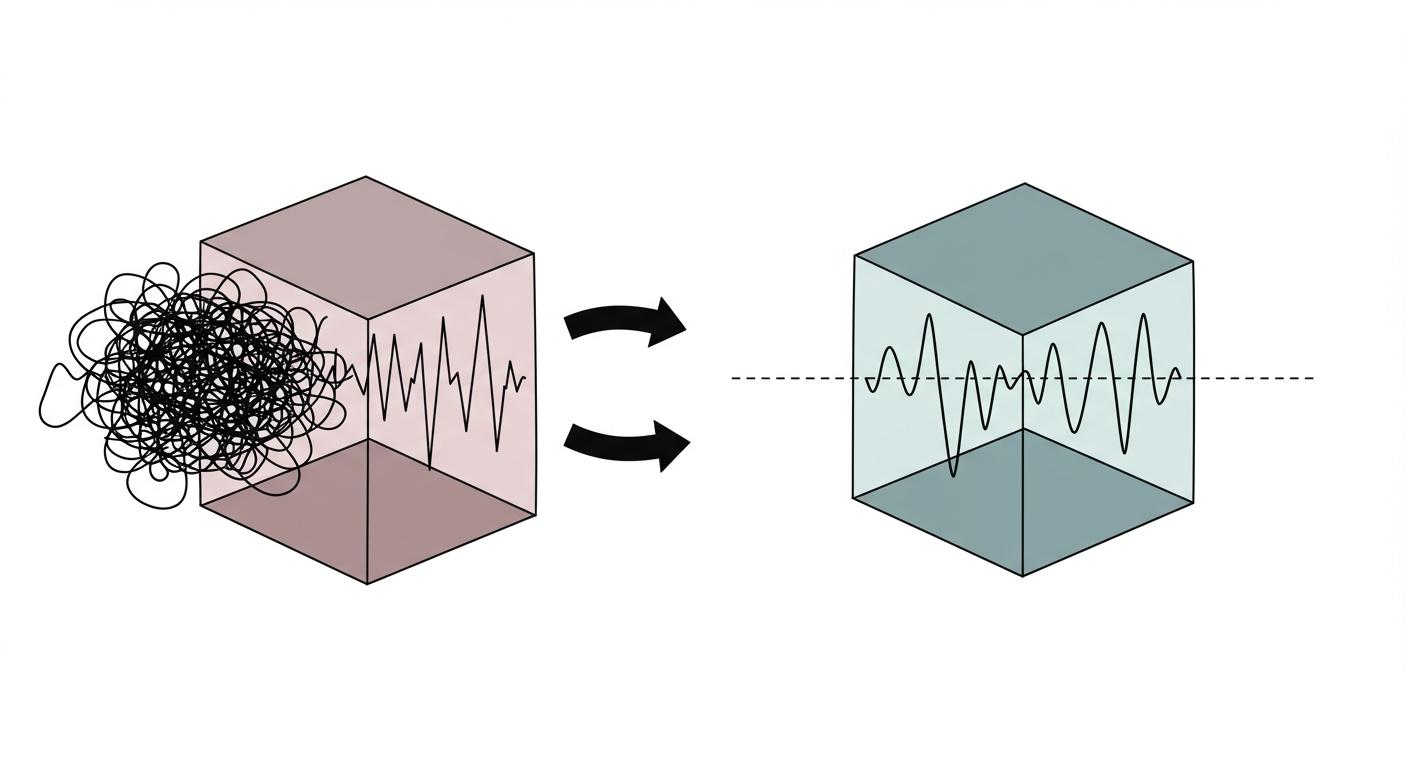
A low pass filter is a circuit or algorithm that passes signals below a specific cut-off frequency. Think of it like a sieve; it lets fine sand (the low frequency signal) pass through but holds back larger stones. In audio contexts, it is often called a high-cut filter. The importance of this simple circuit is clear from the projected growth in the global electronic filter market.
| Metric | Value |
|---|---|
| Market Size in 2024 | USD 22.90 Billion |
| Projected Market Size by 2032 | USD 72.53 Billion |
| Compound Annual Growth Rate (Forecast Period) | 15.50% |
This growth is driven by its integration into many advanced technologies:
- Smartphone Cameras: Reduces artifacts for clearer images.
- Autonomous Vehicles: Filters signals in LiDAR for accurate object detection.
- Medical Imaging: Improves image contrast in devices like endoscopes.
- Laser Systems: Suppresses noise to boost signal integrity.
- Industrial Inspection: Filters ambient light for better defect detection.
This filtering process achieves three primary outcomes for a signal.
Key Takeaways
- A low pass filter lets low-frequency signals go through. This helps keep important parts of a signal, like bass sounds in music.
- A low pass filter stops high-frequency signals. This removes unwanted noise, making signals cleaner in electronics.
- A low pass filter makes signals smoother. It takes away sharp changes, which helps devices like robots work better.
- The filter has a 'cut-off frequency.' This is the point where it starts to block higher frequencies.
Function 1: Passing Low Frequencies
The first and most fundamental job of a low pass filter is to allow signals below a certain frequency to pass through unharmed. This core function is essential in applications ranging from securing military communications to ensuring satellite signal integrity by removing unwanted interference.
The Pass-Through Mechanism
A low pass filter creates a specific range called the "passband." The filter presents very little opposition to any input signal with a frequency inside this passband. The output signal remains strong and clear. The boundary of this passband is the cut-off frequency. This is the exact point where the filter begins to work, defined as the frequency where the signal’s amplitude drops to 70.7% of its original strength (a -3 dB reduction).
The frequency response within the passband is a key indicator of a filter's quality. High-quality designs, like a Butterworth filter, provide a "maximally flat" response. This ensures all desired frequencies pass through with equal strength.
Inside the Passband:
- Signals experience minimal reduction in strength.
- The output amplitude remains nearly constant across the entire range.
- The phase shift between the input and output is close to zero degrees.
This predictable behavior makes the low pass filter a reliable tool for isolating the useful part of a signal.
Audio Application
This filtering principle is perfectly demonstrated in audio systems, especially with subwoofers. Designers build subwoofers to reproduce only deep, low frequency sounds like the rumble of an explosion or the beat of a bass drum. They are not equipped to handle high-frequency sounds like cymbals or vocals.
A low pass filter circuit acts as a gatekeeper. It takes the full audio signal and strips away all the high frequencies, sending only the bass signals to the subwoofer. This prevents the driver from trying to reproduce sounds it wasn't designed for, which can cause mechanical damage and create a muddy, unclear sound.
🔊 Pro Tip: A common
cut-off frequencyfor a home theater subwoofer is 80 Hz. This setting ensures the subwoofer focuses on deep bass, leaving midrange and high-frequency sounds to the main speakers. Some systems use a simplepassive low pass filterfor this task.
By allowing only the intended frequencies to pass, the low pass filter ensures every speaker in a system performs its job perfectly.
Function 2: Blocking High Frequencies
While a low pass filter excels at passing low frequencies, its second key function is the opposite: actively blocking or attenuating high-frequency signals. This is where the "filtering" action truly happens. The region of frequencies that the filter attenuates is known as the stopband. This area includes all frequencies above the filter's designated limit.
Defining the Cut-Off Frequency
The boundary between passing a signal and blocking it is not an abrupt wall. Instead, it is a specific point called the cut-off frequency. This threshold is the -3 dB point, which marks the exact frequency where the signal's power drops to half its original strength. At this point, the output voltage is about 70.7% of the input signal voltage.
Beyond the cut-off frequency, the filter's frequency response shows a steady decline. This decline is called the "roll-off," and it measures how effectively the filter blocks higher frequencies.
- Roll-off describes how quickly the filter reduces signal strength.
- It is measured in decibels per decade (dB/decade) or decibels per octave (dB/octave).
- A simple first-order
rc low pass filterhas a roll-off of 20 dB/decade.
This predictable roll-off allows engineers to precisely control which frequencies are removed from a signal.
Noise Reduction in Electronics
One of the most common uses for a low pass filter is removing unwanted high-frequency electronic "noise" from power supplies and data lines. This noise can come from many sources, including radio frequency interference (RFI), variable frequency drives (VFDs), and switch-mode power supplies. A simple passive low pass filter, like an rc low pass filter circuit, handles this job perfectly.
⚡ Signal Cleaning in Action: Imagine a signal waveform that looks jagged and messy due to high-frequency noise. After passing through a
low pass filter, theoutput signalwaveform appears much smoother. Thecircuiteffectively shaves off the sharp, high-frequency peaks, leaving behind the clean, underlying signal.
This filtering is critical in many fields. Broadcasting systems use a low pass filter to ensure clear transmissions, while sensitive medical devices rely on them to protect against interference that could compromise accuracy. The rc low pass filter provides a simple yet powerful way to ensure signal integrity.
Function 3: Smoothing a Signal

Beyond passing and blocking frequencies, a low pass filter performs a third key function: it smooths a signal. This process removes abrupt fluctuations and sharp spikes, transforming a jagged or "jerky" signal into a much cleaner waveform. This smoothing capability is critical in robotics and control systems, where it ensures the seamless operation of components like motors and actuators.
The Averaging Effect
A low pass filter achieves smoothing by acting like a running average calculator. It effectively averages the input signal over time. This action is similar to an exponential moving average, a technique that gives more weight to recent data points while gradually forgetting older ones.
- An RC
circuitdemonstrates this well. Its time constant determines how quickly it responds. A long time constant causes thecircuitto charge and discharge slowly, averaging out rapid changes. - This averaging removes high-frequency components. For example, a square wave contains a fundamental frequency plus many higher harmonics. A
low pass filterstrips away these harmonics, leaving a smooth sine wave.
This averaging makes the low pass filter excellent for reducing high-frequency noise. However, there is a trade-off. A very low cut-off frequency creates a smoother signal but can also make the system respond more slowly to changes.
Digital to Analog Conversion
Smoothing is essential in digital-to-analog converters (DACs). A DAC converts digital numbers into an analog voltage. The raw output signal is not a smooth curve but a series of discrete steps, like a staircase.
📈 From Steps to Smooth: This "stair-step" signal contains the desired analog information plus unwanted high-frequency energy. These high-frequency artifacts are called "images" or "aliases." They are replicas of the original signal that appear at multiples of the sampling frequency.
A low pass filter, called a reconstruction filter in this context, is placed at the DAC output. It smooths away the sharp edges of the steps, removing the imaging artifacts. The filter's cut-off frequency is set just above the desired signal's frequency range. This action reconstructs a clean, continuous analog waveform, which is crucial for high-fidelity audio and precise instrumentation.
In summary, a low pass filter accomplishes three primary tasks:
- It allows low-frequency signals to pass through.
- It blocks unwanted high-frequency noise.
- It smooths out rapid fluctuations in a signal.
The core purpose of this simple circuit is to cleanly separate a signal based on its cut-off frequency. It effectively keeps the low part and discards the high part.
This capability makes the low pass filter a fundamental building block in countless applications, from high-fidelity audio systems to complex data processing.
FAQ
What is the difference between a low pass and a high pass filter?
A low pass filter lets low frequencies through and stops high frequencies. A high pass filter does the opposite. It allows high frequencies to pass and blocks low ones. Each filter type serves a unique purpose in signal processing.
Can a filter be used in software?
Yes. A filter can be a software algorithm, not just a physical circuit. Digital signal processing uses these algorithms to remove unwanted high frequencies from audio, images, and other digital data.
What does the "order" of a filter mean?
A filter's "order" defines its steepness. A higher order means the filter blocks high frequencies more aggressively. For example, a second-order filter has a much steeper "roll-off" than a first-order one.
Why is the cut-off frequency called the -3 dB point?
The -3 decibel (dB) point marks where the signal's power is cut in half. Engineers use this standard measurement to define the exact frequency where the filter starts working effectively.