VFD or Soft Starter An Engineer's Selection Guide
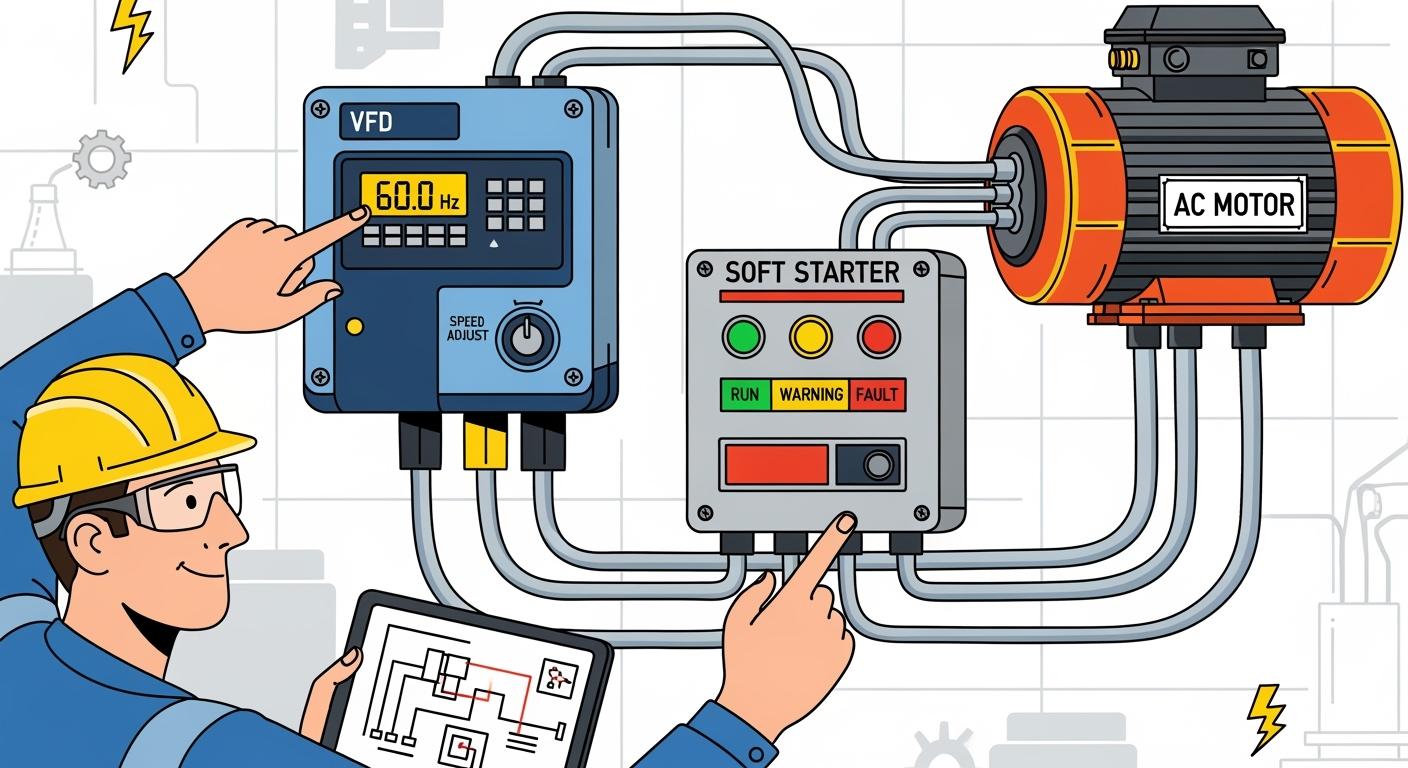
The primary decision in motor control centers on one question: Does the application require adjusting the motor's speed during operation?
A variable frequency drive is the solution for processes needing continuous motor speed control. A soft starter is the cost-effective choice for a fixed-speed motor requiring only startup and shutdown protection.
Both VFDs and soft starters are seeing rapid adoption due to demands for energy efficiency. The use of VFDs alone helped avoid over 1.75 million tons of CO₂ emissions in 2023, showing their significant impact. This guide provides engineers with the framework to make the optimal technical and financial selection.
Key Takeaways
Choose a VFD when you need to change a motor's speed often. VFDs control motor speed and save energy.
Choose a soft starter for motors that run at one speed. Soft starters protect the motor and equipment during start and stop.
VFDs cost more upfront but can save a lot of energy over time, especially for pumps and fans.
Soft starters are simpler and cheaper. They are good for fixed-speed jobs and reduce wear on machines.
The right choice depends on what the motor needs to do. Pick the device that fits the job best.
VFDs vs Soft Starter Core Functions
Understanding the internal workings of these devices reveals why their applications are so different. Both are advanced forms of motor control, but they achieve their goals through distinct methods.
Understanding a Variable Frequency Drive
A variable frequency drive is a sophisticated piece of motor control technology. It gives an operator total control over a motor's speed. The VFD accomplishes this by changing the electrical power supplied to the motor. Most modern VFDs use a Voltage-Source Inverter (VSI) design.
The process works in a few steps:
The drive first converts incoming AC power into DC power.
An inverter then uses this DC power to create a new, simulated AC output.
The VFD uses a technique called Pulse Width Modulation (PWM) to control the motor. It sends thousands of rapid voltage pulses to the motor each second.
How PWM Works: By changing the width of these pulses, the VFD adjusts the voltage, which controls motor torque. By changing the frequency of the pulse groups, it adjusts the overall frequency, which controls motor speed. This dual control makes VFDs incredibly precise.
This capability allows VFDs to manage motor speed throughout its entire operational range.
Understanding a Soft Starter
A soft starter has a much simpler and more focused job. It protects a motor from electrical and mechanical stress during startup and shutdown only. It is not used to control speed during operation.
The core of a soft starter consists of solid-state components.
Power Circuit: This contains pairs of silicon-controlled rectifiers (SCRs), also called thyristors.
Control Circuit: This small electronic brain manages the SCRs.
During startup, the control circuit adjusts the firing angle of the SCRs. This action gradually "opens the gate," allowing voltage to ramp up smoothly. This controlled acceleration prevents high inrush currents and reduces mechanical shock on belts, gears, and couplings. Once the motor reaches full speed, an internal bypass contactor often closes, allowing the motor to run directly from the power line.
Application-Based Motor Control
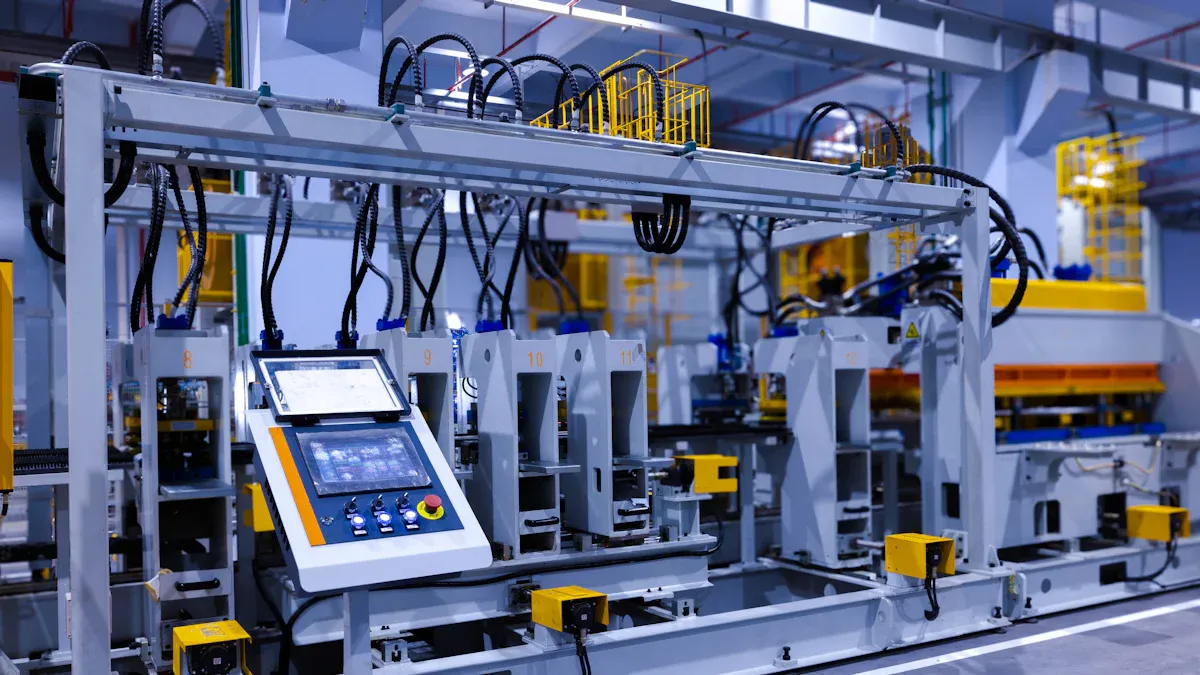
The correct motor control choice depends entirely on the job the motor must perform. An engineer selects a VFD for dynamic process control. They choose a soft starter for simple, protective starting of a fixed-speed motor.
When to Choose a VFD
Engineers should specify a VFD for any application requiring precise speed or torque adjustments during operation. These devices are essential for optimizing processes and achieving significant energy savings in variable load scenarios. VFDs provide the flexible motor control needed for complex systems.
Conveyor Systems ⚙️ Manufacturing and logistics operations benefit greatly from VFDs. They allow operators to fine-tune conveyor speed for different products or production rates without mechanical changes.
Food Processing: In baking and drying applications, VFDs vary conveyor speed to match the product type. This ensures uniform processing.
Bottling Plants: A VFD can adjust conveyor speed based on bottle size. It also synchronizes different conveyor sections to prevent jams.
Automated Lines: VFDs enable a conveyor to match the speed of other equipment, like a robotic arm, for perfect synchronization.
HVAC Systems 🌬️ VFDs are a cornerstone of modern, energy-efficient HVAC design. They adjust fan and pump speeds to match the real-time heating and cooling demand of a building. This dynamic motor control avoids the energy waste of running a motor at full speed constantly.
Air Handling Units (AHUs): VFDs manage fan speeds to improve air circulation and maintain consistent comfort. They adjust airflow based on occupancy or temperature sensors.
Cooling Towers: A VFD controls the cooling tower fan speed to match the current cooling load. This maintains optimal water temperature, reduces motor wear, and lowers electricity costs.
Exhaust Systems: In systems with VFDs, fan speeds adapt based on air quality sensors. This ensures proper ventilation without overworking the system.
A Practical Guideline: For variable torque loads like pumps and fans, engineers often consider VFDs for any motor rated 5-hp and up. Industry standards like ASHRAE 90.1 often mandate variable speed capabilities for motors of this size to meet energy efficiency goals.
When to Choose a Soft Starter
A soft starter is the ideal, cost-effective choice for fixed-speed applications. Its main purpose is to limit inrush current and reduce mechanical shock during motor startup and shutdown. Once the motor is at full speed, the soft starter's job is done until the next stop/start cycle.
Fixed-Speed Pumping 💧 Many pumping applications do not require variable speed operations. The pump simply needs to turn on, run at a constant speed, and turn off.
Irrigation: A pump dedicated to a single pivot in an irrigation system is a perfect use case.
Municipal Water: Water pumps that consistently operate at the same speed to fill a reservoir or maintain pressure benefit from a soft starter.
Wastewater Treatment: Many pumps in treatment plants run at a fixed flow rate, making a soft starter the right motor control solution.
Protecting Mechanical Equipment 🛡️ The smooth acceleration provided by a soft starter is critical for protecting the entire mechanical system. A direct-on-line start creates a massive torque spike that can damage connected components.
Reduced Mechanical Shock: A soft starter gradually ramps up voltage. This smooth start minimizes wear and tear on belts, gearboxes, and couplings by avoiding sudden jolts. This protection significantly reduces maintenance expenses.
Water Hammer Prevention: In pumping systems, an abrupt start or stop can create a damaging pressure wave known as water hammer. A soft starter eliminates this effect by ensuring the column of water accelerates and decelerates smoothly. Many modern soft starters include special torque control features designed specifically to prevent water hammer.
Key Technical and Financial Factors
Beyond the primary application, an engineer must weigh several technical and financial factors. These details determine the total cost of ownership and long-term viability of the chosen motor control solution. A thorough analysis ensures the selected device aligns with both performance needs and budget constraints.
Speed Control Capability
The most significant technical difference lies in speed control. A VFD offers complete and continuous command over the motor's speed, while a soft starter provides no speed regulation during operation.
A standard VFD gives an operator a wide speed control range, typically 10:1. For a common 1800 RPM motor, this allows for adjustments from about 175 to 1725 RPM while maintaining full motor torque. This dynamic capability is central to process optimization. A soft starter, in contrast, only manages the motor's acceleration and deceleration. Once the motor reaches its designated speed, the soft starter's job is complete.
This functional difference is summarized below:
Feature | Variable Frequency Drive (VFD) | Soft Starter |
|---|---|---|
Primary Function | Manages startup, shutdown, and continuous speed | Manages startup and shutdown only |
Speed Control | Continuously adjusts motor speed and torque | Motor runs at a fixed speed after startup |
Stopping Methods | Multiple options like ramp-down and braking | Gradual voltage reduction (soft stop) |
Energy Savings and ROI
VFDs offer substantial energy savings, particularly in variable torque applications like pumps and fans. This potential for high energy efficiency is a major driver for their adoption. The relationship between motor speed and power consumption is defined by the Affinity Laws for centrifugal loads.
The Affinity Laws in Action: These laws state that power is proportional to the cube of the speed. This means a small reduction in motor speed creates a large reduction in energy use. For example, reducing a fan's speed by just one-third can cut power consumption by 30% to 70%. This level of energy savings is impossible with a fixed-speed soft starter.
This high energy efficiency translates into a strong return on investment (ROI). Most VFD projects in HVAC systems see a payback period between 1.5 and 3 years. The exact ROI depends on factors like local energy costs and the motor's operating hours.
Equipment Type | Typical Payback Period |
|---|---|
Fans and Pumps | 1 to 2 years |
Chillers | 2 to 5 years |
Advanced VFDs can deliver even greater energy savings using vector control. Unlike standard V/Hz control, which provides a fixed voltage for a given frequency, vector control uses feedback to supply the precise voltage and frequency needed for the required torque. This optimization ensures the motor uses the minimum current necessary, maximizing energy efficiency.
Upfront Cost
When considering initial investment, a soft starter has a clear advantage. Soft starters are significantly less expensive than VFDs. Their simpler design and focused function make them a highly economical choice for fixed-speed applications. If the only goal is to reduce inrush current and mechanical stress at startup, a soft starter provides excellent value and significant cost savings over a VFD. The higher cost of a VFD is only justified when its advanced speed control and energy savings capabilities are required.
System Complexity and Harmonics
A soft starter is a simple "plug-and-play" device that is easy to install and integrate. VFDs, on the other hand, are more complex electronic devices that can introduce challenges into an electrical system.
The primary issue with VFDs is harmonic distortion. The switching process inside a VFD creates electrical noise on the power lines. The most significant of these are the 5th, 7th, and 11th order harmonics. This distortion can interfere with other sensitive electronic equipment on the same power network. Therefore, an engineer may need to include mitigation equipment, which adds complexity and cost to the motor control installation.
Here are common methods to manage VFD-induced harmonics:
Mitigation Technique | Description |
|---|---|
Line/DC Reactors | Simple inductors that reduce harmonic distortion. A 3% line reactor is a standard, cost-effective solution. |
Multi-pulse Drives | 12-pulse or 18-pulse VFDs use special transformers to cancel out major harmonics at the source. |
Passive Filters | Use a combination of inductors and capacitors to block specific harmonic frequencies. |
Active Filters | Electronic devices that monitor harmonics and inject an opposite current to cancel them out. |
Reliability and Maintenance
Due to their simpler design, soft starters are generally more reliable than VFDs. A soft starter has fewer internal components. In many designs, a bypass contactor engages once the motor is at full speed, taking the electronic components offline. This reduces heat and stress, contributing to a very long operational life with minimal trouble.
VFDs are more complex and contain components with finite lifespans. The Mean Time Between Failures (MTBF) for a VFD is typically shorter than for a motor or a soft starter. Proper maintenance is critical to ensure a VFD's reliability.
Cooling Fans: These must be inspected regularly and typically require replacement every 3 to 5 years.
Bus Capacitors: These are essential for the VFD's operation and should be replaced every 7 years.
Environment: The VFD must be kept clean and dry to prevent premature failure.
This regular maintenance adds to the long-term cost of owning a VFD, a factor not typically associated with a soft starter.
Physical Footprint
A soft starter is typically compact and requires minimal cabinet space. VFDs, however, are larger and have more demanding installation requirements.
VFDs generate a significant amount of heat during operation and require proper ventilation to function correctly. Manufacturers specify minimum clearance areas above, below, and to the sides of the drive to ensure adequate airflow. Obstructing this airflow can cause the VFD to overheat and fail. This need for cooling clearance increases the total installation footprint. For higher-power VFDs, liquid cooling systems may be used, which are more compact than air cooling but add their own components and complexity. An engineer must account for this extra space when designing the motor control panel.
The selection between these devices is a clear engineering choice. One is not better than the other. An engineer invests in a VFD for total process control and efficiency. They choose a soft starter for simple, reliable, and cost-effective motor starting. The wrong motor control choice leads to poor performance and wasted money.
An aggregate company used a soft starter on a jaw crusher motor. It could not provide the needed starting torque or speed control. The ineffective soft starter required replacement to give the motor proper control.
Matching the controller to the job is critical.
FAQ
Can a VFD also act as a soft starter?
Yes. A VFD provides excellent soft starting capabilities. An engineer can program the VFD's acceleration ramp to control motor startup smoothly. However, a VFD is more expensive. Its use is only justified when an application also needs continuous speed control during operation.
When is a soft starter better than a simple contactor?
A soft starter is better when an application needs to reduce mechanical shock or limit high inrush current. A simple contactor provides no protection. It sends full power to the motor instantly. This direct start can damage belts, gears, and electrical systems over time.
Do soft starters save energy? ⚡
No, soft starters do not save energy during motor operation. They only manage the motor during startup and shutdown. Once the motor reaches full speed, it runs directly from the power line at full power. Only VFDs provide significant energy savings by adjusting motor speed.
Can you use a VFD on any AC motor?
Most standard AC induction motors work with VFDs. However, an engineer must use an "inverter-duty" motor for the best performance and reliability. These special motors have better insulation and cooling. They are designed to handle the unique electrical stresses created by a VFD.