How Variable Capacitors Improve Signal Quality and Efficiency
You can use a variable capacitor to achieve real-time tuning and adjustment, which leads to better signal quality and increased efficiency. This technology plays a vital role in modern electronics by letting you optimize performance across different frequencies. Many applications benefit from variable capacitors, such as antenna matching, RF circuits, and filters. For example:
- Variable capacitors help antenna tuners match impedance, reduce signal loss, and prevent transmitter damage.
- In RF circuits, they allow dynamic tuning and improve linearity and power consumption.
- Filters use variable capacitors to sharpen signal attenuation and control cutoff frequencies.
Innovations in capacitor technology, including MEMS varactors and trimmers, give you more flexibility and control in electronic design.
Key Takeaways
- Variable capacitors let you adjust capacitance in real time, improving signal clarity and reducing noise in many electronic devices.
- Using variable capacitors helps circuits run more efficiently by reducing power loss and heat, especially under different load conditions.
- Different types of variable capacitors, like air gap, trimmer, and MEMS, offer options for various applications and tuning needs.
- Variable capacitors provide flexibility to tune frequencies, match antennas, and control filters, making them essential in radios, communication, and modern electronics.
- Choosing and installing the right variable capacitor carefully ensures reliable performance and longer device life.
Variable Capacitor Basics
What Is a Variable Capacitor
You use a variable capacitor to change the amount of electrical charge it can store. Unlike a fixed capacitor, which has a set value, a variable capacitor lets you adjust its capacitance. This adjustable capacitance helps you tune circuits for different needs, such as radio stations or signal filters. The main difference between fixed and variable capacitors comes from their construction and how you use them.
Tip: You can find variable capacitors in devices that need frequency tuning, like radios and communication equipment.
Here is a table that compares the basic properties of fixed and variable capacitors:
| Property | Fixed Capacitor | Variable Capacitor |
|---|---|---|
| Capacitance | Predetermined, unchangeable | Adjustable, tunable |
| Adjustability | None | Manual or electronic |
| Construction | Stable plates and dielectric materials | Movable (rotor) and stationary (stator) plates with dielectric |
| Typical Uses | Filtering, smoothing, energy storage, timing | Tuning circuits, impedance matching, sensor applications |
| Stability | High stability | Lower stability due to mechanical/environmental factors |
How Adjustment Works
You can change the capacitance of a variable capacitor by moving its parts. Most variable capacitors use metal plates called rotors and stators. When you rotate the rotor, you change how much the plates overlap. More overlap means higher capacitance, and less overlap means lower capacitance. Some designs let you slide cylinders or adjust the distance between plates. Trimmer capacitors allow you to make small changes for fine-tuning.
Electronic variable capacitors, such as varactors, work differently. You adjust their capacitance by changing the voltage across a semiconductor junction. This method does not use moving parts, so you get smooth and fast control.
Types of Variable Capacitors
You can choose from several types of variable capacitors, each with unique construction and uses. Here is a table that shows the main types:
| Type of Variable Capacitor | Construction Method Details | Dielectric Material | Mechanical Design Features | Typical Applications |
|---|---|---|---|---|
| Air Gap Variable Capacitor | Uses air as dielectric between metal plates; capacitance changes by rotating rotor plates to vary overlap area | Air | Rotor and stator metal plates; no contact between plates; dielectric insulator | Older radios, analog tuning circuits |
| Vacuum Variable Capacitor | Enclosed in vacuum tubes to improve insulation and reduce losses | Vacuum | Rotor/stator plates in vacuum | Industrial RF transmitters, ham radio |
| Trimmer Capacitor | Small adjustable capacitor, usually set once during calibration | Ceramic or plastic | Tiny adjustable plates, fixed once set | PCB fine-tuning, TV tuner calibration |
| Ceramic Variable Capacitor | Uses ceramic dielectric for stability and compactness | Ceramic | Solid dielectric, stable capacitance | Devices needing reliability and compactness |
| MEMS-Based Capacitor | Microfabricated silicon structures with movable microscopic arms controlled by voltage | Silicon microstructures | Microscopic movable arms | Smartphones, sensors, wearable tech |
- Air gap and vacuum variable capacitors use moving plates for adjustable capacitance.
- Trimmer capacitors help you make small adjustments during setup.
- MEMS-based capacitors use advanced technology for tiny, precise changes.
You can select the right variable capacitor based on your application and the level of adjustable capacitance you need.
Advantages of Variable Capacitors
Signal Quality Improvement
You can use variable capacitors to improve signal quality in many electronic circuits. These components let you adjust capacitance in real time, which helps you tune circuits for the best performance. When you fine-tune a circuit, you reduce unwanted noise and make the signal clearer. For example, in radio receivers, you can use variable capacitors to select the exact frequency you want, blocking out other signals that might cause interference.
Experimental studies show that variable capacitors, especially ferroelectric types, can boost the signal-to-noise ratio (SNR). Researchers found that adding the right amount of noise to these capacitors helps them switch polarization more effectively. This process improves SNR and makes it easier to detect weak signals, even in noisy environments. In MRI strip detectors, the number and value of tuning capacitors also affect SNR. Using air as the dielectric material gives you a higher SNR than other materials. These findings prove that variable capacitors play a key role in making signals stronger and clearer.
Note: By using variable capacitors, you can minimize noise, improve selectivity, and support frequency control in your circuits.
Efficiency in Circuits
Variable capacitors help you make your circuits more efficient. When you adjust capacitance to match the needs of your circuit, you can reduce power loss and improve overall performance. For example, in power converters, using variable capacitors allows you to tune the circuit for different load conditions. This tuning reduces the peak resonant current and saves energy.
Here is a table that shows how efficiency improves when you use variable capacitors in a 450 W LLC converter:
| Load Current (A) | Optimal Resonant Capacitance (nF) | Peak Resonant Current Reduction | Efficiency Improvement (%) |
|---|---|---|---|
| 2 | 330 | Reduced from 7 A to 6.2 A (11.4%) | 3.55 (light load) |
| 3 | 750 | Smaller resonant current than 470 nF fixed | 1.98 (intermediate load) |
| 4.5 | 1480 | Smaller resonant current than 470 nF fixed | N/A |
| 5 | 1900 | Smaller resonant current than 470 nF fixed | 3.89 (heavy load) |
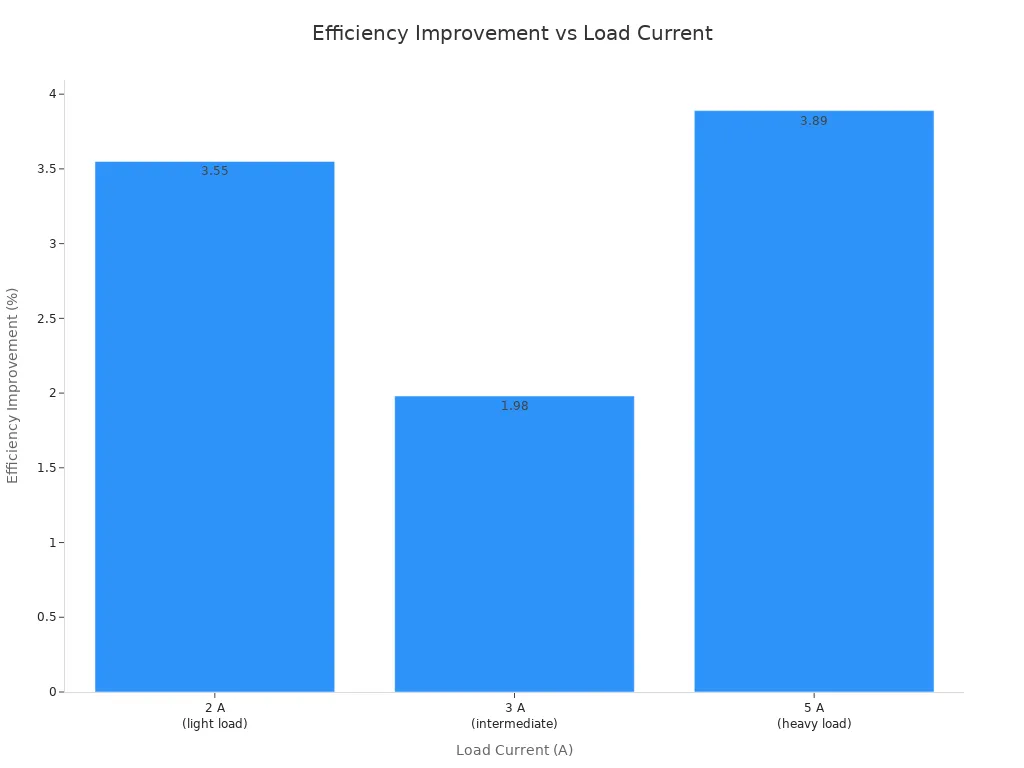
You can see that efficiency gains reach up to almost 4% at heavy loads. By tuning capacitance closer to the optimal resonant frequency, you cut down on wasted energy and improve circuit performance. This method also helps you avoid extra heat and stress on your components.
Variable capacitors offer both mechanical and electronic tuning options. Mechanical tuning is simple and reliable, but it can wear out over time. Electronic tuning, such as using varicap diodes, gives you faster and more precise adjustments. This approach works well in modern systems that need high precision and automated control.
Flexibility and Adaptability
One of the main advantages of variable capacitors is their flexibility and adaptability. You can use them to adjust circuits for different frequencies and changing conditions. This tuning flexibility is important in applications like frequency tuning, antenna matching, and filters.
- Piezoelectric elements with circuits that include variable capacitors can create tunable band gaps. This means you can guide waves across a wide range of frequencies.
- Adaptive metamaterials with shunted piezoelectric patches let you change circuit behavior without changing the physical structure.
- The extra electrical control from variable capacitors lets you select specific frequencies and improve system performance.
- In MEMS devices, variable capacitors allow sensitive, reliable, and low-power operation. You can adapt these circuits to different vibration levels and capacitance changes.
- Variable capacitors in special circuits, like the modified Bennet doubler, let you operate under many different conditions. You can adjust for different modulation depths and vibration amplitudes.
You can also use variable capacitors for real-time tuning in dynamic environments. For example, in electric vehicles, you can change capacitance based on voltage and its rate of change. This adjustment helps you get the best power output and system stability. In RF and microwave circuits, variable capacitors give you the flexibility to tune frequencies, match impedance, and control oscillation. These features make them ideal for use in telecommunications, aerospace, automotive radar, and wearable health devices.
Tip: The adaptability of variable capacitors supports modern trends like miniaturization and modular design, making them a smart choice for advanced electronics.
The advantages of variable capacitors include real-time tuning, improved signal quality, higher efficiency, and unmatched flexibility. You can use them to optimize performance in many different electronic systems.
Applications of Variable Capacitors
Radio and Communication
You can find variable capacitors in many radio and communication applications. When you tune a radio, you adjust the capacitance in an LC circuit. This changes the resonant frequency, helping you select the station you want. By rotating the plates, you control which frequency the receiver picks up. This process improves selectivity, so your radio focuses on one signal and rejects others. You also get better frequency control, making tuning smooth across the dial. Some radios use logarithmic variable capacitors for more even sensitivity, so you avoid big jumps in frequency with small adjustments. These features make variable capacitors essential for high-frequency signal processing in radios and wireless devices.
Tip: You can use variable capacitors to improve selectivity and frequency control, making your radio experience clearer and more enjoyable.
Antenna Matching
Variable capacitors play a key role in antenna matching applications. You use them to fine-tune the impedance between your transmitter and antenna. This tuning helps you transfer the maximum amount of power, reducing signal loss. Engineers use impedance matching networks to measure and adjust the impedance, often with network analyzers. By adjusting the capacitance, you match the load impedance to the source, following the Maximum Power Transfer Theorem. Modern systems use varactor diodes and RF MEMS capacitors for electronic tuning. These components allow real-time adjustments, which is important for multi-band and multi-mode wireless systems. When you use low ESR, high-Q variable capacitors, you can achieve 2 to 3 dB better radiation efficiency in smartphone antennas. Choosing the right voltage rating also improves performance across different bands.
| Matching Method | Efficiency Gain | Application Example |
|---|---|---|
| Aperture Tuning (AFT) | 2-3 dB | Smartphone antennas |
| Impedance Tuning (AIT) | Lower | Narrowband applications |
Filters and Oscillators
You use variable capacitors to fine-tune filters and oscillator circuits in many electronic applications. In filter circuits, you adjust the capacitance to change the cutoff frequency. This lets you select which signals pass through and which get blocked. In oscillator circuits, you control the oscillation frequency, which is important for generating clock or carrier signals. You can change the overlap or distance between plates to set the capacitance. Trimmer capacitors help you make small adjustments for calibration. These features allow you to optimize circuit performance in radio receivers and synthesizers.
- Variable capacitors adjust the resonant frequency in LC circuits.
- You can tune the passband or cutoff frequency in filters.
- You control the oscillation frequency in oscillator circuits for different signal needs.
You may face challenges with stability, especially at high frequencies or low capacitance values. Factors like ESR, temperature, and humidity can affect performance. Careful design and compensation techniques help you maintain stability in your applications in real-world scenarios.
Trimmers and Variable Capacitors Selection
Choosing the Right Capacitor
When you work with trimmers and variable capacitors, selecting the right capacitor for your project is important. You need to think about how often you will adjust the component. If you need to tune a circuit only during setup or calibration, trimmers are the best choice. They offer high precision and fit well on printed circuit boards. If you want to change the capacitance often, variable capacitors work better because you can adjust them easily with a knob or shaft.
Here is a table to help you compare trimmers and variable capacitors:
| Feature | Trimmer Capacitor | Variable Capacitor |
|---|---|---|
| Adjustment Frequency | Infrequent, mainly for calibration | Frequent, for continuous tuning |
| Size | Smaller, typically PCB mountable | Larger, often panel mounted |
| Capacitance Range | Narrow, optimized for fine-tuning | Broader, allows larger adjustments |
| Precision | High precision, critical for calibration | Moderate precision, for general tuning |
| Adjustment Method | Screw or small rotating mechanism | Rotating shaft or knob |
| Typical Applications | Initial circuit calibration, fine-tuning | Radio tuning, variable filter circuits |
Tip: When selecting the right capacitor, check the capacitance range, dielectric material, voltage rating, and mounting style. These factors help you match trimmers and variable capacitors to your application.
Installation Tips
You need to install trimmers and variable capacitors carefully to avoid problems. Always follow the manufacturer’s instructions for mounting and connection. Use the correct tightening torque to prevent damage. Make sure you place trimmers and variable capacitors away from sources of vibration and shock. Loose connections or reversed polarity can cause high equivalent series resistance, leading to heating and failure.
- Handle trimmers and variable capacitors gently during installation.
- Check for secure mounting and proper alignment.
- Avoid mechanical stress and ensure all connections are tight.
Note: Proper installation of trimmers and variable capacitors extends their lifespan and keeps your circuit reliable.
Maintenance and Troubleshooting
Regular maintenance helps you keep trimmers and variable capacitors working well. Inspect them for bulging, swelling, or leakage. Use a capacitance meter to check if values stay close to the rated specifications. Test the equivalent series resistance with an ESR meter. Replace trimmers and variable capacitors if you find high ESR or reduced capacitance. Store them in low humidity to prevent moisture damage.
If you have trouble with trimmers and variable capacitors, follow these steps:
- Check the circuit and power supply.
- Inspect solder joints and PCB traces.
- Test moving parts for wear.
- Measure capacitance and ESR.
- Replace old trimmers and variable capacitors if needed.
Tip: Reforming electrolytic capacitors before use restores their oxide layer and prevents early failure.
Variable capacitors give you precise tuning and adaptability, which improves signal quality and boosts efficiency in many electronic devices. You can use them in wireless communication, automotive electronics, and consumer gadgets to achieve optimal performance.
- Match capacitance and voltage rating to your project needs.
- Choose capacitors with good temperature stability and high Q factor.
- Select the right type for your application and maintain them regularly.
For advanced knowledge, you can explore technical articles on varicaps, which explain design, modeling, and practical circuit integration in detail.
FAQ
What is the main purpose of a variable capacitor?
You use a variable capacitor to adjust the capacitance in a circuit. This helps you tune radios, match antennas, or set filter frequencies. You can improve signal quality and efficiency by making small changes.
How do you adjust a variable capacitor?
You turn a knob or screw to move the plates inside the capacitor. This changes the overlap between the plates. More overlap increases capacitance. Less overlap decreases it.
Can you use variable capacitors in digital circuits?
You usually find variable capacitors in analog circuits. They work best for tuning frequencies and matching signals. Digital circuits rarely need them, but some special cases use them for timing or filtering.
What problems can happen with variable capacitors?
Dust, moisture, or mechanical wear can cause poor contact or drift in capacitance.
You may also see noise or signal loss if the capacitor gets damaged. Regular checks help prevent these issues.