How transceivers are powering the next wave of data transmission
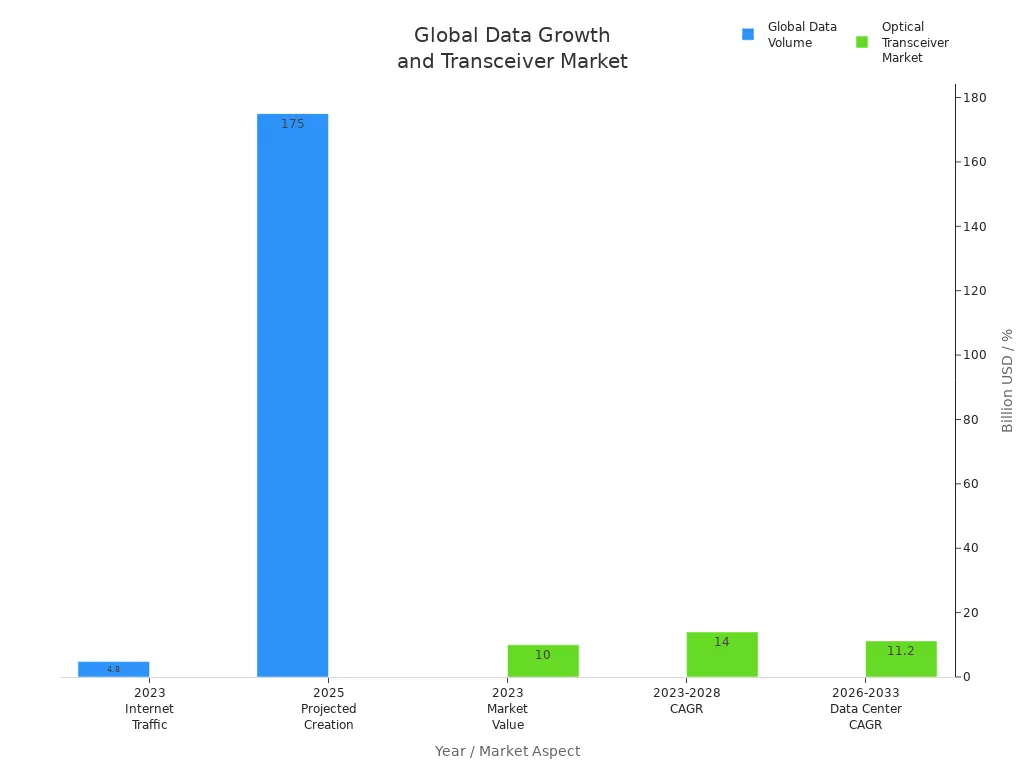
Transceivers serve as the foundation of the data transmission landscape, especially in high-speed data transmission. Optical transceivers convert electrical signals to optical signals, allowing communication across long distances and supporting the increasing demands of modern networks. The global internet traffic surpassed 4.8 zettabytes in 2023, and experts project 175 zettabytes of data creation by 2025. This rapid growth drives innovation in transceiver technology, pushing the market value of optical transceivers above $10 billion.
| Statistic / Market Aspect | Value / Projection |
|---|---|
| Global internet traffic (2023) | 4.8 zettabytes |
| Projected data creation (2025) | 175 zettabytes |
| Optical transceiver market (2023) | $10 billion |
| CAGR (next 5 years) | 14% |
Industries like AI, 5G, and data centers rely on advanced transceivers for reliable, energy-efficient connectivity. These innovations shape the data transmission landscape, offering greater speed and efficiency than ever before.
Key Takeaways
- Transceivers convert electrical signals to optical signals, enabling fast and long-distance data transmission essential for modern networks like AI, 5G, and data centers.
- Different transceiver types support various speeds and distances, with newer models like QSFP28 reaching up to 100 Gbps to meet growing data demands.
- Innovations such as silicon photonics and 200G/lane VCSELs improve speed, energy efficiency, and scalability, powering next-generation high-speed networks.
- Managing heat and ensuring reliability are critical challenges; advanced cooling and regular maintenance keep transceivers stable and efficient.
- The optical transceiver market is rapidly growing, driven by increasing internet traffic and the need for faster, smarter, and more sustainable digital communication.
Transceivers in Modern Networks
Backbone of Data Transmission
Transceivers form the backbone of modern networks by enabling seamless data transfer across vast distances. These devices convert electrical signals into optical signals, allowing information to travel through fiber optic cables at ultra-fast speeds. Fiber transceivers determine the speed, distance, and connectivity in data centers, making them essential for handling large data volumes. Single-mode transceivers support long-range transmissions, often exceeding 100 kilometers, while multi-mode transceivers work best for shorter distances.
Network designers rely on transceivers for compatibility and interoperability with switches, routers, and servers. This ensures smooth integration and optimized performance. In fiber-to-the-home (FTTH) networks, transceivers deliver reliable, high-speed internet by converting signals for fiber optic cables. Specialized models like DWDM and CWDM optimize bandwidth and cost, while BiDi transceivers reduce infrastructure expenses by enabling bidirectional communication over a single fiber strand.
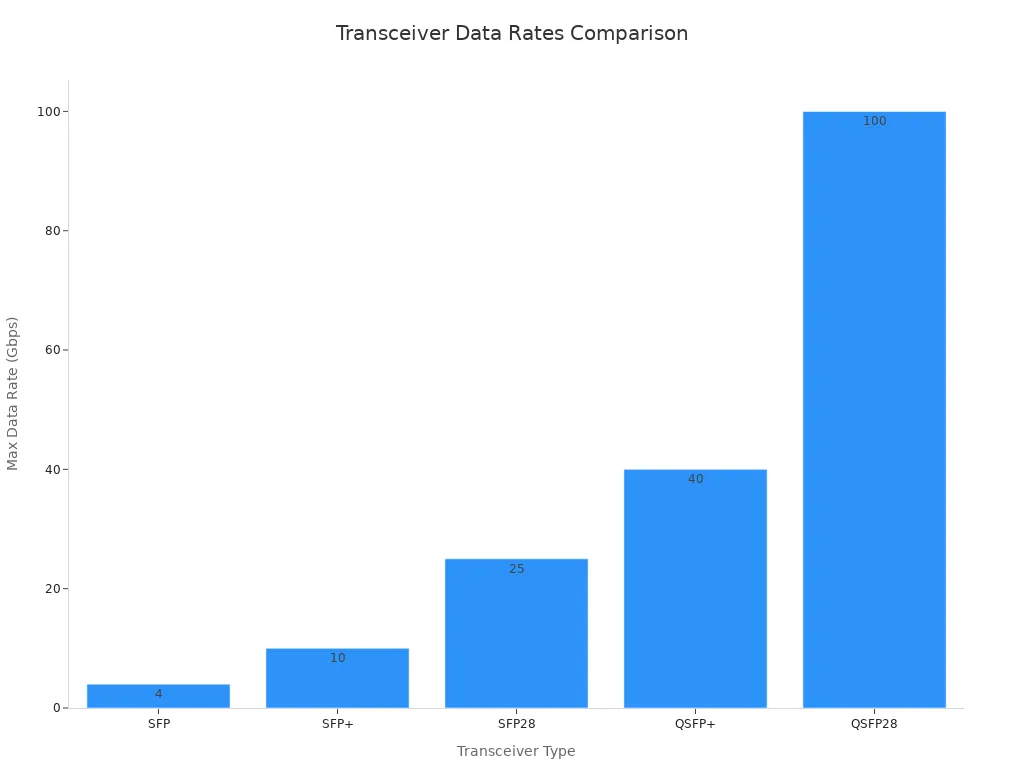
Selecting the right transceivers supports future scalability and network reliability. The most common types include SFP, SFP+, and QSFP, each offering unique advantages for different environments. The table below highlights their key features:
| Transceiver Type | Data Rate | Key Advantages |
|---|---|---|
| SFP | Up to 4 Gbps | Cost-effective, hot-swappable, versatile, low power, widely compatible |
| SFP+ | Up to 10 Gbps | Higher speed, backward compatible, reliable, ideal for data centers |
| SFP28 | Up to 25 Gbps | Enhanced signal integrity, energy efficient, scalable, space-efficient |
| QSFP+ | Up to 40 Gbps | High bandwidth, compact, energy efficient, scalable |
| QSFP28 | Up to 100 Gbps | Very high speed, future-proof, ideal for large data centers and telecom |
Enabling High-Speed Connectivity
Transceivers enable high-speed data transfer by supporting a wide range of data rates and link distances. SFP+ transceivers reach up to 10 Gbps, while SFP28 and QSFP28 models deliver ultra-fast speeds of 25 Gbps and 100 Gbps. These devices support both single-mode and multi-mode fiber optic cables, allowing flexible network design for different needs.
25G transceivers provide more than double the bandwidth of 10G models, improving scalability and preparing networks for future demands. They also enhance Ethernet efficiency and reduce bottlenecks, all while using existing cabling and hardware. This simplifies network design and supports both optical and direct attach cables for better performance and power efficiency.
Transceivers play a critical role in cloud computing, 5G, and AI applications by reducing latency and increasing bandwidth. Their modular, hot-swappable design allows easy upgrades and maintenance, ensuring networks can keep pace with rapid technological change.
Optical Transceivers

Role in High-Speed Data Centers
Optical transceivers play a central role in high-speed data centers. These devices convert data into light signals, enabling rapid transmission over fiber optic cables. Data centers use different types of optical transceivers to handle various distances and speeds. For example, grey transceivers manage single-channel data, while CWDM and DWDM models allow multiple channels on a single fiber, increasing capacity. Single fiber transceivers use two wavelengths to send and receive data over one strand, saving fiber resources.
Network engineers rely on optical transceivers for seamless integration with routers, switches, and servers. These devices support both single-mode and multimode fibers, making them flexible for different network designs. The table below highlights key functions and specifications:
| Function / Aspect | Description |
|---|---|
| Signal Conversion | Converts electrical signals to optical signals and vice versa. |
| Usage in Devices | Used in routers, switches, firewalls, and network cards. |
| Data Rate and Distance Support | Supports speeds from 100G to 800G and distances from 30 meters to 120 kilometers. |
| Fiber Modes | Works with single-mode (long distance) and multimode (short distance) fibers. |
| Applications | Used in Ethernet, Fiber Channel, and optical communication systems. |
Optical transceivers help high-speed data centers manage large data volumes and support cloud computing. They ensure reliable, scalable, and efficient optical communication links for modern digital infrastructure.
Powering AI and 5G
Optical transceivers drive the performance of next-generation AI workloads and 5G networks. These advanced devices enable extremely low latency, which is essential for real-time AI processing and 5G applications. Modern optical transceivers, such as 800G modules, transmit more data over a single fiber, reducing network complexity and supporting the massive bandwidth needs of AI and 5G.
AI-powered optical transceivers can adjust signal parameters like modulation and power levels to optimize speed and reduce errors. They predict and fix network issues, ensuring smooth data flow even during heavy traffic. These smart devices also monitor their own health, allowing early detection of problems and reducing downtime.
- Key benefits of optical transceivers in AI and 5G:
- Enhance data throughput for next-generation AI workloads.
- Reduce latency for real-time applications in 5G networks.
- Improve energy efficiency by adjusting power use based on demand.
- Support cloud computing and edge computing with fast, reliable connections.
Optical transceivers enable robust backhaul and fronthaul networks for 5G, supporting smart cities, IoT, and industrial automation. Their scalability allows networks to upgrade easily, meeting future demands without major changes. As a result, optical transceivers remain vital for the growth of AI, 5G, and cloud computing.
Transceiver Innovations
Silicon Photonics
Silicon photonics has emerged as a promising optical transceiver development, transforming how data centers and telecom networks achieve ultra-fast speeds. By integrating optical components like modulators and detectors directly onto silicon chips, manufacturers can produce optical transceivers that deliver higher data rates with lower power consumption. This approach uses CMOS-compatible fabrication, making it possible to scale production efficiently and cost-effectively.
Recent breakthroughs in silicon photonics include improvements in modulator efficiency and integration density. For example, Mach-Zehnder Interferometer (MZI) modulators now achieve energy consumption as low as 13 fJ/bit and extinction ratios above 20 dB. These advances support high-speed performance and reduce the energy required for each bit transmitted. The use of advanced materials such as graphene and new lithography techniques further boosts modulator performance.
Silicon photonics-based optical transceivers now support wavelength-division multiplexing, allowing multiple data channels to travel over a single fiber. This multiplexing increases bandwidth and meets the growing demands of AI and cloud computing. Wavelength-division multiplexing systems on silicon chips also enable higher efficiency and scalability, making them ideal for next-generation data centers.
The table below highlights key differences between silicon photonics and traditional transceivers:
| Feature | Silicon Photonics | Traditional Transceivers |
|---|---|---|
| Power Consumption | 3.5x lower | Higher |
| Integration Density | Hundreds of components per chip | Limited by discrete assembly |
| Latency | Lower (shorter signal paths) | Higher (longer signal paths) |
| Scalability | High (modular, compact) | Limited by complexity |
| Cost Efficiency | Improves with scale | Higher for small batches |
| Wavelength-Division Multiplexing | Integrated on-chip | External modules |
Silicon photonics also enables co-packaged optics, where transceivers are integrated with switch chips. This design shortens signal paths, improves reliability, and allows for faster deployment. As a result, silicon photonics stands out as a promising optical transceiver development for supporting ultra-fast speeds and higher data rates in modern networks.
200G/lane VCSELs
Vertical-cavity surface-emitting lasers (VCSELs) have long played a role in short-reach optical transceivers. The latest 200G/lane VCSEL technology marks a major leap forward, doubling the bandwidth of previous multimode interconnects. This innovation enables optical transceivers to achieve data rates of 200 Gbps per lane, supporting total capacities up to 1.6 Tbps in a single module.
Keysight Technologies and Coherent Corp. recently demonstrated this technology, showing that 200G VCSELs deliver both higher data rates and improved power efficiency. The new lithographic-aperture VCSELs reach bandwidths of 45 GHz, far surpassing the 27 GHz limit of older designs. This advancement supports 106.25 GBaud PAM4 signaling, which is essential for AI clusters and high-performance computing.
- Key benefits of 200G/lane VCSELs:
- Double the data throughput compared to previous VCSELs.
- Lower power consumption per bit, reducing operational costs.
- Enhanced reliability and reproducibility for large-scale deployments.
- Support for multiplexing and wavelength-division multiplexing, increasing network capacity.
200G/lane VCSELs make it possible for optical transceivers to deliver ultra-fast speeds in AI and machine learning data centers. These transceivers meet the need for higher efficiency and cost-effective scaling, especially as workloads demand more bandwidth and lower latency.
Energy Efficiency Advances
Energy efficiency has become a top priority for optical transceiver innovation, especially in large-scale data centers. Operators now use advanced cooling methods like liquid immersion cooling, which submerges transceivers in non-conductive liquids. This approach provides better heat dissipation than air cooling, allowing optical transceivers to operate at higher speeds with greater stability. It also reduces operational costs and supports more compact data center designs.
Micro-thermoelectric coolers (micro-TECs) represent another step forward. These devices offer precise temperature control for laser diodes, ensuring stable operation at high data rates such as 400G, 800G, and even 800g transceivers. Micro-TECs consume less power and take up less space, which helps maintain reliability and extend device lifespan.
Co-packaged optics, silicon photonics, and the development of 400G, 800G, and 1.6T optical transceivers all contribute to higher efficiency and sustainability. These innovations support multiplexing and wavelength-division multiplexing, which are essential for meeting the growing data demands of AI, 5G, and cloud computing.
Industry experts use metrics like data energy efficiency (bit/Joule) and coverage energy efficiency (m2/Joule) to evaluate optical transceiver performance in real-world deployments. These metrics help data centers balance the need for higher data rates with energy consumption, supporting both operational cost reduction and environmental goals.
Overcoming Challenges
Thermal Management
High-speed transceivers generate significant heat as data rates increase. Engineers face several challenges in managing this heat. Module power requirements continue to rise, while the size of each module remains limited. As speeds reach 400G, 800G, and even 1.6T, modules approach their thermal limits. Temperature changes can shift the wavelength of laser diodes, causing crosstalk and risking device failure. Performance drops if the temperature moves outside the safe range.
To address these issues, manufacturers use advanced Thermal Interface Materials (TIMs). Henkel developed TIMs like ultra-low modulus gap pads and curable gels. These materials provide rapid heat dissipation, low compressive stress, and stable bonding. They also reduce oil bleed and outgassing, which helps maintain long-term reliability. Micro-thermoelectric coolers (micro-TECs) offer precise temperature control in compact modules. These coolers respond quickly to temperature changes and improve laser diode performance.
Engineers also use EMI shielding and electromagnetic wave absorbers to protect signal integrity. Conductive elastomer gaskets and ferrite materials help block external noise and minimize signal reflections.
By combining these solutions, data centers and telecom networks keep transceivers cool and stable, even as speeds and workloads grow.
Reliability and Scalability
Reliability and scalability remain critical for large-scale network deployments. Any weak link, such as a faulty transceiver or connector, can slow down the entire network. In AI data centers, nearly half of training tasks fail due to network or compute issues. To prevent this, teams perform rigorous testing. They check signal integrity, run stress tests under heavy workloads, and validate performance at high temperatures.
Routine inspections help detect physical damage or contamination. Cleaning optical interfaces with isopropyl alcohol and lint-free wipes removes dust and keeps signals clear. Monitoring temperature and optical power ensures modules stay healthy. Environmental controls, like managing humidity, extend the lifespan of transceivers.
Scalability brings its own set of challenges. High manufacturing costs, technical compatibility issues, and thermal losses can slow down upgrades. As data speeds rise, maintaining signal quality becomes harder. The industry addresses these barriers by optimizing manufacturing, developing new materials, and collaborating on standards.
Regular maintenance, advanced monitoring, and backup systems all help networks stay reliable as they scale. These strategies ensure that transceivers support the growing demands of AI, 5G, and cloud computing.
High-Speed Networking Impact

Data-Driven Era
High-speed networking shapes the modern data-driven era. Advanced transceivers support the explosive growth in bandwidth demand from video streaming, gaming, IoT telemetry, and cloud computing. Hyperscale cloud providers like AWS, Azure, and Google Cloud deploy 400G and 800G transceivers to keep up with annual traffic growth over 30%. These upgrades enable fast data transfer and low latency capabilities, which are essential for AI workloads and real-time analytics.
| Factor | Impact Summary |
|---|---|
| Bandwidth Demand | Exponential growth from streaming, gaming, IoT, and SaaS drives upgrades |
| AI Workloads | Large models need high-throughput, low-latency optical links |
| Modularity | Pluggable optics allow flexible upgrades for data centers and telecom |
| Market Expansion | Growth in Southeast Asia, Middle East, and Latin America increases demand |
| Ecosystem Maturity | Standardization and interoperability foster competition and adoption |
| Application Scope | Used in cloud computing, machine learning, and multi-cloud architectures |
| Key Consumers | Hyperscale providers deploy 400G/800G transceivers for rapid traffic growth |
Data centers now consume nearly 1% of global electricity, making energy-efficient transceivers vital. Technologies like Dense Wavelength Division Multiplexing (DWDM) increase bandwidth by sending multiple signals over a single fiber. These innovations support the digital economy and smart infrastructure, while also enabling future fiber connectivity solutions.
Future Trends
Transceiver technology continues to evolve rapidly. The industry sees a shift toward coherent optical transceivers that support multi-terabit data rates for hyperscale data centers and edge computing. Silicon photonics integration makes transceivers more scalable and energy-efficient. Compact, pluggable modules like QSFP-DD and OSFP allow flexible deployment in high-density environments.
- Coherent optics and PAM4 modulation enable higher data rates with improved energy efficiency.
- 5g networks and edge computing drive demand for high bandwidth and low latency.
- Submarine cables now use coherent transceivers for long-distance, reliable data transfer.
- Software-defined networking enhances transceiver management and control.
- Transceivers support the expanding IoT ecosystem by managing massive data traffic from billions of devices.
Transceiver innovations address interference, signal degradation, and compatibility issues. These advances promise faster, more reliable communication for 5g, autonomous vehicles, and future fiber connectivity solutions.
Transceiver innovations have revolutionized high-speed networking and data centers.
- Copackaged optics and advanced cabling deliver ultra-low latency and higher bandwidth for AI workloads.
- Silicon photonics and new packaging options improve energy efficiency and scalability.
- The global optical transceiver market is projected to grow at a 14% CAGR over the next five years, driven by 5G, AI, and cloud computing.
Ongoing research and development remain essential for meeting future data demands. Transceivers will continue to shape digital communication, enabling faster, smarter, and more sustainable networks.
FAQ
What is an optical transceiver?
An optical transceiver sends and receives data using light signals. It converts electrical signals to optical signals for transmission through fiber optic cables. Data centers and telecom networks use optical transceivers to achieve high-speed communication.
How do transceivers improve energy efficiency?
Transceivers use advanced cooling methods and energy-saving designs. Silicon photonics and micro-thermoelectric coolers help reduce power consumption. These innovations allow data centers to operate faster while using less electricity.
Why are 200G/lane VCSELs important?
200G/lane VCSELs double the data rate of previous models. They support faster connections for AI and cloud computing. These lasers also lower power use and improve reliability in large-scale networks.
Tip: Upgrading to 200G/lane VCSELs can help future-proof network infrastructure.
What challenges do transceivers face in high-speed networks?
Transceivers face heat management, reliability, and scalability issues. Engineers use thermal interface materials and regular maintenance to keep devices stable. Advanced monitoring systems help detect problems early.
Which industries benefit most from transceiver innovations?
Industries such as AI, 5G, cloud computing, and data centers gain the most. These sectors need fast, reliable, and energy-efficient data transmission to support growing workloads and new technologies.