Best Semiconductor Companies for Smart Investors

If you want to invest in the top semiconductor companies for 2025, focus on those leading the AI revolution. Companies like Nvidia, TSMC, Broadcom, AMD, and Qualcomm stand out for growth and innovation. The AI boom has fueled rapid revenue jumps. For example:
- Nvidia’s revenue soared by 78%, reaching $39.3 billion.
- TSMC’s revenue climbed nearly 42% as demand for AI servers grew.
- The global semiconductor industry saw a 27% jump in integrated circuit sales.
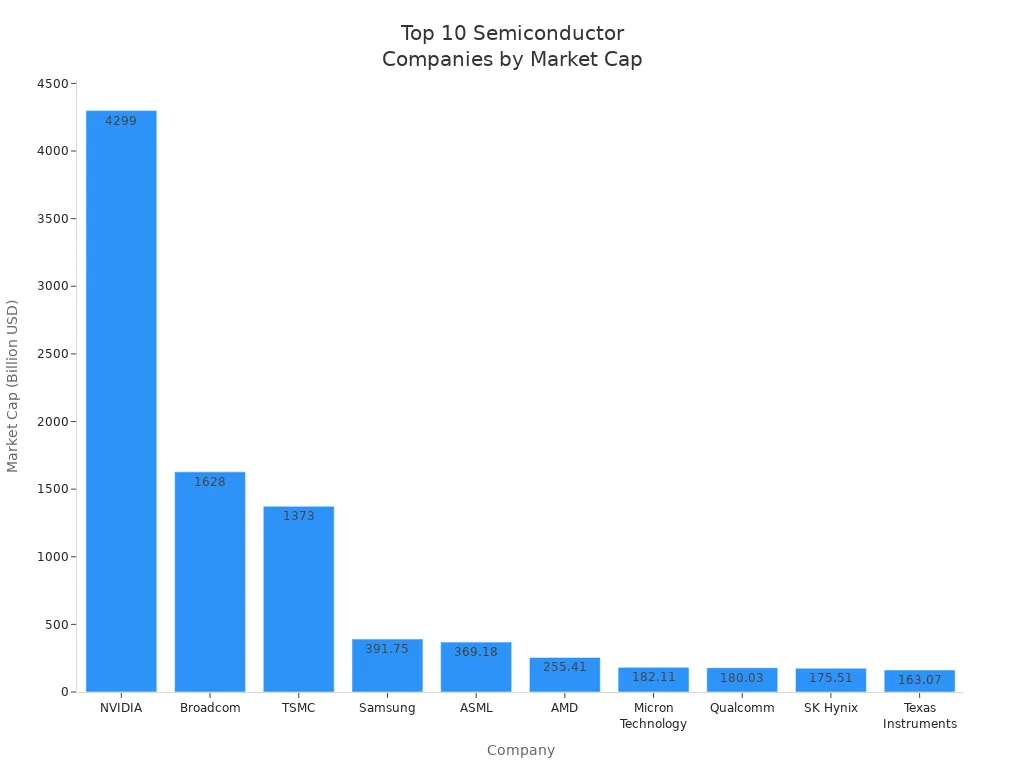
You can see the market caps of these leaders in the table below:
| Rank | Name | Market Cap |
|---|---|---|
| 1 | NVIDIA | $4.299 T |
| 2 | Broadcom | $1.628 T |
| 3 | TSMC | $1.373 T |
| 4 | Samsung | $391.75 B |
| 5 | ASML | $369.18 B |
| 6 | AMD | $255.41 B |
| 7 | Micron Technology | $182.11 B |
| 8 | Qualcomm | $180.03 B |
| 9 | SK Hynix | $175.51 B |
| 10 | Texas Instruments | $163.07 B |
A smart strategy balances established giants with emerging semiconductor companies. This approach helps you capture steady growth and new opportunities.
Key Takeaways
- Focus on leading semiconductor companies like Nvidia, TSMC, and Qualcomm for strong growth and innovation.
- Use clear criteria such as revenue growth and R&D expenses to select top semiconductor stocks for your portfolio.
- Balance investments between established giants and emerging players to capture steady growth and new opportunities.
- Stay informed about market trends and risks in the semiconductor industry to make smart investment decisions.
- Regularly review and adjust your portfolio to align with changes in the fast-evolving semiconductor sector.
Top Semiconductor Companies for 2025
Quick Picks Overview
When you look for the top semiconductor companies to invest in for 2025, you want to focus on those with strong growth, innovation, and leadership. Here are some of the top semiconductor companies that experts and analysts expect to perform well:
| Company | Projected Growth | Key Strengths |
|---|---|---|
| Qualcomm Inc. | 4.74% | Strong in 5G and edge AI, leading in automotive and AI-driven processing. |
| Advanced Micro Devices (AMD) | 4.17% | Focus on AI accelerators, high-performance computing, and cloud markets. |
| Texas Instruments (TXN) | 4.16% | Demand in industrial and automotive, strong in-house manufacturing. |
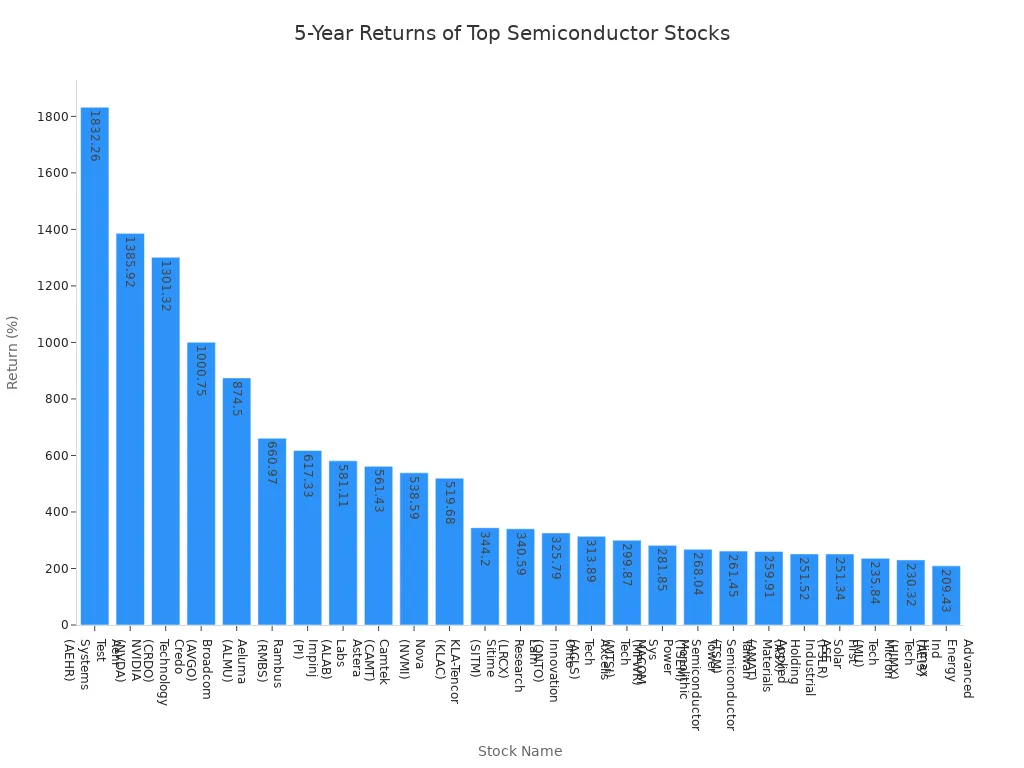
You also see impressive historical returns from the top semiconductor companies. For example, Nvidia delivered a 1,385.92% return over five years, while Broadcom reached 1,000.75%. These numbers show why many investors trust these semiconductor companies for long-term growth.
Selection Criteria
You should use clear criteria when picking the top semiconductor companies. Look for market leadership, financial health, and a strong focus on innovation. The most important financial metrics include:
| Metric | Description |
|---|---|
| Revenue Growth | Shows if a company can increase sales and meet demand. |
| Gross Margin | Measures how much profit a company keeps after costs. |
| R&D Expenses | Tells you how much a company invests in new technology. |
| Capital Expenditure | Shows investment in factories and equipment for future growth. |
| Inventory Turnover | Measures how quickly a company sells its products. |
Companies that invest heavily in research and development often lead the semiconductor industry. U.S. semiconductor companies spend over half of the global R&D budget, which helps them stay ahead in technology and attract investors.
By using these criteria, you can find the top semiconductor companies that offer both stability and growth for your portfolio.
Nvidia (NVDA)
Market Leadership
You see Nvidia at the top of the semiconductor industry. The company dominates the global market for AI accelerators and data center GPUs.
- Nvidia’s market share in AI chips ranges from 70% to 95%.
- Its data center GPUs hold 92% to 94% of the market.
- The Blackwell and Rubin GPUs help Nvidia keep its lead in AI hardware.
- The CUDA platform supports many AI developers and researchers.
Nvidia’s leadership in the semiconductor sector means you benefit from strong demand and steady growth. When you invest in Nvidia, you tap into the company’s unmatched position in AI and advanced computing.
Financial Strength
Nvidia’s financial results show why it stands out among semiconductor companies. You can see the company’s impressive growth in both revenue and net income over the past three years:
| Year | Revenue (in billions) | Year-over-Year Growth |
|---|---|---|
| 2023 | N/A | N/A |
| 2024 | $130.50 | +114.20% |
| 2025 | $165.22 | +71.55% |
| Year | Net Income (in billions) | Year-over-Year Change |
|---|---|---|
| 2023 | $4.368 | -55.21% |
| 2024 | $29.76 | +581.32% |
| 2025 | $72.88 | +144.89% |
You notice that Nvidia’s revenue and profits have surged. This financial strength gives you confidence in the company’s ability to invest in new semiconductor technologies and expand its market share.
Innovation
Nvidia leads the way in semiconductor innovation. You benefit from the company’s focus on cutting-edge AI hardware and platforms. Here are some of Nvidia’s latest breakthroughs:
| Architecture/Platform | Description |
|---|---|
| Blackwell Architecture | The engine of the new industrial revolution |
| Hopper Architecture | High performance, scalability, and security for every data center |
| Ada Lovelace Architecture | Performance and energy efficiency for endless possibilities |
| DGX Spark | A Grace Blackwell AI Supercomputer on your desk |
| DGX Station | The ultimate desktop AI supercomputer powered by NVIDIA Grace Blackwell |
| NVIDIA RTX PRO AI Workstations | Accelerate innovation and productivity in AI workflows |
| NVIDIA Grace CPU | Architecture for data centers that transform data into intelligence |
| HGX Platform | A supercomputer purpose-built for AI and HPC |
| IGX Platform | Advanced functional safety and security for edge AI |
| MGX Platform | Accelerated computing with modular servers |
| OVX Systems | Scalable data center infrastructure for high-performance AI |
Nvidia’s commitment to research and development keeps you ahead in the fast-changing semiconductor landscape.
Future Prospects
You can expect Nvidia to remain a top pick in the semiconductor sector. Industry forecasts show strong growth potential:
- The average price forecast for Nvidia in 2025 is $194.53, which suggests an 11% upside.
- The consensus median one-year price target is $211.26, pointing to a 19.61% potential gain.
- Out of 38 analysts, 35 recommend buying Nvidia.
If you want to invest in a semiconductor company with market leadership, financial strength, and innovation, Nvidia offers a compelling choice. You position yourself for growth as AI and advanced computing continue to drive demand.
Advanced Micro Devices (AMD)
Competitive Position
You see AMD making strong moves in the semiconductor industry. The company uses its MI300 series accelerator family to boost its AI market presence. The MI300 series relies on the CDNA 3 architecture and supports large language model training. AMD uses 7-nanometer technology to compete with Intel, especially in commercial and server markets.
- AMD grows its AI market share with advanced accelerators.
- The company challenges Intel in CPUs by using cutting-edge technology.
- AMD faces tough competition from Intel in traditional computing.
- In GPUs, AMD competes with Nvidia, which leads in AI workloads.
- AMD continues to improve but must overcome strong rivals in the semiconductor space.
Growth Metrics
You can track AMD’s growth through its latest numbers. The company shows solid performance in the semiconductor sector.
Here is a table with recent growth metrics:
| Metric | Value |
|---|---|
| Revenue for Q2 2025 | $7.69B |
| Growth in Q2 2025 | 31.71% |
| Revenue last 12 months | $29.60B |
| Year-over-year growth | 27.17% |
| Annual revenue 2024 | $25.79B |
| Annual growth 2024 | 13.69% |
AMD’s revenue keeps rising. You see strong year-over-year growth, which signals demand for its semiconductor products.
Strategic Moves
AMD makes smart decisions to stay ahead in the semiconductor market. The company forms partnerships and acquires new businesses to expand its reach.
Here is a table showing recent strategic moves:
| Partnership/Acquisition | Description |
|---|---|
| AMD and HUMAIN | $10B collaboration to advance global AI, deploying up to 500 megawatts of AI infrastructure. |
| AMD, Absci, and Oracle | Collaboration for AI-driven drug discovery using AMD's hardware like Instinct MI355X GPUs. |
| AMD and ZT Systems | Acquisition of ZT Systems, a provider of AI and compute infrastructure for hyperscale providers. |
You benefit from these moves because they help AMD grow in new areas of the semiconductor industry.
Outlook
Analysts expect AMD to perform well in 2025. You can see the projected stock prices in the table below:
| Year | Lowest Prediction ($) | Average Prediction ($) | Maximum Prediction ($) |
|---|---|---|---|
| 2025 | 171.69 | 180.57 | 189.07 |
You may find AMD a strong choice if you want exposure to the fast-growing semiconductor sector. The company’s focus on AI, smart partnerships, and steady growth make it a top pick for investors who want to stay ahead in technology.
Broadcom (AVGO)
Portfolio Diversity
You find Broadcom’s portfolio covers many areas in the semiconductor industry. The company makes products for wireless, storage, industrial, networking, and broadband markets. This diversity helps Broadcom stay strong when one segment faces challenges. You can see how Broadcom’s semiconductor products reach different industries in the table below:
| Segment | Products |
|---|---|
| Wireless | RF front-end modules, Wi-Fi, Bluetooth, GPS/GNSS SoCs, custom touch controllers |
| Storage | SAS and RAID controllers, PCIe switches, fiber channel host bus adapters |
| Industrial | Optocouplers, industrial fiber optics, motion encoders, LED display drivers |
| Networking Chips | Used in data centers and enterprise networks |
| Broadband | Chips for modems, routers, and set-top boxes |
| Wireless Comm. | Wi-Fi, Bluetooth, and GPS chips |
| Storage Solutions | SAS/SATA/RAID controllers and PCIe switches |
You benefit from Broadcom’s wide range of semiconductor products. This makes your investment less risky and more stable.
Financial Performance
Broadcom shows strong financial results year after year. You see steady growth in revenue and profits. The company’s focus on high-demand semiconductor segments supports this performance. Broadcom invests in research and development to keep its technology ahead. You notice that Broadcom’s financial stability allows it to pay dividends and buy back shares. These actions show the company’s confidence in its semiconductor business.
Broadcom has increased its dividends for 13 straight years. This record shows you the company’s commitment to returning value to shareholders and its financial strength.
M&A Strategy
You see Broadcom using mergers and acquisitions to grow its semiconductor business and expand into software. The company has made several big deals in recent years. These moves help Broadcom enter new markets and strengthen its position. Here is a table showing some major acquisitions:
| Year | Acquisition | Amount | Purpose/Focus Area |
|---|---|---|---|
| 2021 | VMware | N/A | Diversification into software |
| 2018 | CA Technologies | $18.9 billion | Strengthening software line |
| 2019 | Symantec’s enterprise security | $10.7 billion | Entry into cybersecurity |
You benefit from Broadcom’s strategy because it keeps the company competitive in both semiconductor and software markets.
Shareholder Value
Broadcom rewards you with dividends and share buybacks. The company paid an annual dividend of $2.36 per share and has a payout ratio of 57.2%. You also see a dividend yield of 0.68%. Broadcom bought back $10 billion in shares, showing its commitment to shareholders. The table below highlights these actions:
| Action | Amount | Significance |
|---|---|---|
| Share Repurchase | $10 billion | Reflects confidence in business and commitment to returning cash to shareholders. |
| Annual Dividend | $2.36/share | Total dividends paid out to shareholders in a year. |
| Dividend Yield | 0.68% | Indicates annual dividends received per $100 invested. |
| Payout Ratio | 57.2% | Percentage of earnings paid out as dividends. |
You see Broadcom’s strong track record in the semiconductor sector. The company’s actions show you its focus on delivering value and stability.
TSMC
Foundry Power
You see TSMC as the world’s largest pure-play semiconductor foundry. The company holds over 60% of the global foundry market. This leadership puts TSMC far ahead of competitors like Samsung, which has only 11%. Major tech companies, including Apple and Nvidia, depend on TSMC to produce advanced chips for their products. When you invest in TSMC, you gain exposure to a company that shapes the entire semiconductor supply chain.
Financial Stability
TSMC stands out for its strong financial performance. You can review the table below to see how TSMC compares to other foundries:
| Metric | TSMC Q2 2025 | Year-over-Year Change | Gross Margin |
|---|---|---|---|
| Revenue | $30.1B | +44.4% | ~54% |
| Net Income | $12.8B | +60.5% | |
| Q3 Revenue Forecast | $31.8B–$33B |
You notice that TSMC’s revenue and net income have grown rapidly. The company’s gross margin remains high, showing efficient operations in the semiconductor industry.
Technology Edge
TSMC leads in semiconductor process technology. The company was the first foundry to achieve volume production of 5nm FinFET chips in 2020. This step enabled new innovations in smartphones and high-performance computing. TSMC continues to expand its 5nm family with processes like N5, N5P, N4P, and N4C, all in volume production with excellent yields.
- Plans to introduce 2nm chips by 2025.
- 3nm and 5nm processes offer high transistor density and energy efficiency for AI hardware and advanced GPUs.
TSMC unveiled its next cutting-edge logic process technology, A14, designed to drive AI transformation forward by delivering faster computing and greater power efficiency. Compared with the N2 process, A14 will offer up to 15% speed improvement at the same power, or up to 30% power reduction at the same speed, along with more than 20% increase in logic density.
You benefit from TSMC’s focus on research and development, which keeps the company at the forefront of semiconductor innovation.
Global Impact
TSMC’s influence reaches across the globe. The company’s dominance in the semiconductor foundry market directly affects the supply chains of major tech firms. Apple and Nvidia rely on TSMC for the chips that power their devices and AI systems. TSMC’s role also has geopolitical importance. Experts say the company’s presence helps deter conflict over Taiwan, as any disruption would cause economic turmoil worldwide. You see how TSMC’s leadership in the semiconductor industry makes it a key player in both technology and global stability.
Qualcomm (QCOM)
Wireless Leadership
You see Qualcomm as a leader in wireless technology. The company stands out in the global semiconductor industry, especially in Wi-Fi chipsets.
- Qualcomm is one of the top players in the Wi-Fi chipset market.
- The top three companies, including Qualcomm, account for a combined market share of 21%.
Qualcomm’s strong position helps you benefit from the growing demand for wireless devices. You notice that many smartphones and tablets use Qualcomm’s semiconductor solutions to deliver fast and reliable connections.
Revenue Growth
Qualcomm’s revenue continues to grow each year. You can track this progress in the table below:
| Year | Revenue (in Billion USD) | Year-over-Year Growth (%) |
|---|---|---|
| 2023 | 36.29 | N/A |
| 2024 | 38.96 | 8.77 |
| 2025 | 43.26 | 15.82 |
This steady growth shows you that Qualcomm’s semiconductor business remains strong. You see that the company’s focus on wireless and mobile markets drives its financial success.
Innovation in AI
Qualcomm leads in AI-enabled semiconductor chipsets. The company’s latest Snapdragon 8 Elite chipset brings new features to mobile devices. You can review the table below to see some of these innovations:
| Feature | Description |
|---|---|
| Chipset Name | Snapdragon 8 Elite |
| CPU Technology | Utilizes Oryon CPU, which is 45% faster and 44% more energy-efficient than previous Kryo CPUs. |
| AI Capabilities | Supports real-time AI functions on-device, enhancing privacy and efficiency. |
| Applications | Optimized for generative AI tasks, including image generation and language processing. |
| Developer Support | Qualcomm’s AI Hub provides tools for developers to create applications leveraging this technology. |
| Market Impact | Expected to trigger a new upgrade cycle in mobile devices with enhanced AI features. |
| Initial Device Partners | Samsung, Asustek, Xiaomi, among others, will use Snapdragon 8 Elite in upcoming devices. |
You benefit from Qualcomm’s focus on energy efficiency and AI features. The company’s semiconductor innovations help you enjoy smarter and faster devices.
"We are so excited to bring the power of Qualcomm Oryon to our Snapdragon mobile platforms for the first time... it’s a major leap forward and we expect consumers to be thrilled with the new experiences enabled by our CPU technology." — Chris Patrick, Qualcomm’s Senior Vice President
Future Opportunities
You can expect Qualcomm to find new growth in the semiconductor sector. Analysts predict several opportunities for the company:
- Continued wins in smartphone and 5G chipset designs will drive revenue.
- Expansion into automotive and IoT segments will open high-margin markets.
- Patent licensing revenues will remain strong due to global device adoption.
- Growing demand for on-device AI and edge computing will boost premium chip sales.
- International partnerships and entry into emerging markets will strengthen Qualcomm’s relevance.
You see that Qualcomm’s strategy positions you to benefit from future advances in wireless, AI, and semiconductor technology.
Best-Performing Semiconductor Stocks: Emerging Players

Disruptive Innovators
You can find some of the best-performing semiconductor stocks among companies that drive innovation. Marvell Technology stands out as a leader in advanced networking and custom silicon solutions. Marvell develops chips for data centers, cloud infrastructure, and telecom providers. The company also creates SSD controllers and Ethernet-based chips for automotive systems. Marvell’s first 2nm silicon IP helps boost AI and cloud performance. You see Marvell working with TSMC to improve silicon technology for next-generation infrastructure.
- Networking solutions for high-speed data centers
- Storage chips for efficient AI workloads
- Custom ASICs for cloud computing
- 5G and wireless infrastructure chips
- Automotive Ethernet chips for driver-assistance systems
ON Semiconductor also earns attention for its focus on automotive and industrial markets. The company supplies chips for electric vehicles, energy management, and smart sensors. These innovations help ON Semiconductor compete with larger rivals and attract investors looking for growth.
High-Growth Contenders
You may want to watch high-growth contenders when searching for the best-performing semiconductor stocks. Marvell Technology and ON Semiconductor both show strong growth potential. Marvell’s portfolio includes advanced packaging and custom AI accelerators. The company supports cloud service providers with high-bandwidth memory architectures. ON Semiconductor delivers chips for electric vehicles and renewable energy, which are fast-growing markets.
- Marvell develops custom AI accelerators and collaborates with TSMC.
- ON Semiconductor supplies chips for electric vehicles and smart energy systems.
These companies invest in research and development to stay ahead in the semiconductor industry. You see them expanding into new markets and building partnerships to support future growth.
Risk and Reward
You should consider both risks and rewards before investing in emerging semiconductor companies. The cost and complexity of chip manufacturing keep rising as technology advances. Geopolitical tensions and trade disputes can disrupt supply chains. Chip shortages after the pandemic still affect many sectors.
Investing in best-performing semiconductor stocks can bring high returns, but you must weigh the risks.
Here is a table showing historical reward-to-risk ratios for high-growth semiconductor stocks:
| Security Name | Expected Returns | Sharpe Ratio | Beta | Volatility | P/E Ratio | Dividend Yield |
|---|---|---|---|---|---|---|
| ON Semiconductor Corporation | +0.17 | 1.34 | ±47.7% | 13.1 | 0.00% | |
| Marvell Technology Group Ltd. | +0.15 | 1.07 | ±45.4% | 8.1 | 0.00% | |
| Monolithic Power Systems, Inc. | +0.17 | 2.00 | ±54.5% | 44.2 | 0.82% |
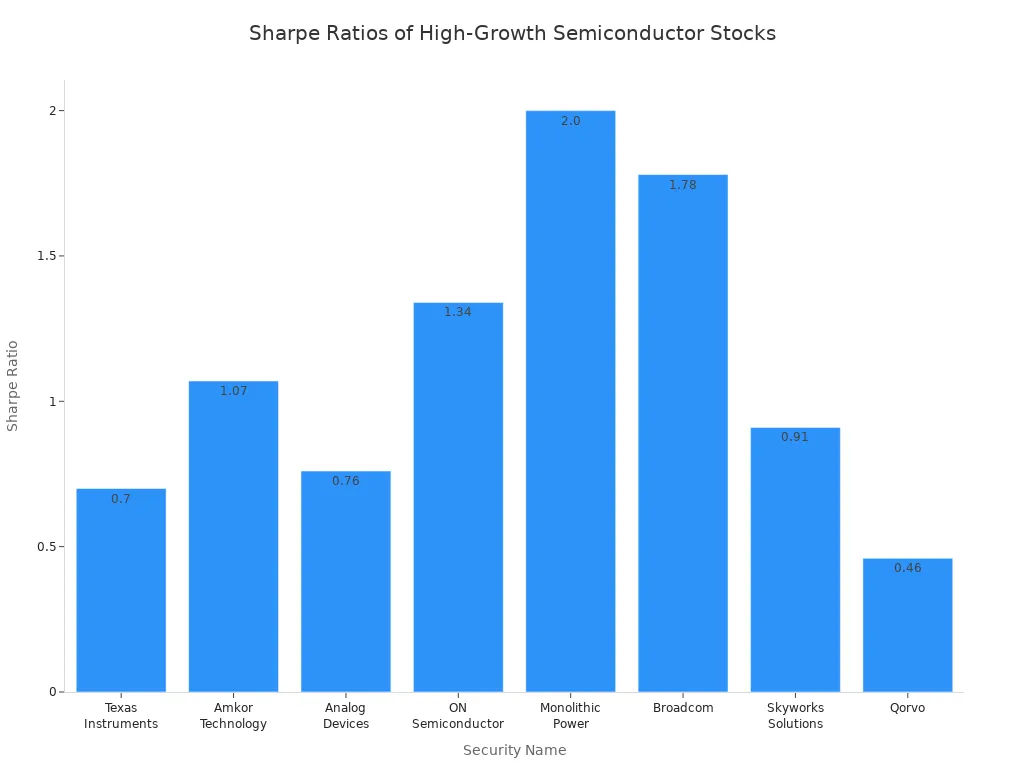
You see that ON Semiconductor and Marvell Technology offer attractive returns, but their stocks can be volatile. If you want to invest in the best-performing semiconductor stocks, you should balance growth potential with risk management.
Investing in Semiconductor Stocks: Key Considerations
Market Trends
You see strong momentum in semiconductor stocks as demand for advanced chips grows. The AI boom drives new investment in the semiconductor industry. You notice that cloud computing, electric vehicles, and smart devices need more powerful chips. Many experts expect the semiconductor sector to expand as companies race to develop faster and smaller chips. You can track trends by watching quarterly earnings reports and new product launches.
Tip: Follow news about AI, automotive, and data center growth. These areas often signal future moves in semiconductor stocks.
Risk Factors
You face several risks when investing in semiconductor stocks. Market cycles can cause sharp price swings. Supply chain disruptions may delay chip production. Geopolitical tensions can affect the semiconductor industry, especially if countries restrict exports. You should watch for changes in government policies and trade agreements.
Here are common risks to consider:
- Volatile stock prices
- Chip shortages
- Regulatory changes
- Competition from new technologies
You can manage risk by diversifying your investments and setting clear goals.
Portfolio Strategy
You build a strong portfolio by mixing leaders and emerging players in semiconductor stocks. You may choose established companies for stability and add high-growth stocks for extra returns.
Here is a simple strategy table:
| Approach | Description | Example Companies |
|---|---|---|
| Core Holdings | Focus on market leaders in the semiconductor industry | Nvidia, TSMC, Broadcom |
| Growth Picks | Add stocks with high innovation and growth | AMD, Marvell Technology |
| Defensive Moves | Include companies with steady dividends | Texas Instruments, Qualcomm |
You should review your portfolio often and adjust as the semiconductor industry changes.
Note: Use research tools to compare financial health and innovation before investing in semiconductor stocks.
You can succeed by staying informed and balancing risk with opportunity. Investing in semiconductor stocks gives you access to one of the fastest-growing sectors in technology.
You have learned why Nvidia, AMD, Broadcom, TSMC, and Qualcomm stand out for 2025. These companies show strong growth and innovation. You can build a smart portfolio by mixing leaders with emerging stocks.
Tip: Track industry news and review your investments often.
You should always research before buying. The semiconductor sector keeps changing. You can expect new breakthroughs and steady demand. Smart investors watch trends and stay ready for the future.
FAQ
What are individual semiconductor stocks?
You can buy individual semiconductor stocks to own shares in one company. This lets you focus on a business you believe will grow. You control your investment and can choose leaders or new players in the semiconductor industry.
How do I choose the best individual semiconductor stocks?
You should look at company growth, new products, and financial health. Check if the company leads in technology. Compare several individual semiconductor stocks before you decide. This helps you find the best fit for your goals.
Are individual semiconductor stocks risky?
Yes, you face risks with individual semiconductor stocks. Prices can change quickly. News, supply issues, or new technology can affect value. You should research each company and consider spreading your money across several stocks to lower risk.
Do I need to follow industry news when investing?
You should follow news about chip demand, new products, and company earnings. This helps you make better choices. Staying updated lets you react quickly if something changes in the semiconductor market.