Key Roles of Terminal Electronics in Modern Industrial Solutions
Terminal electronic components form the backbone of connectivity and adaptability in today’s industrial environments. These electronics help solve common challenges, such as:
Meeting strict environmental regulations with real-time monitoring and reporting.
Improving operational efficiency by reducing errors and optimizing workflows.
Enhancing customer experience with faster information access and streamlined communication.
Terminal electronic solutions also support secure, reliable operations, even in small spaces or under financial constraints. Companies rely on these technologies to stay competitive and ensure safety.
Key Takeaways
Terminal electronics connect and protect electrical systems, making industrial operations safer and more efficient.
Modular terminal blocks and connectors allow quick installation, easy maintenance, and support future system upgrades.
Choosing terminal electronics that meet safety standards prevents accidents and ensures reliable performance.
Durable connectors and terminal blocks withstand harsh environments, reducing downtime and extending equipment life.
Advanced terminal electronics improve workflow, support automation, and help companies stay competitive and compliant.
Terminal Electronic Basics
What Are Terminal Electronics
Terminal electronic components help connect, control, and protect electrical systems in industrial environments. These components include terminal blocks, relays, contactors, transformers, switches, and fuses. Terminal blocks act as secure entry points for electricity, allowing safe connections between multiple wires inside control panels. They link incoming wires to internal parts such as switches and relays. Terminal blocks come in many types, including feed-thru, ground, fused connection, multi-level, and disconnect versions. Each type meets different wiring and safety needs.
Terminal electronics also include heavy-duty connectors, cable entry systems, and housing solutions. These parts provide strong and flexible wiring options. They keep power and data flowing safely, even in harsh conditions. Industrial connectors resist vibration, high temperatures, water, and chemicals. This makes them reliable for both power and data connections. Terminal electronics support modular and plug-and-play setups, which allow fast installation and easy maintenance.
Core Functions
Terminal electronic components play several key roles in industrial settings. They organize and secure electrical connections, making systems safer and easier to manage. Terminal blocks and electrical terminals help technicians connect and disconnect wires quickly. This speeds up repairs and changes. These components also reduce wiring errors and help keep control panels neat.
Terminal electronics ensure reliable signal and power transmission. They support high-speed data transfer, which is important for modern automation. Industrial connectors and cable assemblies withstand mechanical stress and harsh environments. This keeps electrical systems running smoothly and reduces downtime.
Terminal electronics also improve safety and efficiency. They help enforce safety protocols, such as regular inspections and proper use of personal protective equipment. Terminal operating systems use real-time data to manage vessel schedules, cargo tracking, and staff allocation. These systems help prevent accidents and keep operations running smoothly. By providing accurate reporting and analytics, terminal electronics support better decision-making and compliance with safety standards.
Terminal Blocks in Modern Applications
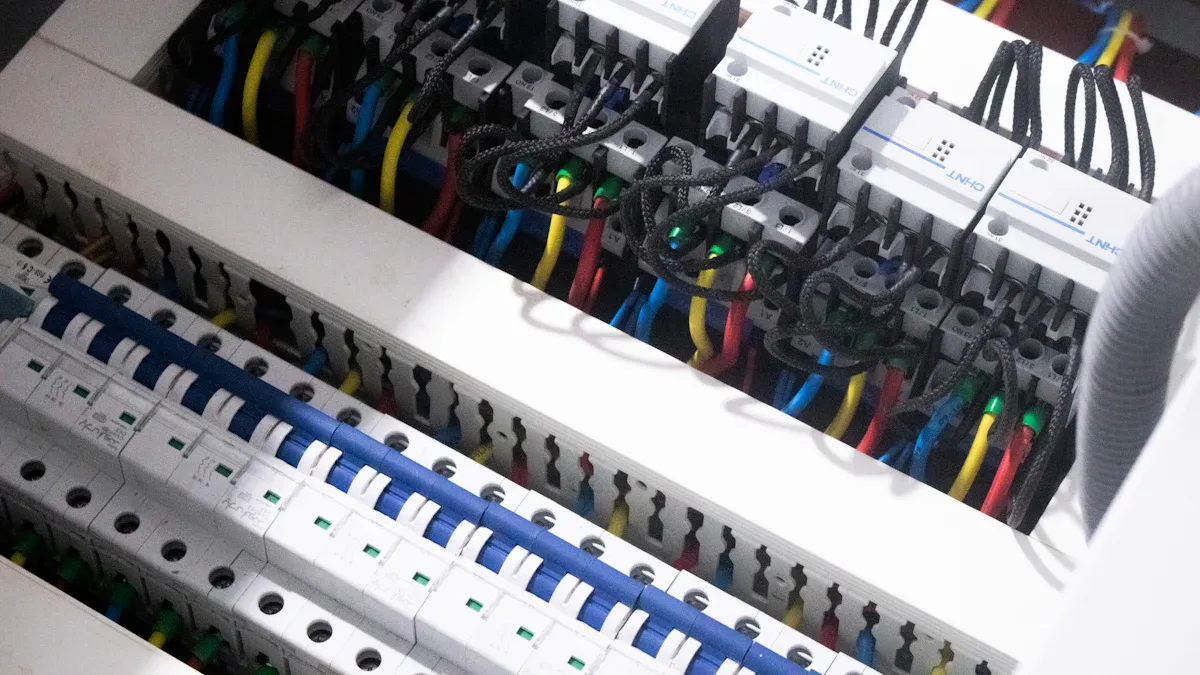
Terminal blocks play a vital role in modern applications across many industries. These components connect, organize, and protect electrical terminal points in control panels and machinery. Their design supports expanding applications of terminal blocks in automation, power management, and communication systems. Engineers choose terminal blocks for their reliability and ability to handle complex wiring needs.
Types of Terminal Blocks
Terminal blocks come in many forms to suit different versatile applications. The table below shows common types and their uses:
Category | Terminal Block Types / Examples | Typical Uses / Features |
|---|---|---|
By Connection Style | Barrier strips, IEC PCB mount, Feed-through, Edge connectors | Power distribution, control, PCB connections, wire-to-wire links |
By Wire Securing Method | Screw terminals, Spring-cage, Push-in, IDC | Secure clamping, quick connect/disconnect, mass termination |
By Application Function | Ground, Fuse, Thermocouple, Power distribution, Pluggable | Grounding, overcurrent protection, high current, hot-swapping |
Mounting Solution | DIN rail | Simplifies wiring, saves panel space |
Wire Orientation | Horizontal, Vertical, 45° | Matches design requirements |
Specialized terminal blocks meet unique needs, such as thermocouple compatibility or fuse protection. These options help users match the right electrical terminal to each task.
Mounting Options
Terminal blocks offer several mounting choices for modern applications:
DIN rail mounting saves space and makes installation fast.
Panel mounting provides strong support for heavy-duty uses.
PCB mounting connects directly to circuit boards for compact designs.
Screw terminals give secure connections but need tools. Spring clamp and push-in terminals allow tool-free, quick installation. Some DIN rail terminal blocks include test points and clear labels, making them easy to use in complex setups.
Flexibility and Adaptability
Terminal blocks provide maximum flexibility in changing environments. Their modular design lets users add, remove, or reorganize connections quickly. Plug-in connections speed up assembly and repairs, reducing downtime. Organized layouts make troubleshooting simple and safe. Pluggable terminals allow fast disconnection for maintenance or upgrades. These features support the flexibility needed in dynamic industrial settings. Electrical terminal blocks adapt to different currents and voltages, making them suitable for many applications. This adaptability ensures reliable performance in both routine and specialized tasks.
Tip: Choose terminal blocks with modular features to support future system changes and ensure long-term flexibility.
Vital Role of Connectors
Signal and Power Transmission
Connectors play a vital role of connectors in keeping industrial systems running smoothly. They help move both signals and power between different parts of a machine or system. In industrial automation, connectors must work in tough places. They need to keep working even when there is dust, water, or strong vibrations. Here are some ways connectors support reliable interconnection solutions in these settings:
Connectors create secure and stable interconnections that keep machines working without stopping.
They resist harsh conditions like heat, cold, moisture, and dust, which helps them last a long time.
Connectors handle many types of signals, such as power, data, and control, making them useful for many jobs.
Special locking systems and seals stop connectors from coming loose or letting in dirt, which keeps the signal strong.
EMI shielding blocks unwanted electrical noise, so signals stay clear even near loud machines.
Connectors make it easy to swap out parts or fix problems, which saves time and keeps systems running.
People use connectors in robots, machines, control panels, and assembly lines, showing their importance in many areas.
These features show why connectors are a key part of reliable interconnection solutions in modern industry.
Use in Consumer and Industrial Devices
Connectors look different in consumer electronics and industrial devices. The table below shows some main differences:
Feature | Consumer Electronics Usage | Industrial Devices Usage |
|---|---|---|
Rectangular (USB, RJ45) | Circular with strong locking (bayonet) | |
Environmental Protection | Low; for mild places | High; sealed against water and dust |
Mechanical Durability | Medium; easy to use and small | High; resists shaking and stress |
Pin Density | High; fits many signals in small space | Lower; focuses on strength |
Typical Materials | Plastic, light metals | Metal alloys, tough plastics |
Common Applications | Phones, computers, home devices | Control systems, aerospace, military |
Consumer connectors focus on being small and easy to use. They work well in safe, clean places. Industrial connectors must be tough. They need to handle water, dust, and strong forces. Many industrial connectors use circular shapes and strong locks. These features help them last longer and keep working in hard conditions. Both types of connectors help create strong interconnection solutions, but their designs match their different jobs. The vital role of connectors in both areas shows how important they are for safe and steady transmission of signals and power.
Key Features and Benefits
Efficiency and Workflow
Terminal electronics drive efficiency in industrial environments. Terminal Operating Systems (TOS) help manage multiple terminals from one place. They give real-time updates and automate tasks like cargo handling and container tracking. These systems connect with warehouse and transportation management tools. This integration helps companies manage resources and improve security. Advanced technologies such as AI, machine learning, and IoT make these systems smarter. They predict demand, optimize storage, and automate transportation. These features reduce downtime and increase productivity.
Factories use custom-configured transfer tables and workflow stations to increase efficiency. Transfer tables move materials smoothly between workstations. This reduces manual handling and speeds up production. Workflow stations help workers complete tasks like assembly, inspection, and packaging with fewer errors. These tools support lean manufacturing by increasing throughput and reducing downtime.
Terminal electronics also offer modularity and scalability. Companies can adapt their systems as needs change. Upgrades become easier and less costly. Cybersecurity features protect critical infrastructure and data, keeping operations running without interruption. IoT sensors monitor sustainability, helping reduce environmental impact and improve resilience. Technologies like RFID and Real-Time Locating Systems track assets and containers. This precise tracking improves workflow coordination and efficiency.
Device Type | Time Efficiency Impact on Nurses' Documentation | Relative Time Difference Range | Weighted Average Time Saved |
|---|---|---|---|
Bedside Terminals | Generally reduce documentation time | -2.1% to -45.1% | 24.5% time saved |
Central Station Desktops | Mixed results; some studies show increase, others decrease | -2.1% to -45.1% (varied) | 23.5% time saved |
Handheld PDAs | Increase documentation time significantly | Up to +128.4% | N/A |
This table shows that advanced terminal electronics, such as bedside terminals, can save up to 24.5% of time on documentation tasks. This demonstrates high efficiency and the ability to increase efficiency in many settings.
Note: Choosing the right device type matters for workflow efficiency. Bedside terminals and central station desktops save time, while handheld PDAs may slow down work.
Safety and Compliance
Safety and compliance are top priorities in industrial environments. Terminal electronics must meet strict safety standards. In the United States, the National Electrical Code (NEC) requires terminal blocks to be rated for voltage and current. They must be installed in accessible locations and labeled with voltage, current, and signal type. Connections must be tightened to manufacturer specifications. International standards, such as those from the International Electrotechnical Commission (IEC), require testing and certification for safety and performance. In Europe, CE Mark certification proves compliance with safety, health, and environmental rules.
Safety Standard / Regulation | Region / Applicability | Key Requirements and Practices |
|---|---|---|
National Electrical Code (NEC) | United States | Rated for voltage/current, accessible, labeled, proper tightening |
IEC Standards | International | Tested and certified for safety/performance |
CE Mark Certification | Europe | Mandatory certification, documentation required |
Best Practices | Industrial Environments | Correct ratings, secure mounting, proper labeling |
Common compliance issues include electromagnetic interference, immunity problems, and harmonic pollution. High-frequency emissions can cause electrical noise. Equipment may malfunction under electromagnetic stress. Harmonic pollution from nonlinear loads can distort voltage and cause power quality problems. Flicker and line disturbances may lead to voltage instability. Other issues include using the wrong wire type or gauge, ignoring environmental factors, and underspecifying current and voltage ratings. Overlooking space and accessibility can make maintenance hard. Failing to follow regulatory requirements can result in safety violations.
Tip: Always select terminal electronics that meet or exceed required safety standards. Proper installation and labeling help prevent hazards and ensure compliance.
Reliability in Harsh Environments
Industrial environments often expose electrical systems to extreme conditions. Terminal electronics must remain reliable despite dirt, moisture, vibration, and temperature changes. Hermetically sealed connectors use special seals to protect against moisture, debris, shock, and pressure. These connectors are vital in industries like aerospace, petrochemical, and automotive. They keep electrical connections safe in wings, engines, drilling equipment, and sensors.
Manufacturers use advanced materials such as conductive polymers and composite metals. Corrosion-resistant coatings like tin or gold plating improve durability and conductivity. Mechanical designs, including crimp, solder, and quick-disconnect terminals, provide strong bonds and easy maintenance. Modular designs allow quick adaptation in changing environments. Compliance with standards like IEC, UL, and MIL-SPEC ensures safety and performance.
High-temperature electronics use components rated for extreme heat. Designers place thermocouple terminals close together and arrange parts to keep temperatures steady. These strategies help systems work reliably even when temperatures rise by 25°C or more.
Condition Type | Failure Rate Range (Failures per Unit Time) | Increase Factor Compared to Standard |
|---|---|---|
Accessible parts (standard) | 0.01 to 0.1 | Baseline |
Accessible parts (exposed to dirt/contamination) | 1.0 to 10.0 | ~10x higher |
Inaccessible parts (standard) | 0.1 to 1.0 | Baseline |
Inaccessible parts (fouling/plugging) | 0.1 to 1.0 | ~10x higher |
This table shows that failure rates for terminal electronics can be ten times higher in harsh environments. Using the right materials and designs helps reduce these risks.
Continuous innovation in terminal electronics leads to better protection, longer life, and improved reliability in tough conditions.
Applications in Industry

Automation Systems
Terminal electronics play a key role in automation systems. Engineers use these components to connect, control, and protect electrical circuits. In factories, PCB terminal blocks mount directly on circuit boards. This setup creates secure wire terminations for many electrical applications. Different connection types, such as screw-type, spring clamp, and push-in, offer unique benefits for installation and reliability. Modular and compact designs allow for flexibility and easy upgrades. Vibration-resistant features help maintain stable connections in busy environments. Fixed terminal blocks work well for low-maintenance needs, while pluggable terminal blocks make wiring changes fast and simple.
Aspect | Description |
|---|---|
Terminal Electronics Type | PCB terminal blocks mounted directly on circuit boards for secure wire termination. |
Connection Types | Screw-type, spring clamp, push-in, each offering different installation and reliability benefits. |
Key Features | Modular, compact, vibration-resistant, fixed and pluggable styles for flexibility and scalability. |
Integration Benefits | Ensures signal integrity, power distribution, maintenance access, and supports system reliability. |
Application Areas | Industrial automation, power management, building controls, transportation, communication hardware. |
Fixed Terminal Blocks | Permanently soldered, stable, cost-effective for low-maintenance needs. |
Pluggable Terminal Blocks | Modular, allow easy wiring changes, improve installation and testing efficiency. |
These features make terminal electronics essential for many automation applications.
Power Management
Power management systems depend on reliable terminal electronics. Power terminal blocks provide safe and efficient connections for power supply and distribution. These blocks include insulation and built-in circuit protection to prevent accidents and system failures. Smart technologies in terminal blocks monitor circuit health and predict failures. This helps maintenance teams fix problems before they cause downtime. Environmentally friendly designs support long-term stability and reduce harm to the environment. High-quality components, good thermal management, and strong environmental protection all improve efficiency and reliability.
Factor | Impact on Efficiency and Reliability | Explanation |
|---|---|---|
Enhances reliability by reducing premature failures; improves efficiency by selecting low-loss, high-performance parts | High thermal ratings, electrical stress tolerance, and reliable materials ensure durability and performance | |
Thermal Management | Prevents overheating that degrades efficiency and reliability | Use of heat sinks, cooling systems, and thermal interface materials maintains safe operating temperatures |
Environmental Considerations | Improves system robustness and reliability | Sealing against dust/moisture and vibration resistance protect components in harsh conditions |
Electromagnetic Compatibility (EMC) | Maintains reliable operation by reducing interference that can cause malfunctions | Shielding, filtering, and grounding techniques reduce EMI and ensure stable function |
Semiconductor Device Selection | Directly influences efficiency by minimizing conduction and switching losses | Use of low on-resistance MOSFETs, fast switching GaN/SiC devices, and soft recovery diodes reduce losses |
Passive Component Optimization | Enhances efficiency by reducing core and ESR losses | Low-loss magnetic materials and high-frequency capacitors reduce power dissipation |
Circuit Design Techniques | Improves efficiency through topology choice and loss minimization | Resonant converters, synchronous rectification, and interleaved designs reduce conduction and switching losses |
Advanced Control Techniques | Increases efficiency by adapting operation to load conditions | Dynamic PWM, variable frequency, and predictive control reduce power consumption and transient losses |
Smart Terminal Blocks | Enhances reliability by enabling failure prediction and preventive maintenance | Integrated monitoring supports early fault detection and maintenance planning |
Terminal electronics ensure safe, efficient, and reliable power supply for many electrical applications.
Data and Communication
Terminal electronics support strong data and communication networks in industrial settings. Devices like industrial switches, routers, and wireless access points create secure and reliable connections. These devices enable automation, remote control, and real-time data transmission. Hardware withstands harsh conditions, such as extreme temperatures, shock, and dust. Terminal electronics help connect operational technology and information technology systems. This integration supports edge intelligence and digital upgrades. Network designs use zones to separate data flows, which improves security and efficiency. Cybersecurity features, such as anomaly detection and access policy management, protect sensitive information. Industrial-grade hardware, like rugged Ethernet switches, keeps electrical systems running even in tough environments.
Tip: Using the right terminal electronics in data and communication networks helps companies achieve reliable performance and strong security.
Selecting Terminal Electronics
Environment and Load
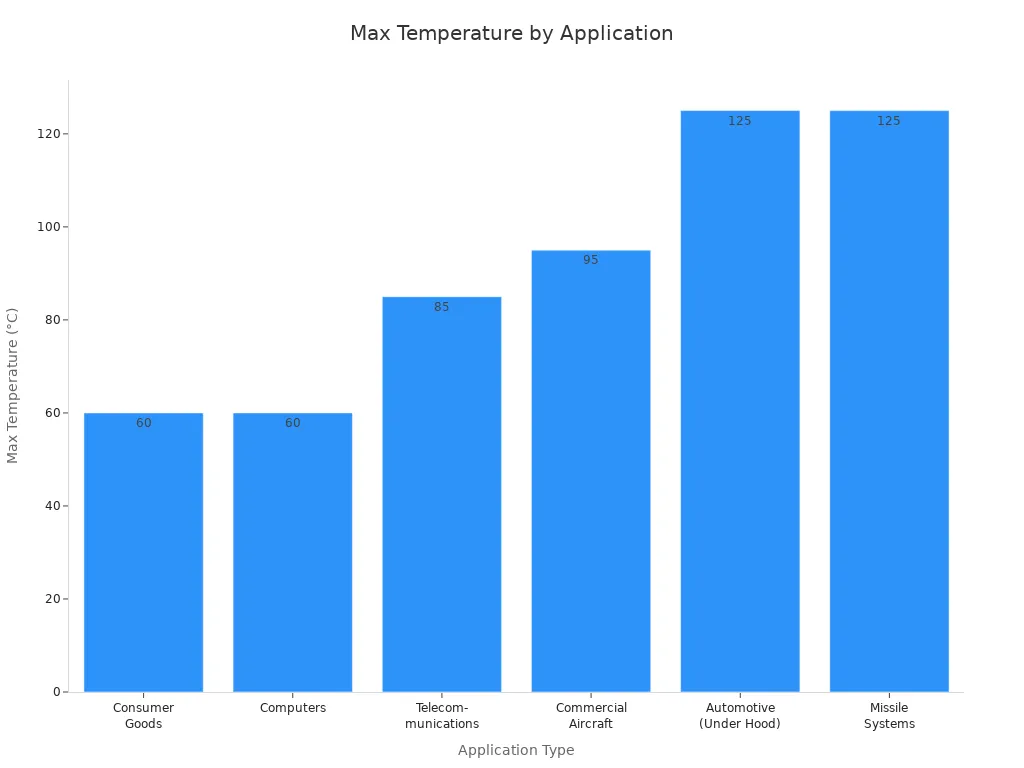
Selecting the right terminal electronics starts with understanding the environment and load. Industrial settings often expose equipment to extreme temperatures, high humidity, vibration, shock, contamination, and even radiation. Terminal blocks must handle these conditions without failing. For example, automotive and missile systems face high temperatures and strong vibrations, while consumer goods see milder conditions. The table below shows how different applications have unique environmental and load needs:
Application | Temperature Range (°C) | Humidity | Vibration | Mechanical Shock |
|---|---|---|---|---|
Consumer Goods | 0 to 60 | Low | Low | Low |
Automotive (Under Hood) | Up to 125 | High | High | High |
Missile Systems | Up to 125 | Low | Very High | Very High |
Terminal blocks must also match the electrical load. This includes voltage, current, and frequency. Choosing a terminal block with a current rating at least 150% of the maximum expected current helps prevent overheating. Material choice, such as copper alloys with tin or gold plating, improves conductivity and resists corrosion.
Safety Standards
Safety is a top priority in industrial electronics. Terminal blocks must meet standards like UL 508A and IEC guidelines. These standards require testing for voltage drop, temperature rise, and short-circuit endurance. Proper spacing and labeling help prevent accidents. Terminal blocks should match the wire size to avoid poor connections. Spring-cage terminals work well in high-vibration areas, while screw terminals need regular checks to stay tight. Material compatibility, such as using stainless steel for harsh environments, increases safety and reliability.
Tip: Always check that terminal blocks have the right safety certifications for your industry.
Installation and Expansion
Planning for installation and future growth saves time and money. Terminal blocks should fit the available space and allow for easy wiring. Experts recommend leaving about 20% extra space on guide rails for future expansion. Modular and miniaturized terminal blocks make upgrades easier and support higher wiring density. The table below compares terminal boxes and junction boxes for installation and expansion:
Aspect | Terminal Box | Junction Box |
|---|---|---|
Wiring Capacity | Fixed, organized | Flexible, easy to expand |
Installation Time | Longer, easier troubleshooting | Faster, harder troubleshooting |
Expansion | Limited | More suitable |
Choosing terminal blocks with plug-and-play features or spring clamping technology helps with quick changes and maintenance. Matching the terminal block to the wire size and ensuring vibration resistance are also important for long-term performance.
Terminal electronics, including terminal blocks and connectors, support safe and reliable connections in many industries. Their design improvements, such as miniaturization and durability, help meet the needs of modern automation, smart manufacturing, and electric vehicles.
Understanding features and selection criteria ensures optimal performance and safety.
Ongoing learning through industry resources and events helps professionals adapt to new technologies and changing requirements.
Staying informed allows companies to use the best solutions for current and future applications.
FAQ
What is the main purpose of terminal blocks in industrial systems?
Terminal blocks help connect wires safely. They organize electrical connections inside control panels. This makes repairs and changes easier. Terminal blocks also help prevent wiring mistakes.
How do connectors improve safety in harsh environments?
Connectors use seals and strong materials. These features protect against dust, water, and vibration. They help keep electrical systems safe and working in tough places.
Why should engineers consider modular terminal electronics?
Modular terminal electronics allow quick changes and upgrades. Engineers can add or remove parts without rewiring the whole system. This saves time and supports future growth.
What standards should terminal electronics meet for safety?
Terminal electronics should meet standards like UL 508A and IEC. These standards require testing for voltage, current, and temperature. Meeting these rules helps prevent accidents.
Can terminal electronics handle both power and data signals?
Yes. Many terminal electronics support both power and data. They use special designs to keep signals clear and strong. This helps machines work together in modern factories.