4 key RTD resistance temperature standards with real facts
You will find four main rtd resistance temperature standards: IEC 60751, DIN 43760, ASTM E1137/E287, and JIS C1604. These standards help you choose the right rtd sensor for accurate temperature measurement in many industries. Thin-film and wire-wound rtds have different features. Wire-wound sensors give higher accuracy and better stability, while thin-film sensors respond quickly and fit tight spaces.
| Feature | Thin-Film RTD Sensors | Wire-Wound RTD Sensors |
|---|---|---|
| Accuracy | Good | Higher, especially at extremes |
The wiring setup—2-wire, 3-wire, or 4-wire—also affects how well your sensor reads the temperature.
Key Takeaways
- Understand the four main RTD standards: IEC 60751, DIN 43760, ASTM E1137/E287, and JIS C1604. Each standard defines resistance values and accuracy for different applications.
- Choose the right RTD sensor type based on your needs. Thin-film sensors are cost-effective and fit tight spaces, while wire-wound sensors offer higher accuracy and stability.
- Select the appropriate wiring configuration. A 2-wire setup is simple but less accurate, while a 4-wire configuration provides the highest precision by eliminating lead wire errors.
- Regularly calibrate your RTD sensors to maintain accuracy. Calibration helps avoid errors and ensures reliable temperature readings in critical applications.
- Consider environmental factors when selecting an RTD sensor. Choose materials and designs that withstand specific conditions, such as moisture or vibration, for optimal performance.
RTD Sensor Basics
What is a Resistance Temperature Detector?
You use a resistance temperature detector, or RTD, to measure temperature by tracking changes in electrical resistance. When you heat a metal, its resistance goes up. When you cool it, the resistance drops. This simple idea forms the core of every RTD sensor. Most RTD sensor elements use platinum, which gives you reliable and repeatable results. The relationship between resistance and temperature follows a formula:
- Rt = R0(1 + αt + βt²)
- Rt is the resistance at temperature t.
- R0 is the resistance at 0°C.
- α is the temperature coefficient.
- β is a small correction for higher accuracy.
You can trust an RTD sensor for precise temperature measurement in many settings, from labs to factories.
RTD Sensor Construction Types
You will find two main types of RTD sensor construction: thin-film and wire-wound.
- Thin-film RTD sensors use a thin layer of platinum or nickel on a ceramic base. This design keeps costs low and lets you fit the sensor into tight spaces.
- Wire-wound RTD sensors use coils of platinum wire. These sensors give you the best accuracy and work well over a wide temperature range.
- Platinum RTD sensors are the most popular because they offer the best linear response and repeatability.
- Some RTDs use nickel, copper, or nickel-iron, but these do not match the performance of platinum RTDs.
When you choose an RTD sensor, think about your need for accuracy, space, and budget.
RTD Wiring Configurations
You can connect an RTD sensor in three main ways. Each wiring setup affects how accurate your readings will be.
| Configuration | Description | Accuracy Level |
|---|---|---|
| 2-Wire | Simple and low-cost, but lead wires add errors | Least accurate |
| 3-Wire | Reduces some errors, good for most industrial uses | Moderate accuracy |
| 4-Wire | Removes all lead wire errors, best for precision | Highest accuracy |
The 4-wire RTD sensor gives you the most accurate results. It cancels out errors from long wires, making it perfect for high-precision jobs.
If you need a temperature sensor for short distances and low cost, a 2-wire RTD might work. For better accuracy, especially in industrial settings, a 3-wire RTD is a smart choice. When you need the best accuracy, always pick a 4-wire RTD sensor.
RTD Resistance Temperature Standards
You will find four main standards that define how rtd resistance temperature works. These standards help you compare rtd sensor elements and choose the best sensor for your job. Each standard sets rules for accuracy, resistance values, and temperature coefficients. You need to know these standards to make sure your resistance temperature detector gives you reliable results.
IEC 60751
You will see IEC 60751 as the most common standard for platinum rtd sensors. This standard sets the resistance value for Pt100 sensors at 100 Ohms when the temperature is 0°C. IEC 60751 also defines the temperature coefficient for platinum rtd at 0.00385 ohms/ohm/°C. You can use this standard for a wide temperature range, from -200°C to +850°C. IEC 60751 gives you clear tolerance classes, so you know how accurate your rtd sensor will be.
- The tolerance classes include F 0.6 (2B), F 0.3 (B), F 0.15 (A), and F 0.1 (1/3B).
- You can see the deviation at 0°C for each class in the table below.
| Tolerance Class | Temperature Range | Deviation at 0°C |
|---|---|---|
| F 0.6 (2B) | -70°C to 500°C | ±0.6 K |
| F 0.3 (B) | -70°C to 500°C | ±0.3 K |
| F 0.15 (A) | -50°C to 300°C | ±0.15 K |
| F 0.1 (1/3B) | 0°C to 150°C | ±0.1 K |
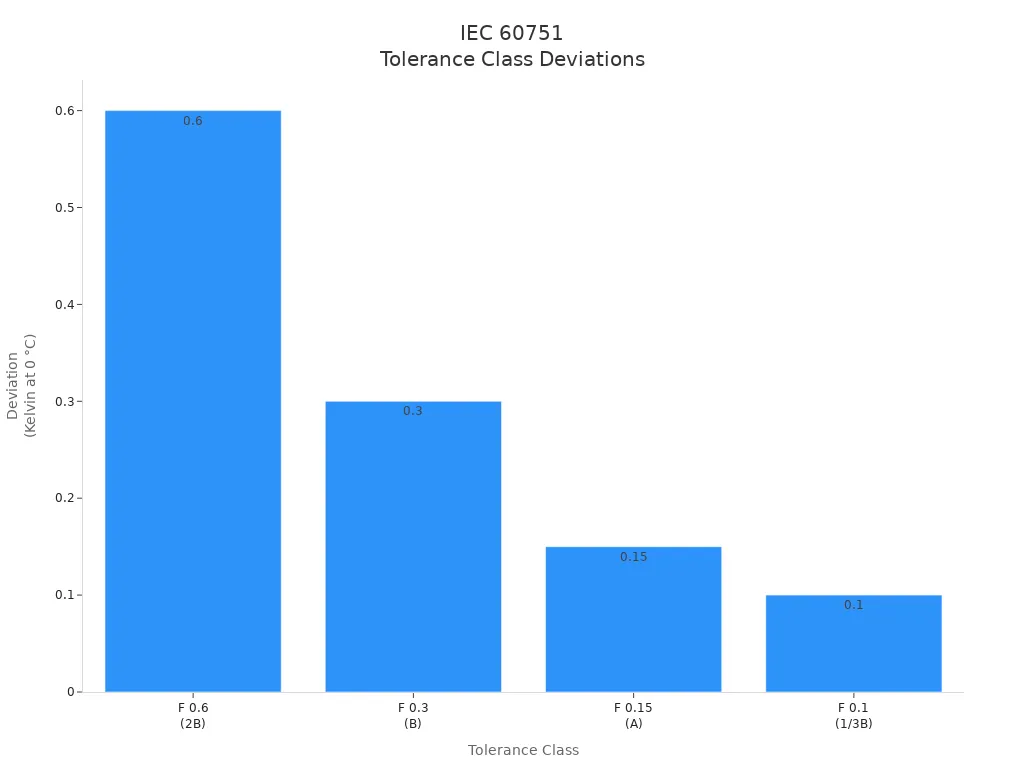
IEC 60751 gives you the most trusted rules for rtd resistance temperature in industries like pharmaceuticals, biotechnology, and semiconductor manufacturing. You can rely on this standard for high accuracy and repeatability.
DIN 43760
You may come across DIN 43760 in older systems. This standard first covered both nickel and platinum rtd sensor elements, but now it only applies to nickel rtd sensors. DIN 43760 does not set a temperature coefficient for platinum rtd. Instead, it uses the DIN curve to show how resistance changes with temperature for nickel sensors. The DIN curve uses the Callendar-Van Dusen equation to handle non-linearity, especially outside the 0°C to 100°C range.
- DIN 43760 does not specify tolerance classes for platinum rtd sensors.
- You will find this standard mostly in legacy equipment.
| Standard | Temperature Coefficient | Tolerance Classes | Applicable Elements |
|---|---|---|---|
| DIN 43760 | Not specified | Not specified | Nickel only |
| IEC 60751 | 3850 ppm | Specific classes | Platinum rtd only |
If you work with older nickel rtd sensors, you may need to use DIN 43760. For new platinum rtd sensors, IEC 60751 is the better choice.
ASTM E1137/E287
You will see ASTM E1137/E287 used widely in North America. This standard sets rules for platinum rtd sensors, just like IEC 60751. ASTM E1137 defines the temperature coefficient at 0.00385 ohms/ohm/°C for platinum rtd. It covers a temperature range from -200°C to 650°C. ASTM E1137 also gives you clear tolerance grades, such as Grade A and Grade B.
| Feature | Description |
|---|---|
| Temperature Coefficient of Resistance | 0.00385 ohms/ohm/°C between 0°C and 100°C |
| Nominal Resistance at 0°C | 100 Ω or other specified value |
| Temperature Range | -200 to 650 °C |
| Tolerance Grade | Tolerance Definition | ||
|---|---|---|---|
| Grade B | ± (0.25 + 0.0042 | t | ) |
| Grade A | ± (0.13 + 0.0017 | t | ) |
You need to program your signal conditioning device for the right temperature coefficient. If you do not, you may get large errors in your rtd resistance temperature readings.
JIS C1604
You will find JIS C1604 as the main standard for rtd sensors in Japan. This standard sets the base resistance for Pt100 sensors at 100 Ohms at 0°C, just like IEC 60751. JIS C1604 covers a temperature range from -200°C to +650°C. The temperature coefficient is 0.003916 ohms/ohm/°C, which is slightly higher than IEC 60751. JIS C1604 uses tolerance classes J and K, which match IEC classes A and B.
| Parameter | JIS C1604 Specification | IEC 60751 Specification |
|---|---|---|
| Base Resistance at 0°C | 100.00Ω | 100.00Ω |
| Temperature Range | -200 to +650°C | -200 to +850°C |
| Temperature Coefficient | 0.003916 Ω/Ω/°C | 0.00385 Ω/Ω/°C |
| Tolerance Classes | J and K (A and B) | A and B |
If you work in Japanese industries, you will use JIS C1604 for rtd resistance temperature. This standard helps you meet local requirements for accuracy and reliability.
Comparing the Standards
You can compare the main rtd resistance temperature standards using the table below. This table shows the tolerance classes and definitions for each standard.
| Standard | Tolerance Class/Grade | Tolerance Definition | ||
|---|---|---|---|---|
| IEC 60751 (B) | F 0.3 | ± (0.3 + 0.005 | t | ) |
| IEC 60751 (A) | F 0.15 | ± (0.15 + 0.002 | t | ) |
| ASTM E1137 (B) | Grade B | ± (0.25 + 0.0042 | t | ) |
| ASTM E1137 (A) | Grade A | ± (0.13 + 0.0017 | t | ) |
| JIS C1604-1997 | 3850ppm | |||
| JIS C1604-1987 | 3916ppm | |||
| DIN 43760 | Nickel only | |||
| DIN EN IEC 60751 | Platinum applicable |
IEC 60751 and ASTM E1137/E287 are the most widely used standards for platinum rtd sensors. You will see these standards in industries that need high accuracy, such as pharmaceuticals, biotechnology, and semiconductor manufacturing.
You need to understand these standards before you select an rtd sensor. The right standard helps you get accurate rtd resistance temperature readings and meet industry requirements.
RTD Standard Parameters
Resistance at 0°C (Pt100, Pt1000)
When you select an rtd sensor, you need to know the resistance value at 0°C. This value helps you identify the type of rtd sensor elements you are using. Most platinum rtd sensors come in two main types: Pt100 and Pt1000. Pt100 sensors have a resistance of 100 ohms at 0°C, while Pt1000 sensors measure 1,000 ohms at the same temperature. You will see these values across all major rtd standards, including IEC 60751, DIN 43760, ASTM E1137/E287, and JIS C1604.
| Sensor Type | Nominal Resistance at 0°C |
|---|---|
| Pt100 | 100 ohms |
| Pt1000 | 1,000 ohms |
If you need a temperature sensor for industrial temperature measurement, Pt100 is the most common choice. Pt1000 sensors work well when you want to reduce the effect of lead wire resistance, especially in a 2-wire configuration.
Temperature Coefficient (Alpha)
The temperature coefficient, or alpha (α), shows how much the resistance changes for each degree of temperature. You use this value to calculate the temperature from the resistance reading. Platinum rtd sensors have a stable alpha, which makes them ideal for high accuracy temperature sensing. The main standards set different alpha values, but most platinum rtd sensors use 0.00385 Ω/Ω/°C. ASTM E1137 and JIS C1604-1987 use slightly higher values.
| Standard | Temperature Coefficient (α) |
|---|---|
| IEC 60751 | 0.003850 Ω/Ω/°C |
| DIN 43760 | 0.003850 Ω/Ω/°C |
| ASTM E1137 | 0.003911 Ω/Ω/°C |
| JIS C1604-1987 | 0.003916 Ω/Ω/°C |
| JIS C1604-1997 | 0.003850 Ω/Ω/°C |
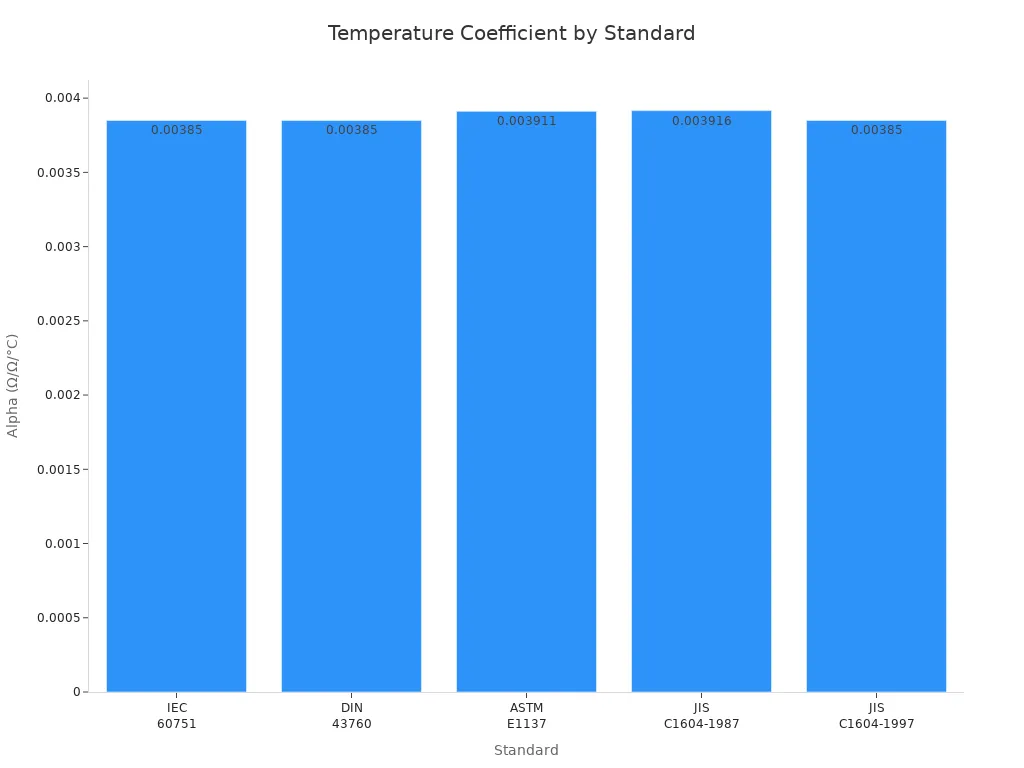
You will find that platinum rtd sensors with a higher alpha value respond more accurately to temperature changes. Nickel rtd sensors use a different alpha, so you need to check the standard before you choose your sensor.
Tolerance Classes and Grades
Tolerance classes tell you how close your rtd sensor readings are to the true temperature. You need to match the tolerance class to your application. The main standards define several classes, such as AA, A, B, and C. Class AA gives you the highest accuracy, while Class C is suitable for less critical tasks. Class B rtds are popular for industrial temperature measurement because they offer a wide temperature range and good accuracy at a reasonable cost.
| RTD Class | Range | Tolerance at T°C | ||
|---|---|---|---|---|
| AA | –30°C to +200°C | ±(0.10 + 0.0017 × | T | ) |
| A | –30°C to +300°C | ±(0.15 + 0.002 × | T | ) |
| B | –50°C to +600°C | ±(0.30 + 0.005 × | T | ) |
| C | –50°C to +600°C | ±(0.60 + 0.06 × | T | ) |
You should choose Class A or AA for high accuracy needs, such as laboratory work or precise process control. Class B works well for most industrial uses, including wire wound rtd and coiled element rtd sensors. Thin film rtd sensors often meet Class B or A standards.
The DIN standard also uses classes A, B, and C, with formulas that show the maximum allowed deviation. IEC 751 classifies rtd sensors by resistance and temperature deviation, which helps you pick the right sensor for your temperature measurement job. If you use a 4-wire configuration, you can achieve the best accuracy, even with lower tolerance classes.
RTD Sensor Real-World Usage
Industry Applications
You see rtd sensors used in many industries because they give you reliable temperature measurement. You can find different types of rtd sensors in places like food processing, medical labs, and even cars. Each industry has its own needs for accuracy and durability. For example, food and beverage companies use rtd sensor elements to monitor pasteurization and keep food safe. In HVAC systems, rtd sensors help control indoor climates for comfort and energy savings. Industrial automation relies on rtd sensors to track heat exchangers and reactor temperatures. You also find rtd sensors in automotive engines, electronics, and aerospace systems.
Here is a table showing where you might use rtd sensors and what environments they face:
| Industry | Typical Operating Environments |
|---|---|
| Food and Beverage | Pasteurization processes, refrigeration systems, cooking equipment, transportation and storage of perishable goods |
| HVAC | Indoor environments, automated control systems for energy efficiency and comfort |
| Industrial Automation | Process temperature monitoring, heat exchanger performance, reactor temperature control, pipe and tank monitoring |
| Automotive | Engine temperature, oil level, intake air, exhaust system, battery management |
| Pharmaceuticals | Sterilization processes, storage facilities, cold chain transportation, fermentation processes |
| Electronics and Computer | Amplifier over-temperature, power supply, server room control, thermal system evaluation |
| Medical | Medical device control, refrigerated drug storage, blood temperature monitoring, laboratory equipment |
| Aerospace | Engine temperature, hydraulic system control, fuel temperature, environmental control systems |
You often face challenges when you use rtd sensors in real-world temperature measurement applications. You might get inaccurate readings if you do not calibrate your sensor or if sensor drift occurs. Sensor placement matters, so you need to avoid heat sources and make sure there is good ventilation. Wiring problems can cause errors, so you should inspect connections and use proper connectors. Environmental factors like moisture or vibration can affect your rtd sensor, so you need to choose the right enclosure and sensor type. Power supply issues also matter; stable voltage helps your sensor work well.
| Challenge | Solution |
|---|---|
| Inaccurate Readings | Regular calibration, check for sensor drift, shield from external interference. |
| Sensor Placement Issues | Review sensor placement, avoid heat sources, ensure proper ventilation. |
| Wiring and Connection Problems | Inspect wiring, use proper connectors, maintain good contact. |
| Environmental Factors | Choose suitable enclosures, select appropriate sensor type, implement environmental monitoring. |
| Power Supply Problems | Check power supply stability, use voltage regulators. |
Tip: You should always check your rtd sensor before you use it in critical temperature measurement applications. Regular maintenance helps you avoid costly mistakes.
Regional Preferences
You notice that rtd standards and types of rtd sensors vary by region. In Europe, you see a mature market that values innovation and premium products. People in Europe often choose rtd sensors with health-conscious features. North America leads in fast innovation and likes rtd sensors that offer convenience and health benefits. Asia Pacific grows quickly because of urbanization and a younger population. You find many types of rtd sensors in Asia, with diverse flavor profiles and new uses. If you work in Japan, you might use nickel rtd sensors because local standards like JIS C1604 support them. In North America and Europe, platinum rtd sensors are more common.
You should learn about local standards before you select an rtd sensor for your project. This helps you meet regulations and customer expectations in your region.
Resistance Temperature Detector Comparison
When you compare RTD standards, you see important differences in resistance values, temperature coefficients, tolerance classes, wiring setups, and usage. You need to know these details to pick the right RTD sensor for your job.
Here is a table that shows how the main standards stack up:
| Standard | Resistance Value at 0°C | Alpha (ppm/°C) | Tolerance Class/Grade | Tolerance Definition | Wiring Options | Typical Usage | ||||
|---|---|---|---|---|---|---|---|---|---|---|
| IEC 60751 | 100 Ω (Pt100) | 3850 | F 0.3 (B), F 0.15 (A) | ±(0.3 + 0.005 | t | ), ±(0.15 + 0.002 | t | ) | 2, 3, 4-wire | Industrial, lab, process |
| DIN 43760 | 100 Ω (Nickel) | 6180 | N/A | N/A | 2, 3-wire | Legacy, nickel applications | ||||
| ASTM E1137/E287 | 100 Ω (Pt100) | 3850 | Grade B, Grade A | ±(0.25 + 0.0042 | t | ), ±(0.13 + 0.0017 | t | ) | 2, 3, 4-wire | North America, industry |
| JIS C1604 | 100 Ω (Pt100) | 3850/3916 | J, K | Similar to IEC classes | 2, 3, 4-wire | Japan, electronics |
You notice that IEC 60751 and ASTM E1137/E287 both use platinum elements and set similar resistance values and alpha coefficients. These standards also offer clear tolerance classes, which help you know how accurate your RTD readings will be. JIS C1604 matches IEC 60751 in many ways but uses a slightly different alpha value for older sensors. DIN 43760 stands out because it focuses on nickel elements and does not define tolerance classes for platinum.
When you look at wiring, you see three main options:
- 2-wire RTD: You use this for short distances or when you do not need high precision. It is simple and low-cost.
- 3-wire RTD: You find this setup in most industrial settings. It balances cost and accuracy.
- 4-wire RTD: You choose this for laboratory work or high-precision jobs. It removes errors from lead wires.
You see that IEC 60751, ASTM E1137/E287, and JIS C1604 support all three wiring types. DIN 43760 usually works with 2-wire and 3-wire setups.
Here are some practical differences and similarities:
- IEC 60751 and ASTM E1137/E287 both give you clear tolerance formulas. You can trust these standards for platinum RTD sensors in industrial and lab settings.
- JIS C1604 is the standard you use in Japan. It matches IEC 60751 for most specs but has a unique alpha value for older sensors.
- DIN 43760 is best for nickel RTDs and legacy systems. You do not use it for new platinum sensors.
- You get the highest accuracy with a 4-wire RTD, especially when you use a wire wound rtd or coiled element rtd sensor.
Tip: You should always check the standard and wiring before you select an RTD sensor. This helps you get the best accuracy for your application.
Choosing the Right RTD
Application Considerations
When you select an RTD for your project, you need to match the sensor to your application. Start by defining the temperature range you want to measure. Each RTD sensor works best within a specific range, and accuracy is highest at the calibration temperature, usually 0°C. If you measure temperatures outside the recommended range, you may see lower accuracy and wider tolerances.
You should also think about the environment. Some RTDs have protective sheaths that resist corrosion, making them ideal for harsh settings. The insulation material and encapsulation, such as ceramic or metal, affect how quickly the sensor responds and how well it performs. Regular calibration checks help you maintain reliable readings, especially in critical applications.
- Choose an RTD sensor designed for your temperature range.
- Select construction materials that suit your environment.
- Schedule calibration to keep your measurements accurate.
Industry and Region
Your industry and location play a big role in RTD selection. In food processing, you need sensors that handle moisture and frequent cleaning. In pharmaceuticals, high accuracy and repeatability matter most. Automotive and electronics industries often use RTDs for precise control and monitoring.
Regional standards also guide your choice. In North America, ASTM E1137 is common. In Europe, IEC 60751 leads. Japanese industries often follow JIS C1604. You should check which standard fits your local regulations and customer expectations.
Tip: Always confirm the standard required for your region before you buy an RTD sensor.
Industry-Specific Checklist
| Step | What to Consider |
|---|---|
| 1 | Define your temperature range |
| 2 | Decide on required accuracy |
| 3 | Check for vibration concerns |
Practical Tips
You can improve RTD performance by following expert advice. Make sure you immerse the probe deep enough—usually 8 to 10 times its diameter—to avoid errors. Use thermally conductive compounds in thermowell installations for faster response and better accuracy. Install strain relief loops in wiring to protect against vibration. Keep signal cables away from power lines and use shielding to prevent interference.
Calibrate your RTD at several points across its operating range, not just at one temperature. Use reference thermometers that are much more accurate than your RTD. For critical jobs, choose calibration labs with proper accreditation. Always analyze all possible error sources to understand your measurement uncertainty.
- Insert the RTD sheath into a thermowell for protection and easy removal.
- Use a connection head to shield the leads from ambient conditions.
- Employ radiation shields when measuring air temperature near heat sources.
Following these steps helps you get the most accurate results from your RTD sensor.
You have learned about four main RTD resistance temperature standards: IEC 60751, DIN 43760, ASTM E1137/E287, and JIS C1604. Each standard sets unique rules for resistance, temperature coefficient, and tolerance. When you understand RTD sensor types and wiring, you improve measurement accuracy by:
- Choosing the right material, like platinum, for better linearity.
- Using proper wiring, such as three-wire or four-wire methods, to reduce errors.
- Following standards for reliable calibration.
If you use these comparisons and practical tips, you can select the best RTD sensor for your application.
FAQ
What does "Pt100" mean in RTD sensors?
Pt100 means your RTD sensor uses platinum and has a resistance of 100 ohms at 0°C. You see this label on most industrial RTD sensors. Pt100 sensors give you reliable and accurate temperature readings.
How do you choose between 2-wire, 3-wire, and 4-wire RTD sensors?
You pick a 2-wire RTD for simple jobs. You use a 3-wire RTD for most industrial tasks. You select a 4-wire RTD when you need the highest accuracy. More wires help you reduce errors from lead resistance.
Why do RTD standards matter for temperature measurement?
RTD standards set rules for resistance, accuracy, and temperature range. You follow these standards to get consistent and reliable readings. Standards help you compare sensors and meet industry requirements.
Can you use a platinum RTD sensor with any standard?
You need to match your platinum RTD sensor to the right standard. IEC 60751 and ASTM E1137 work for most platinum RTDs. JIS C1604 is common in Japan. You check the sensor specs before you install it.