How the RK3588S2 Delivers High-End AI and Multimedia Capabilities
The rockchip rk3588s2 stands out as a powerful solution for advanced AI and multimedia tasks. This processor combines a high-performance CPU, a robust GPU, and an innovative NPU, which enable smooth 8K video playback and efficient AI processing. Recent devices, such as the ODROID-M2, feature the rk3588s2, showcasing its growing presence in next-generation smart displays, edge AI devices, and multimedia systems. The rockchip design team built the rk3588s2 to handle demanding workloads, making it a top choice for developers who need reliable features and strong performance.
Key Takeaways
The RK3588S2 combines a powerful CPU, GPU, and NPU to deliver strong AI and multimedia performance, supporting smooth 8K video and real-time AI tasks.
Its efficient 8nm design balances high speed with low power use, making it ideal for edge AI devices, smart displays, and embedded systems.
The chip supports up to 16GB of fast LPDDR5 memory and offers versatile connectivity options, enabling flexible integration with cameras, displays, and peripherals.
Developers benefit from broad AI framework support and robust software tools, which simplify AI model deployment and speed up project development.
The RK3588S2 powers versatile single-board computers like the Radxa Rock 5c, which excel in multimedia, AI, and industrial applications with reliable performance.
Rockchip RK3588S2 Features
CPU and Performance
The Rockchip RK3588S2 uses a powerful CPU configuration that combines two Cortex-A76 cores and four Cortex-A55 cores. This setup follows the DynamIQ architecture, which allows the processor to balance high performance and energy efficiency. The chip is manufactured using an advanced 8nm low-power process, which helps reduce heat and power consumption.
Specification | Details |
|---|---|
CPU Core Configuration | 2x Cortex-A76 + 4x Cortex-A55 cores |
CPU Architecture | DynamIQ configuration |
Manufacturing Process | 8nm Low Power (LP) |
Benchmark results show that the RK3588S2 delivers strong multi-core performance. In Geekbench 5, it achieves a single-core score of 500 and a multi-core score of 1803. These scores reflect a 3x faster multi-core processing performance compared to previous Rockchip SoCs. The following chart highlights the improvement in both single-core and multi-core benchmarks:
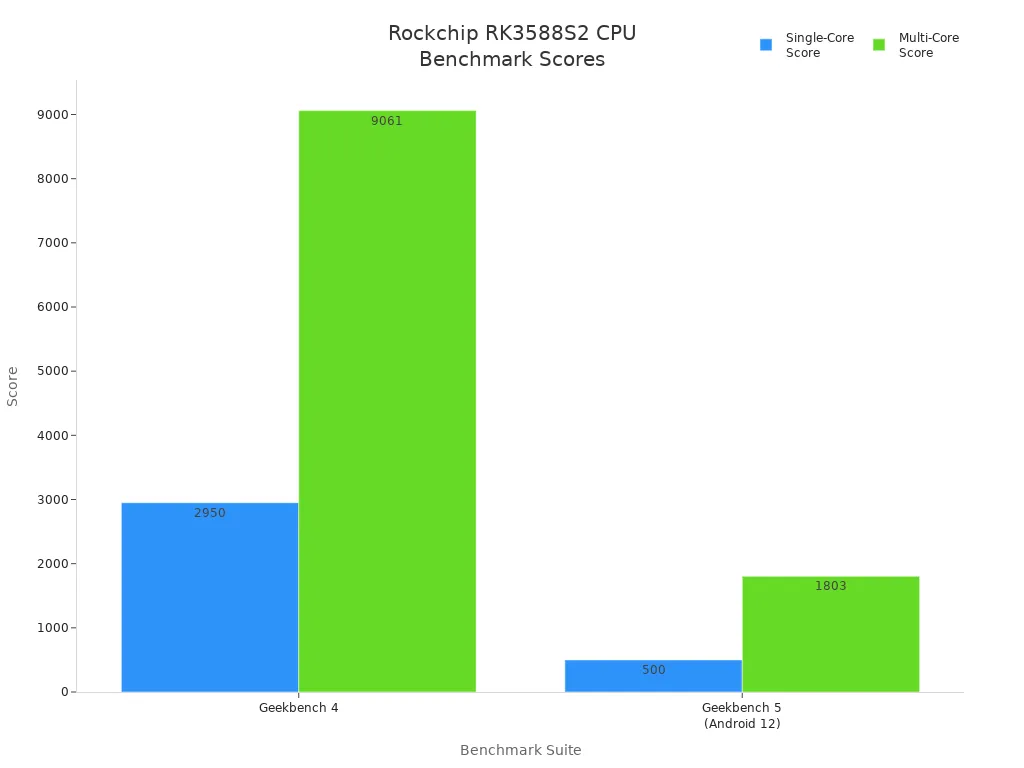
This level of CPU power enables the RK3588S2 to handle demanding workloads, such as real-time AI inference and high-resolution multimedia processing.
GPU and Graphics
The RK3588S2 integrates a Mali-G610 MP4 GPU, which supports advanced graphics tasks. This GPU can handle 4K video encoding and decoding at high frame rates. It also drives dual DisplayPort 1.3 outputs at 4K resolution and 60Hz, ensuring smooth and vibrant visuals. The GPU achieves a score of 1401 in the GL Mark 2 benchmark, which demonstrates its ability to deliver 5 times faster graphics compared to older SoCs from Rockchip.
The GPU in the RK3588S2 supports gaming and other graphics-intensive applications. While it may not match desktop-class integrated GPUs, it offers excellent power efficiency. This makes the SoC ideal for embedded and industrial devices that require reliable graphics without excessive energy use.
NPU and AI
The NPU in the Rockchip RK3588S2 delivers up to 6 TOPS (trillion operations per second) of AI processing power. This dedicated hardware accelerates machine learning tasks, such as image recognition and natural language processing. The NPU supports multiple precision models, including INT8, INT16, and FP16, which allows developers to optimize AI workloads for both speed and accuracy.
With this NPU, the RK3588S2 can run complex AI models directly on the device. This reduces latency and increases privacy, since data does not need to leave the device for cloud processing. The NPU’s efficiency also keeps power consumption low, making the chip suitable for edge AI applications.
Memory and Connectivity
The RK3588S2 supports up to 16GB of LPDDR5 memory, which provides high bandwidth for data-intensive tasks. This shared memory architecture allows the CPU, GPU, and NPU to access data quickly, reducing delays and improving throughput for AI and multimedia workloads.
Feature Category | Details & Impact on AI/Multimedia Performance |
|---|---|
Memory Architecture | Shared up to 16GB of LPDDR5 memory among CPU, GPU, and NPU enables efficient data sharing, reducing latency and boosting throughput. |
NPU Precision Support | INT8, INT16, FP16 models supported for high-performance AI inference with low power consumption. |
Connectivity Options | MIPI interfaces for up to 3 cameras, HDMI output, USB-A and USB-C, M.2, GPIO, supporting integration into smart devices. |
Power Efficiency | Low TDP (5-10W) ensures strong performance with modest power and heat requirements. |
Comparative Advantage | Competitive edge AI and multimedia performance at lower cost and power than many alternatives. |
The SoC also offers a wide range of connectivity options. Devices based on the RK3588S2 can include WiFi 6 and Bluetooth 5, which provide fast wireless networking and reliable device pairing. Multiple USB ports, HDMI, and MIPI interfaces support cameras, displays, and other peripherals. These features make the RK3588S2 a flexible choice for smart cameras, digital signage, and industrial systems.
Note: The combination of high-speed memory, advanced connectivity, and efficient processing units allows the RK3588S2 to excel in both AI and multimedia applications.
AI Performance
NPU Architecture
The Rockchip RK3588S2 features a triple-core npu that delivers 6.0 TOPS, making it a strong choice for edge AI tasks. This architecture supports several data precision formats, such as INT4, INT8, INT16, FP16, BF16, and TF32. These options give developers flexibility to balance speed and accuracy in their models. The chip uses advanced 8nm process technology, which helps boost performance and keep power use low. The npu works closely with the Cortex-A76 and Cortex-A55 CPUs and the Mali-G610 MC4 GPU, allowing the chip to handle complex AI and multimedia workloads.
Triple-core design for high throughput
Multiple data precision formats for flexible AI computation
8nm process for better efficiency
Integration with high-performance CPU and GPU
AI Benchmarks
The RK3588S2 achieves 6.0 TOPS at INT8 precision, placing it among the top performers in its class. This level of ai performance supports real-time tasks like speech and image recognition. When compared to other Rockchip models, the RK3588S2 matches the RK3576 in raw computing power and framework support. However, the RK3588S2 stands out for its power efficiency, making it ideal for mobile and battery-powered devices.
Feature | RK3588S NPU | RK3576 NPU |
|---|---|---|
Computing Power | 6.0 TOPS @ INT8 | 6.0 TOPS @ INT8 |
Supported Data Types | INT4, INT8, INT16, FP16, BF16, TF32 | INT4, INT8, INT16, FP16, BF16, TF32 |
Frameworks | TensorFlow, Caffe, Tflite, Pytorch, Onnx NN, Android NN | TensorFlow, Caffe, Tflite, Pytorch, Onnx NN, Android NN |
AI Task Suitability | Speech, image recognition | Speech, image recognition |
Note: The RK3588S2 offers lower static power consumption and more precise power control, which helps extend battery life in portable devices.
Supported Frameworks
Developers can use many popular AI frameworks with the RK3588S2. The RKNN-Toolkit2 SDK allows easy model conversion, deployment, and performance evaluation. It supports Python and C/C++ APIs, making it simple to run AI models on the hardware. The toolkit works with ONNX models and includes a model zoo for tasks like detection, segmentation, and OCR. Hardware modules such as the Radxa CM5 and DEEPX DX-M1 show strong compatibility and expandability, helping users deploy advanced AI solutions quickly.
Multimedia Capabilities

Video Decoding/Encoding
The Rockchip RK3588S2 stands out in video processing. It supports a wide range of formats and resolutions, making it suitable for both consumer and industrial applications. The chip handles high-speed video decoding and encoding, which is essential for streaming, surveillance, and smart displays.
Capability | Supported Formats & Bit-depths | Encoding Support | Decoding Support | Max Resolution & Speed |
|---|---|---|---|---|
H.264 (AVC) | 8-bit and 10-bit (High10) | 8-bit encoding supported | 8-bit and 10-bit decoding | |
HEVC (H.265) | 8-bit and 10-bit | 8-bit encoding supported | 8-bit and 10-bit decoding | Up to 1080p @ 480fps or 4K @120fps |
AV1 | 8-bit and 10-bit | Encoding not supported | Decoding supported | Not specified |
Hardware HDR Tone-mapping | Supported via OpenCL only on RK3588/3588S | N/A | N/A | N/A |
The RK3588S2 uses RKMPP for hardware acceleration on Linux. The Mali-G610 GPU supports OpenCL-based HDR tone-mapping, which improves video quality in real time. Users can run multiple video streams without session limits, making the chip ideal for multi-channel video systems.
Display Outputs
The RK3588S2 offers flexible video output options for modern displays. It supports dual DisplayPort 1.3, HDMI 2.1, and eDP interfaces. These outputs allow the chip to drive multiple screens at high resolutions and refresh rates. Users can connect up to three displays at once, each with 4K resolution at 60Hz. This capability benefits digital signage, control panels, and smart TVs.
Tip: The chip’s advanced video output features help developers create immersive visual experiences for both entertainment and professional environments.
Camera and Audio
The RK3588S2 provides robust camera and audio support. It features two MIPI DC combo PHYs and four MIPI CSI DPHY interfaces, allowing up to six cameras to connect at once. The chip supports high-speed data transfer, with each MIPI DPHY lane reaching 4.5 Gbps. The image signal processor handles up to 48MP input resolution and includes features like auto exposure, autofocus, and noise reduction.
Feature Category | Specifications |
|---|---|
Camera Interfaces | Up to 6 cameras, MIPI DPHY/CPHY, DVP, BT.601/656/1120, HDMI 2.0 RX (4K@60fps) |
Image Signal Processor | 48MP input, dual ISP, advanced image processing (AE, AF, AWB, HDR, etc.) |
Audio Interfaces | I2S, SPDIF, PDM, up to 8 channels, 192 KHz, multi-mic array, VAD, volume control |
The audio subsystem supports up to eight channels with high sample rates. Features like voice activity detection and multi-mic array support make the RK3588S2 suitable for smart speakers and voice-controlled devices.
RK3588S2 Single-Board Computer
Use Cases
Radxa has developed the radxa rock 5c as a versatile platform for many applications. This rk3588s2 single-board computer supports projects that need strong performance and reliability. Makers and IoT enthusiasts use the radxa rock 5c for smart home hubs, AI-powered robots, and digital signage. Developers also choose this single-board computer for building intelligent surveillance systems and edge AI devices. The radxa rock 5c handles high-resolution video processing, real-time data analysis, and multi-camera setups with ease.
Tip: The radxa rock 5c works well in both personal and industrial environments. Its flexibility allows users to create custom solutions for education, research, and automation.
Many single board computers struggle with demanding workloads. The radxa rock 5c stands out because it can run multiple applications at once without slowing down. This makes it a strong choice for users who want to experiment with advanced projects or deploy reliable systems in the field.
Performance in Edge Computing
Radxa designed the radxa rock 5c to deliver high performance in edge computing scenarios. The board uses the RK3588S2 chip, which outperforms many low-end Intel CPUs in benchmark tests. This level of performance supports tasks like AI inference, video analytics, and cloud gateway functions at the edge. Users can process large amounts of data locally, which reduces latency and improves privacy.
Radxa's ROCK 5 series, including the radxa rock 5c, targets server, AI, IoT, and edge computing markets.
The radxa rock 5c shows excellent raw performance, making it suitable for demanding edge workloads.
Some users report that software support for the RK3588S2 single-board computer is less mature than for other platforms like Raspberry Pi.
Community feedback highlights issues with outdated or incomplete Linux and Android builds.
The hardware performance advantage remains clear, but the overall experience depends on both hardware and software quality.
Radxa continues to improve the software ecosystem for its single-board computers. As updates roll out, the radxa rock 5c will become even more attractive for edge computing projects.
Comparison
Previous Rockchip Models
The RK3588S2 brings major improvements over earlier rockchip processors. Users notice faster memory speeds and better video performance. The RK3588 supports a wider memory interface, which increases memory bandwidth compared to the RK3576. This upgrade allows the rock 5 series to handle more data at once. Video decoding and encoding also see a boost. The RK3588 can process up to 8K resolution, while the RK3576 only supports 4K. Display support matches this jump, with the RK3588 driving 8K screens for sharper images.
Audio features in the RK3588 are more advanced. The chip adds more channels and voice activity detection, which helps in smart audio devices. High-speed interfaces improve as well. The RK3588 offers PCIe 3.0 and USB 3.1, while the RK3576 uses PCIe 2.1 and USB 3.0. Software support stays current, with Linux 5.10 and Android 12 available for the RK3588. The image signal processor in the RK3588 reaches 48MP, much higher than the 16MP in the RK3576. These changes make the rock 5 series a strong choice for multimedia and AI projects.
Note: Security features remain similar, but the RK3576 includes more detailed encryption support.
Feature | RK3588 (High-end) | RK3588S (Cost-optimized) |
|---|---|---|
CPU Architecture | 4x Cortex-A76 + 4x Cortex-A55 cores | Same CPU cores (4x Cortex-A76 + 4x Cortex-A55) |
GPU | Mali-G610 MP4 | Mali-G610 MP4 |
Process Technology | 8nm | 8nm |
Video Capability | 8K decoding, 4K encoding | 8K decoding, 4K encoding |
PCIe Support | PCIe 3.0 (higher expansion capability) | PCIe 2.1 (reduced expansion capability) |
Maximum Memory | Up to 32GB | Up to 16GB |
I/O Interfaces | Full set of high-end interfaces, more USB ports | Reduced interface functionality |
Peripheral Support | More GPIO and external module support | Limited GPIO and peripheral functionalities |
Target Market | High-end devices requiring high expandability | Mid-to-low-end, cost and energy optimized |
The table shows that both chips share core strengths. The RK3588S reduces some features to lower cost and power use, making it fit for less demanding rock 5 projects.
Competing SoCs
The RK3588S2 stands out among competing soc options in the market. Many rival chips offer strong CPU and GPU performance, but the rock 5 series delivers a unique mix of AI, multimedia, and connectivity features. Some competitors focus on raw speed, while the RK3588S2 balances efficiency and versatility. The chip supports up to 8K video, advanced AI processing, and flexible I/O, which gives developers more options for smart devices.
Other SoCs may provide higher memory limits or extra expansion, but they often use more power or cost more. The rock 5 series targets users who need reliable performance without high energy use. This approach makes the RK3588S2 a popular choice for edge AI, digital signage, and smart camera applications.
Tip: Developers who want a flexible platform for multimedia and AI should consider the rock 5 series for their next project.
Software and Ecosystem
OS Support
The RK3588S2 platform supports a wide range of operating systems. Developers can choose from Linux distributions such as Ubuntu, Debian, and Fedora. Android 12 also runs smoothly on this chip. Many users prefer Linux for server and edge computing tasks. Android works well for multimedia and smart display projects. The chip’s compatibility with both mainline and vendor-specific kernels gives developers flexibility.
Operating System | Version Supported | Use Case Example |
|---|---|---|
Ubuntu | 20.04, 22.04 | Edge servers, AI boxes |
Debian | 11, 12 | IoT gateways |
Android | 12 | Smart displays, kiosks |
Fedora | 36+ | Developer workstations |
Note: Some features may require custom kernel modules or firmware updates. Developers should check board vendor documentation for the latest support.
Development Tools
Developers have access to a robust set of tools for the RK3588S2. The RKNN-Toolkit2 stands out for AI model deployment. This toolkit supports Python and C/C++ APIs, making it easy to convert and optimize models. The platform also supports standard development environments like GCC, CMake, and Visual Studio Code. Many users rely on Docker for containerized application deployment.
RKNN-Toolkit2 for AI model conversion and benchmarking
GCC and CMake for compiling native applications
Visual Studio Code for code editing and debugging
Docker for managing and deploying software stacks
Tip: Using these tools, developers can accelerate project timelines and ensure stable performance.
Community
A strong community supports the RK3588S2 ecosystem. Forums like Radxa, Armbian, and CNX Software provide troubleshooting help and project ideas. Many users share open-source drivers, kernel patches, and sample code. This collaboration speeds up development and helps solve common problems.
Radxa Forum: Hardware support and tutorials
Armbian Community: OS images and updates
GitHub: Open-source projects and code samples
Developers benefit from active discussions and frequent software updates. The community’s shared knowledge makes the RK3588S2 a reliable choice for both beginners and professionals.
Applications
AI Devices
Developers use the radxa rock 5c to build advanced AI devices for real-world environments. This single-board computer supports machine learning at the edge, allowing devices to process data locally. Smart cameras powered by radxa hardware can detect faces, recognize objects, and track movement in real time. These features help improve security and automation in homes and businesses. The radxa platform also enables voice assistants and smart speakers to respond quickly and accurately. By using the radxa rock 5c, engineers create robots that navigate spaces, avoid obstacles, and interact with people. The strong AI acceleration from the RK3588S2 chip ensures these devices work efficiently and reliably.
Multimedia Systems
The radxa rock 5c brings high-quality multimedia experiences to digital signage and smart displays. Its processor supports 8K video decoding and encoding at up to 60 frames per second. This capability allows businesses to show crisp, detailed images on large screens. The board enables multi-screen output, making it possible to run several displays from one device. Users can connect screens using eDP, DP, HDMI 2.1, or MIPI interfaces. Retail stores, airports, and hotels use radxa-based systems to deliver dynamic content and advertisements. AI-powered enhancements, such as audience analytics and content personalization, help companies engage viewers more effectively.
Key features for multimedia systems:
8K resolution support
Multi-screen output
Versatile display interfaces
AI-driven content optimization
Tip: The radxa platform makes it easy to upgrade existing signage with smarter, more interactive features.
Embedded Solutions
In April 2024, radxa introduced the radxa rock 5c and its Lite version, both powered by the RK3588S2 chipset. These boards deliver up to six TOPS of AI acceleration, making them suitable for industrial and commercial applications. Companies use radxa solutions in machine learning, edge computing, and automation projects. The boards support up to 32GB of memory, HDMI 2.1 for 8K output, and multiple connectivity options like USB, Ethernet, and Wi-Fi 6. Factories deploy radxa hardware for quality control, predictive maintenance, and real-time monitoring. The radxa rock 5c provides a reliable foundation for embedded systems that require strong performance and flexible integration.
Application Area | Example Use Case | Key Benefit |
|---|---|---|
Industrial Automation | Machine vision inspection | Fast, accurate analysis |
Smart Retail | Interactive kiosks | Engaging customer experience |
Edge Computing | IoT gateways | Local data processing |
The rk3588s2 delivers advanced AI and multimedia features that set it apart in the market. Developers and businesses choose the rock platform for its strong performance and flexibility. Many users rely on rock boards to power smart displays, edge AI, and embedded systems. The rock ecosystem offers a reliable foundation for future projects. Those interested in exploring the rk3588s2 can join the community, test development kits, or review technical resources.
FAQ
What operating systems does the RK3588S2 support?
The RK3588S2 supports Linux distributions like Ubuntu and Debian. It also runs Android 12. Developers can choose the best system for their project needs.
Can the RK3588S2 handle 8K video playback?
Yes, the RK3588S2 supports 8K video decoding and encoding. This feature allows smooth playback and recording for high-resolution displays and multimedia systems.
How much memory can devices with the RK3588S2 use?
Devices with the RK3588S2 can use up to 16GB of LPDDR5 memory. This high bandwidth supports fast data processing for AI and multimedia tasks.
Which AI frameworks work with the RK3588S2?
The RK3588S2 works with TensorFlow, PyTorch, ONNX, and Caffe. Developers can use the RKNN-Toolkit2 for easy model deployment and optimization.
What are common applications for the RK3588S2?
Smart cameras
Digital signage
Edge AI devices
Industrial automation
These applications benefit from the chip’s strong AI and multimedia performance.