How to Choose Between RG6 and RG59 for Your Next Installation
You want the best signal quality for your installation. Most experts recommend RG6 for modern setups because it handles higher frequencies and longer runs better than RG59. Choosing the right coaxial cable helps you avoid problems like poor picture quality, interference from nearby devices, and loose connections. When you compare rg6 vs rg59, you see that using the wrong cable leads to blurry images and unreliable performance. Make your decision with confidence and enjoy clear signals every time.
Key Takeaways
- Choose RG6 for modern installations. It handles higher frequencies and longer distances better than RG59.
- Use RG59 for older analog systems and short runs. It is suitable for CCTV but loses signal over longer distances.
- RG6 offers better signal quality and bandwidth. It minimizes interference, making it ideal for internet and cable TV.
- Consider installation flexibility. RG59 is easier to handle in tight spaces, while RG6 is bulkier but provides superior performance.
- Always check device compatibility before purchasing. RG6 works with most modern devices, while RG59 fits older setups.
RG6 vs RG59 Overview
Quick Recommendation
You want the best cable for your installation. Most experts recommend RG6 for most modern setups. RG6 handles higher frequencies and longer distances better than RG59. You get better signal quality and bandwidth with RG6. If you need a cable for internet, cable TV, or satellite TV, RG6 is the right choice. RG59 coaxial cable works best for older analog video systems and some CCTV setups. You should choose RG6 if you want reliable performance and clear quality for your devices.
Tip: RG6 is more versatile and supports more applications than RG59. You avoid signal loss and get better bandwidth with RG6.
Key Differences
You need to know how RG6 and RG59 compare before you buy. The main differences affect performance, signal quality, and bandwidth. Here is a simple coaxial cable comparison:
| Aspect | RG59 Coaxial Cable | RG6 Coaxial Cable |
|---|---|---|
| Conductor Size | Smaller (20 AWG) | Larger (18 AWG) |
| Dielectric Insulation | Thinner | Thicker |
| Shielding | Braided | Combination of foil and braided |
| Recommended Frequency | Below 50 MHz | Above 50 MHz |
| Applications | Analog video, CCTV | Internet, cable TV, satellite TV |
| Signal Loss (Attenuation) | Higher | Lower |
You see that RG6 has a thicker conductor and better shielding. This means RG6 can carry signals farther and handle higher frequencies. RG59 coaxial cable has a thinner conductor and less shielding. You get more signal loss and lower bandwidth with RG59.
Here is how signal loss compares for each cable:
- RG59 has a signal loss of about 3.4 dB per 100 feet at 100 MHz.
- RG6 has a signal loss of about 2.3 dB per 100 feet at 100 MHz.
- RG6 is preferred for modern applications because it has lower signal loss.
You want to match the cable to your application. RG6 works best for cable TV, satellite, and internet. RG59 coaxial cable fits security cameras and antennas. You get better performance and quality with RG6 in most cases.
| Cable Type | Common Applications |
|---|---|
| RG6 | Cable and satellite signal transmission |
| RG59 | Security cameras and antennas |
You should use RG6 for high-frequency and long-distance runs. RG59 works for short runs and older analog systems. RG6 gives you better bandwidth, signal quality, and overall performance.
Application Guide
TV and Satellite
You want the best picture and sound for your tv. RG6 coaxial cable gives you better signal quality for tv and satellite tv. This cable handles high frequencies and supports cable tv and satellite tv signals over long distances. RG59 does not work as well for modern tv systems because it loses more signal, especially when you need to connect your tv to a satellite dish or cable tv box far from the source.
RG6 coaxial cables are preferred for applications requiring higher frequencies, such as internet and satellite tv, due to their superior signal quality and bandwidth capabilities compared to RG59 cables, which are more suited for lower-frequency uses.
| Cable Type | Frequency Handling | Impedance | Application Use |
|---|---|---|---|
| RG6 | Effective for high-frequency signals | 75 ohm | Cable tv, satellite tv, internet |
| RG59 | Not ideal for long distances | 75 ohm | Shorter tv antenna connections |
You get clearer tv images and fewer interruptions with RG6.
Internet and Broadband
For internet connections, you need a cable that supports high speeds and stable signals. RG6 is the top choice for internet connections because it supports high bandwidth and reduces interference. You can stream videos, play games, and download files faster with RG6.
- RG6 is favored for high-speed internet due to its better performance characteristics.
- It supports high bandwidth and minimizes interference, making it ideal for fast downloads, smooth streaming, and reliable online gaming.
RG59 cannot keep up with the demands of modern internet connections.
CCTV and Security
When you set up cctv installations, you want clear video and reliable performance. RG59 works for short cctv installations, but it loses signal over longer distances. RG6 provides higher bandwidth and less signal loss, so it is better for high-definition cctv installations and longer cable runs.
| Cable Type | Characteristics | Recommended Use |
|---|---|---|
| RG59 | Good for short cctv installations | Up to 300 feet (100 meters) |
| RG6 | Better for high-definition and long-distance cctv installations | Larger installations |
- RG59 is effective for shorter distances and lower bandwidth applications but has higher signal loss.
- RG6 provides higher bandwidth and reduced signal loss, making it better for high-quality video and longer distances.
Choose RG6 for most cctv installations to get the best results.
Antennas
You use antennas to get tv signals from the air. RG6 is designed for high-bandwidth, high-frequency applications, making it suitable for tv, cable tv, and internet signals. RG59 is more appropriate for lower-frequency uses, but it loses more signal over long distances. If your tv equipment works above 50 MHz, RG6 is the recommended choice. For older analog tv systems below 50 MHz, RG59 may work, but RG6 is usually better for modern tv antennas.
Signal loss is mainly related to cable shielding performance and transmission distance. RG6 typically experiences less signal loss than RG59 over longer distances.
Differences Between RG59 and RG6
Construction
When you look at the differences between rg59 and rg6, you notice that the construction of each coaxial cable affects how well it handles transmission. RG59 cables use a smaller center conductor, usually 20 AWG, and a thinner insulating layer. You find only a braided copper shield in rg59, which makes it less sturdy for high-frequency transmission. RG6 cables have a larger 18 AWG center conductor, a thicker insulation layer, and both foil and braided shielding. This design helps rg6 support low signal loss and better transmission over long distances.
Here is a quick comparison of the construction:
| Aspect | RG59 Coaxial Cable | RG6 Coaxial Cable |
|---|---|---|
| Conductor Size | Smaller (20 AWG) | Larger (18 AWG) |
| Dielectric Insulation | Thinner | Thicker |
| Shielding | Braided only | Foil + Braided |
- RG59 cables typically have a braided copper shield without a foil layer, a thinner insulating layer, and a smaller center conductor.
- RG6 cables feature both braided and foil shielding, a thicker insulation layer, and a larger inner conductor.
You get better transmission quality with rg6 because of its improved construction. This means you experience less signal loss and more reliable coaxial cable performance.
Shielding
Shielding plays a big role in the differences between rg59 and rg6. RG6 cables use dual-layer shielding, which includes both foil and braided layers. This setup blocks outside interference and keeps your transmission clear, even in places with lots of electronic noise. RG59 cables only have a single braided shield. This makes them less effective at stopping interference, especially when you use them for high-frequency transmission or in areas with many electronic devices.
Note: RG6’s dual-layer shielding gives you stronger protection against interference, so you get clearer signals and less signal loss in your coaxial cable runs.
If you install cables in environments with high electromagnetic interference, rg6 will give you better results. You avoid transmission problems and keep your signal strong over long distances.
Signal Loss
Signal loss is one of the most important differences between rg59 and rg6. When you send a signal through a coaxial cable, some of the signal fades away. This is called attenuation. RG6 cables have a larger copper core and better shielding, so they keep signal loss low, even at high frequencies and over long distances. RG59 cables lose more signal, especially as the frequency goes up or the cable run gets longer.
Check out this table to see how signal loss compares at different frequencies:
| Cable Type | 50 MHz | 100 MHz | 400 MHz | 900 MHz |
|---|---|---|---|---|
| RG-59 | -2.4dB | -3.4dB | -7.0dB | -11.0dB |
| RG-6 | -1.7dB | -2.3dB | -4.8dB | -8.0dB |
You can also see the differences in this chart:
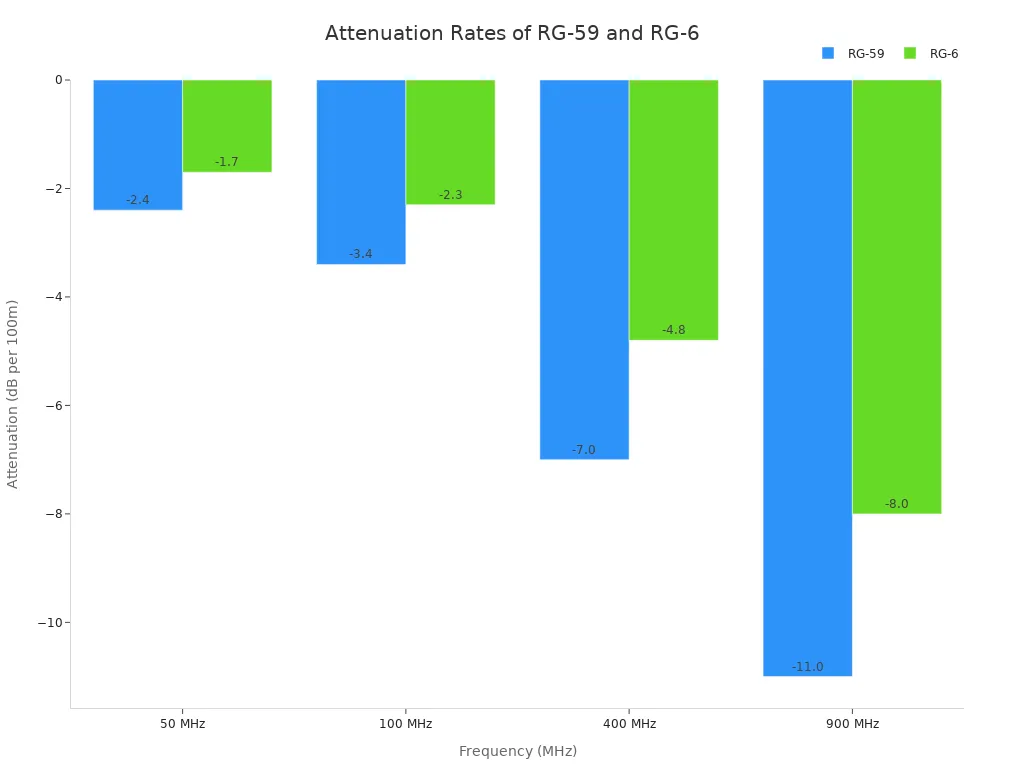
When you use rg6, you get lower signal loss at every frequency. This means your transmission stays strong, and you avoid problems like fuzzy video or slow internet. RG6’s low signal loss makes it the best choice for high-frequency transmission and long distances.
Let’s look at more technical details:
| Metric | RG6 | RG59 |
|---|---|---|
| Copper Core Cross-Section | 2.08mm² | 1.53mm² |
| Attenuation at 100MHz | 6.5dB/100m | 8.5dB/100m |
| Attenuation at 550MHz | 11.2dB/100m | 15.8dB/100m |
| Conductor Diameter | 18AWG | 20AWG |
- RG6 has a 36% larger copper core cross-section than rg59, which leads to lower signal loss.
- At 100MHz, rg6 shows 23% lower attenuation compared to rg59.
- At 550MHz, rg6’s attenuation is 41% lower than that of rg59.
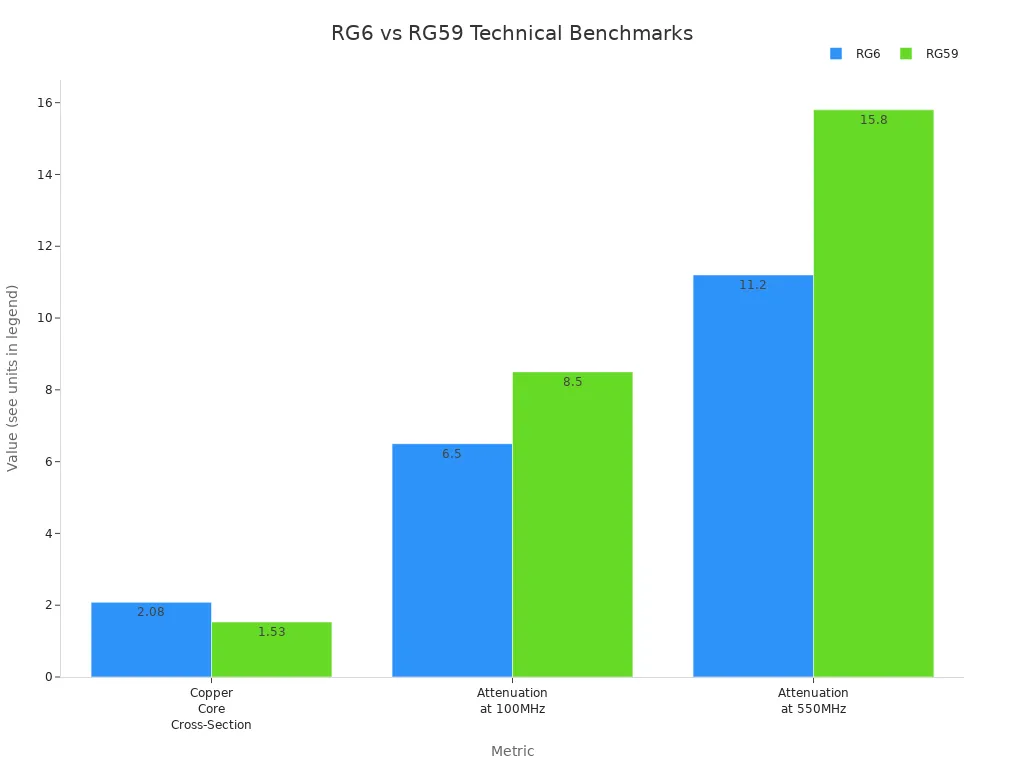
Engineering tests show that rg6 outperforms rg59 in high-frequency and long-distance transmission. You get low signal loss, strong transmission, and better results for your coaxial cable needs. If you want the best performance for your installation, choose rg6 for high-frequency transmission and long distances.
RG6 Coaxial Cable vs RG59 Coaxial Cable: Installation
Flexibility
When you install cables in your home or office, flexibility matters. RG6 coaxial cable has a thicker diameter, which makes it less flexible than RG59. You may find it harder to bend rg6 coaxial cable around corners or fit it into tight spaces. RG59 is easier to handle because it is thinner and more flexible. If you need to run cable through small holes or around sharp bends, RG59 gives you less trouble.
| Cable Type | Flexibility | Diameter | Installation Challenges |
|---|---|---|---|
| RG6 coaxial cable | Less flexible | Bulkier | Difficult in tight spaces |
| RG59 | More flexible | Smaller | Easier to handle and install |
You should think about the space where you want to install your cable. If you have narrow pathways or sharp turns, RG59 may fit better. RG6 coaxial cable works best in open areas or straight runs.
Compatibility
You want your cable to work with your devices. RG6 coaxial cable supports most modern TVs, satellite receivers, and internet modems. Many new devices need the higher bandwidth that rg6 coaxial cable provides. RG59 works with older analog systems and some CCTV cameras. If you use new equipment, you should choose rg6 coaxial cable for the best results. Always check the device specifications before you buy your cable.
Tip: RG6 coaxial cable matches most modern electronics, while RG59 fits older setups.
Cost
Cost can affect your decision. RG59 usually costs less than rg6 coaxial cable because it uses less material. You may save money if you only need a short cable run for a simple system. RG6 coaxial cable costs more, but it gives you better performance for high-frequency signals and longer distances. If you want reliable signal quality, spending a little more on rg6 coaxial cable makes sense.
You should balance your budget with your needs. If you want strong signals and future-proof installation, rg6 coaxial cable is worth the investment.
Choosing RG6 for Your Project
Home Use
You want your home entertainment and security systems to work smoothly. RG6 gives you strong performance for modern devices. When choosing the right coaxial cable, you should look at material quality and shielding. These features help you get clear signals for HD CCTV, satellite TV, and broadband internet. RG6 works well for long cable runs in multi-room homes. You can also use RG6 for digital audio and video distribution.
| Factors to Consider | Common Use Cases for RG6 |
|---|---|
| Material Quality | HD CCTV Systems |
| Shielding | Satellite and Cable TV |
| Application Scenarios | Broadband Internet |
| Long cable runs in commercial or multi-room buildings | |
| Digital audio and video distribution |
You get reliable connections and fewer interruptions when you select RG6 for your home.
Commercial Use
You need dependable cables for large buildings and business setups. RG6 supports high-frequency applications like satellite TV and broadband. It has lower attenuation and better shielding than RG59. You can run RG6 over longer distances without losing signal quality. RG59 works for short CCTV runs, but RG6 is better for most commercial installations.
| Coaxial Cable | Applications | Advantages |
|---|---|---|
| RG6 | High-frequency applications (satellite TV, broadband) | Lower attenuation, better shielding, supports longer runs |
| RG59 | CCTV systems, short-distance video | Flexibility, easy installation |
Choosing the right coaxial cable for commercial projects helps you avoid costly repairs and downtime.
Mistakes to Avoid
You want to avoid common errors when installing coaxial cables. Many people forget proper grounding, which can cause electrical noise and safety problems. Mixing different types of cables can lead to interference and poor data transmission. Skipping cable management accessories makes your setup messy and hard to maintain.
- Poor grounding practices can create electrical noise and safety risks. Always use qualified professionals for grounding.
- Mixing different types of cables may cause electromagnetic interference and affect data quality.
- Not using cable management accessories leads to clutter and makes maintenance difficult.
When choosing the right coaxial cable, you should consider mechanical specifications, signal protection, and environmental factors. You also need to check how easy it is to strip the cable and balance price with long-term performance.
Tip: Take time to match your cable type to your project needs. This helps you get the best results and saves you trouble later.
You usually get the best results with RG6 for modern installations. Most experts agree that RG6 offers better signal quality and works well for longer cable runs and modern TV or internet connections. Matching your cable to your needs helps you avoid interference and damage.
- Use RG59 for short, analog runs.
- Choose RG6 for high-frequency, long-distance, or digital setups.
Before you buy, follow these steps:
- Check device compatibility.
- Think about durability and installation.
- Pick the right cable type and size.
Take time to assess your project. You will enjoy reliable performance and clear signals.
FAQ
Can you use RG59 instead of RG6 for internet or cable TV?
You should not use RG59 for internet or cable TV. RG59 loses signal faster and cannot handle high frequencies. RG6 gives you better performance for these uses. Always pick RG6 for modern internet or cable TV setups.
How do you tell the difference between RG6 and RG59 cables?
You can check the thickness. RG6 cables look thicker than RG59. You may also see labels printed on the cable jacket. RG6 usually has a larger center conductor and more shielding.
Is RG6 compatible with older devices?
Yes, RG6 works with most older devices that use coaxial connections. You may need an adapter for some very old equipment. Always check your device’s connector type before you buy.
Does cable length matter when choosing RG6 or RG59?
Yes, cable length affects signal quality. Longer runs increase signal loss. RG6 handles long distances better than RG59. For cable runs over 100 feet, always choose RG6 to keep your signal strong.