Quick MPa to psi pressure conversion guide for 2025
You need to know two main formulas for pressure conversion: psi = MPa × 145.0377 and MPa = psi × 0.00689476. Use these formulas to switch between metric and imperial units quickly. Understanding both MPa and psi helps you make safe and efficient choices, especially in engineering and chemistry. Try easy examples or shortcuts for fast mpa to psi pressure conversion. Always check your numbers to avoid mistakes.
Key Takeaways
- Use the formula psi = MPa × 145.0377 to convert MPa to psi quickly.
- For psi to MPa conversion, apply the formula MPa = psi × 0.00689476.
- Always double-check your numbers to avoid mistakes in pressure calculations.
- Utilize online calculators for fast and accurate pressure conversions.
- Keep a conversion chart handy for quick reference during pressure measurement tasks.
MPa to psi pressure conversion
Formula
You often need to switch between MPa and psi when working with pressure. MPa stands for megapascal, which is a metric unit. Psi means pounds per square inch, and it is an imperial unit. You use the mpa to psi pressure conversion formula to change values from one system to another.
The conversion factor for mpa to psi is about 145.0377. This number comes from the relationship between metric and US customary units. The International Yard and Pound Agreement of 1959 helped set this standard. You also use the definitions of force and area, like pounds, kilograms, meters, and inches.
- The conversion factor for mpa to psi is 145.03773773.
- You multiply the MPa value by this conversion factor to get psi.
- The formula looks like this:
psi = MPa × 145.0377 - You use this formula for mpa to psi pressure conversion in many fields.
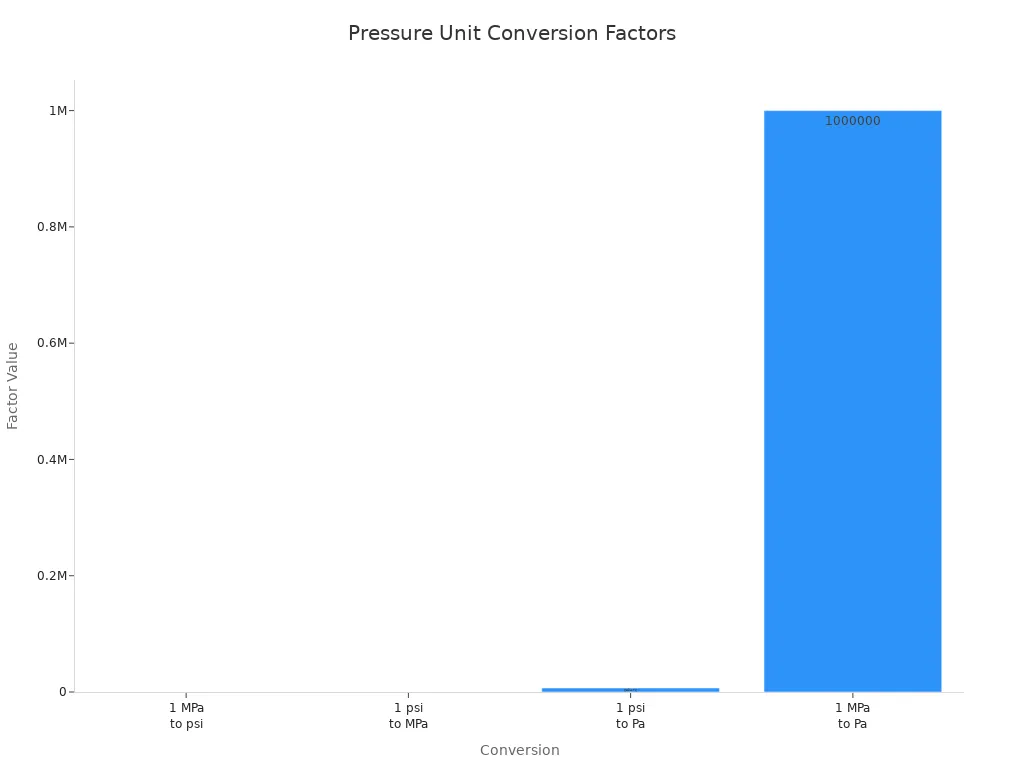
Here is a table that compares mpa to psi conversion factors with other pressure units:
| Pressure Unit | Conversion Factor |
|---|---|
| 1 MPa | 145.03773773 psi |
| 1 psi | 0.0068947573 MPa |
| 1 psi | 6,894.76 Pa |
| 1 MPa | 1,000,000 Pa |
In England and America, the unit of force was the pound and the unit for area was square inch, so the pressure unit became pounds per square inch (psi). In Continental Europe, the metric system uses the gram and meter, but g/m² was not practical, so kg/cm² and MPa became common.
You see mpa to psi pressure conversion in many real-world situations:
- Tire pressure uses psi in the US, but MPa in other countries.
- Hydraulic systems need mpa to psi conversion for safety checks.
- Material strength is measured in both MPa and psi.
- Pressure vessels use both units for compliance.
- Divers calculate underwater pressure in MPa and psi.
You can also look at this chart to see how different pressure units compare:
Example
Let’s walk through a step-by-step example of mpa to psi pressure conversion. You want to convert 8 MPa to psi.
- Write down the formula:
psi = MPa × 145.0377 - Plug in your value:
psi = 8 × 145.0377 - Multiply:
psi = 1,160.3016 - So, 8 MPa equals about 1,160.30 psi.
You can use this method for any mpa to psi conversion. If you need to convert mpa to psi quickly, you can use a mpa to psi converter online. These tools use the same conversion factor and help you avoid mistakes.
Here is another example for practice:
- You want to convert 15 MPa to psi.
- Use the formula:
psi = 15 × 145.0377 - Calculate:
psi = 2,175.566 - So, 15 MPa equals about 2,175.57 psi.
You see mpa to psi pressure conversion in many places. Engineers use it for pressure measurement in machines. Scientists use it for experiments. You use it for tire pressure checks. The mpa to psi converter makes your work easier and faster.
You should remember that MPa is a metric unit, and psi is an imperial unit. The conversion factors help you switch between them. Always use the correct conversion factor for accurate results.
psi to MPa conversion
Formula
You often need to convert psi to MPa when you work with pressure in science or engineering. Psi stands for pounds per square inch. MPa means megapascal. These two units come from different systems. Psi is part of the imperial system, while MPa belongs to the metric system. You use conversion factors to switch between them.
The main conversion factor for psi to MPa is 0.00689476. This means that one psi equals about 0.00689476 MPa. You can use this formula for quick and accurate results:
MPa = psi × 0.00689476
You should always use the correct conversion factors. Even a small mistake can cause big problems in pressure calculations. Accurate conversions help you avoid equipment failure and safety risks. Scientists and engineers rely on this formula to make sure their pressure measurements are correct. If you use the wrong number, you might damage equipment or create safety hazards.
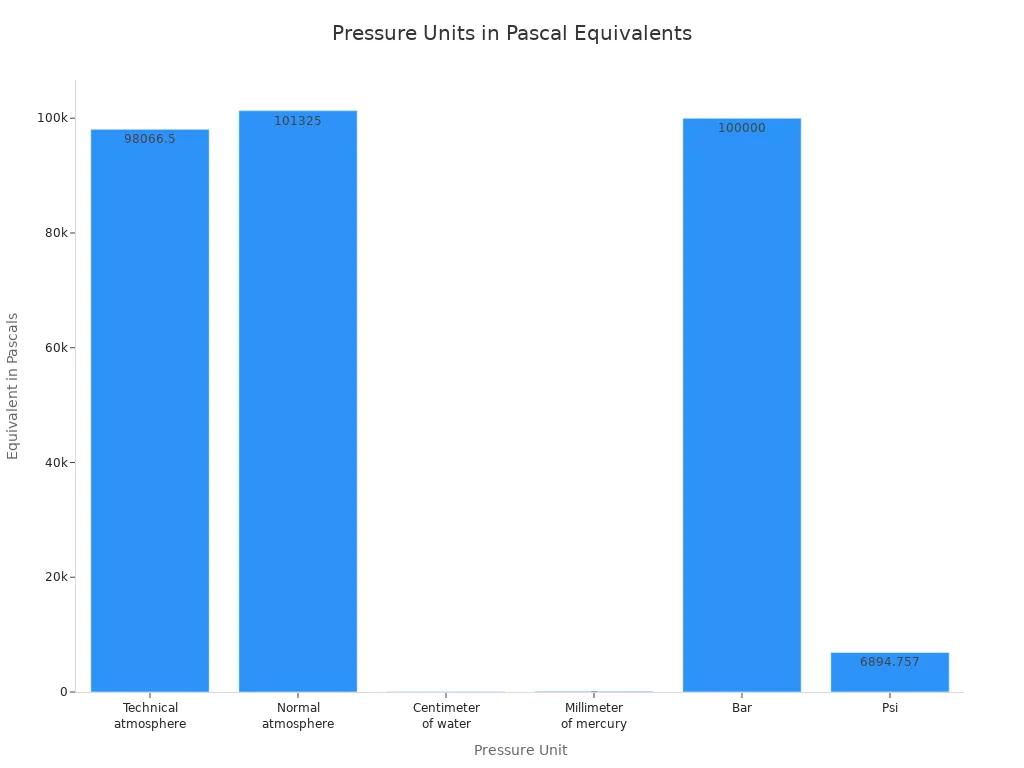
Here is a table that shows how different pressure units compare to pascals, which is the base unit for pressure in the metric system:
| Pressure Unit | Pascal Equivalent |
|---|---|
| Technical atmosphere | 98,066.5 Pa |
| Normal atmosphere | 101,325 Pa |
| Centimeter of water | 98.0638 Pa |
| Millimeter of mercury | 133.3224 Pa |
| Bar | 100,000 Pa |
| Psi | 6,894.757 Pa |
Tip: Always double-check your conversion factors before you start any pressure measurement. This habit helps you avoid costly errors.
You can also see how these units compare in the chart below:
Example
Let’s try a step-by-step example. Suppose you want to convert 500 psi to MPa.
- Write the formula:
MPa = psi × 0.00689476 - Plug in your value:
MPa = 500 × 0.00689476 - Multiply:
MPa = 3.44738 - So, 500 psi equals about 3.45 MPa.
You can use this method for any psi to MPa conversion. Many fields use this process, such as engineering, chemistry, and even dentistry. For example, dental materials often list their bond strength in both MPa and psi. This helps professionals compare products and make safe choices.
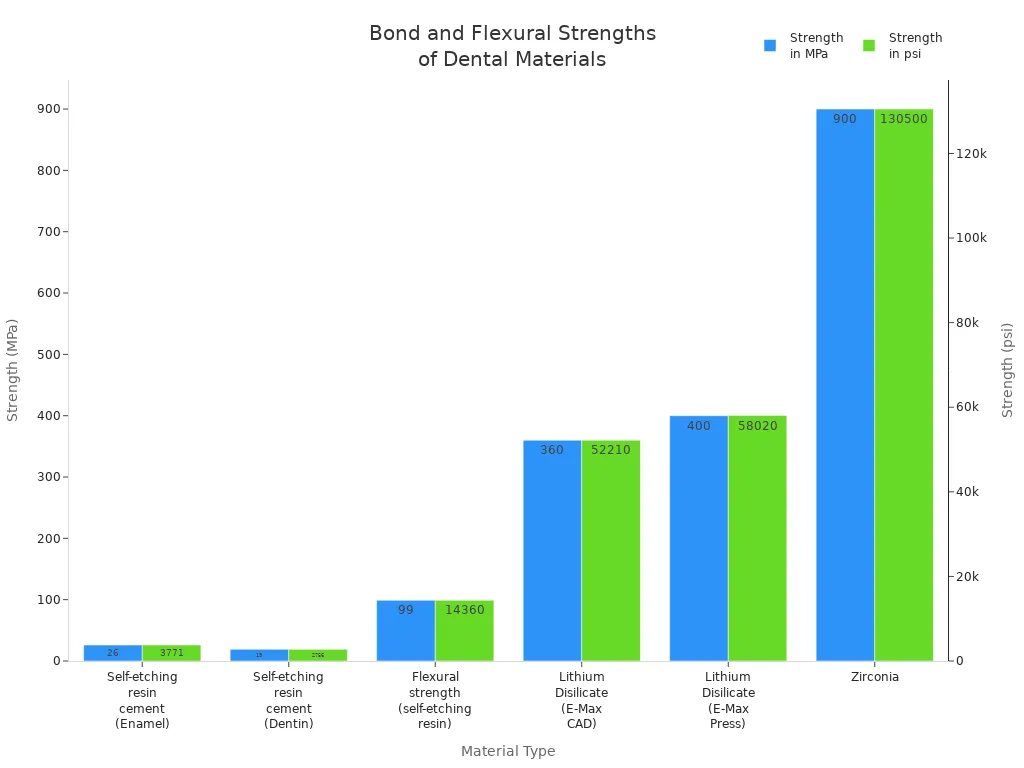
Here is a table that shows the bond strength of different dental materials in both units:
| Material Type | Bond Strength (MPa) | Bond Strength (psi) |
|---|---|---|
| Self-etching resin cement (Enamel) | 26 | 3,771 |
| Self-etching resin cement (Dentin) | 19 | 2,756 |
| Flexural strength (self-etching resin) | 99 | 14,360 |
| Lithium Disilicate (E-Max CAD) | 360 | 52,210 |
| Lithium Disilicate (E-Max Press) | 400 | 58,020 |
| Zirconia | 900 | 130,500 |
You can see how important it is to use the right conversion factors. This table shows that the same material can have very different numbers, depending on the unit. If you use the wrong formula, you might get the wrong answer.
Here is a chart that compares the bond and flexural strengths of dental materials in MPa and psi:
Note: Psi and MPa measure the same thing—pressure—but they come from different systems. Psi uses pounds and inches. MPa uses newtons and meters. You need to know both for global work.
You now know how to convert psi to MPa. Use the formula, check your conversion factors, and always double-check your work. This will help you get accurate pressure results every time.
Unit conversion table

When you work with pressure, you often need to switch between different units. A unit conversion table helps you find the right value quickly. You can use this table for fast reference during pressure measurement tasks. This section gives you a simple mpa to psi conversion chart and also shows how to convert psi back to MPa.
MPa to psi
You may need to convert MPa to psi when you read technical documents or check equipment. The table below shows common values. You can use it to save time and avoid mistakes.
| MPa | psi |
|---|---|
| 0.1 | 14.50 |
| 0.5 | 72.52 |
| 1 | 145.04 |
| 2 | 290.08 |
| 5 | 725.19 |
| 10 | 1,450.38 |
| 20 | 2,900.75 |
| 50 | 7,251.89 |
Tip: You can print this mpa to psi conversion chart and keep it near your workspace for quick checks.
psi to MPa
Sometimes you need to convert psi to MPa, especially if you work with international standards. The table below gives you the most common conversions. You can use these numbers to make sure your pressure readings are correct.
| psi | MPa |
|---|---|
| 10 | 0.07 |
| 50 | 0.34 |
| 100 | 0.69 |
| 200 | 1.38 |
| 500 | 3.45 |
| 1,000 | 6.89 |
| 2,000 | 13.79 |
| 5,000 | 34.47 |
You can see how easy it is to use a unit conversion table for pressure. These tables help you avoid errors and speed up your work. If you want to check more values, you can use online tools or calculators. Remember, accurate conversions keep your pressure measurement safe and reliable.
Conversion tips and mistakes
Online tools
You can save time and avoid errors by using online calculators for pressure conversions. These tools help you switch between MPa and psi quickly. Many professionals rely on them for accurate results. You find several reliable options in 2025:
- West Yorkshire Steel offers a unit conversion calculator for yield or tensile values, including MPa to psi. This tool helps you check pressure values for engineering tasks.
- Kyle's Converter specializes in pressure conversions from MPa to psi. You can use it for fast and simple calculations.
Online calculators make your work easier. You enter your value, select the units, and get the result instantly. You do not need to memorize conversion factors or formulas. These tools reduce the risk of mistakes and help you focus on your main task.
Tip: Always check that the calculator uses the latest conversion factors. This ensures your pressure readings stay accurate.
Common errors
You may face mistakes when converting between MPa and psi. These errors can lead to wrong pressure readings and unsafe results. You can avoid most problems by following a few simple steps.
Common mistakes include:
- Entering the wrong unit. Make sure you use psi, not another pressure unit.
- Typing extra zeros or missing decimals. Always check your number before you convert.
- Reading the wrong result. Some tools show many units. Pick the bar value, not kPa or MPa.
- Forgetting to clear old values. Start fresh each time for the best results.
- Calculator malfunctions. Verify your digital converter before you start.
You can use this table to help avoid common mistakes:
| Mistake | How to Avoid |
|---|---|
| Wrong unit | Check labels before typing |
| Extra zeros/decimals | Review your input carefully |
| Wrong result | Read the bar field only |
| Old values | Clear before new conversion |
You should double-check your calculations every time. Cross-verify results with more than one converter if possible. Rounding errors can change your pressure value, so keep your numbers precise. Understanding psi units helps you interpret results correctly. You improve safety and accuracy by following these tips.
You now know the formulas for converting MPa to psi and psi to MPa. Use these steps to get quick and accurate results. Reliable tools and double-checking your work keep pneumatic tools safe and prevent damage.
- Accurate pressure measurement protects equipment and people.
- Regular calibration and trusted calculators help you avoid mistakes.
Want to help others?
- Share this guide if you found it useful.
- Leave a comment with your questions or tips.
Your feedback makes this guide better for everyone.
FAQ
What is the fastest way to convert MPa to psi?
You can multiply the MPa value by 145.0377. This gives you the pressure in psi. You can also use an online calculator for quick results.
Why do some countries use MPa and others use psi?
Countries that use the metric system prefer MPa. The United States and a few others use psi. You may see both units in international projects.
Can I use a calculator for pressure conversions?
Yes. Many online calculators help you convert between pressure units. You just enter your value and select the units you need.
How do I avoid mistakes when converting pressure units?
You should double-check your numbers. Always use the correct formula. Make sure you read the result in the right unit.
Where do I see pressure units like MPa and psi in real life?
You see these units on tire gauges, hydraulic machines, and engineering reports. They help you measure and compare pressure safely.