How Pulse Code Modulation Audio Became the Backbone of Digital Sound
You experience digital sound every day, but have you wondered how music or voices transform into a format your devices understand? Pulse code modulation audio acts like a translator, turning the waves of analog sound into digital language your computer can process. This process uses precise sampling and quantization, ensuring your audio stays clear and detailed.
Recent market analysis shows that pulse code modulation audio powers high-fidelity sound in everything from smartphones to car infotainment systems.
| Step | What Happens |
|---|---|
| Sampling | Captures sound at regular intervals |
| Quantizing | Assigns digital values to each sample |
| Encoding | Converts values into binary format |
Curiosity leads you to discover the technology behind every audio experience, making you appreciate the science of digital audio.
Key Takeaways
- Pulse code modulation (PCM) turns analog sound into digital signals by sampling, quantizing, and encoding, making audio clear and easy to store or share.
- PCM provides high-quality, noise-resistant audio used in phones, music CDs, streaming, and broadcasting for reliable sound.
- The process includes filtering out unwanted frequencies, capturing sound details at regular intervals, and converting them into binary code.
- PCM files are large and need more bandwidth, but compression methods like ADPCM help reduce size while keeping good sound quality.
- PCM remains essential in modern audio technology and will continue improving sound quality in devices and streaming services.
Why Pulse Code Modulation Audio Matters
Digital Sound Foundation
You rely on pulse code modulation audio every time you listen to music or make a call on your phone. This technology forms the backbone of digital sound. Pulse code modulation takes the smooth waves of analog audio and turns them into a series of numbers. These numbers become the digital code that your devices can store, process, and play back with high fidelity.
The Redbook CD standard uses linear pulse code modulation (LPCM) as its audio format, demonstrating PCM's critical role in the standardization and widespread adoption of digital audio playback.
Pulse code modulation began changing the world of sound in the late 1930s.
- In 1938, a British telephone engineer invented pulse code modulation, creating the first way to turn analog audio into digital data.
- By the 1970s, digital audio recordings appeared, and PCM became the accepted method for professionals.
- The first digitally recorded pop album, "Bop 'Til You Drop," used PCM in 1979.
- PCM technology led to the development of CDs, streaming, and even MP3s.
Pulse code modulation audio digitizes sound by sampling it at regular intervals and assigning each sample a numeric value. This process allows you to enjoy music and speech with clarity and detail. The digital format also makes it easy to copy, edit, and share audio without losing quality.
Reliable Audio Conversion
You want your music and calls to sound clear every time. Pulse code modulation ensures this by converting analog signals into digital form with accuracy. The process uses three main steps: sampling, quantizing, and encoding. Each step helps capture the original sound and turn it into a digital signal.
- PCM converts analog signals to digital by sampling, quantizing, and encoding, which ensures discrete digital representation of continuous signals.
- Sampling rate is critical; higher rates (like 44 kHz for CDs) improve accuracy and audio quality.
- Quantizing rounds amplitudes to discrete levels, enabling binary encoding, though it introduces minimal quantization error.
- Digital signals reduce noise and distortion compared to analog, preserving audio integrity during conversion and playback.
Pulse code modulation stands out because it resists noise. Digital signals use pulses of equal height, so even if the signal gets distorted, repeaters can restore it perfectly. This means you hear your audio as it was meant to sound, with high fidelity and little interference. Pulse code modulation audio remains the trusted method for reliable, high-quality digital audio in modern systems.
Pulse Code Modulation Process
Pulse code modulation lets you turn real-world sounds into a digital format that computers and devices can understand. You can break down the process into three main steps: low-pass filtering, sampling and quantization, and encoding to binary. Each step plays a key role in making sure the digital audio you hear is clear and accurate.
Low-Pass Filtering
Before you sample any sound, you need to prepare the signal. Low-pass filtering removes high-frequency parts of the analog audio that could cause problems. If you skip this step, unwanted frequencies might sneak in and create distortion or strange noises in your digital recording.
Think of low-pass filtering as a way to clean up the sound before you capture it. You only keep the important frequencies that your ears can hear. This step helps prevent a problem called aliasing, which happens when high frequencies get mixed up with lower ones during sampling.
Sampling and Quantization
Once you have a clean signal, you move to sampling. In pulse code modulation, sampling means measuring the loudness of the sound at regular intervals. The number of samples you take each second is called the sampling rate. For example, CD-quality audio uses a sampling rate of 44,100 samples per second. A higher sampling rate lets you capture more detail and higher frequencies, making the digital sound closer to the original.
Quantization comes right after sampling. Here, you round each measured value to the nearest step on a digital scale. The number of steps depends on the bit depth. More steps mean you can capture softer and louder sounds with more accuracy. For example, 16-bit quantization gives you 65,536 possible levels. This step introduces a tiny error called quantization noise, but with enough levels, you barely notice it.
The combination of sampling and quantization in pcm lets you capture the full range of music, speech, or any sound you want to digitize. You balance quality and file size by choosing the right sampling rate and bit depth.
Encoding to Binary
After quantization, you need to turn those numbers into a language that computers understand. Encoding changes each quantized value into a string of 1s and 0s, which is the binary code used in digital systems. This step is what makes pulse code modulation so powerful. You can now store, copy, or send your audio anywhere without losing quality.
You might see different encoding schemes in pcm. Linear pcm uses evenly spaced steps, while other methods like u-law and a-law compress the data to save space, especially in telephony. No matter the method, the goal stays the same: represent the original sound as accurately as possible in digital form.
- Common Encoding Schemes in PCM:
- Linear pcm (LPCM): Uses equal steps for all values.
- u-law: Compresses audio for efficient transmission, used in the US.
- a-law: Similar to u-law, used in Europe and other regions.
When you listen to music on a CD or stream a song online, you enjoy the results of pulse code modulation. The process ensures that every note and word reaches your ears with clarity, thanks to careful filtering, precise sampling, and smart encoding.
Pulse code modulation stands as the backbone of digital audio because it captures, processes, and delivers sound with high fidelity. Each step—filtering, sampling, quantization, and encoding—works together to give you a digital copy that stays true to the original analog signal.
PCM Advantages and Challenges
High Fidelity and Noise Immunity
You want your music and voice calls to sound clear and lifelike. PCM gives you this clarity by turning analog sound into digital samples. Each sample captures the sound’s loudness at a moment in time. The bit depth of pcm, like 16-bit for CDs or 24-bit for studios, lets you hear quiet and loud parts without extra noise. The sample rate, such as 44.1 kHz for CDs, ensures you hear all the important details.
Pulse code modulation stands out because it resists noise better than analog systems. When you use pcm, you get a high signal-to-noise ratio. This means you hear more of the music and less of the hiss or static. Digital signals do not fade or pick up interference as easily as analog ones. That is why pcm is trusted for space communication and telephony, where clear sound matters most.
PCM’s digital encoding keeps your audio safe from distortion, even over long distances. You can rely on it for high-resolution sound in professional and home audio.
Bandwidth and Complexity
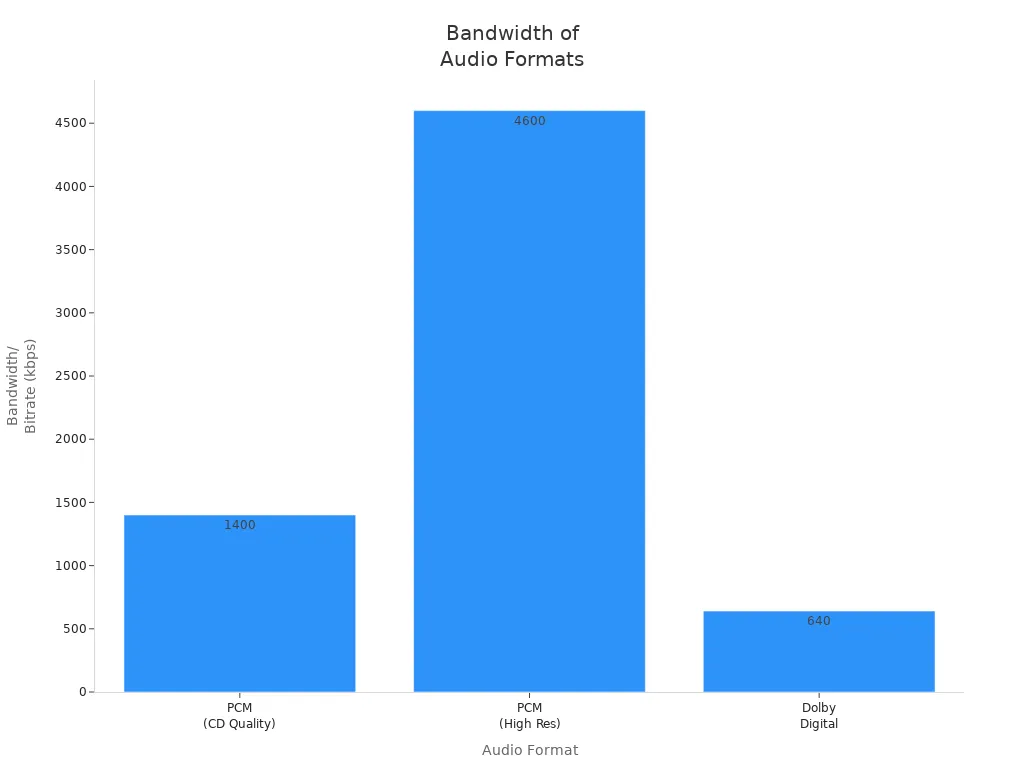
PCM gives you great sound, but it comes with a cost. Because pcm does not compress the audio, it needs a lot of bandwidth and storage. For example, CD-quality pcm uses about 1.4 Mbps. High-resolution sound with higher sample rates and bit depths needs even more. This makes pcm less practical for streaming or mobile devices.
| Audio Format | Sampling Rate & Bit Depth | Channels | Bandwidth / Bitrate | File Size (approx.) | Notes |
|---|---|---|---|---|---|
| PCM (CD Quality) | 44.1 kHz / 16-bit stereo | 2 (stereo) | ~1.4 Mbps | ~10 MB per minute | Uncompressed, high fidelity, large file size |
| PCM (High Res) | 96 kHz / 24-bit stereo | 2 (stereo) | ~4.6 Mbps | ~34 MB per minute | Even higher quality, much larger files |
| Dolby Digital | Compressed (lossy) | 5.1 | 384-640 kbps | Much smaller | Lower quality, but easier to stream |
You also face technical challenges with pcm. The process of sampling, quantizing, and encoding needs advanced hardware and software. Large-scale pcm systems can be hard to manage. Older pcm protocols use many pins and wires, which adds to the hardware complexity. Newer solutions like SoundWire® help reduce this, but testing and scaling up still take effort.
- PCM systems require:
- High bandwidth for transmission, especially with high-quality audio.
- Complex hardware for sampling and encoding.
- Careful management of quantization noise.
Compression and Variants
To solve the problem of large file sizes, engineers created new ways to make pcm more efficient. Differential pulse code modulation (DPCM) and adaptive DPCM (ADPCM) do not store every sample. Instead, they save the difference between samples. This reduces the bit rate and saves space. ADPCM goes further by changing the step size based on the sound, making compression even better.
- DPCM and ADPCM:
- Lower the bit rate by encoding differences, not full values.
- Use prediction to guess the next sample, then store only the change.
- ADPCM adapts to the sound, giving better results for speech and music.
Delta modulation is another simple form. It uses just one bit per sample but can lose detail if the sound changes quickly. These methods help you balance quality and file size. They make pcm practical for phones, streaming, and other uses where space and speed matter.
Compression techniques let you enjoy pcm audio on more devices, even when bandwidth is limited. You get the benefits of pulse code modulation with less storage and faster transmission.
Pulse Code Modulation Audio Applications
Telephony and VoIP
You use pcm every time you make a phone call or join a video chat. Telephony and VoIP systems rely on pcm to deliver clear voice communication. The G.711 codec, based on pcm, is a standard in phone networks. It provides toll-quality audio at 64 kbps, which means you hear voices with high clarity. Most VoIP providers choose G.711 because it works well with existing phone systems and keeps things simple.
- pcm in telephony and VoIP:
- Delivers high-quality, uncompressed audio.
- Ensures compatibility across different networks.
- Simplifies the process of connecting calls between old and new systems.
You benefit from pcm because it keeps your conversations crisp and easy to understand. The technology also supports wideband codecs like G.722, which offer even better sound for modern calls.
Music and CDs
When you listen to music on a CD, you experience the power of pcm. Music producers use pcm because it captures every detail of a performance. This format does not lose any audio data, so you hear the music exactly as it was recorded. CDs and DVDs use pcm as their main audio format, making sure you get consistent, high-quality sound.
- Why pcm is used in music and CDs:
- Uncompressed and lossless, so no sound is lost.
- Supports up to 8 channels for complex audio setups.
- Preferred by professionals for its accuracy.
PCM set the standard for digital music. It made it possible to move from analog tapes to digital discs, giving you noise-free, durable audio that lasts for years.
Streaming and Broadcasting
Streaming platforms and broadcasters use pcm in many ways. In studios, pcm records and mixes audio with the highest quality. When you watch a live concert or a sports event, pcm helps deliver sound with low delay, so everything stays in sync. However, pcm files are large and need a lot of bandwidth. For this reason, streaming services often use compressed formats for delivery, but they still rely on pcm during production and archiving.
- pcm in streaming and broadcasting:
- Preserves original sound for professional work.
- Offers universal compatibility with devices like Blu-ray players and TVs.
- Supports multi-channel audio for surround sound experiences.
You notice the difference when you hear a live performance or a high-resolution track. pcm keeps the audio true to the source, even if other formats are used for streaming to save space.
Pulse code modulation continues to shape your digital audio experiences. You trust PCM because it delivers reliable, high-quality sound in music, calls, and streaming. Today, you see new advancements like:
- Noise shaping and machine learning for better audio quality
- Oversampling and delta-sigma modulation for higher fidelity
- Low-power PCM for energy-efficient devices
- Support for high-resolution formats in modern gadgets
Experts believe PCM will stay at the heart of digital sound. You can expect even richer, more detailed audio as technology evolves, from wireless headphones to next-generation streaming.
FAQ
What does PCM stand for in audio?
PCM stands for Pulse Code Modulation. You use PCM to turn analog sound into digital signals. This process lets your devices store and play music, speech, and other audio with high quality.
Why do CDs use PCM audio?
CDs use PCM because it gives you clear, uncompressed sound. You hear music as it was recorded, without losing detail. PCM helps CDs deliver reliable audio that lasts for years.
Is PCM better than MP3 for sound quality?
You get higher sound quality with PCM because it does not compress audio. MP3 uses compression to save space, which can remove some details. Choose PCM for the best listening experience.
Can you stream PCM audio online?
You can stream PCM audio, but it needs a lot of bandwidth. Most streaming services use compressed formats to save space. Studios and broadcasters use PCM for recording and editing before streaming.