Is the LM393 Right for Your Electronics Hobby?
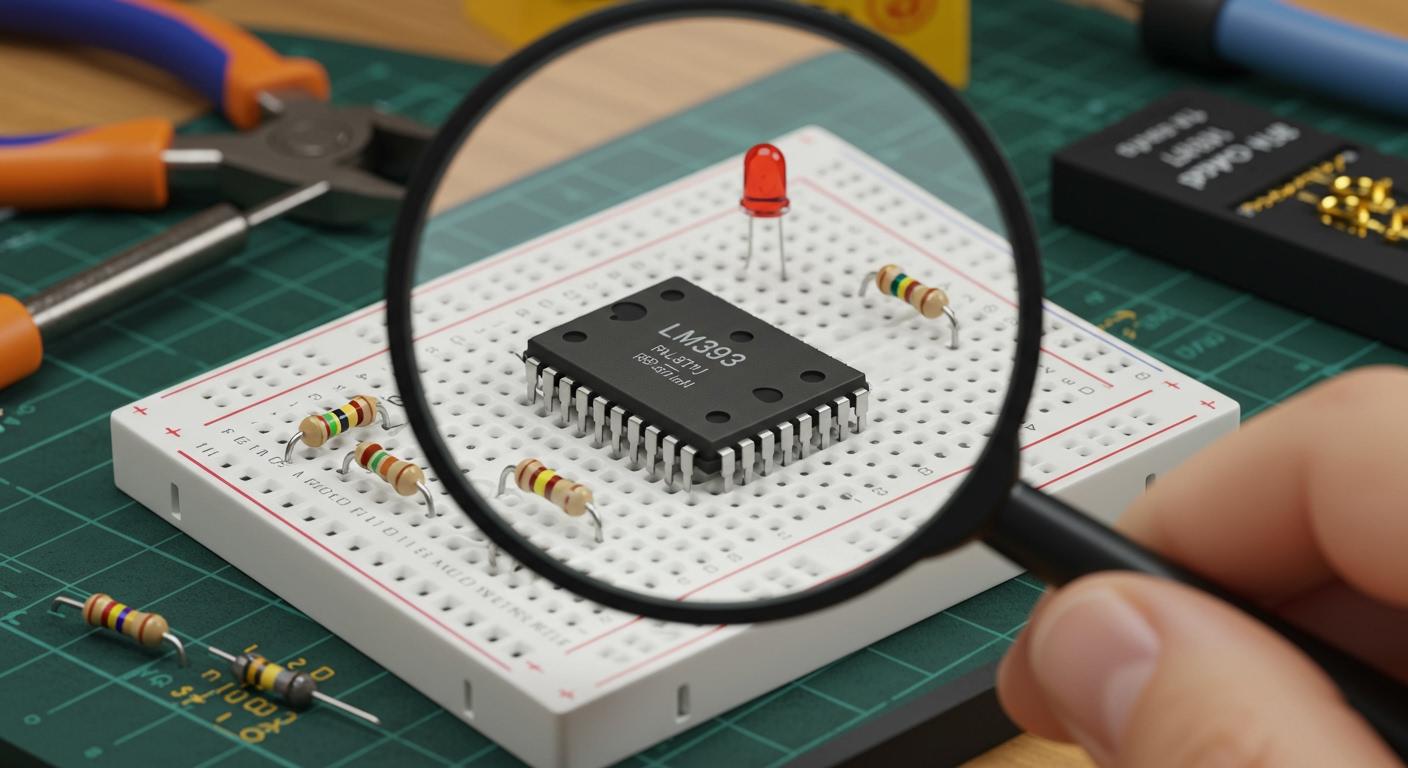
Answering your question directly, the LM393 integrated circuit is a fantastic choice for many hobby projects. You will find this low-cost voltage comparator IC is a true workhorse. It excels in simple tasks like sensor triggers, battery level indicators, and basic oscillators. You can often find a single LM393 dual-voltage comparator IC for under a dollar, with sites like Soldered.com listing it for $0.85. However, this comparator is the wrong tool for high-speed signal processing or high-precision measurement. The LM393 IC is not designed for tasks that require a fast response or extreme accuracy in a circuit.
Key Takeaways
- The LM393 is a cheap and useful chip. It works well for simple tasks like turning things on or off.
- This chip uses little power. It can run on many different voltages, from 2V to 36V.
- The LM393 has an 'open-collector' output. You must add a pull-up resistor for it to work right.
- The LM393 is not for fast signals or very exact measurements. It is also not an op-amp.
- You can use the LM393 for projects like light-activated switches. Do not use it for audio circuits.
Key Advantages of the LM393
The LM393 integrated circuit has earned its place in every hobbyist's parts bin for several excellent reasons. You will find its combination of low cost, efficiency, and flexibility makes it a go-to component for a wide range of projects. Let's explore the key advantages that make this voltage comparator so popular.
Low Cost and Availability
One of the biggest draws of the LM393 IC is its incredibly low price. You can experiment without worrying about damaging an expensive component. This makes it perfect for beginners learning circuit design or for building projects on a tight budget. You can easily find this IC from various suppliers. For example, you can find it on sites like ProtoSupplies.com for as little as $0.59 per unit. Other hobbyist-focused stores like Soldered.com also stock the LM393, confirming its popularity for electronic projects. This widespread availability means you can get your hands on one quickly and affordably.
Low Power Consumption
Are you building a battery-powered device? The LM393 is an excellent choice. This IC is designed for efficiency and draws very little current to operate. Its low power consumption is largely independent of the supply voltage, a key feature noted in its datasheet. This means your batteries will last much longer, making it ideal for portable sensors, alarm circuits, and other applications where power conservation is critical. 🔋
Flexible Power Supply
The LM393 offers fantastic power supply flexibility. It can run on a single power supply with a voltage anywhere from 2V to 36V. This wide range is a massive advantage for you as a hobbyist.
- It works with 3.3V systems like the Raspberry Pi or ESP32.
- It is compatible with 5V systems like the Arduino Uno.
- It can operate in 12V or 24V automotive or industrial circuits.
This flexibility means you can use the same comparator IC across different projects without needing separate voltage regulators just for the comparator itself. The LM393 IC simplifies your design process.
Versatile Open-Collector Output
The output stage of the LM393 is perhaps its most powerful feature. It uses an "open-collector" design. This means the output pin can pull a signal down to ground (LOW), but it cannot push it up to a positive voltage (HIGH). To get a HIGH signal, you must add an external "pull-up" resistor. While this is an extra component, it unlocks a huge benefit: voltage level shifting.
This feature allows the LM393 IC to interface between different voltage domains easily. You can use a low-voltage signal to control a high-voltage device safely.
Practical Example: Controlling a 12V Relay with a 5V Signal
Imagine you want your 5V Arduino to turn on a 12V motor using a relay. You can't connect the relay directly. The LM393 IC provides a perfect solution for these applications.
- You power the LM393 with 5V.
- You connect its output through a pull-up resistor to a 5V rail.
- This 5V output signal then drives a transistor (like a BC547).
- The transistor acts as a switch for the separate 12V circuit, turning the relay on and off.
In this setup, the comparator acts as a bridge, safely isolating your delicate 5V logic from the powerful 12V circuit. This is one of the most common and useful applications for this chip.
Limitations of the LM393 IC
While the LM393 is a powerful tool, knowing its limitations is key to avoiding frustration in your projects. You should see these points not as deal-breakers, but as important characteristics to be aware of. Understanding them will help you use this IC correctly and effectively.
Relatively Slow Response Time
You might see the term "slow" associated with the LM393, which can be confusing. Its response time is actually quite fast for a general-purpose comparator, typically around 1.3 microseconds (µs). This is more than enough for tasks like detecting a light level change or monitoring a battery voltage.
However, this speed is not sufficient for high-frequency applications. You should not use the LM393 IC for:
- Processing audio signals.
- Comparing fast-switching PWM signals.
- Working with high-speed digital data.
For those tasks, you would need a much faster, dedicated high-speed comparator. For most simple trigger circuits, the LM393 is perfectly adequate.
Requires a Pull-Up Resistor
The versatile open-collector output we discussed earlier comes with a requirement: you must add an external pull-up resistor to get a HIGH output signal. Without it, the output pin can only pull the voltage LOW (to ground) or float in a high-impedance state. This is a very common point of confusion for beginners.
A hobbyist once asked, "I realized a very simple schematic using the LM393N but the output is never V-, it's always in high impedance and R5 pulls it to +5V! Is there anybody can show me what I did wrong?"
This user's experience is a classic example of how the open-collector output works. The pull-up resistor is what pulls the voltage HIGH when the comparator's internal transistor is off. This is a feature, not a flaw, but it is an essential design step you cannot skip.
So, what value resistor should you use? A good general-purpose range for the pull-up resistor is between 1 kΩ and 100 kΩ. A common choice for 5V logic is a 10 kΩ resistor. The ideal value depends on your specific circuit, but starting with 10 kΩ is a safe bet for most hobbyist applications.
Not for High-Precision Tasks
The LM393 is a budget-friendly IC, and its precision reflects that. While it performs well for its price, it is not the right tool for high-accuracy measurement instruments. The datasheet for the LM393 IC specifies certain small errors:
- Low input bias current: Typically around 25nA.
- Low input offset current: Typically around 5nA.
These values are impressively low and mean the IC draws very little current from your input sources. However, the input offset voltage (the small voltage difference needed at the inputs to force the output to switch) can be a few millivolts. For a simple threshold detector, this is perfectly fine. But if you are trying to build a precise digital voltmeter, these small errors will affect your readings. You would need a more expensive, precision comparator for that kind of application.
It Is Not an Op-Amp
This is the most important limitation to understand. ⚠️ You cannot use an LM393 as an operational amplifier (op-amp). Although the schematic symbol looks similar, their internal designs and purposes are completely different.
An LM393 comparator is designed to be fast and run "open-loop" (without feedback), making it unstable if you try to use it in a typical op-amp feedback circuit. If you connect the output back to the inverting input (negative feedback) to build an amplifier, it will not work. The LM393 IC lacks the internal frequency compensation needed for stability in such a configuration. Instead of amplifying, it will likely oscillate or behave unpredictably.
The internal architecture of this comparator IC is optimized for comparison, not linear amplification. Look at how it differs from a typical op-amp.
| Feature | LM741 (Op-Amp) | LM393 (Comparator) |
|---|---|---|
| Output Stage | Push-pull design to source and sink current. | Open-collector design to only sink current. |
| Internal Design | Compensated for stability in feedback loops. | Uncompensated for maximum speed. |
| Primary Use | Amplification, filtering, and signal processing. | Comparing two voltages (A > B?). |
If you find your lm393 circuit is oscillating, you may need to add hysteresis. You can achieve this with positive feedback (connecting a resistor from the output to the non-inverting +IN pin). This technique is crucial for creating clean switching behavior, especially with noisy input signals. Learning concepts like hysteresis is a key step in mastering components like the lm393.
Practical Project Examples

Theory is great, but seeing the LM393 IC in action is better. This versatile IC is perfect for many simple and useful applications. You can build a wide range of projects without needing a complex microcontroller. Some popular beginner-friendly applications include:
- A sensor-controlled pump circuit that turns a motor on or off.
- A simple carbon monoxide alarm that triggers a buzzer.
- A delay-off timer circuit to keep a light on for a set period.
Let's look at a great example and a poor one to help you understand its best uses.
Ideal Use: A Light-Activated Switch
A light-activated switch is a perfect first project for the LM393 IC. In this circuit, you use a Light Dependent Resistor (LDR) to sense the ambient light level. The LM393 comparator then compares the LDR's voltage to a fixed reference voltage. When the light drops below a certain point, the comparator output switches, turning on an LED or a relay.
Tip: Many LM393 modules include a small potentiometer. You can use this knob to adjust the circuit's sensitivity. Turning it one way makes the circuit trigger in lower light, while turning it the other way requires more darkness. This adjustment changes the reference voltage for the comparator.
Poor Use: A High-Frequency Audio Circuit
You should not use the LM393 IC for audio applications. While it is a fast comparator, it is not designed to handle the high frequencies and continuous changes of an audio signal. If you try to build an audio amplifier or filter with this IC, it will not work correctly. The output will likely be distorted or the circuit will oscillate. For audio projects, you need an operational amplifier (op-amp), not a comparator.
Using the Comparator IC in a Circuit
When you build your comparator circuit, you will work with the 8-pin LM393 IC. The key pins you need to know are:
- VCC (Pin 8): Your positive power supply.
- GND (Pin 4): Your connection to ground.
- IN- and IN+ (Pins 2 & 3): The two voltage inputs you want to compare.
- Output (Pin 1): The result of the comparison.
This IC actually contains two independent comparators. If you only use one, you must handle the unused pins correctly.
To ensure stable operation, you should connect any unused input and output pins of the second comparator to ground.
Following these simple rules will help you succeed with your LM393 applications.
The lm393 ic is an essential IC for your electronics toolkit. This low-cost comparator excels in simple, low-speed comparison tasks. Always remember its two main quirks: its response time and the need for a pull-up resistor. Knowing when to use this lm393 ic is a key step in becoming a more skilled builder.
For a successful circuit, you should always use bypass capacitors near the power pins of the ic. This simple step helps ensure your lm393 ic comparator provides a stable output. Mastering this versatile lm393 ic will improve your projects.
FAQ
What is the main difference between an LM393 and an op-amp?
You should use an LM393 for comparing voltages. It gives a HIGH or LOW output. You should use an op-amp for amplifying signals. This ic is not designed for amplification and will not work correctly in those circuits.
Why is my LM393 output always HIGH?
Your output is likely always HIGH because you are missing a pull-up resistor. The LM393 has an open-collector output. It needs an external resistor connected to your positive voltage supply to create a HIGH signal.
Can I power the LM393 with a 9V battery?
Yes, you can easily power the LM393 with a 9V battery. This ic works with a wide voltage range, from 2V up to 36V. A 9V battery fits perfectly within this range, making it great for portable projects.
What happens if I don't connect the unused comparator?
You should not leave the inputs of the unused comparator floating. This can cause instability and increase power consumption.
Best Practice: Connect the inputs of the unused comparator to ground (GND) to ensure stable operation.