Photoelectric Cells Definition and Key Concepts
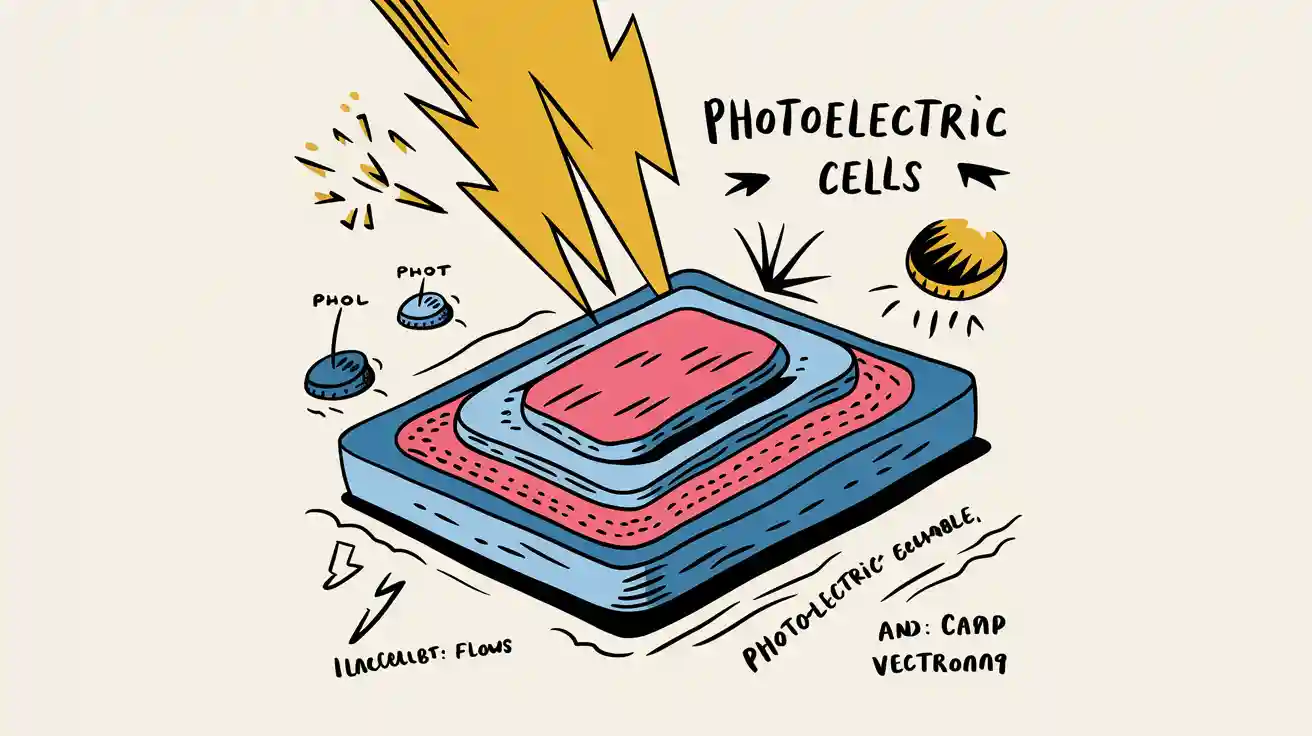
A photoelectric cell detects light and changes it into electric current. You may see these devices called photocells or photodetectors.
- It works by absorbing light and releasing electrons, which creates an electric current you can measure or use.
- You find photoelectric cells in many areas, from medical devices to solar panels.
| Market Size (2024) | Projected Market Size (2033) | CAGR (2023-2030) |
|---|---|---|
| USD 10.5 billion | USD 20.2 billion | 6.2% |
Key Takeaways
- Photoelectric cells convert light into electricity by releasing electrons when light hits them. This process is essential for many devices, including solar panels and automatic doors.
- Different materials, like silicon and cadmium telluride, affect the efficiency of photoelectric cells. Choosing the right material can improve performance based on your needs.
- The photoelectric effect is crucial for how these cells work. It allows light energy to create an electric current, which powers various technologies.
- Photoelectric cells and solar cells both use light to generate energy, but they serve different purposes. Photoelectric cells detect light, while solar cells produce electricity from sunlight.
- Understanding how photoelectric cells operate can help you select the best type for your projects, whether for sensing light or generating power.
Photoelectric Cell Basics
Definition of Photoelectric Cell
You use a photoelectric cell to detect light and turn it into electricity. Scientists and engineers often call this device a photocell or photodetector. When light hits the cell, it releases electrons. These electrons create an electric current that you can measure or use in a circuit.
You might see other names for photoelectric cells. The table below shows some common terms and their meanings.
| Alternative Name | Definition |
|---|---|
| photocell | An electronic device that changes its electrical output based on the strength of incoming light. |
| photovoltaic cell | Another term for photoelectric cell, used to generate electrical power from light. |
| solar cell | A type of photovoltaic cell designed to convert sunlight into electricity. |
Photoelectric cells help you in many ways. You find them in automatic doors, light sensors, and solar panels. These devices respond quickly to changes in light, making them useful in safety systems and energy production.
Structure and Components
A photoelectric cell contains several important parts. You will see a cathode and an anode inside most cells. The cathode releases electrons when light strikes it. The anode collects these electrons and helps create an electric current.
The main structure includes a photoelectrode and a counter electrode. When you charge the cell, electrons move from the photoelectrode to the counter electrode. Holes enter the electrolyte and help stabilize the system. During discharge, the common electrode acts as a cathode and guides electrons back to the circuit.
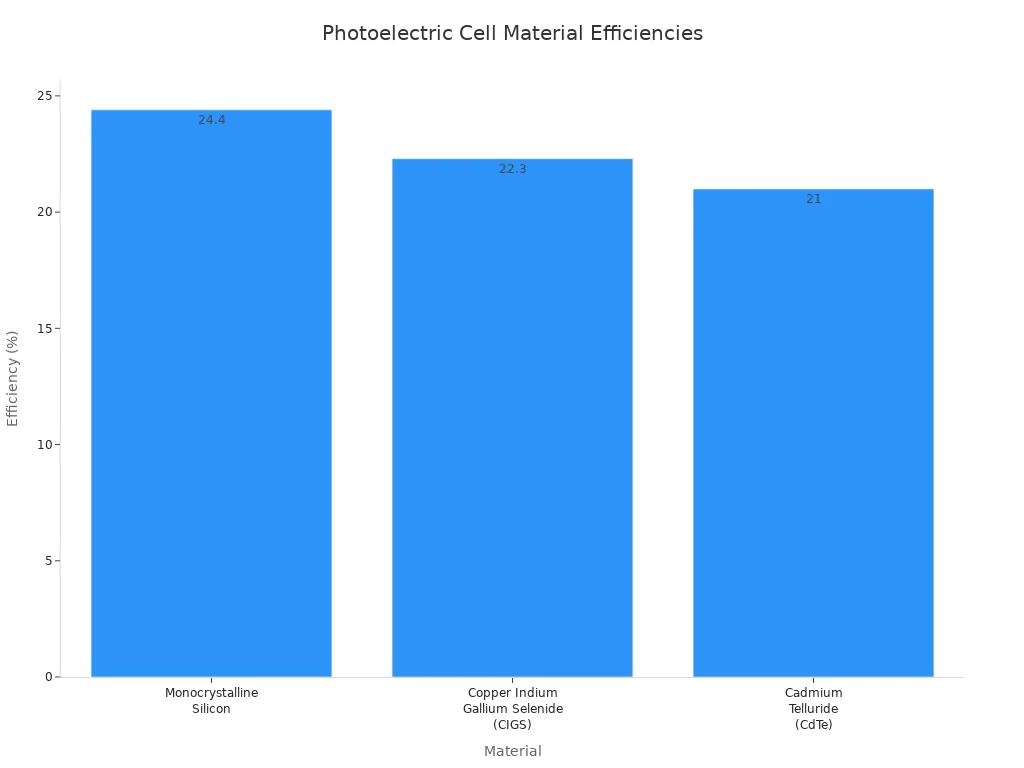
Photoelectric cells use different materials to improve efficiency. The table below shows some common materials and their performance.
| Material | Efficiency (%) | Notes |
|---|---|---|
| Monocrystalline Silicon | 24.4 | High production cost, made using the Czochralski process. |
| Copper Indium Gallium Selenide (CIGS) | 22.3 | Laboratory efficiency, made by co-evaporation or other methods. |
| Cadmium Telluride (CdTe) | 21 | Good for single-junction cells, many production methods. |
| Gallium Arsenide (GaAs) | N/A | High efficiency for multi-junction cells, used in space due to radiation resistance. |
Photoelectric cells work in different ways depending on their components. The table below explains how each part helps the cell function.
| Component | Function |
|---|---|
| Photoconductive | Reduces resistance by increasing electron movement when light shines on the material. |
| Photovoltaic | Generates voltage by letting electrons jump between layers when exposed to light. |
| Photoemissive | Releases electrons when light hits the material, which you collect to produce electric power. |
| Photomultiplier | Boosts light signals by releasing many electrons from one photon, making the electrical response stronger. |
You need to consider environmental factors when you use photoelectric cells. Temperature and light wavelength affect how well the cell works. Lower temperatures help the cell produce more voltage. Different wavelengths of light change how many electrons the cell can generate.
Tip: Always connect a load to your photoelectric cell and avoid using it in explosive environments. Make sure you wire the cell correctly to prevent damage.
Photoelectric cells play a key role in modern technology. You see them in everyday devices and advanced scientific equipment. Their structure and components allow you to harness light and turn it into useful electricity.
Photoelectric Effect and Operation

How the Photoelectric Effect Works
You can understand the operation of photoelectric cells by looking at the photoelectric effect. When you shine light on a metal surface inside a photoelectric cell, the light gives energy to the electrons in the metal. If the light has enough frequency, these electrons absorb the energy and leave the metal surface right away. This process is called the photoelectric effect.
The photoelectric effect is important because it lets you turn light into electrical energy. When light hits the photoelectrode, it causes electrons to escape from the metal. You collect these electrons to create a flow of electric current, which you can use in a circuit. The effect happens instantly when the light shines on the metal. The energy of the electrons depends on the frequency of the light, not its brightness. If the light does not reach a certain frequency, no electrons will come out, no matter how bright the light is.
The photoelectric effect is the key reason why photoelectric cells work. It allows you to change light energy into electrical energy quickly and efficiently.
Photoconductivity in Photocells
Photoconductivity is another important effect in photocells. When you use a photocell made from special materials called semiconductors, the material changes its electrical resistance when light shines on it. In the dark, the semiconductor has high resistance, so very little current flows. When light hits the material, the resistance drops, and more current can pass through.
You will find that different materials show photoconductivity in different ways. Some semiconductors, like graphene and black phosphorus, respond to a wide range of light, including the full solar spectrum. Other materials, such as crystalline topological insulators, also show strong photoelectric effects. Each material has its own strengths and weaknesses. Some absorb light better, while others are more stable in air.
Tip: You can choose the right material for your photocell based on the type of light you want to detect and the environment where you will use the cell.
Conversion of Light to Electricity
Photoelectric cells convert light into electricity through a simple but powerful process. When light hits the cell, it causes electrons to move. These moving electrons create an electric current that you can measure or use to power devices.
- The number of electrons that come out of the photoelectric cell depends on how bright the light is. If you increase the light intensity, more photons hit the surface, and more electrons are released.
- The energy of each electron does not change with brighter light. Only the number of electrons increases.
- The maximum energy of the electrons depends on the frequency of the light, not its intensity.
You can see this relationship in action when you use a photoelectric cell in a light sensor. If you shine a brighter light on the sensor, the current increases. If you use light with a higher frequency, the electrons have more energy, and the current can be stronger.
Note: The photoelectric effect and photoconductivity work together in many modern photoelectric cells. This combination lets you detect light, measure its strength, and even use it to generate power.
Photoelectric cells use these effects to help you in many ways. You can find them in automatic doors, alarms, and solar panels. By understanding how the photoelectric effect and photoconductivity work, you can choose the best cell for your needs and use light as a source of energy.
Types of Photoelectric Cells
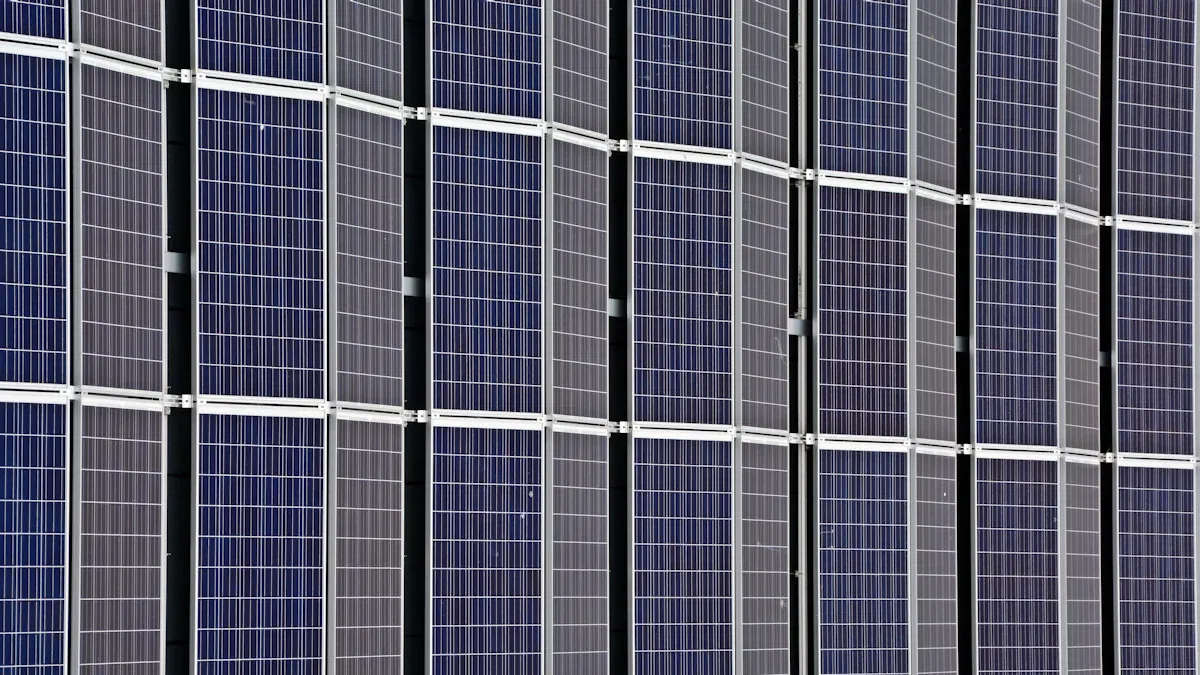
Photoelectric cells come in several types. Each type uses the photoelectric effect to turn light into energy, but they work in different ways and have unique features. You can group these cells into three main categories: vacuum photoelectric cells, semiconductor photocells, and photovoltaic cells.
Vacuum Photoelectric Cells
Vacuum photoelectric cells use a simple design. You find a metal cathode and an anode inside a glass tube with no air. When light hits the cathode, the photoelectric effect releases electrons. These electrons move to the anode, creating a current.
- You get high sensitivity to light, especially in the ultraviolet and visible ranges.
- The response time is fast, so you can detect quick changes in light.
- The construction is simple and reliable, with few parts that can fail.
- These cells do not need outside power to work.
- They last a long time because the vacuum protects the parts from air and moisture.
You often use vacuum photoelectric cells in light meters, flame detectors, and early television cameras. They also work well in places where you need to measure weak light signals.
Semiconductor Photocells
Semiconductor photocells use materials like silicon or cadmium sulfide. When light shines on the semiconductor, the photoelectric effect lowers the resistance and lets more current flow. You can use these cells to sense changes in light or measure its strength.
- These cells are small and easy to use in many devices.
- They respond to a wide range of light, from visible to infrared.
- You find them in automatic doors, alarms, and light sensors.
Scientists classify semiconductor photocells into generations based on their materials:
- First Generation: Monocrystalline and polycrystalline silicon, gallium arsenide.
- Second Generation: Thin films like microcrystalline silicon, amorphous silicon, copper indium gallium selenide, and cadmium telluride.
- Third Generation: Chemical compounds, nanocrystalline films, quantum dots, dye-sensitized, and organic polymers.
- Fourth Generation: Thin film polymers and new nanostructures like metal oxides and carbon nanotubes.
Photovoltaic Cells
Photovoltaic cells, also called solar cells, use the photoelectric effect to turn sunlight into electrical energy. When photons from the sun hit the cell, they knock electrons loose in the semiconductor. This movement creates a current you can use for power.
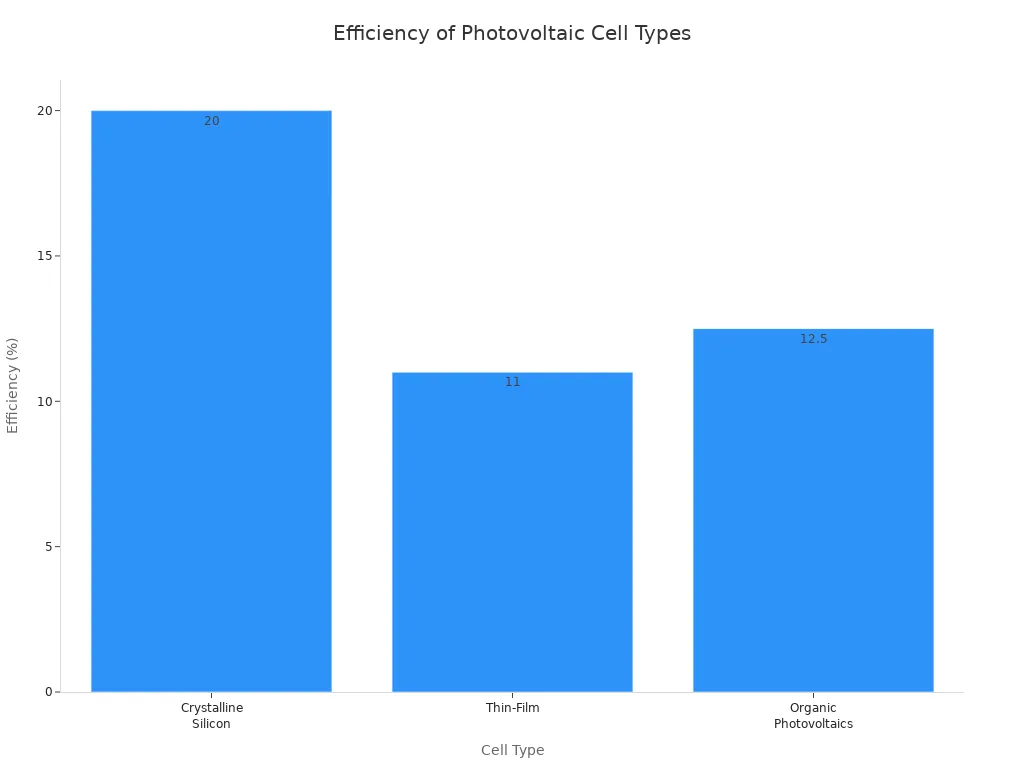
| Type of Cell | Material Used | Efficiency | Advantages | Disadvantages |
|---|---|---|---|---|
| Crystalline Silicon | Silicon | >20% | High efficiency, widely used | Expensive production |
| Thin-Film | Cadmium Telluride | 10-12% | Flexible, lightweight | Lower efficiency |
| Organic Photovoltaics | Organic materials | 10-15% | Low cost, easy to produce | Shorter lifespan |
You see photovoltaic cells in solar panels on rooftops and calculators. They help you use sunlight as a clean source of energy.
Note: The main difference between a photoelectric cell, a photocell, and a photovoltaic cell is how you use them. A photoelectric cell or photocell usually detects light or measures its strength. A photovoltaic cell mainly produces electricity from sunlight.
Scientific Principles
Quantum Theory
You can understand the operation of a photoelectric cell by looking at quantum theory. Quantum theory tells you that light does not act only as a wave. Light also behaves as tiny packets of energy called photons. When you shine light on a metal surface, each photon carries a specific amount of energy. If a photon has enough energy, it can knock an electron out of the metal. This process is the photoelectric effect.
- Light interacts with matter in small, quantized units called photons.
- The energy of each photon depends on its frequency.
- When a photon hits the metal, it transfers its energy to an electron.
The kinetic energy of the electron that leaves the metal depends on the energy of the photon minus the work needed to remove the electron. You can use the equation KE = hf - φ, where KE is kinetic energy, h is Planck’s constant, f is the frequency of the light, and φ is the work function of the metal. If the light does not have enough frequency, no electrons will escape, no matter how bright the light is.
In a photoresistor, you see resistance drop from millions of ohms in darkness to just a few hundred ohms in bright light. The operation of photocells is most sensitive to light between 400 and 700 nanometers, which matches the range of human vision.
Einstein and the Photoelectric Effect
Albert Einstein helped you understand the photoelectric effect by introducing the idea of light quanta. He said that light consists of discrete packets of energy. When these packets hit a metal, they can release electrons if they have enough energy. Einstein’s theory explained why only light above a certain frequency causes electrons to escape.
Robert Millikan tested Einstein’s predictions. He found that the energy of the electrons depended on the frequency of the light, not its brightness. Millikan’s experiments showed that the stopping potential for the electrons increased in a straight line with the frequency of the light. This result matched Einstein’s photoelectric equation and proved his theory correct.
You see the photoelectric effect in action every time you use a photoelectric cell. The scientific principles behind it help you convert light into electrical energy and understand how energy moves in the world.
Photoelectric Cells vs Solar Cells
Similarities
You will notice that photoelectric cells and solar cells share many features. Both devices use light to create energy. When light hits the surface, it excites electrons and forms hole-electron pairs. These pairs move and create an electric current. You see this process in both types of cells. Each device uses a junction between two materials. This junction creates a potential difference, which helps the charge carriers move and generate a flow of energy. You rely on this mechanism to power devices or sense light.
Both photoelectric cells and solar cells use the same basic principle: they turn light into usable energy by moving electrons. This process is fast and efficient, making these devices important in modern technology.
Differences
You will find some key differences between photoelectric cells and solar cells. The table below shows how they compare:
| Feature | Photoelectric Cells | Solar Cells |
|---|---|---|
| Operational Mechanism | Convert light into electric current via the photoelectric effect | Convert sunlight into electrical energy for continuous use |
| Primary Applications | Light-sensing equipment, cameras | Solar panels for renewable energy |
Photoelectric cells help you detect and measure light. You often use them in cameras, alarms, and automatic doors. Solar cells, on the other hand, focus on producing energy from sunlight. You see solar panels on rooftops, calculators, and even in outdoor area lighting. These panels help you generate solar power for homes and businesses.
- Solar cells play a big role in renewable energy. By the end of 2022, the world had about 1030 gigawatts of solar photovoltaic capacity. This number shows how much people use solar energy for clean power.
- Photoelectric cells usually work in devices that need to sense or measure light, not to supply large amounts of energy.
Tip: If you want to power a device using sunlight, choose solar cells. If you need to sense light or control a system, photoelectric cells are the better choice.
You have seen how photoelectric cells turn light into electricity using the photoelectric effect and photoconductivity. These cells power devices like digital cameras and smart sensors. Recent advancements, such as perovskite and bifacial solar cells, have improved efficiency and opened new uses.
| Advancement | Benefit |
|---|---|
| Perovskite Cells | Higher efficiency |
| Bifacial Panels | More power from both sides |
Remember, weather and calibration can affect performance. Understanding how light’s frequency changes photocurrent helps you avoid common mistakes. Explore new technologies and see how photoelectric cells shape your world. 🚀
FAQ
What is the main use of a photoelectric cell?
You use a photoelectric cell to detect light and turn it into electricity. Many devices, like automatic doors and alarms, rely on this technology to sense changes in light.
How do photoelectric cells help in daily life?
You find photoelectric cells in many places. They help open doors, control streetlights, and power solar calculators. These cells make your life easier by responding quickly to light.
Can you use photoelectric cells for photo controls?
Yes, you can use photoelectric cells for photo controls. These controls turn lights on or off based on the amount of light. You often see them in outdoor lighting systems.
What materials work best in photoelectric cells?
You get the best results from materials like silicon, cadmium telluride, and gallium arsenide. Each material offers different efficiency and cost. Choose the right one for your needs.
Do photoelectric cells work at night?
Photoelectric cells need light to work. At night, they do not produce electricity unless you use artificial light. Some systems store energy during the day for use at night.