Understanding the Importance of a Parallel Resistor Calculator for Accurate Design
You need accurate resistance values when you design and analyze electronic circuits. A parallel resistor calculator gives you fast and reliable answers, so you avoid mistakes in circuit design. This indispensable tool helps you save time and makes your work easier, whether you are a beginner or a professional. Many engineers trust a parallel resistor calculator to check their results and improve their projects.
Key Takeaways
A parallel resistor calculator quickly and accurately finds total resistance in circuits with resistors connected side by side.
Using this calculator saves time, prevents math errors, and helps both beginners and professionals design better electronic circuits.
The tool supports multiple resistors, shows formulas, and offers educational resources to improve your understanding of parallel circuits.
Parallel resistor calculators help you test different resistor combinations to achieve exact resistance values for real-world applications.
Always double-check your inputs and resistor power ratings to ensure safe and effective circuit designs.
Parallel Resistors
Circuit Basics
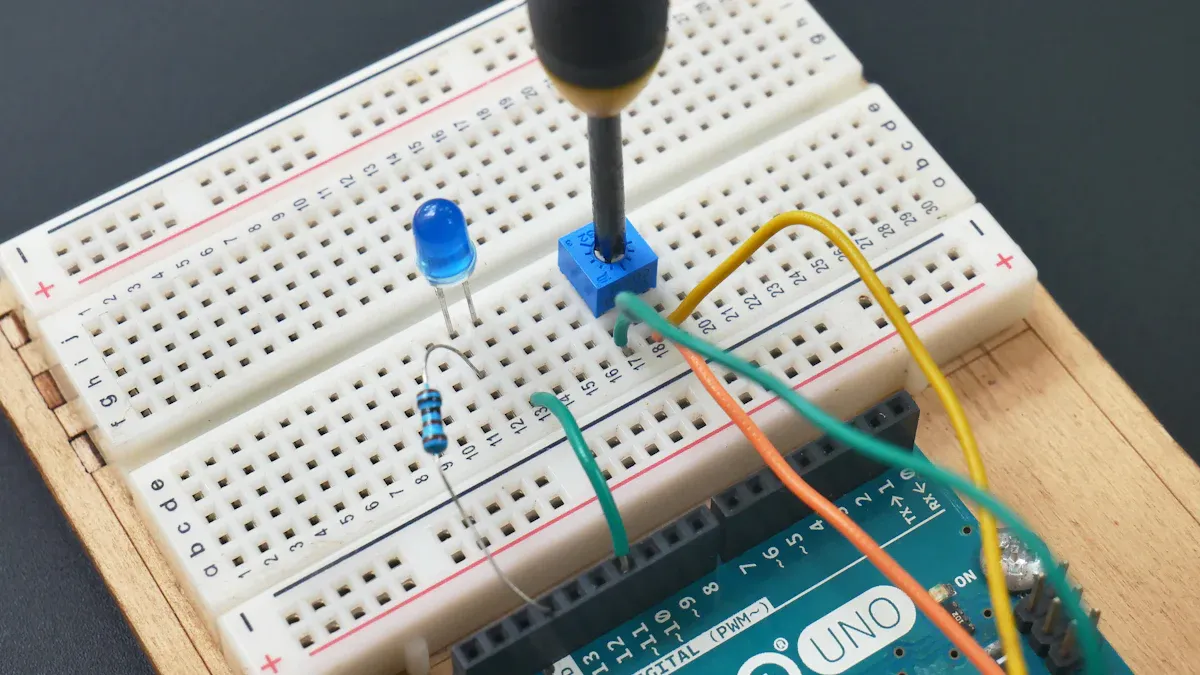
When you work with parallel resistors, you connect each resistor so that both ends join directly together. This setup forms a parallel configuration. You see this in many parallel circuits, where each resistor shares the same two connection points. Here is what you need to know about parallel resistors:
All leads on one side of each resistor connect together, and all leads on the other side connect together.
The voltage across each resistor in parallel stays the same because their ends connect to the same wires.
The current through each resistor can differ, depending on its resistance.
The equivalent resistance of parallel resistors is always less than the smallest individual resistor. Multiple current paths reduce the overall resistance.
The total current entering the parallel combination splits among the branches, but the voltage across each branch remains equal.
You often use parallel circuits to control current flow and manage voltage in electronic devices. When you add more resistors in parallel, you create more paths for current, which lowers the total resistance. This property helps you design circuits that need specific resistance values.
Calculation Challenges
You may find it easy to calculate total resistance in simple parallel circuits. You add the reciprocals of each resistor’s value and then take the reciprocal of that sum to get the equivalent resistance. For example, if you have three resistors in parallel, you use the formula:
1 / R_P = 1 / R1 + 1 / R2 + 1 / R3
This method works well for basic networks. However, when you deal with complex parallel resistor networks, the process becomes much harder. Advanced parallel circuits, such as m×n cylindrical networks, require you to use special mathematical tools like Chebyshev polynomials or discrete cosine transforms. These tools help you solve for equivalent resistance more efficiently, but they also make the calculations more challenging. As a result, you may need a parallel resistor calculator to save time and avoid mistakes when you calculate total resistance in complicated parallel circuits.
Parallel Resistor Calculator
Features and Benefits
A parallel resistor calculator helps you solve problems with parallel resistors quickly and accurately. You do not need to remember complex formulas or do long calculations by hand. This tool lets you enter the values for each resistor, and it gives you the total resistance right away. You can use it for two, three, four, or even five resistors in parallel. The calculator uses the standard reciprocal formula for parallel resistors:
1 / RT = 1 / R1 + 1 / R2 + 1 / R3 + ... + 1 / Rn
You see the result instantly after entering your resistor values. This makes it easy to test different combinations and find the best setup for your circuit. Many resistor calculators also show you the formula and give examples, so you can learn how the calculation works. Some even link to guides about resistor types and how to use them in real circuits.
Tip: Use a parallel resistor calculator when you want to combine standard resistor values to reach a specific total resistance. This saves you time and helps you avoid mistakes.
You can use a resistor calculator to manage voltage drop, share current, and balance loads in your circuit. This is important because parallel resistors help you control how much current flows through each branch. The calculator helps you see how changing one resistor affects the total resistance and the voltage drop across each resistor. This makes it easier to protect your components and make sure your design works as planned.
Many resistor calculators are interactive and user-friendly. You do not need special training to use them. You just enter the resistor values, and the tool does the rest. Some calculators also offer tutorials, resources, and even social media channels for extra support. This helps you learn more about parallel circuits and improve your skills.
Here are some key features you will find in leading parallel resistor calculators:
Quick calculation of total resistance for parallel resistors.
Support for two to five resistors in parallel.
Instant display of equivalent resistance after entering values.
Educational content, including formulas and calculation examples.
Links to guides on resistor types and circuit applications.
User-friendly design for easy use in circuit design tasks.
Tutorials and resources for ongoing learning.
Error Prevention
A parallel resistor calculator helps you avoid common mistakes when working with parallel resistors. Manual calculations can lead to errors, especially when you have more than two resistors. The calculator uses the reciprocal sum method, which is the standard way to find the total resistance in a parallel circuit. This method works for any number of resistors and gives you accurate results every time.
When you use a resistor calculator, you do not have to worry about missing a step or making a math error. The calculator checks your input and shows you the correct equivalent resistance. This helps you prevent problems like incorrect voltage drop or too much current in one branch. You can also use the calculator to test different resistor values and see how they affect your circuit.
Many users say that resistor calculators are easy to use and give fast results. You do not need to know advanced math or electronics to get the right answer. The table below shows what users like and dislike about these tools:
Feedback Aspect | Positive Points | Negative Points |
|---|---|---|
Ease of Use | Straightforward calculations without technical knowledge; user-friendly interface | Some users find it too simplistic, lacking advanced features |
Speed | Quick input and instant results | N/A |
Educational Value | Helpful for students learning resistance and circuitry concepts | Limited educational resources or tutorials |
Design & Accessibility | Minimalist design, no ads, no registration required, accessible via web | Dependent on internet connection, no offline use |
Functionality | Supports various resistor color codes, series and parallel calculations | Limited compared to advanced electronic design software |
You can use a parallel resistor calculator for rapid prototyping and circuit optimization. This means you can try different resistor values and see how they change the total resistance and voltage drop. You can make changes quickly and find the best solution for your project. This tool helps you design circuits that work well and protect your components from damage.
Note: Always double-check your resistor values before building your circuit. A resistor calculator helps you catch mistakes early and keeps your design safe.
Resistor calculators support both beginners and professionals. You can use them to learn about parallel resistors, check your work, and improve your designs. This makes them a valuable tool for anyone who works with electronic circuits.
Circuit Design Applications
Real-World Uses
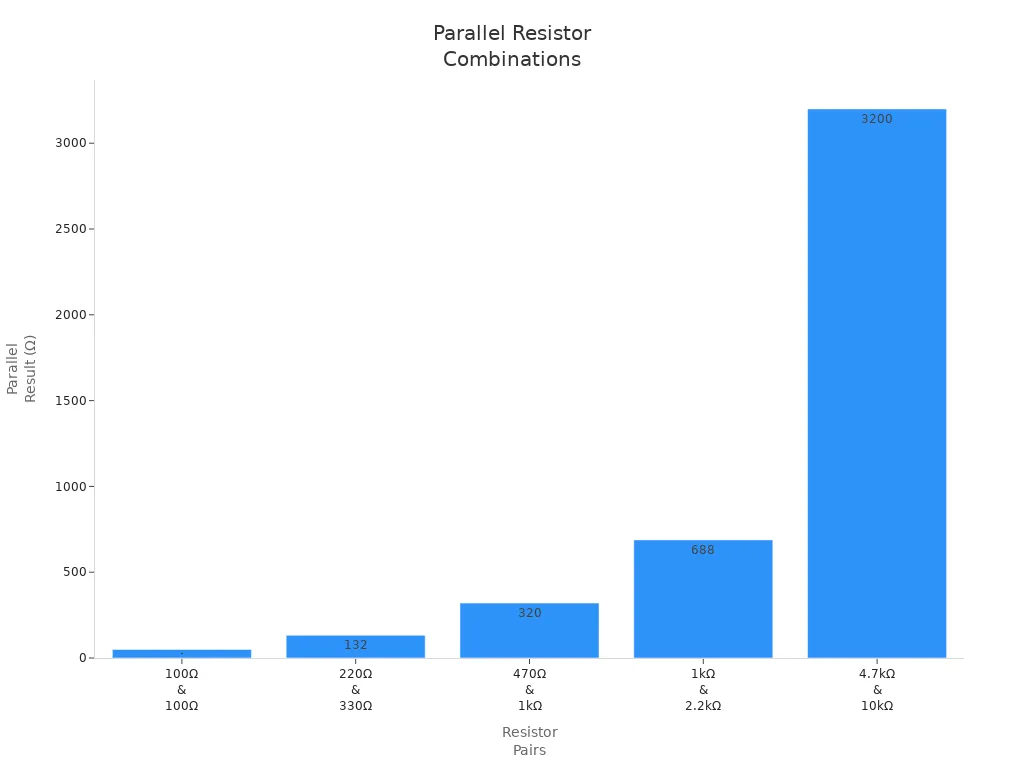
You often use parallel resistors in many types of circuit design. When you build an electrical circuit design, you may not always have the exact resistor value you need. A parallel resistor calculator helps you find the right combination of standard resistors to reach your target total resistance. For example, you can use two 100Ω resistors in parallel to get 50Ω, which is useful for limiting current to an LED. In audio circuits, you might combine 220Ω and 330Ω resistors in parallel to get 132Ω for better sound quality.
Here is a table that shows how you can combine standard resistor values in parallel for different applications:
Resistor 1 | Resistor 2 | Parallel Result | Application |
|---|---|---|---|
100Ω | 100Ω | 50Ω | LED current limiting |
220Ω | 330Ω | 132Ω | Audio circuits |
470Ω | 1kΩ | 320Ω | Signal processing |
1kΩ | 2.2kΩ | 688Ω | Voltage dividers |
4.7kΩ | 10kΩ | 3.2kΩ | Pull-up resistors |
You can see how parallel resistors help you solve real problems in circuit design.
Achieving Target Resistance
When you need a special resistance value, a parallel resistor calculator lets you combine two or more standard resistors to get the exact total resistance you want. You can follow these steps:
Enter the number of resistors you want to use.
Input the value for each resistor.
Choose the unit for each resistor.
Calculate the total resistance.
Check if the result matches your target.
You also need to think about power ratings. By placing resistors in parallel, you spread the power across each one. This keeps any single resistor from overheating. You can use formulas like P = I²R or P = V²/R to check if your resistors can handle the power.
Parallel resistors also affect how your circuit connects to other parts. They change the input and output impedance, which can help match your source and load for better performance. Using a parallel resistor calculator helps you make smart choices for your electrical circuit design.
Tip: Always check resistor tolerance to make sure your total resistance stays within safe limits.
Resistor Calculator Tips
Troubleshooting
You may sometimes get unexpected results when you use a resistor calculator. If you see a value that does not match your expectations, check your input first. Make sure you enter each resistor value correctly. Double-check the units, such as ohms (Ω), kilo-ohms (kΩ), or mega-ohms (MΩ). A small mistake in units can change your answer a lot.
If your resistor calculator shows an error, look for missing or zero values. Most resistor calculators need all fields filled in. Some resistor calculators will not accept negative numbers or letters. Always use numbers for each resistor value.
Tip: If you get a strange answer, try entering the values again. Sometimes, refreshing the page or restarting the resistor calculator can fix the problem.
You may also want to compare your answer with a manual calculation. Use the formula:
1 / RT = 1 / R1 + 1 / R2 + 1 / R3 + ...
This helps you see if the resistor calculator works as expected.
Best Practices
You can get the most out of a resistor calculator by following some best practices. Always use standard resistor values when possible. This makes it easier to find real parts for your project. If you need a special value, use the resistor calculator to test different combinations.
Keep a record of the resistor values you try. This helps you remember what worked best. You can use a table like this:
Attempt | R1 (Ω) | R2 (Ω) | R3 (Ω) | Total Resistance (Ω) |
|---|---|---|---|---|
1 | 220 | 330 | - | 132 |
2 | 470 | 1k | - | 320 |
You should always check the power rating for each resistor. The resistor calculator gives you the total resistance, but you must make sure each resistor can handle the current.
Remember: Resistor calculators help you save time and avoid mistakes. Use them to test ideas before you build your circuit.
If you use resistor calculators often, bookmark your favorite one. Some resistor calculators offer extra features, like color code charts or links to learning guides. Explore these options to improve your skills.
You need a resistor calculator for accurate circuit design. This tool helps you find total resistance when standard values do not fit your needs. Electronics professionals use a resistor calculator to manage shortages, improve power handling, and meet safety standards. You can use it to adjust amplifier gain or create precise voltage dividers.
A resistor calculator lets you combine standard resistors for exact total resistance.
You save time and avoid errors with every calculation.
For deeper learning, explore textbooks, video tutorials, and interactive tools like the DO Supply resistor calculator.
FAQ
What is a parallel resistor calculator?
A parallel resistor calculator helps you find the total resistance when you connect resistors side by side. You enter the values, and the calculator gives you the answer quickly. This tool saves you time and helps you avoid mistakes.
Why do you need to use a parallel resistor calculator?
You need a parallel resistor calculator because manual math can be tricky. The calculator checks your work and gives you fast, accurate results. You can test different resistor values and see how they change your circuit.
Can you use a parallel resistor calculator for any number of resistors?
Most calculators let you enter two to five resistors. Some advanced tools allow more. Always check the calculator’s instructions. If you have many resistors, using a calculator makes the process much easier.
What should you do if the calculator gives a strange result?
Double-check your input values. Make sure you use the correct units, like ohms (Ω). Try entering the numbers again. If the problem continues, refresh the page or use another calculator.