Your 2026 Guide to nRF24L01 ESP8266 and LoRa Modules
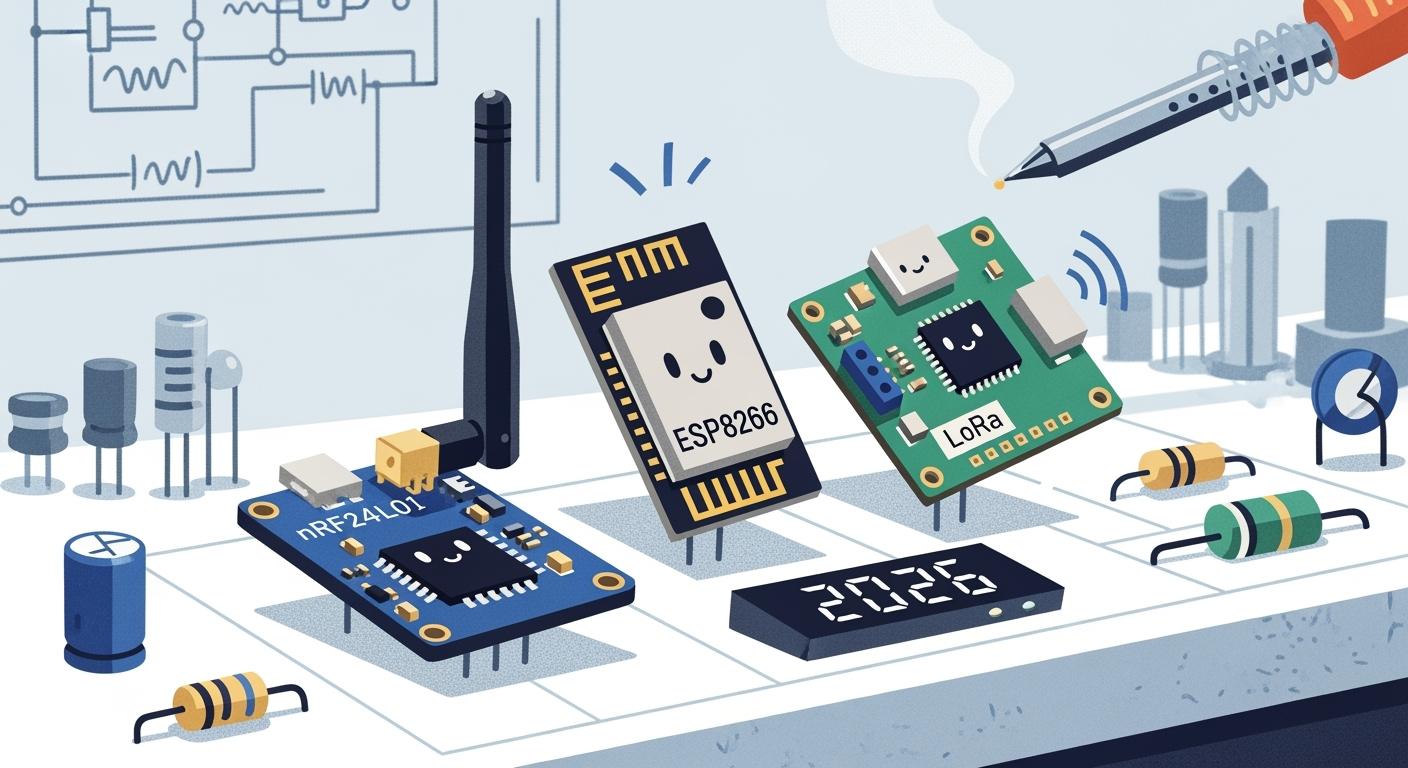
You need to choose the right wireless module for your project. This guide helps you make a confident decision. Let's find your perfect match right now.
Your project needs short-range, low-cost communication. The nrf24l01 is your answer. You want to connect your device to the internet over Wi-Fi. Choose the ESP8266. Your battery-powered sensor is far from a Wi-Fi signal. LoRa is the undisputed champion for this long-range task.
Key Takeaways
Choose nRF24L01 for short-range, low-cost wireless links between devices.
Use ESP8266 for projects needing Wi-Fi and internet connection, like smart home devices.
Select LoRa for very long-range communication and devices that need to save battery power.
Each module has different strengths for range, speed, and power use.
Consider your project's needs for distance, data speed, and battery life to pick the best module.
Core Feature Comparison
You understand the basic role of each module. Now, you need to dive into the technical details. This comparison will help you match the right features to your project's specific demands.
Range and Transmission Power
The distance your signal needs to travel is a critical factor. This is where these modules show their biggest differences.
LoRa: LoRa is the undisputed king of long-range communication. It can send data over several kilometers in rural areas. Under ideal conditions, a single LoRa gateway can achieve a range of 7 km. This makes it perfect for projects like monitoring soil conditions in large, open fields.
nRF24L01: The basic nRF24L01 module is designed for short-range tasks, like a custom remote control. However, you can choose the
nRF24L01+PA+LNAversion. This upgraded module includes a Power Amplifier (PA) and Low-Noise Amplifier (LNA), boosting its maximum range to about 1 kilometer with a clear line of sight.ESP8266: The ESP8266 connects to a standard Wi-Fi network. Its range depends on your Wi-Fi router. It generally offers better indoor range than a basic nrf24l01, but it will not compete with LoRa's long-distance capabilities.
Transmission power (TX Power), measured in dBm, directly impacts range. Higher power often means a longer reach.
Module | |
|---|---|
NRF24L01 | 0 dBm |
SX1280 (LoRa) | 12.5 dBm |
ESP8266 | ~20 dBm |
Note: While the ESP8266 has high TX power, its Wi-Fi protocol is not designed for the same long-range efficiency as LoRa's modulation technique.
Data Rate and Bandwidth
Data rate determines how fast you can send information. You must balance speed with range and power.
ESP8266: As a Wi-Fi device, the ESP8266 is the speed champion. It offers data rates up to 72.2 Mbps. This makes it ideal for projects that need to transfer large files, stream data, or host a web server with a responsive interface.
nRF24L01: This module gives you flexible speed options. You can configure it for data rates of 250 kbps, 1 Mbps, or 2 Mbps. The 2 Mbps rate is excellent for low-latency projects like wireless audio streaming or responsive drone controls.
LoRa: LoRa trades speed for its incredible range. Its data rates are very low, typically measured in kilobits per second (kbps). The speed depends on a setting called the Spreading Factor (SF). A higher SF increases range but decreases the data rate.
As you can see, LoRa is best for sending small packets of data, like a temperature reading or a sensor status, over long distances.
Power Consumption for Battery Life
If your project runs on batteries, power consumption is your most important concern.
LoRa: LoRa modules are designed for ultra-low power consumption. In deep sleep mode, a LoRa module can use as little as 5 microamps (µA). This incredible efficiency allows a sensor node to run for years on a single battery. For example, a LoRaWAN sensor reporting data every 20 minutes can last for approximately 3 years.
nRF24L01: This module is also very power-efficient. It has a "power down" mode that consumes only 900 nanoamps (nA), which is less than 1 µA. When transmitting, it uses around 11.3 mA. This makes the nrf24l01 a great choice for battery-powered remote controls or sensors that wake up infrequently.
ESP8266: The ESP8266 is the most power-hungry of the three. Connecting to Wi-Fi requires significant energy. While it has a deep sleep mode, its active power consumption is much higher than the other two. You should plan to use it with a reliable power source, not for long-term, battery-only sensor nodes.
Module and Project Cost
Your budget will always play a role in your decision. Luckily, all three options are very affordable for hobbyists.
Module Type | |
|---|---|
nRF24L01 Module | ~$1 - $3 |
ESP8266 (NodeMCU Board) | ~$3 - $7 |
LoRa (RA-02 Module) | ~$5 - $15 |
Cost Tip: The nRF24L01 is the cheapest way to add wireless communication between two microcontrollers. The ESP8266 offers incredible value as an all-in-one solution. LoRa modules cost more, but you are paying for their unique long-range, low-power technology.
Ease of Use and Community Support
Getting your project running smoothly depends on good documentation and a helpful community.
ESP8266: The ESP8266 is arguably the easiest to start with for internet-connected projects. It is a System-on-Chip (SoC), which means it has a microcontroller and Wi-Fi radio on a single chip. You do not need a separate Arduino to control it. You can program it directly using the Arduino IDE, and its built-in Wi-Fi simplifies connecting to the internet.
The ESP8266 is a powerful MCU in itself. In contrast, the nRF24L01 is primarily an RF transceiver module that requires a separate microcontroller for computational tasks.
nRF24L01: This module is a simple transceiver, not a full microcontroller. You will need to connect it to a host controller like an Arduino or Raspberry Pi. However, it has massive community support. Libraries like RF24 are extremely popular, with thousands of users and extensive tutorials available to guide you.
LoRa: LoRa can be simple for point-to-point communication between two modules. However, if you want to build a true wide-area network, you will likely use the LoRaWAN protocol. LoRaWAN adds layers for security, network management, and scalability, which introduces more complexity to your setup.
All three modules have strong communities, but the nature of their use defines the learning curve.
Project-Based Selection Guide
You now understand the technical differences. Let's connect those features to real-world projects. This guide will show you exactly where each module shines, helping you select the perfect one for your idea.
Ideal Projects for the nRF24L01
You should choose the nRF24L01 when your project needs reliable, short-range communication without the complexity of Wi-Fi. It is the king of simple, low-cost wireless links between two or more microcontrollers.
Common projects include:
Custom Wireless Remote Controls: You can build a remote for your robot, drone, or home media center. A simple setup uses an Arduino Nano, a few pushbuttons, and an nRF24L01 module to send commands wirelessly.
Simple Sensor Networks: You can create a network to collect data from multiple points. For example, you can set up several sensor nodes around your home to monitor temperature and send the data back to a central base station. Libraries like
RF24NetworkandRF24Meshhelp you manage these multi-device setups.Wireless Data Streaming: The module's 2 Mbps data rate makes it great for low-latency applications. You can stream audio between two points with minimal delay. One project achieves this by converting an analog audio signal to digital on an STM32 microcontroller and sending it in 32-byte chunks.
Two-Way Communication: You can build a wireless chat or data link between two computers. Each computer connects to an Arduino and an nRF24L01, allowing you to send and receive text messages.
Heads-Up: Common Pitfalls Power supply issues are the most common problem with the nrf24l01. The 3.3V pin on many Arduino boards cannot supply enough current. You should use a dedicated 3.3V power adapter board or add a 10µF capacitor between the VCC and GND pins to stabilize the power.
Best Use Cases for the ESP8266
You should choose the ESP8266 when your project needs to connect to the internet. It is a complete package: a powerful microcontroller with built-in Wi-Fi. This makes it the ultimate all-in-one solution for most IoT projects.
Here are some excellent use cases:
Web Server for Sensor Data: You can turn your ESP8266 into a mini web server. This allows you to view sensor readings from any device on your local network. For example, you can connect a BME280 sensor and display temperature and humidity data in real-time gauges on a webpage. The ESP8266 can serve HTML, CSS, and JavaScript files to create a modern, responsive interface.
Mobile App Controlled Devices: You can build smart home devices that you control with your phone. Using a service like Blynk, you can create a mobile app to turn a relay on or off from anywhere in the world. This lets you control lights, fans, or other home appliances with a tap on your screen.
IoT Data Logger: You can send sensor data to a cloud platform for storage and analysis. The ESP8266 can easily connect to services like ThingSpeak or AWS IoT Core. This is perfect for projects that monitor environmental data over a long period, like tracking air quality or weather conditions.
Pro Tip: Powering Your ESP8266 The ESP8266 needs a stable 3.3V power source that can provide at least 500mA of current, especially when the Wi-Fi radio is active. Using a dedicated voltage regulator like the AMS1117 and adding a large 470µF capacitor across the power rails will prevent unexpected resets and ensure reliable operation.
When to Choose a LoRa Module
You should choose LoRa when your project demands long-range communication and long battery life. It is the ideal choice for deploying sensors in remote locations where Wi-Fi is unavailable and power is limited.
Consider LoRa for these scenarios:
Agricultural Monitoring: You can deploy sensors across a large farm to monitor environmental conditions. LoRa makes it possible to collect soil moisture, temperature, and humidity data from nodes that are kilometers away from the gateway. This helps farmers make smart decisions about irrigation and crop health.
Asset Tracking: You can track the location of vehicles, equipment, or even pets over a wide area. By combining a LoRa module with a GPS module, you can create a tracker that sends location updates periodically. This is perfect for non-real-time tracking where updates every 10-15 minutes are sufficient, and it avoids the cost of a cellular data plan.
Remote Environmental Sensing: You can build a weather station or pollution monitor in a remote park or rural area. A LoRa-based sensor can run for years on a single battery, sending small data packets (like temperature or air quality readings) back to a central gateway several kilometers away.
Understanding LoRa vs. LoRaWAN For simple point-to-point communication between two modules, LoRa is straightforward. However, if you want to build a robust network with many nodes and a gateway connected to the internet, you will use the LoRaWAN protocol. LoRaWAN adds features for network management, security, and scalability, but it also introduces a higher level of complexity to your project setup.
You now have the knowledge to choose the right wireless module. Each one offers unique strengths for different kinds of projects. This final summary makes your decision simple.
Final Verdict 🎯
You are ready to bring your wireless idea to life. Go ahead and start building your next amazing project!
FAQ
Can I use an ESP8266 with a LoRa module?
Yes, you can combine them. You can use the ESP8266 as a Wi-Fi gateway for your LoRa nodes. The ESP8266 collects data from the LoRa module and sends it to the internet. This setup gives you the best of both worlds: long-range and internet connectivity.
Do I always need an Arduino with these modules?
You do not always need an Arduino.
The ESP8266 is a full microcontroller. You can program it directly. The nRF24L01 and LoRa modules are transceivers. They need a separate microcontroller, like an Arduino, to control them and process data.
Which module is the most secure for my project?
The ESP8266 is a strong choice for security. It supports standard Wi-Fi encryption like WPA2. LoRaWAN also provides end-to-end encryption for your data. The nRF24L01 offers minimal security, making it better for projects where data privacy is not a primary concern.
What is the difference between LoRa and LoRaWAN?
Think of it this way:
📡 LoRa is the radio signal technology that sends your data a long distance.
🌐 LoRaWAN is the full network system. It manages many devices and securely connects them to the internet through a gateway.