NPN vs PNP Choosing the Best Transistor for Modern Applications
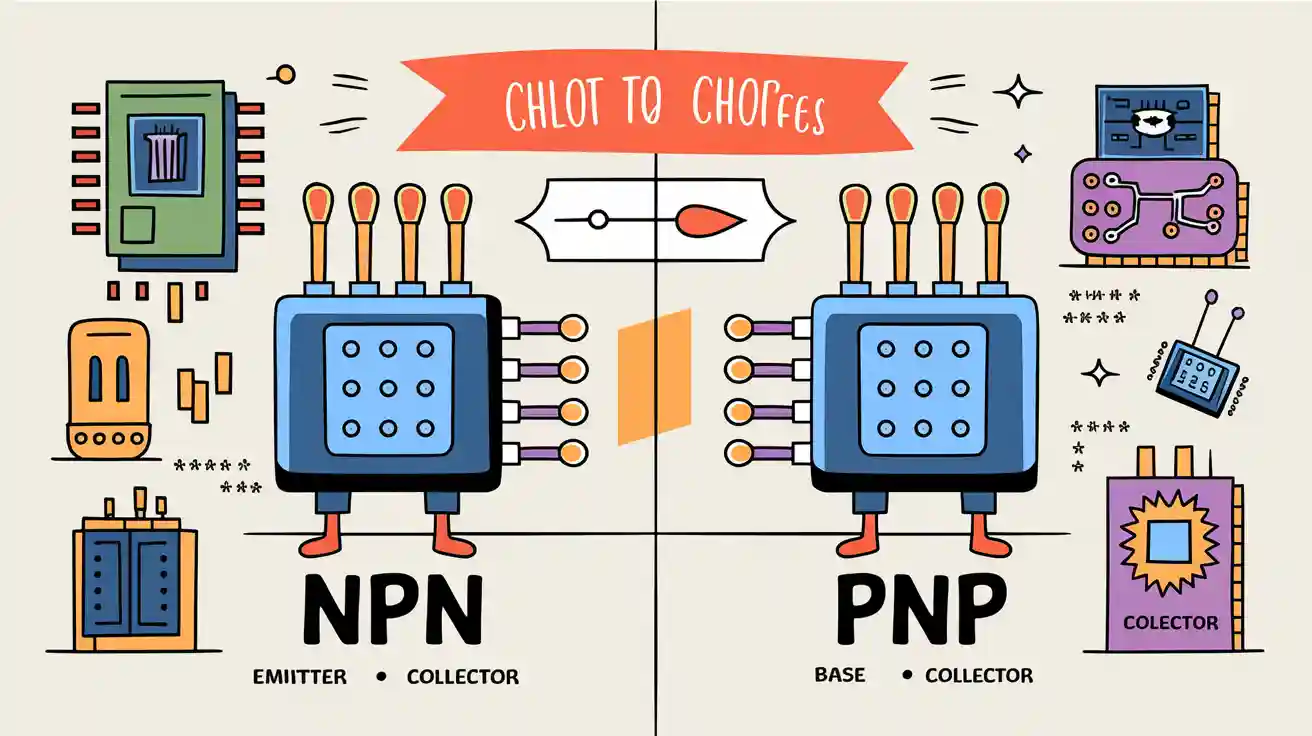
You will usually find that NPN transistors are the top choice for modern electronic circuits. They use electrons as majority charge carriers, which move faster than holes in PNP types. This means NPN transistors switch quicker and handle most low-side switching tasks in electronic devices. When you look at npn vs pnp, remember that NPN types use an N-type semiconductor as the emitter, while PNP types use a P-type semiconductor. The direction of current and the way you connect each transistor in a circuit also change based on this structure. Understanding these differences helps you pick the right transistor for your electronic needs.
Key Takeaways
- NPN transistors switch faster and work well with negative-ground circuits, making them ideal for most modern digital and high-speed applications.
- PNP transistors control current from the positive supply and suit high-side switching or positive-ground systems, often used in industrial and analog circuits.
- Choose NPN for low-side switching and fast response; choose PNP for high-side switching and stable current control to match your circuit’s design.
- Using both NPN and PNP transistors together can improve circuit performance by combining their strengths in speed and noise immunity.
- Always check your circuit’s voltage, ground type, and load position before picking a transistor to ensure safe and reliable operation.
NPN vs PNP Basics
Transistor Structure
When you look at a bipolar junction transistor, you see two main types: npn and pnp. Both types use layers of semiconductor material, but the way these layers stack makes a big difference in how each transistor works.
Most transistors use silicon as the main semiconductor. Sometimes, you might find silicon-germanium alloys, but silicon remains the most common. Manufacturers dope these materials to create n-type and p-type regions. This doping process gives each layer its special electrical properties.
Here is a table that shows the internal structure of each type:
| Feature | NPN Transistor | PNP Transistor |
|---|---|---|
| Semiconductor Layer Structure | Two N-type layers separated by a thin P-type layer (N-P-N) | Two P-type layers separated by a thin N-type layer (P-N-P) |
| Internal Structure | P-type layer between two N-type layers | N-type layer between two P-type layers |
The npn transistor has two n-type layers with a thin p-type layer in the middle. The pnp transistor has two p-type layers with a thin n-type layer in the middle. This structure decides which charge carriers move through the device. In an npn, electrons are the main carriers. In a pnp, holes carry the charge.
Tip: The structure of the semiconductor layers not only affects the type of charge carrier but also the speed and efficiency of the transistor in your circuit.
Current Flow and Control
The way current moves through a bipolar junction transistor depends on its structure. In an npn transistor, electrons flow from the emitter, through the base, and into the collector. You control this flow by applying a small current to the base. This small base current lets a much larger current move from the collector to the emitter. The npn acts as a current sink, connecting your load to ground.
In a pnp transistor, the process works in reverse. Holes move from the emitter to the collector. You control the current by drawing a small current out of the base. The pnp acts as a current source, connecting your load to the positive supply.
Here is a table to help you compare the current flow in both types:
| Aspect | NPN Transistor | PNP Transistor |
|---|---|---|
| Semiconductor Layers | N-type emitter, P-type base, N-type collector | P-type emitter, N-type base, P-type collector |
| Majority Charge Carriers | Electrons | Holes |
| Emitter Function | Supplies electrons to base | Supplies holes to base |
| Base Function | Thin, lightly doped; allows electrons to pass | Thin, lightly doped; allows holes to pass |
| Collector Function | Collects electrons | Collects holes |
| Biasing | Emitter-base junction forward biased; collector-base junction reverse biased | Emitter-base junction forward biased; collector-base junction reverse biased |
| Current Flow Inside Transistor | Electrons flow from emitter → base → collector | Holes flow from emitter → base → collector |
| Conventional Current Direction | From emitter to collector (arrow out of emitter) | From emitter to collector (arrow into emitter, opposite polarity) |
| External Circuit Current | Electron flow opposite to conventional current | Electron flow opposite to conventional current |
You will often see npn vs pnp discussed in terms of current direction and control. In npn, you apply a positive voltage to the base to turn it on. In pnp, you apply a negative voltage to the base. This difference affects how you design your circuit and choose your logic levels.
For example, in digital circuits, an npn transistor usually needs a pull-up resistor to the positive supply to show a logic-1 when off. A pnp transistor needs a pull-down resistor to ground to show a logic-0 when off. Both types can handle similar voltage and current ratings, but you must match the control signals to the type you use.
Note: Remember, npn = switch to negative (ground), pnp = switch to positive voltage. This simple rule helps you pick the right transistor for your project.
Why NPN vs PNP Matters
Circuit Design Impact
When you design an electronic circuit, the choice between npn vs pnp transistors shapes how your system works. NPN transistors conduct current from collector to emitter using electrons, which move quickly through the semiconductor. You turn on an npn by applying a positive voltage to the base. This makes npn transistors ideal for circuits grounded at the negative terminal. They switch faster and fit well in digital and high-speed electronic applications.
PNP transistors work differently. They use holes as charge carriers and conduct current from emitter to collector. You activate a pnp by applying a negative voltage to the base. PNP transistors often appear in circuits grounded at the positive terminal. They are common in analog, signal processing, and industrial control systems. The npn vs pnp choice affects how you wire your circuit, how fast it switches, and how you design your logic.
Here are some key points to remember:
- NPN transistors offer faster switching speeds, perfect for high-speed and high-current electronic circuits.
- PNP transistors provide positive logic alignment, making signal reading and troubleshooting easier.
- PNP configurations can improve safety by reducing the risk of damage if a wire touches ground.
- Many modern circuits use both npn and pnp transistors to combine their strengths.
Signal Polarity
Signal polarity plays a big role in choosing between npn vs pnp transistors. In an npn circuit, you connect the load between the positive supply and the transistor. The npn acts as a sinking output, pulling current down to ground. In a pnp circuit, the load sits between the transistor and ground. The pnp acts as a sourcing output, pushing current from the positive supply through the load.
This difference changes how you wire your inputs and outputs. For example, sourcing outputs (pnp) pair with sinking inputs (npn) to keep current flowing in the right direction. Signal polarity ensures your circuit works safely and reliably.
When you use pnp transistors in standard negative-ground systems, you may face some compatibility issues:
| Compatibility Issue | Description and Impact |
|---|---|
| Temperature Sensitivity | PNP transistors can behave unpredictably as temperature changes. |
| Lower Current Gain | PNP types may not amplify signals as well as npn types. |
| Increased Leakage Current | Leakage can rise with temperature, risking malfunction in low-power circuits. |
| Lower Frequency Response | PNP transistors may distort signals at high frequencies. |
| Higher Noise Levels | More noise can affect sensitive analog or low-noise circuits. |
Understanding these differences helps you make better choices in circuit design and electronic projects.
NPN Transistor Applications
Modern Uses
You see npn transistors in almost every modern electronic device. These transistors play a key role in many applications because they handle switching and signal amplification with speed and efficiency. Here are some common ways you use npn transistors in daily life:
- Smartphones and wireless devices rely on npn transistors to process signals from antennas. This helps your phone maintain clear calls and strong connections.
- TVs, radios, and audio equipment use npn transistors for amplification. They boost weak signals so you get better sound and picture quality.
- Digital logic circuits and integrated circuits depend on npn transistors. These applications include computers, tablets, and storage devices.
- In prototyping and development boards like Arduino, you use npn transistors for switching, voltage regulation, and pulse-width modulation (PWM) control.
- Many consumer electronics use npn transistors to manage power and control signals, making devices more reliable and energy-efficient.
Tip: When you build or repair electronic projects, start with npn transistors. They fit most applications and offer reliable performance.
Advantages
You benefit from several advantages when you choose an npn transistor for your electronic applications. First, npn transistors are more widely available than pnp types. Manufacturers produce them in higher volumes, so you find them at lower prices. This makes npn transistors a smart choice for large-scale projects or when you need to keep costs down.
Npn transistors also dominate digital circuits, amplifiers, and switching applications. Their structure allows electrons to move quickly, which means faster switching and better performance in high-speed circuits. You get more options and flexibility because npn transistors support a wide range of electronic applications.
Another advantage is their compatibility with standard negative-ground systems. Most modern electronics use this setup, so npn transistors integrate easily. You can design circuits that are simple, efficient, and easy to troubleshoot.
Remember, npn transistors give you speed, cost savings, and broad compatibility. These features make them the top choice for most modern electronic applications.
PNP Transistor Applications
Typical Uses
You will find the pnp transistor in many important applications, especially in industrial and automation systems. This type of transistor works well in circuits that need high-side switching. In these circuits, you connect the load between the transistor and ground. The pnp transistor then controls the flow of current from the positive supply to the load.
Here are some common applications where you use a pnp transistor:
- You see pnp transistors in human-machine interfaces (HMI) for industrial automation. These transistors help improve the way machines and people interact.
- Many factory automation and process control systems use pnp transistor-based solutions. These transistors provide reliable performance in harsh environments.
- Industrial IoT devices often include pnp transistors. They help these devices handle power and signals with high reliability.
- You use pnp transistors for precise current amplification and voltage regulation. This improves signal quality and reliability in control systems.
- Sensor interfaces, motor control, and power management systems in factories often rely on pnp transistors.
- Pnp transistors also play a role in current sensing and low-noise amplification. This is important for accurate measurements in industrial settings.
When you design positive-ground circuits, you often choose a pnp transistor. You may need to flip the transistor orientation or use a charge pump to make the circuit work. These methods help you manage the unique needs of positive-ground designs.
Strengths
The pnp transistor offers several strengths that make it valuable in many applications. You benefit from its ability to reduce noise and improve signal integrity. Advanced manufacturing techniques, such as SiGe:C technology, help pnp transistors minimize thermal and flicker noise. This means your circuits can work better in noisy environments.
You also get better current gain and frequency response with modern pnp transistor designs. Companies like Infineon and IBM use special layouts and isolation techniques. These features help your circuits handle high frequencies and reduce crosstalk between components.
When you use a pnp transistor in high-side switching, you can control loads connected to the positive supply. This is useful in automotive and industrial circuits. Sometimes, you need extra components like driver ICs or optoisolators to manage voltage differences. These additions help you keep your control signals safe and reliable.
Tip: Choose a pnp transistor when you need strong noise immunity, high signal integrity, and reliable performance in tough environments.
You will find that the complementary nature of pnp and npn transistors allows you to design circuits with better noise performance. This is important in precision analog and communication applications.
Choosing the Right Transistor
Key Criteria
When you choose a transistor for your project, you need to look at several important factors. The right choice depends on how your circuit works and what you want it to do. Here is a table that shows the main criteria for picking between an npn transistor and a pnp transistor:
| Criteria | NPN Transistors | PNP Transistors |
|---|---|---|
| Current Directionality | Sinks current (low-side switching) | Sources current (high-side switching) |
| Load Configuration | Load between collector and ground | Load between emitter and positive supply |
| Voltage Considerations | Higher breakdown voltage at collector | Higher breakdown voltage at emitter |
| Typical Applications | Amplifiers, digital circuits, LED drivers, relays | High-voltage, battery-powered designs, push-pull amplifiers |
| Switching Performance | Handles rapid switching well, suitable for fast response | Provides stable operation and smooth current regulation |
| Circuit Role | Common in low-side switching and signal amplification | Common in high-side switching and current regulation |
| Design Benefits | Effective current flow management, fast switching | Minimizes power loss, simplifies circuitry |
You should start by checking the voltage and current your circuit needs. If your application needs fast switching, like in digital circuits or LED drivers, an npn transistor often works best. If you need to control the positive side of the power supply, a pnp transistor is a better fit. The way you connect your load also matters. For low-side switching, use npn. For high-side switching, use pnp.
Tip: Always match the transistor type to your circuit’s logic and load position. This helps you avoid wiring mistakes and keeps your system safe.
You also need to think about the type of signal you want to control. If you need signal amplification, both npn and pnp transistors can work, but npn types usually offer faster response. For applications that need smooth current control, like in analog circuits, pnp transistors can provide more stable operation.
Real-World Scenarios
You see the difference between npn and pnp transistors in many real-world applications. Here are some examples to help you decide which type to use:
-
Industrial Control Systems:
In factories, you often use npn transistors for switching relays and controlling machines. These transistors handle fast signals and work well with negative-ground systems. Pnp transistors appear in high-side switching, where you need to control the positive voltage to a device. This setup can make wiring simpler and safer in some control panels. -
Switching Circuits:
When you build a circuit to turn on a motor or light, you need to decide if you want to switch the ground or the positive supply. If you put the load between the power supply and the collector, use an npn transistor. If you put the load between the emitter and the positive supply, use a pnp transistor. This choice affects how your circuit handles current and how you wire your control signals. -
Sensor Integration:
In sensor circuits, the choice between npn and pnp depends on the control system. For example, in North America, many control systems expect sourcing inputs, so you use pnp sensors that source current. In other regions, systems often use sinking inputs, so npn sensors that sink current are more common. Some modern sensors can switch between npn and pnp modes, giving you more flexibility. -
Automotive Electronics:
You find pnp transistors in automotive sensor applications like engine management and tire pressure monitoring. These transistors amplify small signals and work at low voltages, which is important for accurate sensor readings. Companies use special designs to make pnp transistors handle high voltages and reduce noise, which helps with signal accuracy in cars. -
Specific Applications:
If your project needs fast switching, like in digital logic or LED drivers, choose an npn transistor. For circuits that need stable current control, like analog amplifiers or battery-powered devices, a pnp transistor may be the better choice.
🛠️ Note: Always check your control system’s input type and load connection before choosing a transistor. This step helps you avoid compatibility problems and keeps your circuit running smoothly.
You can see that the right transistor depends on your application, the type of signal you need to control, and how your circuit handles current. By matching the transistor to your needs, you get better performance and fewer problems.
Quick Comparison Table
You may find it helpful to see the main differences between NPN and PNP types side by side. This table gives you a quick way to compare their features and uses. If you want to choose the right part for your project, check each row and see which type fits your needs best.
| Feature | NPN Type | PNP Type |
|---|---|---|
| Symbol Arrow Direction | Points out of emitter | Points into emitter |
| Main Charge Carrier | Electrons | Holes |
| Current Flow | Collector to emitter | Emitter to collector |
| Base Activation | Needs positive voltage | Needs negative voltage |
| Common Use | Low-side switching | High-side switching |
| Speed | Faster switching | Slightly slower |
| Circuit Polarity | Works with negative ground | Works with positive ground |
| Availability | Very common | Less common |
| Typical Application | Digital circuits, amplifiers | Industrial control, sensors |
💡 Tip: If you work with modern electronics, you will likely use NPN types more often. These parts switch faster and match most negative-ground systems.
- Use this table as a reference when you design or repair circuits.
- Remember, the symbol arrow shows the direction of conventional current.
- Always check your circuit’s ground and supply voltage before you pick a type.
You can see that each type has its own strengths. When you understand these differences, you make better choices for your projects. If you ever feel unsure, look back at this table for a quick answer.
You usually find NPN transistors work best for modern circuits, especially when you need fast switching and use a negative ground. PNP transistors fit positive ground or high-side switching. Both types can work together for better results.
- NPN transistors suit digital, amplifier, and fast-switching jobs.
- PNP transistors help in analog, high-side, or positive-ground circuits.
- Your choice depends on voltage, current, and how you want to control the device.
| Project Need | Best Choice |
|---|---|
| Fast switching | NPN |
| High-side switching | PNP |
| Low current (<100mA) | 2N3904/2N3906 |
| High current | TIP122/TIP127 |
Always check your project’s needs. Try both types if you are unsure. This helps you find the best fit for your circuit.
FAQ
What is the main difference between NPN and PNP transistors?
You will see that NPN transistors use electrons as charge carriers, while PNP transistors use holes. NPN types switch current from collector to emitter. PNP types switch current from emitter to collector. The direction of current flow sets them apart.
Can you use NPN and PNP transistors together in one circuit?
Yes, you can use both types in one circuit. Many circuits use NPN and PNP transistors together to create push-pull amplifiers or complementary logic. This combination helps you improve performance and balance current flow.
Why do most modern circuits use NPN transistors?
You find NPN transistors in most modern circuits because they switch faster and work well with negative-ground systems. Their electron flow allows for quick response and easy integration with digital logic.
How do you know which transistor type to choose for your project?
You should check your circuit’s ground, voltage, and load position. Use NPN for low-side switching and fast signals. Use PNP for high-side switching or positive-ground systems. Always match the transistor to your control logic.
What happens if you use the wrong transistor type?
If you use the wrong type, your circuit may not work. You might see reversed current flow or failed switching. Always double-check your wiring and logic before powering up your project.