Five Ways Motor Soft Start Protects Your Industrial Motors
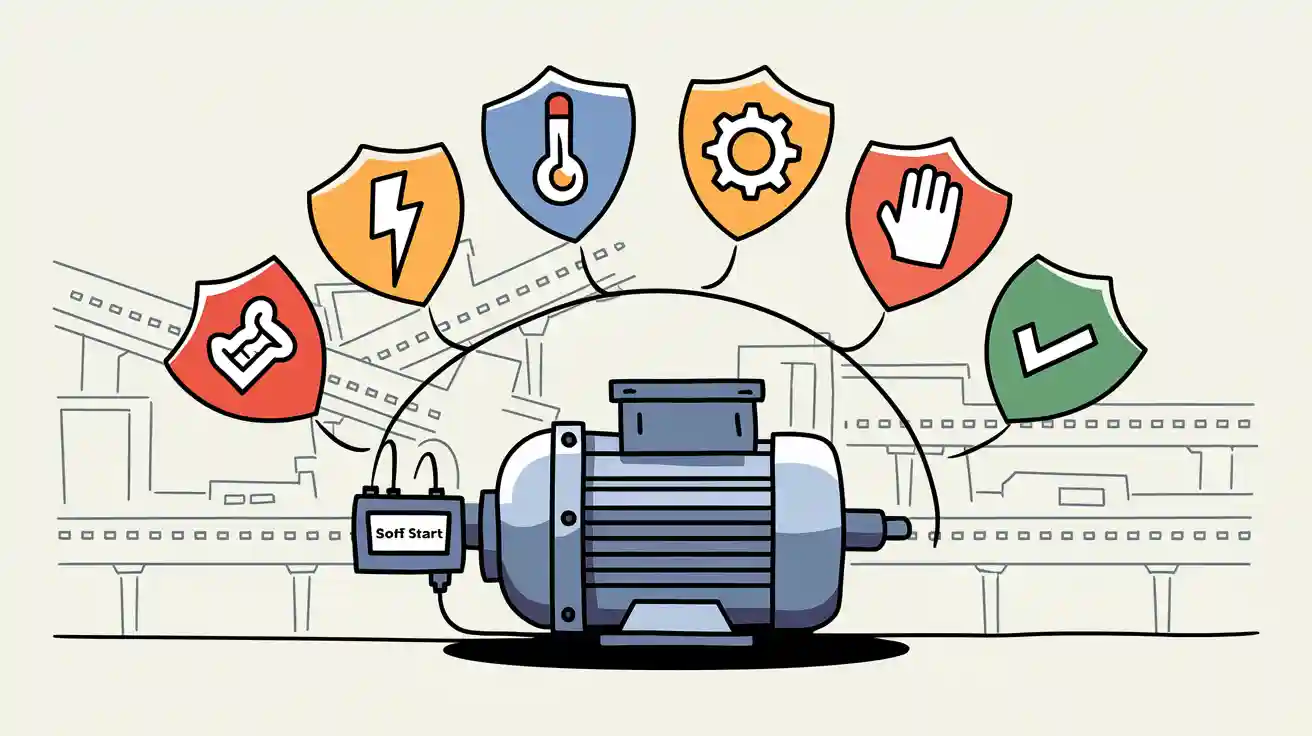
Industrial professionals face frequent motor failures due to mechanical stress, electrical issues, and improper startup procedures. Soft starter solutions address these challenges by providing smoother motor startups and reducing sudden torque or current surges. The table below highlights the leading causes of motor failures:
| Cause Category | Percentage of Total Motor Failures | Key Details and Examples |
|---|---|---|
| Mechanical Failures | 30%-40% | Bearings cause ~50% of mechanical failures; improper lubrication and mechanical loads are common factors. |
| Electrical Issues | Over 28% (electrical imbalance) | Electrical imbalance alone accounts for over 28% of failures; voltage fluctuations and insulation issues contribute significantly. |
| Improper Startup Procedures | Linked to ~5% rotor failures and ~15% capacitor failures | Frequent starts, extended start times cause rotor and capacitor failures; overheating and insulation damage are common. |
A motor soft start protects motors by reducing mechanical stress, limiting electrical faults, extending service life, minimizing downtime, and improving safety. Facilities report fewer breakdowns and smoother operations after installing a soft starter. Soft starter advantages include reliable operation and easier maintenance, making them ideal for various soft starter applications.
Key Takeaways
- Motor soft starters reduce mechanical stress by gradually increasing voltage, preventing sudden torque spikes that damage motors and connected equipment.
- Soft starters limit electrical inrush current during startup, protecting motor windings and electrical systems from overheating and faults.
- Using soft starters extends motor lifespan by minimizing wear and tear, lowering maintenance costs, and improving energy efficiency.
- Soft starters decrease downtime and repair needs by reducing breakdowns and enabling safer, controlled motor shutdowns.
- Advanced safety features in soft starters protect operators and equipment by detecting faults early and ensuring smooth, reliable motor operation.
Mechanical Stress
Motor Soft Start Reduces Torque
Motor soft start technology provides smooth acceleration by gradually increasing voltage to the motor during startup. This process reduces sudden torque spikes that often occur with traditional starting methods. When a facility uses direct-on-line starters, the motor receives full voltage instantly. This causes high inrush current and large torque spikes, which can damage belts, shafts, gearboxes, and drive trains. In contrast, soft starters use solid-state switches to ramp up voltage, which lowers inrush current to about three or four times the full load amps, compared to up to ten times with traditional methods. The starting torque also drops significantly. For example, a 50% reduction in voltage leads to a 75% reduction in torque. This controlled ramp-up protects the motor and connected equipment from mechanical shock, improving motor performance and reliability.
| Aspect | Soft Start Technology | Traditional Starting Methods (e.g., DOL) |
|---|---|---|
| Starting Voltage | Gradually ramped up using SCRs | Full line voltage applied instantly |
| Inrush Current | Reduced to 3-4 times full load amps (FLA) | Can be up to 10 times FLA |
| Starting Torque | Reduced proportional to voltage | Large torque spikes |
| Mechanical Shock | Significantly lowered | High mechanical shock |
| Motor Life and Efficiency | Extended motor life; reduced heating and wear | Increased wear and risk of early failure |
Minimizes Wear on Components
By reducing mechanical shock, motor soft start technology helps minimize wear on critical components such as bearings, couplings, and gearboxes. This benefit extends to pumps and other equipment that are sensitive to pressure surges and hydraulic shock. The soft start method gradually increases motor voltage over a set time, eliminating sudden torque spikes that can cause mechanical stress. This controlled acceleration reduces hydraulic shock and pressure surges, protecting pipes, valves, and seals from excessive stress. The pump control feature in many soft starters regulates acceleration and deceleration, preventing water hammer and cavitation. These features not only improve motor performance but also extend the lifespan of pumps and connected equipment. Facilities experience fewer breakdowns and lower maintenance costs. Real-time monitoring and early fault detection further support proactive maintenance, ensuring consistent motor performance.
Tip: Using motor soft start technology can help facilities avoid costly repairs and downtime by protecting both motors and connected equipment from unnecessary mechanical stress.
Electrical Protection
Soft Starter Limits Inrush Current
A soft starter plays a vital role in controlling the electrical load during motor startup. When a motor starts with a direct-on-line starter, it draws a very high inrush current—often 600% to 800% of its rated current. This surge can strain both the motor and the facility’s electrical system. In contrast, a soft starter reduces the inrush current to about 300% of the rated current. This significant reduction lowers the risk of overheating and electrical faults.
| Starter Type | Typical Inrush Current (% of Rated Current) |
|---|---|
| Direct-On-Line (DOL) Starter | 600-800% |
| Soft Starter | ~300% |
By limiting inrush current, a soft starter protects motor windings from thermal stress and insulation damage. This controlled startup also prevents voltage dips that could affect other equipment on the same power grid. Facilities benefit from fewer power surges, which helps maintain a stable and reliable electrical environment.
Note: Lower inrush current means smaller transformers, cables, and circuit breakers can be used, reducing installation costs and extending the life of electrical infrastructure.
Prevents Overload and Overheating
Soft starters help prevent overload and overheating by managing the current flow during startup. This protection keeps the motor from reaching dangerous temperatures that can damage windings and insulation. As a result, motors can start multiple times in a short period without risk of overheating or shutdown.
- Soft starters reduce thermal and mechanical stress on motor windings.
- Controlled startup extends the operational life of both motors and electrical components.
- Lower current surges improve grid stability and protect sensitive equipment.
- Facilities experience fewer breakdowns and less frequent repairs.
Soft starters also contribute to energy efficiency by optimizing the amount of power used during startup. This improvement in energy efficiency leads to lower operational costs and supports sustainable industrial practices. In many industries, soft starters play a key role in maintaining grid stability, reducing voltage drops, and ensuring smooth operations. By minimizing electrical and thermal stress, a motor soft start solution enhances both safety and reliability.
Motor Lifespan
Smoother Startups Prevent Damage
Motor soft start technology improves motor performance by providing gradual acceleration and deceleration during motor startup. This process prevents sudden torque spikes and high inrush currents that can damage motor components over time. Facilities using soft starters avoid the mechanical shock and electrical stress caused by traditional direct-on-line starting methods. Soft starters use thyristor control to ramp up voltage slowly, which reduces wear between moving parts and keeps motors operating within safe current limits.
Tip: Smoother motor startup not only prevents overheating but also reduces energy consumption, helping facilities maintain reliable motor performance.
Operators benefit from multiple starting modes, such as constant current and voltage ramp, which adapt to different load conditions. Intelligent protection functions monitor motor parameters like current, voltage, and temperature. These features respond to overload or overheating by cutting power or issuing alarms, preventing long-term damage. Remote monitoring capabilities allow real-time status checks and timely maintenance, further protecting motor health.
Extends Service Life
Gradual acceleration and deceleration reduce wear and tear on motor components. This approach minimizes sudden jerks, friction, and heat, which can shorten the lifespan of bearings, gearboxes, and other critical parts. Facilities that adopt motor soft start solutions report significant improvements in motor performance and reliability.
- Soft starters reduce inrush current and mechanical strain, extending equipment life.
- Facilities experience up to a 20% reduction in unexpected motor outages, lowering downtime and maintenance costs.
- Integrated diagnostic features enable proactive maintenance, reducing unexpected failures.
- Energy efficiency improvements of up to 30% support overall cost savings.
A longer service life means fewer breakdowns and less frequent repairs. Facilities save on maintenance and replacement costs, as supported by studies from the Electric Power Research Institute and the International Energy Agency. Consistent motor performance leads to smoother operations and increased productivity.
Downtime and Maintenance
Fewer Breakdowns
Motor soft start technology plays a key role in reducing downtime for industrial motors. Facilities that use soft starters see fewer breakdowns because these devices limit mechanical and electrical stress during startup. Motors experience less wear on belts, gears, and bearings. Soft starters also prevent pressure surges and water hammer in pumping systems by controlling the ramp down of motors. This protection keeps pipework and equipment safe from sudden impacts.
Operators benefit from features like electronic shear pins and controlled shutdowns. These features allow motors to switch off safely during breakdowns, such as mill blockages, without causing restarting problems. Companies report smoother operations and improved energy efficiency. Market research shows that facilities using advanced soft start solutions achieve about a 15% reduction in downtime. This improvement leads to better motor performance and higher productivity.
| Aspect | Description | Relation to Soft Starters |
|---|---|---|
| Benefits of Improving MTBF | - Increased reliability - Reduced downtime - Lower maintenance costs - Longer equipment lifespan | Soft starters reduce mechanical/electrical stresses and harmonics, leading to fewer failures and longer motor life, thus increasing MTBF |
| How to Improve MTBF | - Design improvements - Preventive maintenance - Quality control and testing - Data analysis and monitoring | Soft starters represent a design improvement by smoothing motor startup, reducing current surges, and eliminating harmonics, which lowers failure rates and maintenance needs |
Less Frequent Repairs
Soft starters help facilities reduce the need for frequent repairs. By minimizing mechanical shock and electrical disturbances, these devices extend the lifespan of motors and connected equipment. Operators notice fewer unexpected failures and lower maintenance costs. The ability to safely stop motors during breakdowns allows for quick troubleshooting and repair, further reducing downtime.
Different types of soft starters offer unique design features that support long-term reliability. For example, FCMA soft starters use magnetic amplifiers and passive components, which require minimal maintenance and eliminate harmonics. HFSR soft starters use air-core reactors for harmonic-free operation and superior heat dissipation. These features ensure high mean time between failures (MTBF) and support energy efficiency.
| Soft Starter Type | Key Design Features | Impact on MTBF and Motor Reliability |
|---|---|---|
| FCMA Soft Starter | - No semiconductor components - Uses magnetic amplifiers - Passive components requiring minimal maintenance - Eliminates harmonics | - Ensures long life and high MTBF - Reduces mechanical and electrical stress during startup - Lowers failure rates and maintenance needs - Suitable for high-inertia and high-duty cycle applications |
| HFSR Soft Starter | - Air-core reactor design (no magnetic core) - Harmonic-free operation - Thermal stability and superior heat dissipation - Robust mechanical and electrical construction - Limits starting current effectively | - Improves long-term performance and reliability - Reduces thermal aging and waveform distortion - Minimizes motor stress and electrical disturbances - Enhances motor life and operational uptime |
- Soft starters reduce downtime by minimizing mechanical stresses.
- They protect equipment from sudden torque impacts.
- Controlled ramp down prevents damage in pumping systems.
- Safe shutdown features allow quick repairs and troubleshooting.
- Facilities achieve better energy efficiency and operational flexibility.
Tip: Facilities that invest in soft starter technology see long-term savings through reducing downtime, fewer repairs, and improved energy efficiency.
Safety
Soft Starter Improves Operator Safety
A soft starter enhances operator safety by providing advanced protection features and clear diagnostics. Operators face fewer risks when motors include built-in overload protection, phase loss detection, and phase imbalance monitoring. These features form a safety net that prevents dangerous conditions before they reach the operator. The Allen-Bradley M100 Motor Starter, for example, integrates these protections and complies with IEC 61508 SIL 3 PL-e standards. This compliance ensures a robust safety framework for critical applications.
The table below highlights how specific features of a soft starter contribute to operator safety:
| Safety Improvement Feature | Description | Operator Safety Benefit |
|---|---|---|
| Overload Protection | Detects and prevents motor from drawing excessive current | Prevents motor damage and reduces risk of unexpected failures affecting operators |
| Phase Loss Detection | Monitors loss of one or more phases in power supply | Avoids motor damage and unsafe operating conditions |
| Phase Imbalance Monitoring | Detects voltage/current imbalance between phases | Ensures motor runs within safe electrical parameters, reducing risk of faults |
| Soft Start and Soft Stop | Gradual ramp-up and ramp-down of motor voltage | Reduces mechanical stress on equipment, minimizing sudden failures and hazards to operators |
| Fault Code Display | Provides diagnostic codes for faults like overload, phase loss, undervoltage | Enables quick troubleshooting, reducing downtime and unsafe conditions |
| Enhanced User Interface | Advanced controls and diagnostics without full network integration | Gives operators better control and insight, improving safe operation |
| Compliance with Safety Standards | Adheres to IEC 61508 SIL 3 PL-e standards | Ensures robust safety framework, increasing reliability and operator protection |
| Optional Communication Modules | Allows integration with control systems for monitoring and diagnostics | Improves remote monitoring and proactive safety management |
Operators gain peace of mind knowing that a soft starter monitors and responds to faults quickly, reducing the chance of accidents.
Reduces Equipment Risks
A soft starter reduces equipment risks by controlling how motors start and stop. Traditional direct-on-line starters send full voltage instantly, causing high inrush currents and mechanical shocks. These sudden surges can damage motors, belts, and connected machinery. Soft starters use thyristors to gradually increase voltage and current, which lowers mechanical and electrical stress.
- Soft starters prevent sudden power surges and inrush currents that can damage equipment.
- They provide overload protection and phase loss detection, which helps avoid electrical faults.
- The smooth start and stop process reduces the chance of water hammer in pumps and jerks in conveyor belts.
- Built-in protections such as overcurrent and short circuit detection cut off power during faults, keeping equipment safe.
Soft starters also stabilize motor operation and prevent voltage fluctuations. This stability protects both the motor and other connected devices. By reducing the risk of electrical accidents and mechanical failures, a soft starter creates a safer and more reliable industrial environment.
Tip: Facilities that use soft starters experience fewer equipment failures and lower maintenance costs, making operations safer for both people and machines.
A soft starter protects industrial motors by reducing mechanical stress, limiting electrical faults, extending equipment life, minimizing downtime, and improving safety. Industry reports show that a soft starter enables controlled acceleration, lowers energy use, and reduces maintenance costs. Facilities benefit from fewer breakdowns and improved reliability. Experts recommend evaluating current systems by observing maintenance needs and calculating potential savings. Upgrading to a soft starter supports energy efficiency and sustainability, making it a smart choice for modern industrial operations.
- Key benefits:
- Lower mechanical and electrical stress
- Fewer repairs and longer motor life
- Improved operational efficiency
- Reduced energy consumption and environmental impact
- Enhanced safety for operators and equipment
Consider reviewing your existing motor systems to identify where a soft starter upgrade can deliver the most value.
FAQ
What is a motor soft starter?
A motor soft starter is an electronic device. It controls the voltage supplied to a motor during startup. This process reduces mechanical and electrical stress. Facilities use soft starters to protect motors and connected equipment.
Can a soft starter save energy?
Yes. Soft starters lower inrush current and reduce energy waste during startup. Facilities often see improved energy efficiency and lower electricity bills.
How does a soft starter differ from a variable frequency drive (VFD)?
| Feature | Soft Starter | VFD |
|---|---|---|
| Speed Control | No | Yes |
| Startup Method | Voltage Ramp | Frequency and Voltage Ramp |
| Application | Simple Start/Stop | Full Speed Control |
Are soft starters suitable for all motor types?
Soft starters work best with standard three-phase induction motors. They may not suit applications that require precise speed control. Facilities should check motor compatibility before installation.