MEMS vs Optical Gyroscopes A 2025 Project Guide
For most 2025 applications, high-end mems gyroscopes are the optimal choice. They balance performance with size and cost limits. Engineers reserve optical gyroscopes for tasks needing the highest accuracy. This is vital for navigation without satellite signals. The choice between these gyroscopes is a strategic trade-off.
Note: The performance gap is closing. A new gyroscope from the MEMS world can now challenge lower-end fiber optic gyroscopes, making the selection for an inertial navigation system more nuanced for critical navigation.
Key Takeaways
- MEMS gyroscopes are small and cheap. They work well for most projects, especially those needing low power.
- Optical gyroscopes are very accurate. They are best for jobs where high precision is most important, like navigating without GPS.
- MEMS gyroscopes are good for drones and VR headsets. Optical gyroscopes are used in defense systems and submarines.
- MEMS gyroscopes are tough against bumps. Optical gyroscopes handle strong shakes and extreme temperatures better.
- New gyroscopes are being made. They aim to be as good as optical ones but as small and cheap as MEMS.
CORE TECHNOLOGY EXPLAINED
Understanding the core technology behind these motion sensing technologies is key to choosing the right component. MEMS and Optical gyroscopes operate on fundamentally different physical principles. Each approach offers distinct advantages for project integration.
MEMS: THE SILICON ADVANTAGE
MEMS (Micro-Electro-Mechanical Systems) gyroscopes operate using a vibrating structure. The core principle is the coriolis effect. Inside the chip, a tiny proof mass vibrates continuously. When the device rotates, this vibration creates a secondary force perpendicular to the motion. Capacitive sensors detect this tiny displacement and convert it into an electrical signal, which calculates the angular rate.
The "silicon advantage" comes from their manufacturing process. Engineers use advanced semiconductor fabrication techniques to build these complex mechanical structures on a microscopic scale.
- Deep Reactive Ion Etching (DRIE) carves deep, precise trenches in silicon wafers.
- Wafer Bonding allows for the creation of tiny, vacuum-sealed gaps that protect the moving parts.
These methods enable the mass production of small, low-power, and cost-effective gyroscopes.
OPTICAL: THE POWER OF LIGHT
Optical gyroscopes use the properties of light to measure rotation. They rely on a phenomenon called the Sagnac effect. This principle states that a beam of light traveling in a rotating loop will experience a path length difference compared to a beam traveling in the opposite direction.
The Sagnac Effect Explained: Imagine two light beams starting at the same point and traveling in opposite directions around a loop. If the loop is stationary, they arrive back at the start simultaneously. If the loop rotates, one beam has a slightly shorter path, and the other has a longer one. This tiny time difference reveals the rate of rotation.
There are two main types of optical gyroscopes:
- Fiber Optic Gyroscopes (FOGs) send laser light through a long coil of optical fiber. The length of the fiber and the diameter of the coil directly influence the sensor's sensitivity.
- Ring Laser Gyroscopes (RLGs) create a laser within a sealed cavity made of a highly stable material. Precision mirrors guide two counter-propagating laser beams. A detector then measures the frequency shift between the beams to determine rotation with extreme accuracy.
KEY PROJECT METRICS COMPARED
Engineers and project managers must evaluate gyroscopes based on key performance metrics. The right choice directly impacts project success, budget, and system capabilities. This comparison breaks down the critical differences between MEMS and optical technologies for an informed design decision.
As a centerpiece for this analysis, the following table provides a high-level overview of how these two technologies stack up in 2025.
| Metric | High-Performance MEMS | Fiber Optic Gyroscope (FOG) | Project Implication |
|---|---|---|---|
| Bias Instability | 0.1 to 1 °/hr | < 0.01 °/hr (can reach 0.001 °/hr) | Determines long-term navigation drift without GNSS. |
| Angular Random Walk (ARW) | ~0.01 to 0.1 °/√hr | < 0.005 °/√hr | Defines short-term noise and orientation precision. |
| Size, Weight, & Power (SWaP) | Very Low (e.g., <1 W) | Moderate to High | Critical for battery-powered and mobile systems. |
| Relative Cost | Low to Moderate | High to Very High | Major factor in project budget and scalability. |
ACCURACY AND STABILITY
Accuracy defines how well a sensor measures true angular rate. Stability measures how consistent that accuracy is over time. For navigation, these are the most important performance indicators.
-
Bias Instability: This metric shows how much the sensor's output drifts when it is perfectly still. A lower value is better. High-end MEMS gyroscopes now achieve a bias instability as low as 0.1°/hr. This performance level makes them competitive with some entry-level FOGs. However, navigation-grade FOGs offer superior stability, with values often below 0.01°/hr. This low drift is essential for any inertial navigation system that must operate for extended periods without external corrections.
-
Angular Random Walk (ARW): ARW represents the high-frequency noise on the sensor's output. It determines the short-term error in angle measurement. A lower ARW means a "quieter" sensor and better immediate orientation accuracy. Tactical-grade MEMS gyroscopes have an ARW around 0.1 °/√hr, while navigation-grade MEMS can be less than 0.005 °/√hr. FOGs maintain an edge here, with ARW values often an order of magnitude lower. This makes them ideal for precision guidance tasks.
-
Scale Factor Stability: This measures how the sensor's sensitivity changes over time and temperature. It is often measured in parts per million (PPM). Modern MEMS can have a scale factor repeatability under 50 PPM. Advanced compensation algorithms can reduce the scale factor error in FOGs from over 280 PPM down to just 13 PPM, significantly improving angle measurement for high-stakes applications.
SIZE, WEIGHT, AND POWER (SWAP)
SWaP is a critical constraint for nearly all modern engineering projects, especially those involving mobile or autonomous platforms.
MEMS gyroscopes are champions of efficiency. Their silicon-based design allows for tiny, lightweight packages. A high-performance MEMS inertial measurement unit consumes very little energy. For example, some tactical-grade digital MEMS gyroscopes consume less than 1 watt during operation.
COST AND SCALABILITY
The cost difference between MEMS and FOGs is one of the most significant factors in the selection process.
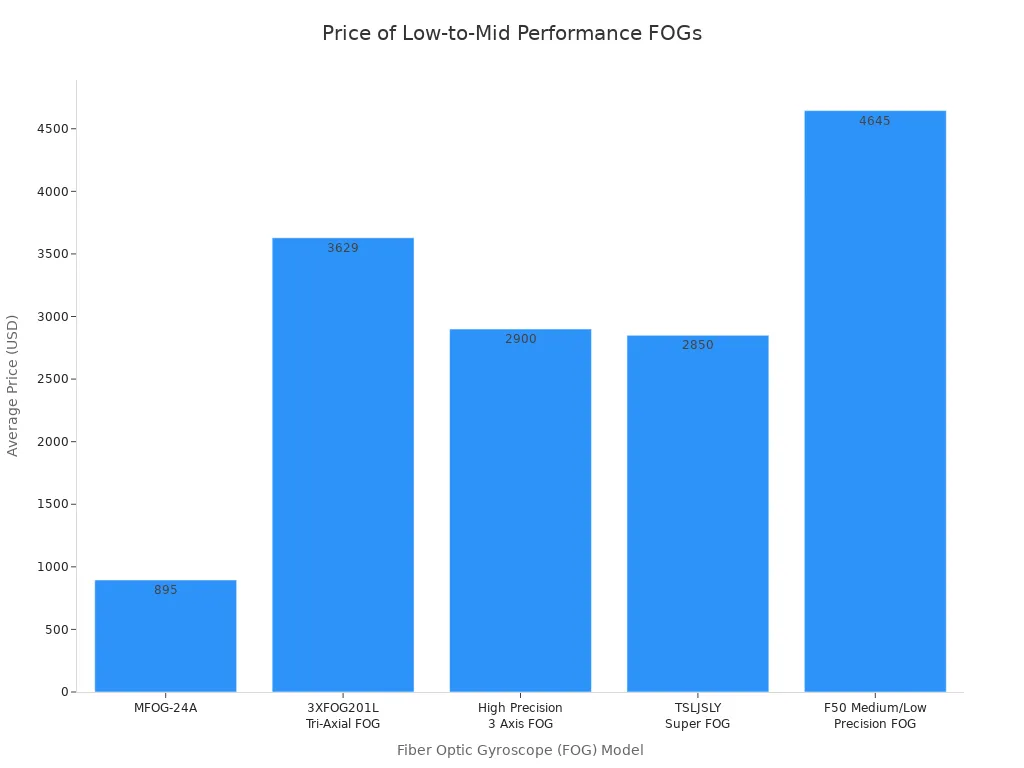
Fiber optic gyroscopes are fundamentally more expensive to produce. The primary cost drivers include:
- High-purity optical fiber
- Precision winding of the fiber coil
- Ultra-stable laser sources
- Complex assembly in cleanroom environments
These factors mean FOGs have a much higher unit price. A single mid-range FOG can cost thousands of dollars, whereas a high-performance MEMS sensor may only cost a fraction of that. This cost structure makes FOGs a choice for high-value systems where performance justifies the expense.
DURABILITY AND ENVIRONMENT
A system's operational environment can dictate the best sensor technology. Both MEMS and FOGs are robust, but they have different strengths and weaknesses.
MEMS gyroscopes are surprisingly tough. Their small, solid-state construction gives them strong impact resistance. Industrial-grade MEMS can tolerate shocks up to 20,000g and vibrations of 6g or more. This makes them suitable for demanding fields like mining and logging. However, the vibrating mechanical structure inside a MEMS sensor can be susceptible to external vibrations, especially at harmonic frequencies. This can increase sensor noise. Temperature is another major factor. The bias of a MEMS sensor can change significantly with temperature variations, requiring sophisticated software compensation to maintain stable navigation performance.
FOGs excel in extreme conditions due to their solid-state design with no moving parts. This makes them exceptionally resistant to shock and vibration. A FOG-based inertial navigation system can withstand impacts of 100g and intense vibrations, making them the top choice for hypersonic aircraft and defense systems. Their performance is also generally more stable across wide temperature ranges, a key advantage for reliable navigation in uncontrolled environments.
APPLICATION DECISION GUIDE

Making the final choice between MEMS and optical gyroscopes requires a clear understanding of project goals. The decision hinges on balancing performance needs with practical constraints. This guide provides scenario-based advice to help project managers select the right technology for their applications.
WHEN TO CHOOSE MEMS
Engineers should choose MEMS gyroscopes if the project prioritizes low Size, Weight, Power, and Cost (SWaP-C). These sensors are the default choice for a huge range of modern systems, especially when a Global Navigation Satellite System (GNSS) signal is consistently available for navigation corrections.
Choose MEMS if... your project involves mobile, battery-powered, or cost-sensitive applications where good performance, not the absolute best, is sufficient.
MEMS technology is ideal for the drone industry. Precision gyroscopes are essential for stabilizing flight, sensing angular movement for navigation, and maintaining balance. Advances in MEMS have made them small, accurate, and power-efficient for these unmanned systems. The required performance often depends on the specific task.
| Performance Grade | Gyro Bias Stability (°/h) | Example Applications |
|---|---|---|
| Industrial/Tactical | 5 – 20 | Robotics, Platform Stabilization |
| High-End Tactical | 0.1 – 5 | Autonomous Systems, Short-Term Navigation |
Consumer electronics also heavily rely on MEMS. Virtual Reality (VR) headsets use MEMS gyroscopes for motion sensing and gesture recognition. For example, STMicroelectronics developed a system using its MEMS sensors for head gesture recognition in VR. Their inertial measurement unit (IMU) combines an accelerometer and a gyroscope. This system accurately recognizes head nods and shakes, showing how MEMS enables complex features in compact, portable devices.
WHEN TO CHOOSE OPTICAL
Project leaders should choose optical gyroscopes if the application demands the highest level of accuracy and stability. This is especially true in environments where GNSS signals are unreliable or completely absent. The superior performance of a highly accurate FOG justifies its higher cost in mission-critical scenarios.
Choose Optical if... your project's success depends on flawless, long-duration navigation without external aiding, and the budget can accommodate a premium component.
Strategic defense systems are a prime example. The precision guidance of advanced weaponry requires gyroscopes with exceptional performance. These applications demand:
- Gyro bias stability near 1°/hr or better
- Extremely low Angle Random Walk (ARW) values
Optical gyroscopes, like fiber optic gyroscopes, meet these strict requirements. Their solid-state nature also makes them highly resistant to the extreme shock and vibration common in defense and aerospace applications. This makes them the top choice for building a robust inertial navigation system. Other high-accuracy scenarios include submarine navigation, where vessels operate underwater for months, and deep-earth mining, where satellite signals cannot penetrate the ground. In these cases, the low drift of optical gyroscopes is essential for safe and accurate navigation.
THE FUTURE: A NEW GYROSCOPE HYBRID
The future of inertial sensing points toward a new gyroscope that combines the best of both worlds. Researchers are developing technologies that aim for the performance of optical gyroscopes with the size and cost benefits of MEMS.
One of the most promising developments is the Nuclear Magnetic Resonance Gyroscope (NMRG). This new gyroscope technology functions by measuring the angular motion of atomic nuclei. It is a rate-integrating sensor with no moving parts. This design makes it a powerful tool for future navigation systems.
Key advantages of this emerging new gyroscope include:
- High precision with the potential to rival optical sensors.
- Compact size and low power consumption, similar to MEMS.
- Insensitivity to acceleration, a major advantage over mechanical gyroscopes.
- Strong anti-interference capabilities.
These characteristics position NMRGs to play a key role in the future of aerospace, aviation, and autonomous navigation. They represent a path toward a precision inertial navigation system that is both high-performing and cost-effective, blurring the lines between today's technology tiers and expanding the possibilities for future applications. The goal is to achieve high accuracy without the traditional trade-offs.
Choosing the right gyroscopes requires balancing project needs. Teams must weigh the required accuracy for navigation against cost and size limits. Advanced MEMS gyroscopes are the top choice for many 2025 applications. They offer great performance for most navigation tasks. However, fiber optic gyroscopes remain the gold standard. They provide unmatched stability for a critical inertial navigation system. This ensures reliable navigation in tough environments where other gyroscopes might fail. The future of navigation may rely on a new gyroscope that combines the best features for future navigation.
FAQ
Why are FOGs so much more expensive than MEMS?
Fiber Optic Gyroscopes (FOGs) use costly materials like high-purity optical fiber. Their assembly requires precision winding and cleanroom environments. MEMS gyroscopes use semiconductor manufacturing. This process allows for mass production and lowers the cost per unit, making them more affordable.
Can I use a MEMS gyro for navigating without GPS?
Yes, for short periods. High-end MEMS gyros support brief navigation without GPS signals. However, their drift is higher than optical gyros. This causes position errors to grow faster over time. FOGs provide much better long-term accuracy in these situations.
Which gyroscope is better for high-vibration environments?
Optical gyroscopes excel in high-vibration areas. They have no moving parts, making them very resistant to shock and intense vibrations.
MEMS gyros contain a tiny vibrating structure. Strong external vibrations can sometimes interfere with their measurements and increase sensor noise, requiring careful system design.
Are MEMS gyros getting good enough to replace FOGs completely?
Not yet. High-performance MEMS now challenge entry-level FOGs for many tasks. However, FOGs remain the top choice for applications needing the absolute highest precision and stability. They are the gold standard for mission-critical navigation where no errors are allowed.