Logic Chips in 2025 How Far We’ve Come Since the First Gates
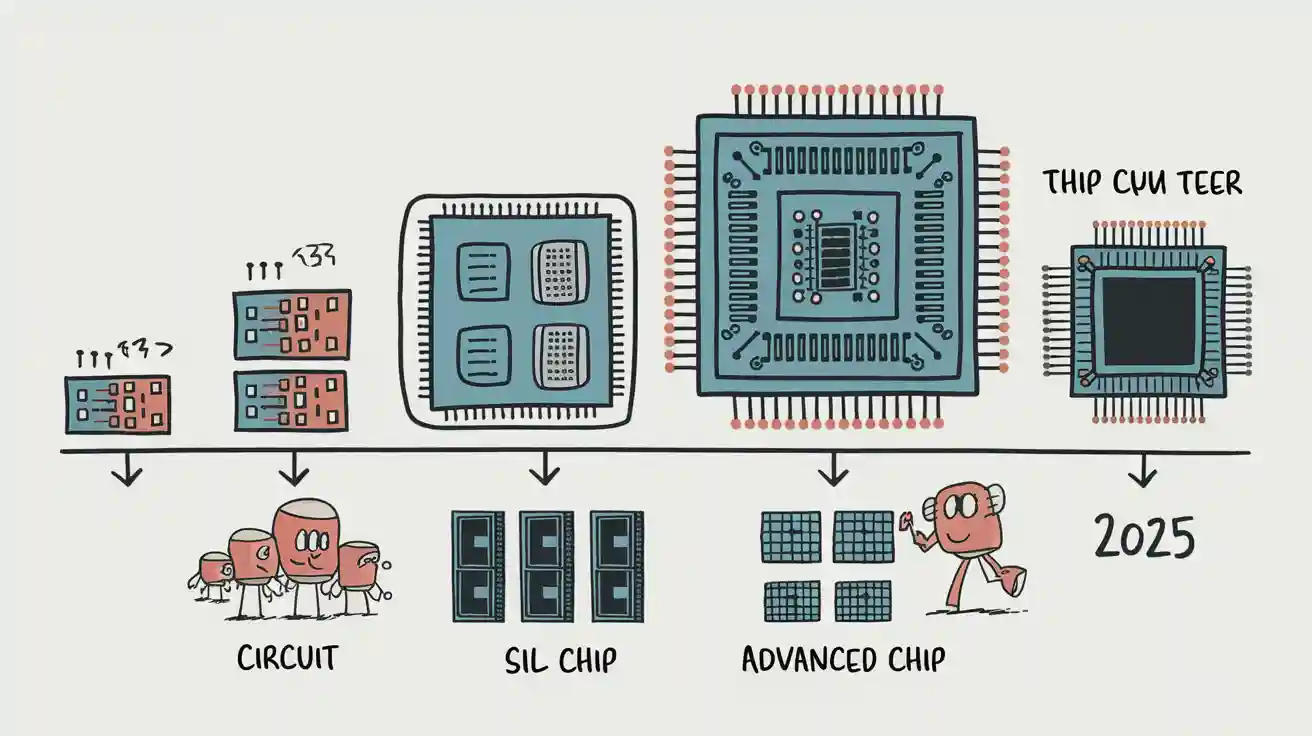
Imagine your smartphone, car, or even a hospital scanner—all powered by tiny circuits. You can trace this digital revolution back to basic logic gates. Consider these milestones:
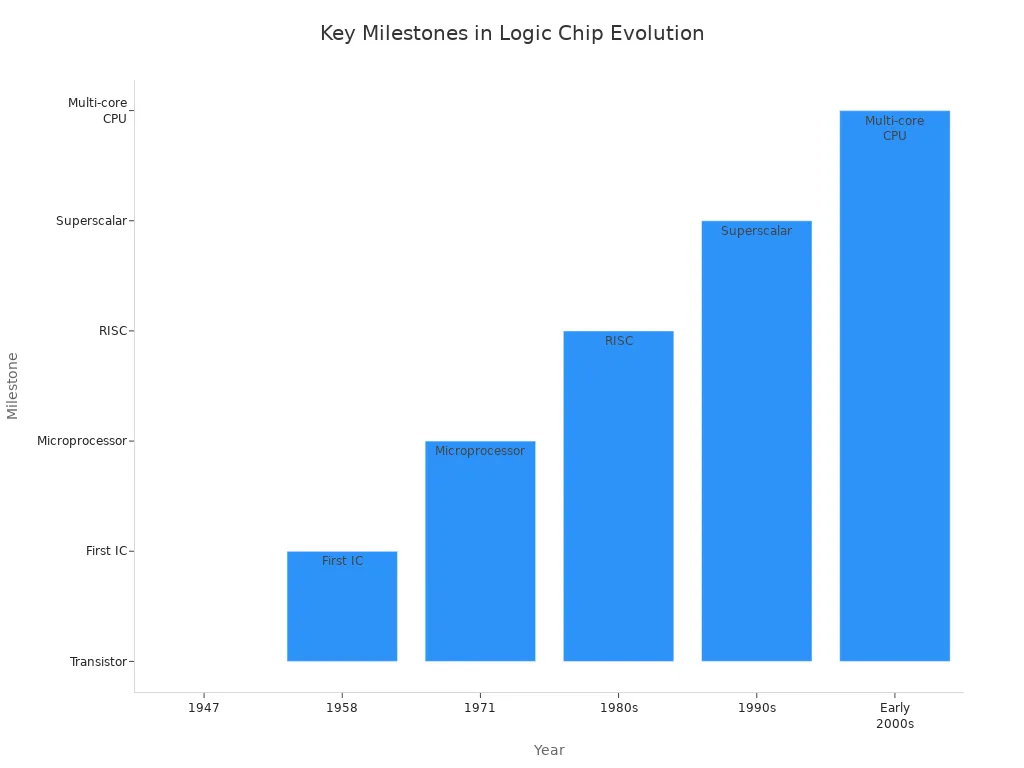
- 1947: Transistor invention started miniaturization.
- 1958: First integrated circuits.
- 1971: First microprocessor.
- 1980s-1990s: Microprocessor power soared.
Today, innovations like nanosheet FETs and GAA transistors push logic chip performance beyond what early engineers dreamed.
| Industry | Application |
|---|---|
| Telecommunications | Logic chips enable fast digital communication in smartphones and routers. |
| Healthcare | Medical imaging devices use advanced logic chips for better diagnostics. |
| Automotive Systems | Logic chips control engines and safety in modern vehicles. |
Key Takeaways
- Logic chips have evolved from simple logic gates to complex microprocessors, enabling the digital devices we use today.
- Innovations like FinFET and GAA transistors improve chip performance, allowing for faster processing and lower energy consumption.
- Specialized AI processors enhance the capabilities of devices, making them smarter and more efficient in everyday tasks.
Logic Chip Evolution
From Logic Gates to Integrated Circuits
You can trace the story of the logic chip back to the basics of math and science. Early engineers used Boolean algebra to design circuits that could make decisions using only two values: true or false. This simple idea became the foundation for all digital electronics.
| Role of Boolean Algebra in Logic Circuits and Integrated Chips | Description |
|---|---|
| Mathematical Framework | Provides a basis for designing and analyzing digital circuits. |
| Simplification of Logical Operations | Converts complex operations into binary values (true/false). |
| Application in Switching Circuits | Introduced by Claude Shannon for circuit analysis and design. |
| Basis for Logic Gates | Essential for the functioning of digital electronics. |
| Efficient Representation of Boolean Functions | Used in modern electronic design automation tools for VLSI circuits. |
| Techniques for Circuit Complexity Reduction | Includes methods like Karnaugh maps to optimize designs. |
You can see how Boolean algebra made it possible to build logic gates like AND, OR, and NOT. These gates became the building blocks for more complex circuits. At first, engineers used vacuum tubes to create these gates, but vacuum tubes were large and unreliable.
The invention of transistors changed everything. Transistors replaced vacuum tubes and made it possible to shrink circuits. You could now fit more components into a smaller space. This breakthrough led to the first integrated circuits, where many transistors worked together on a single chip.
| Breakthrough | Description |
|---|---|
| Development of Transistors | Transistors replaced vacuum tubes, enabling the creation of integrated circuits (ICs) that allowed multiple transistors to be fabricated on a single silicon chip, reducing size and power consumption. |
| Register-Transfer Level (RTL) Design | Introduced a higher abstraction level for describing digital circuits, focusing on data flow and control without delving into transistor-level details. |
| Hardware Description Languages (HDLs) | Languages like Verilog and VHDL allowed engineers to programmatically describe, simulate, and verify complex digital systems, accelerating the development of application-specific integrated circuits (ASICs) and FPGAs. |
| Computer-Aided Design (CAD) Tools | Provided automated placement and routing capabilities, timing analysis, and power optimization, streamlining the design process and enabling the assembly of systems-on-chip (SoCs). |
- First Semiconductor Integrated Circuit (IC), 1958: On September 12, 1958, Jack S. Kilby demonstrated the first working integrated circuit. This moment marked the start of a new era in electronics.
You can think of the integrated circuit as a tiny city, with transistors acting as the buildings and roads. Each chip could now hold thousands, then millions, of transistors. This made computer chips smaller, faster, and more reliable.
The Rise of the Microprocessor
The next big leap came with the first microprocessor. In 1971, Intel introduced the 4004 microprocessor. This chip packed thousands of transistors into a space smaller than a fingernail. For the first time, you could have a central processing unit, or CPU, on a single chip.
- The transistor enabled the miniaturization of electronic components, allowing for more transistors to fit into smaller spaces.
- Integrated circuits in the 1960s allowed multiple transistors on a single chip, reducing size and cost.
- The introduction of microprocessors in the 1970s, containing thousands of transistors, further accelerated miniaturization and increased computational power.
"People were … locked into the concept that a computer was a precious, multi-million-dollar piece of equipment. … With this product, we changed people's perception of computers and the direction that the computing industry would go. We democratized the computer."
The 4004 became the first commercial microprocessor available for general use. You could now build smaller, more affordable devices. The microprocessor revolution began, and it took about five years for engineers to learn how to use these new chips in products. Once they did, the world of computing changed forever.
| Year | Advancement | Description |
|---|---|---|
| 1971 | Intel 4004 | The first commercially available microprocessor, using 2300 transistors and capable of executing 92,600 instructions per second. |
| 1980 | RISC Architecture | Introduced by Patterson and Ditzel, emphasizing a simplified instruction set to optimize performance on single-chip designs. |
| 1985 | ARM Architecture | Developed by Acorn Computers, designed as a 32-bit machine to improve performance and memory bandwidth utilization. |
You can see how the combination of transistors into logic gates allowed engineers to build more complex circuits. Transistors act as electronic switches that turn on and off. Logic gates, made from these switches, process binary data. Gates like AND, OR, NOT, and XOR form the foundation for all modern chips.
- Moore's Law predicted that processing speed and transistor count would double every two years. This trend held for decades, driving the growth of microprocessor performance.
- Today, chips like AMD's Epyc processors have 19 billion transistors. NVIDIA's GP100 Pascal GPU has 15 billion transistors. These numbers show how far you have come since the first microprocessor.
The growth of transistor production in logic chips has fueled the rise of computing technologies. You now see multi-core CPUs and AI accelerators that rely on billions of transistors to deliver incredible speed and power. The journey from the first microprocessor to today's advanced chips shows how innovation in chip design shapes your digital world.
Integrated Circuit and CPU Advances
FinFET and Gate-All-Around Innovations
You live in a world where chips keep getting smaller and faster. This progress comes from new ways to build transistors, the tiny switches inside every logic chip. After the first microprocessor, engineers needed to fit more transistors onto each chip. They wanted to make computer chips more powerful without using more energy.
FinFET and Gate-All-Around (GAA) technologies changed the game. FinFET stands for "Fin Field-Effect Transistor." It uses a 3D structure that looks like a fin. This design gives you better control over the flow of electricity. GAA transistors take this idea further. They wrap the gate all the way around the channel, which means you get even more control and less leakage.
Here is a table that shows the key innovations and advantages of these technologies:
| Technology | Key Innovations | Advantages over Previous Technology |
|---|---|---|
| FinFET | Introduction of trigate control for extended gate-length scaling | Significant architectural shift in transistor design |
| GAA-FET | Superior gate coupling for precise channel tuning, reduced Short Channel Effects | Best electrostatic control with nanowires and higher 'on' current with nanosheets |
You can see how these changes help chips work better. FinFETs switch on and off much faster than older designs. They also let more current flow, which boosts performance. GAA transistors give you even more precise control, so your chips use less power and run cooler.
| Technology | Improvement Type | Description |
|---|---|---|
| FinFET | Switching Times | FinFETs exhibit significantly faster switching times compared to traditional planar CMOS. |
| FinFET | Current Density | Higher current density is achieved with FinFETs, enhancing overall performance. |
| Gate-All-Around | Channel Control | GAA technology allows for better control over the channel, improving performance metrics. |
Transistor density has exploded over the years. In 1947, you had only one transistor. Today, the world produces almost 2 billion trillion transistors each year. Since 1971, the number of transistors in logic circuits has grown more than 600,000 times. This growth lets you use devices that are faster, smaller, and more reliable than ever before.
Multicore CPUs and Computer Chips Today
You use devices every day that rely on powerful microprocessors. In the past, a central processing unit had only one core. That meant it could handle only one task at a time. As you demanded more from your devices, engineers created multicore CPUs. Now, a single chip can have two, four, or even dozens of cores.
This shift changed computing in big ways:
- Multicore CPUs make your computer faster and more efficient.
- You can run many programs at once because each core handles a different task.
- Video editing, gaming, and other demanding jobs run smoother with more cores.
- Multicore designs save energy by spreading work across several cores, so each one uses less power.
You see these advances in all kinds of computer chips. Smartphones, tablets, and laptops use sophisticated processing units to deliver fast performance. Servers and supercomputers use even more advanced chips to solve big problems in science and business.
The design of these chips keeps evolving. Engineers use new materials and layouts to pack more transistors into each chip. They also use smarter ways to connect the cores and manage power. This makes your devices last longer and work better.
Economic factors play a big role in how new CPU technologies spread. When productivity grows in information and communication technology (ICT), the price of investing in ICT drops. This lowers the cost of capital for many industries. Since the mid-1990s, falling prices and better semiconductor technology have helped more people and companies use advanced chips. Large companies often adopt new processors first, especially when older technology still works well. Sometimes, smaller companies move faster if new chips make old ones obsolete.
You benefit from these changes every day. The chips in your devices are smarter and more powerful than ever. The journey from the first microprocessor to today’s sophisticated processing units shows how far you have come. The future of computing depends on how you keep improving chip design, balancing performance, power, and cost.
AI and the Future of Logic Chips
Specialized AI Processors
You see AI everywhere in 2025. The logic chip inside your phone or car does more than basic math. It learns, predicts, and adapts. Specialized processors make this possible. You find several types in modern computing:
- GPUs handle many tasks at once. They train AI models and speed up graphics.
- FPGAs let you reprogram chips for new jobs. They work well for image and video processing.
- ASICs focus on one job. They run AI tasks faster and use less energy.
- NPUs help deep learning and neural networks. They beat GPUs in some AI tasks.
You use computer chips with these processors in smartphones, smart home devices, and even spacecraft. Google’s TPU boosts deep learning. NVIDIA’s chips use AI to manage power and heat. These advanced microchips make your devices smarter and more efficient.
Societal Impact in 2025
AI-enabled logic chips change how you live and work. You see them in embedded systems everywhere:
- Your phone uses AI to recognize faces and voices.
- Spacecraft use chips to spot wildfires and monitor disasters.
- Satellites filter images and alert you to strange events.
- Maintenance software checks satellite health with sensor data.
- Autonomous chips help probes pick landing sites and dodge space debris.
You find embedded systems in air conditioners, rice cookers, and medical devices. These chips power banking ATMs and hospital networks. In cars, embedded systems help with driver assistance and safety.
Advancements in logic chip design shape society. You interact with technology in new ways. Families, schools, and cities change as chips become part of daily life. Experts predict the AI market will grow fast, reaching $733.7 billion by 2027. Modern computing relies on chips that focus on efficiency, not just speed. You see changes in healthcare, automotive, and industry. Europe explores new materials and sustainable chip designs to stay strong in the global market.
You live in a world where embedded systems and computer chips connect everything. The future of computing depends on how you use these chips to solve problems and improve life.
You have seen logic chips evolve through major milestones:
| Year | Milestone | Impact |
|---|---|---|
| 1947 | Transistor | Electronics became smaller and more efficient. |
| 1958 | Integrated Circuit | Devices became faster and more reliable. |
| 1971 | Microprocessor | Personal computers became possible. |
Smart devices now help you stay safe, healthy, and connected every day. You will see even more powerful chips as AI, 5G, and cloud computing grow.
FAQ
What is the difference between microcontrollers and microprocessors?
You use microcontrollers for simple tasks like controlling lights or motors. Microprocessors run computers and handle complex jobs. Microcontrollers work inside many devices you use every day.
How does MOS technology help with miniaturisation in computer chips?
MOS technology lets you shrink computer chips. You get more transistors on a semiconductor. Miniaturisation makes your devices faster, smaller, and more energy efficient.
Tip: You find MOS transistors in almost every modern computer, microcontrollers, and system-on-chip designs. They help boost performance and save power.
Why do you see SOC and system-on-chip in new computers?
SOC combines microcontrollers, MOS transistors, and other parts on one semiconductor chip. You get faster computers, lower power use, and smaller devices. SOC helps you use smart technology everywhere.
| Term | What You Get |
|---|---|
| SOC | Faster computers, lower power, smaller size |
| System-on-chip | All parts on one semiconductor chip |
| Microcontrollers | Control simple tasks in many devices |
| MOS | Key for miniaturisation and performance |