LM7805 Overview What It Is and How It Works in 2025
You often need a way to power your electronics safely. The 7805 voltage regulator helps you do this by turning a higher voltage into a steady 5V. Many hobbyists and engineers trust the 7805 voltage regulator for a stable output voltage in their circuits. The lm7805 works as a reliable regulator, so your devices get the power they need without risk of damage.
Key Takeaways
- The LM7805 voltage regulator provides a steady +5V output from higher input voltages, making it essential for powering various electronic devices safely.
- Built-in protection features, such as thermal shutdown and short-circuit protection, help keep your circuits safe from damage.
- Using capacitors on both the input and output sides of the LM7805 stabilizes voltage and reduces noise, enhancing performance.
- Always check the input voltage and ensure proper pin connections to avoid damaging the LM7805 and ensure reliable operation.
- The LM7805 remains a popular choice in 2025 due to its affordability, ease of use, and versatility in various electronics projects.
LM7805 Basics
What Is LM7805?
You may wonder what the lm7805 is and why so many people use it in electronics. The lm7805 is a type of 7805 voltage regulator. It helps you get a steady +5V output from a higher input voltage. You can find this regulator in many devices, from microcontrollers to sensors. The lm7805 voltage regulator includes special protection features that keep your circuits safe.
- The lm7805 gives you a consistent +5V output.
- It has built-in thermal overload protection.
- It prevents short circuits.
- You can use it in many applications, including robotics and DIY projects.
Tip: If you want to power a microcontroller or sensor safely, you can use the lm7805 to make sure the voltage stays at 5V.
LM7805 Voltage Regulator Function
You use the 7805 voltage regulator to keep your devices running smoothly. This regulator takes a higher voltage and lowers it to a safe 5V. It does this by using a feedback loop that checks the output and adjusts it as needed. The 7805 voltage regulator also protects your circuit from overheating and overloads.
- Maintains a stable output voltage of +5V.
- Uses thermal shutdown to stop overheating.
- Handles current to prevent overloads and short circuits.
- Uses a feedback loop for accurate voltage regulation.
The 7805 voltage regulator is very reliable. You can use it in fixed-output regulators, adjustable output regulators, and systems that need dual supplies. Its main job is to keep the voltage steady at 5V. This is important in places like labs, where you need precise voltage control.
Note: If you want your electronics to last longer and work better, you should use a 7805 voltage regulator for stable voltage regulation.
LM7805 Features
7805 Voltage Regulator Specs
You need to know the main specifications before using the 7805 voltage regulator. This regulator works best when you supply it with the right input voltage range and do not exceed its limits. The table below shows the most important specs:
| Specification | Value |
|---|---|
| Input Voltage Range | 7V to 18V |
| Maximum Input Voltage | 30VDC |
| Typical Output Voltage | 5V |
| Output Voltage Range | 4.8V to 5.2V |
| Maximum Output Current | 350mA |
You get a fixed output voltage of 5V, which is perfect for many digital circuits. The 7805 voltage regulator can handle up to 350mA of output current. If you use a higher input voltage or draw more current, the regulator will heat up. You should always check the temperature during use.
Internal Components
Inside the 7805 voltage regulator, you find several key parts that help with voltage regulation. The main pass transistor controls the current flow from input to output. A voltage reference keeps the output steady, even if the input changes. An operational amplifier checks for errors and helps adjust the output. Overload protection keeps your circuit safe if you draw too much current.
- The pass transistor manages current flow for a stable output.
- The voltage reference keeps the voltage steady.
- The operational amplifier boosts error signals for better control.
- Overload protection stops damage from too much current.
These parts work together to give you reliable voltage every time you use the regulator.
Thermal Protection
The 7805 voltage regulator uses a built-in thermal protection circuit. If the regulator gets too hot, it will shut down to prevent damage. This feature keeps your projects safe from overheating. You can bolt the regulator to a metal case or use a heat sink to help remove heat. Always check if the regulator feels hot during testing. If it does, add a heat sink or improve airflow.
Tip: The 7805 voltage regulator works well from 0°C to 125°C. If you go above this range, the regulator may not last as long or work as well.
LM7805 Pinout
Pin Configuration
You need to know how to identify the pins on the LM7805 voltage regulator before you start wiring your circuit. The LM7805 has three pins, and each pin has a specific function. You can see the standard pin configuration in the table below:
| Pin Number | Function |
|---|---|
| 1 | Input (V+): Unregulated Input Voltage |
| 2 | Ground (Gnd): Connection to Ground |
| 3 | Output (Vo): Regulated +5V Output |
Pin 1 receives the unregulated input voltage. Pin 2 connects to ground. Pin 3 gives you the regulated 5V output. You must connect each pin correctly to make sure the regulator works as expected. If you mix up the pins, your circuit may not get the right voltage or could even get damaged.
Tip: Always double-check the pin numbers on your LM7805 before soldering or plugging it into a breadboard. This helps prevent mistakes and keeps your devices safe.
Circuit Connection
You can connect the LM7805 voltage regulator to your circuit by following a few simple steps. These steps help you get a stable 5V output and protect your components.
- Supply an input voltage at least 2V higher than the output. For a 5V output, use an input voltage range starting at 7V.
- Keep the output current below 100mA to avoid overheating the regulator.
- Attach a heat sink if you expect the regulator to run near its maximum output current.
- Place capacitors close to the regulator pins. This reduces noise and keeps the voltage stable.
You should also think about safety when using the LM7805. Reverse polarity can destroy the regulator and other parts. You can add a fuse in series to protect your circuit from high short circuit currents. Using an anti-parallel diode helps blow the fuse if you connect the battery backwards. Keyed connectors can prevent misconnection and keep your voltage regulator safe.
| Safety Consideration | Description |
|---|---|
| Reverse Polarity Protection | The LM7805 can be destroyed if reverse polarity is applied, leading to damage. |
| Use of a Fuse | A series fuse protects the PCB from high short circuit currents. |
| Diode Implementation | An anti-parallel diode can blow the fuse if the battery is connected backwards. |
| Connector Keying | Keying connectors helps prevent misconnection and reverse polarity issues. |
Note: You can improve the reliability of your voltage regulator by following these connection and safety tips. This helps your circuit deliver a steady voltage and protects your devices.
IC 7805 Voltage Regulator Working
Operation Principle
You can understand how the ic 7805 voltage regulator working process keeps your devices safe and powered. The LM7805 uses a simple but effective method to control voltage. Here is how the regulator works step by step in a typical circuit:
-
Input Voltage
You supply an unregulated voltage to Pin 1 of the LM7805. This voltage must be higher than 5V. Most circuits use 7V to 12V for best results. -
Voltage Regulation
Inside the regulator, several components work together. A series pass transistor controls the flow of current. A reference voltage generator creates a stable 5V reference. A feedback network checks the output voltage and compares it to the reference. -
Adjusting Output
If the output voltage changes, the feedback network reacts. It adjusts the resistance of the pass transistor. This action brings the output back to 5V. The regulator repeats this process constantly, so your devices always get a steady voltage. -
Output Voltage
You receive a regulated 5V at Pin 3. You can use this output to power microcontrollers, sensors, and other electronics. -
Protection Mechanisms
The LM7805 includes built-in protection. Thermal shutdown stops the regulator if it gets too hot. Short-circuit protection keeps your circuit safe if something goes wrong. Safe operating area protection helps the regulator work reliably under different conditions.
Tip: You should always check the input voltage before connecting the LM7805. Using a voltage that is too low or too high can cause the regulator to fail.
Supporting Components
You need supporting components to help the LM7805 work well and last longer. These parts improve voltage stability and protect the regulator from damage.
-
Capacitors
You should use capacitors on both the input and output sides of the regulator. A 330nF capacitor on the input helps keep the voltage stable, especially if the main supply capacitors are far away. On the output, you should use a 10-100µF aluminum capacitor with an ESR between 0.5 and 1 ohms. Adding a 100nF decoupling capacitor close to the load reduces noise and keeps the voltage clean. -
Heat Sink
The LM7805 can get hot when you use it with high input voltage or high current. You should attach a heat sink to the regulator. This helps remove heat and keeps the regulator working well. Good heat management prevents overheating, which can cause voltage instability or damage. You can use thermal interface materials and make sure there is enough airflow for passive cooling.
| Supporting Component | Purpose | Recommended Value/Type |
|---|---|---|
| Input Capacitor | Stabilizes input voltage | 330nF |
| Output Capacitor | Smooths output voltage, reduces noise | 10-100µF, ESR 0.5-1Ω |
| Decoupling Capacitor | Filters high-frequency noise | 100nF, placed near the load |
| Heat Sink | Dissipates heat, prevents overheating | Metal fin or case, good airflow |
Note: You should always place capacitors close to the regulator pins. This helps the LM7805 respond quickly to changes in voltage and load.
You can see that supporting components play a big role in voltage regulation. They help the 7805 voltage regulator deliver a steady output and protect your devices from voltage spikes and heat. If you use the right capacitors and a heat sink, you make your regulator more reliable and extend its life.
LM7805 Applications and Issues
Practical Uses
You can use the 7805 voltage regulator in many electronics projects. It helps you create a regulated power supply for devices that need a stable output voltage. Here are some common 7805 voltage regulator applications:
- Stabilized dual power supply
- Current regulator
- Positive regulator
- Adjustable output regulator
- Fixed output regulator
- Reverse bias protection circuit
- Output polarity reverse protection circuit
You often see the lm7805 in real-world projects. The table below shows examples of devices and systems that use this regulator:
| Project Description | Components Used |
|---|---|
| Power supply unit for a DC gear motor | Bridge rectifier, electrolytic capacitor, 7805 voltage regulator, LED with series resistor |
| 12V to 5V regulated power supply with LED indicator | 5408 diode, 7805 voltage regulator, push switch, capacitors, resistor |
| Solar-powered battery charging and LED lighting system | Solar cell, TP4056 charging module, 7805 voltage regulator, photocell, MOSFET, high-power LED |
| Complex system with multiple power regulation components | 7805 and 7808 voltage regulators, PIR and IR sensors, Arduino Nano, DFPlayer Mini, motor driver |
You can use fixed linear voltage regulators like the 7805 to keep your circuits safe and reliable.
Common Issues
You may face some problems when using the 7805 voltage regulator. Here are the most reported issues:
- The regulator can overheat and enter thermal shutdown, which affects performance.
- You should use heatsinks to help manage heat.
- If the regulator fails, the output voltage may rise close to the input voltage. You may need to replace the regulator often.
- The 7805 voltage regulator has low efficiency and produces a lot of heat.
- Instability in output voltage can happen. Placing capacitors close to the regulator helps stabilize the voltage.
The dropout voltage is another important factor. The 7805 voltage regulator has a typical dropout voltage of 2V. You need an input voltage at least 2V higher than the output. If you use less than 7V as input, the regulator may not work correctly.
Tip: Always check the input voltage and use proper heatsinking to avoid overheating and instability.
LM7805 vs Other Regulators
You may wonder how the 7805 voltage regulator compares to other options. The table below shows differences between the LM7805 and LM317:
| Feature | LM7805 | LM317 |
|---|---|---|
| Output Voltage | Fixed 5V | Adjustable (1.25V to 37V) |
| Current Output | Lower current | Higher current |
| Complexity of Design | Simpler | Needs more components |
| Efficiency | Less efficient at high input voltages | Less efficient at high input voltages |
You can also compare the LM7805 to low-dropout and switching regulators:
| Feature | LM7805 | Low-Dropout Regulators (LDO) | Switching Regulators |
|---|---|---|---|
| Efficiency | ~33% | Higher than LM7805 | Typically ~80% |
| Heat Dissipation | High | Lower | Much lower |
| Noise | Lower | Moderate to high | Higher |
| Cost | Low | Moderate to high | Moderate to high |
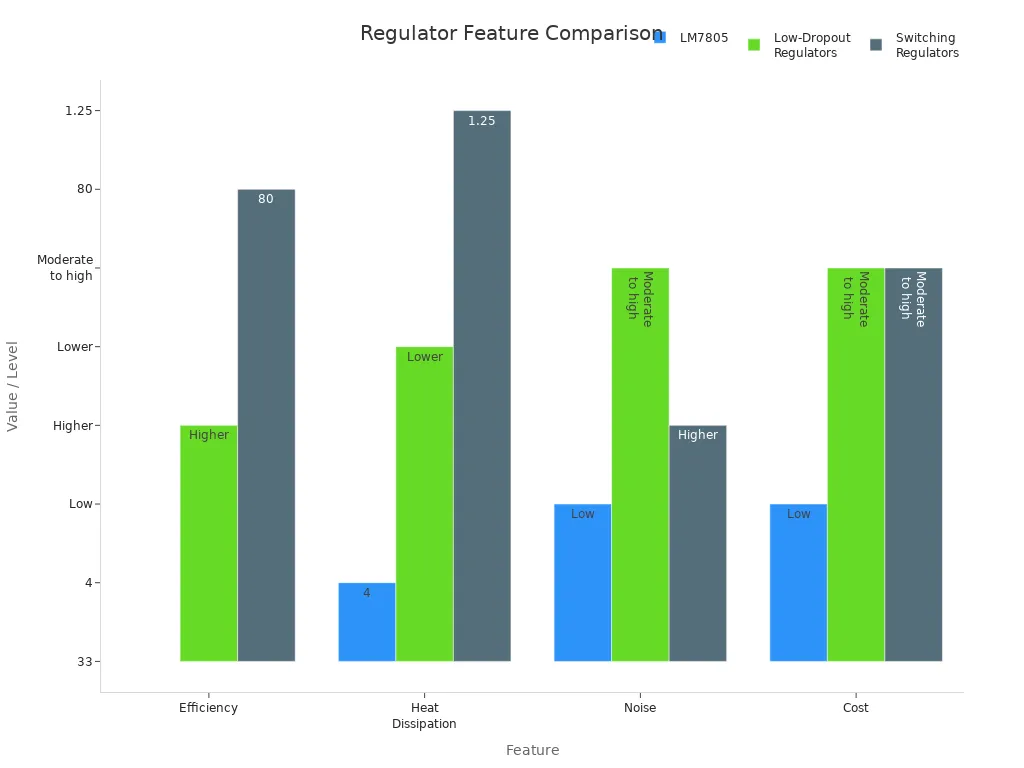
You can use the LM317 for adjustable output or switch to more efficient switching regulators if your project needs better performance. Some projects use split rail converters for dual output. You can also modify the LM7805 for adjustable output regulation.
You benefit from the LM7805 in your electronics projects because it offers:
- Easy availability
- Affordable price
- Versatile functionality
- User-friendly design
- Reliable performance
You find the LM7805 remains relevant in 2025 for these reasons:
- It powers microcontrollers and sensors with stable voltage.
- It adapts to adjustable regulation and current limiting.
- It protects circuits with polarity-reversal features.
| Feature | Description |
|---|---|
| Simplicity | Easy to use with minimal external components. |
| Low Cost | Economically favorable for various applications. |
| Built-in Protection Features | Includes thermal shutdown and current limiting. |
You can trust the LM7805 to deliver consistent voltage and keep your devices safe.
FAQ
How do you know if your LM7805 is working?
You can measure the output voltage with a multimeter. Place the probes on the output and ground pins. You should see about 5V. If you see a much higher or lower value, the regulator may not work correctly.
Can you use the LM7805 without a heat sink?
You can use the LM7805 without a heat sink for low current loads. If your circuit draws more than 100mA or the input voltage is much higher than 5V, you should add a heat sink to prevent overheating.
What happens if you reverse the input voltage?
Reversing the input voltage can damage the LM7805. You should always double-check your connections. Adding a diode for reverse polarity protection helps keep your regulator and circuit safe.
Why do you need capacitors with the LM7805?
Capacitors help stabilize the voltage and reduce noise. Place a capacitor at the input and another at the output. This setup improves performance and protects your devices from voltage spikes.
Can you use the LM7805 to power a Raspberry Pi?
You should not use the LM7805 to power a Raspberry Pi. The Pi needs more current than the LM7805 can safely provide. Use a dedicated 5V power supply with enough current for your Raspberry Pi.