LM2596 vs LM2576 A Practical Comparison for Hobbyists
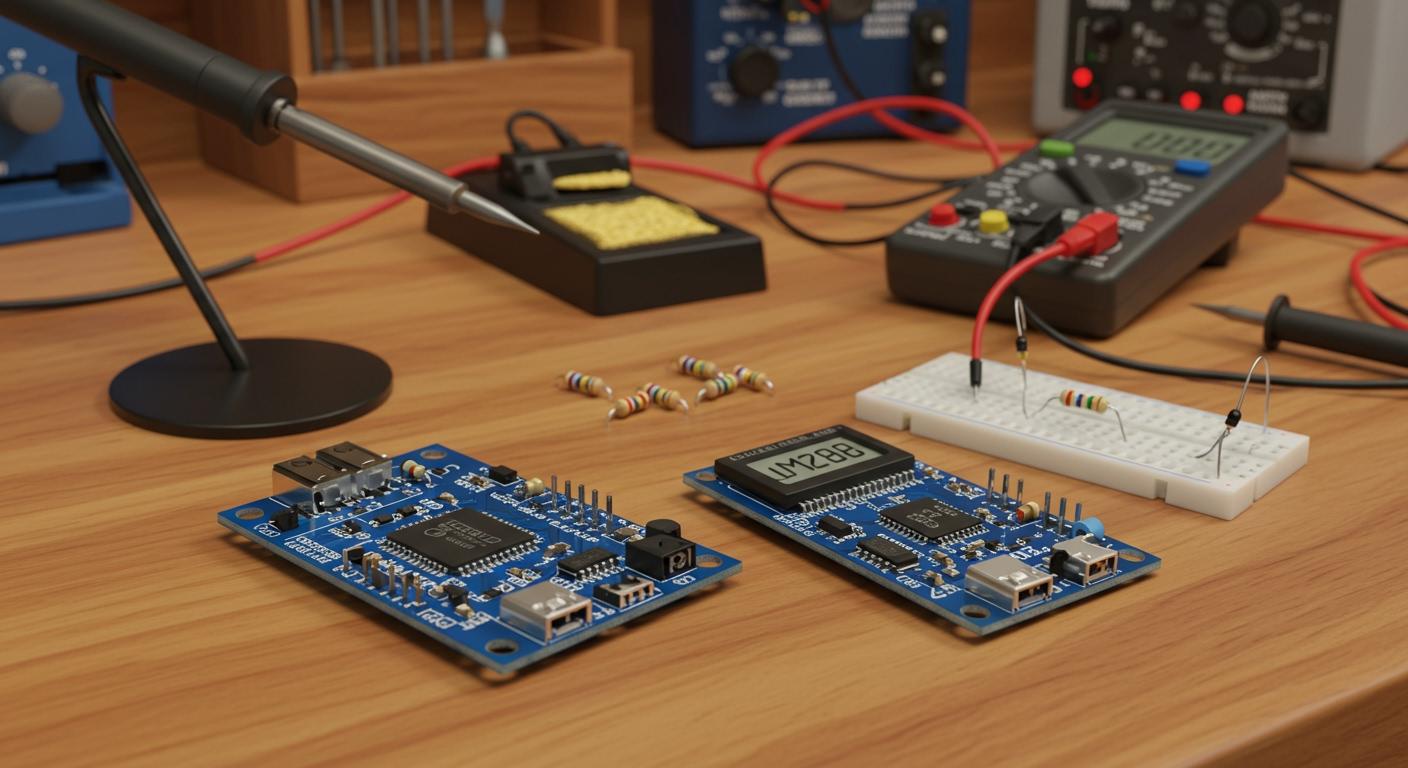
You need to choose between two popular voltage regulators. For your new hobbyist projects, the LM2596 is the clear winner. The primary advantage of the LM2596 is its higher switching frequency.
What this means for you:
- Smaller external components (inductors and capacitors)
- More compact and cost-effective final circuits
This single difference makes the LM2596 a superior choice for modern designs. Let's explore the practical reasons that make the LM2596 the go-to option for your next build.
Key Takeaways
- The LM2596 is better for new projects. It uses a faster switching speed.
- The LM2596 needs smaller parts. This makes your circuits smaller and cheaper.
- Both chips are easy to use. They have the same pins, but the LM2596 is more modern.
- Choose the LM2596 for most new builds. It helps you make compact and efficient projects.
AT-A-GLANCE COMPARISON
To understand why the LM2596 is the better choice, you can look at a direct comparative analysis. This table highlights the key differences that matter most for your projects.
| Feature | LM2576 | LM2596 |
|---|---|---|
| Switching Frequency | 52 kHz (Slower) | 150 kHz (Faster) |
| Typical Inductor Size | Larger | Smaller |
| Output Voltage Range | 1.23V - 37V | 1.25V - 37V |
| General Use Case | Legacy Designs | New Designs |
THE LM2576 VOLTAGE REGULATOR
The LM2576 voltage regulator is a workhorse. For many years, it was a popular choice for projects needing a reliable step-down regulator. This buck converter operates at a switching frequency of 52 kHz. This lower frequency requires larger external components, especially the inductor.
Pin-for-Pin Compatible! 📌 You will find that both the LM2576 and LM2596 are available in the same TO-220 and TO-263 packages. They even share the exact same pin functions, making them physically interchangeable in a circuit.
The LM2576 voltage regulator provides a steady 3A of output current. Its output voltage range is also very flexible, making it useful for many DC applications. However, its age shows in its core specification.
THE SUPERIOR LM2596
The LM2596 is the modern successor. The LM2596 voltage regulator operates at a much higher switching frequency of 150 kHz. This is nearly three times faster than the LM2576. This higher frequency is the main reason the LM2596 is superior for your new builds. It allows you to use smaller and cheaper inductors and capacitors.
Like its older counterpart, the LM2596 is a step-down voltage regulator that delivers a continuous 3A of output current. The output voltage range is nearly identical, so you do not lose any flexibility. The LM2596 simply performs the same job more efficiently in a smaller footprint. This makes the LM2596 the ideal converter for compact and cost-effective electronics.
THE VERDICT FOR HOBBYISTS
So, what does this mean for you? When choosing between these two voltage regulators, the decision is simple.
- For new projects: Always choose the LM2596. You get a more modern design that allows for a smaller, lighter, and cheaper final circuit.
- For existing designs: If you are repairing or modifying an old circuit with an LM2576, you can often upgrade it with an LM2596. You will just need to replace the inductor and capacitors with values appropriate for the higher frequency.
For hobbyists, the benefits of the LM2596 are clear. You build better, more compact projects without any extra complexity.
SWITCHING FREQUENCY EXPLAINED
We mentioned that the higher switching frequency of the LM2596 is its biggest advantage. Now, let's break down what that means for your project. Understanding this single concept will make you a more confident builder.
WHAT IS SWITCHING FREQUENCY?
Imagine a light switch you are flipping on and off very quickly. A switching regulator works in a similar way. The switching frequency is simply the speed at which the regulator’s internal switch turns on and off to regulate voltage. This speed is measured in Hertz (Hz) or kilohertz (kHz).
These DC-DC converters use high-frequency circuits, often operating between 50 kHz and 500 kHz. The switching frequency is a critical parameter. It directly affects the physical size of the inductor and capacitors you need. It also plays a big role in the regulator's efficiency and performance. The LM2596 operates at a much faster frequency than its older counterpart.
FREQUENCY AND COMPONENT SIZE
Here is the most important takeaway for you: a higher switching frequency allows you to use smaller external components. This has a huge impact on your circuit design.
- Higher frequencies let you use inductors and capacitors that are physically smaller.
- Smaller components often cost less money.
- Using smaller parts helps you design a more compact and professional-looking project.
Why does this happen? The relationship is based on a simple principle of physics. The formula V = L * dI/dt shows how voltage, inductance (L), and the change in current (dI/dt) are related. In a buck converter, the switch turns on for a very short time (dt). A higher frequency means this "on time" is even shorter. Because the time is shorter, the inductor (L) does not need to be as large to handle the energy transfer. The LM2596 leverages this principle perfectly.
WHY 150 KHZ BEATS 52 KHZ
Now you can see the clear difference. The LM2596 switches at 150 kHz, while the older LM2576 switches at only 52 kHz. The LM2596 is nearly three times faster. This speed difference has a direct and practical benefit for your builds.
Real-World Component Differences 💡 For a typical 5V output circuit, you might use a 100µH inductor with the LM2576. For the exact same circuit with an LM2596, you would likely use a much smaller and cheaper 33µH inductor.
This is not just a minor improvement. Choosing the LM2596 means your power supply section can be significantly smaller and lighter. For projects like portable gadgets, robotics, or anything you want to fit into a small enclosure, this is a massive advantage. These two voltage regulators may have a similar output voltage range, but the modern design of the LM2596 makes it the superior choice for new projects.
IMPACT ON YOUR PROJECT COMPONENTS
Your choice of regulator directly changes the parts you will use on your circuit board. The higher frequency of the lm2596 allows you to select smaller, more efficient components. Let's see how this affects your build.
CHOOSING THE RIGHT INDUCTOR
The inductor is the largest component in a switching regulator circuit. Its job is to store energy. The faster switching speed of the lm2596 means the inductor needs to store energy for a shorter time. This allows you to use an inductor with a lower value and a smaller physical size.
- LM2576 Circuit: Often needs a 100µH to 330µH inductor.
- LM2596 Circuit: Typically uses a much smaller 33µH to 100µH inductor.
You can find the exact value in the datasheet charts. For most projects, choosing the lm2596 simply means you can pick a smaller and cheaper inductor.
CAPACITOR CONSIDERATIONS
Capacitors smooth out the voltage to give you a clean DC output. The higher frequency of the lm2596 creates smaller ripples in the output voltage. This means you can use output capacitors with a lower capacitance value.
Pro Tip: Check the ESR! 💡 Always use low ESR (Equivalent Series Resistance) capacitors for switching regulators. This is more important than the capacitance value for ensuring a stable output. Both the input and output capacitors are critical for proper operation.
BUILDING A MORE COMPACT CIRCUIT
Smaller inductors and smaller capacitors lead to one obvious benefit: a smaller circuit. You can shrink the power supply section of your project board significantly. This modern buck converter design is perfect for projects where every millimeter counts, like drones, robots, or portable gadgets. While both chips offer a similar output voltage range, the ability to build a more compact and cost-effective circuit makes the lm2596 the clear winner for your new designs. Your final project will look more professional and fit into tighter spaces.
EFFICIENCY, HEAT, AND THE LM2596 VOLTAGE REGULATOR
You know that the lm2596 allows for a smaller circuit, but what about performance? Efficiency and heat are key parts of power management. While the lm2596 is the more modern chip, you will find that both of these voltage regulators handle heat very well in most hobbyist situations.
REAL-WORLD EFFICIENCY
Both chips offer high efficiency because they are switching regulators. They do not burn off excess energy as heat like older linear regulators. The lm2596 voltage regulator generally provides slightly higher efficiency than the LM2576. However, for many low-power projects, like powering a microcontroller that draws very little current, the actual difference in wasted power is tiny. You might only save a few milliwatts. This is a good example of practical power management.
MANAGING HEAT DISSIPATION
Wasted energy from the conversion process becomes heat. Luckily, both chips are designed to handle this well. For many of your projects, you will not need to add a heatsink.
This excellent thermal performance makes building simple power supplies much easier.
IS HIGHER EFFICIENCY ALWAYS NEEDED?
So, should you always chase high efficiency? The answer depends on your project.
- For battery-powered devices: Yes! The high efficiency of the lm2596 helps your batteries last longer.
- For wall-powered projects: The small efficiency gain is less critical.
For most hobbyists, the biggest win is not the small boost in efficiency. The main advantage of the lm2596 voltage regulator remains its ability to use smaller components. It simplifies your design and saves you space on your board.
COMMON LM2596 APPLICATIONS
The lm2596 is a versatile chip you can use in many projects. Its efficiency and small size make it a popular choice for hobbyists. These common lm2596 applications show how you can use it in your own builds.
POWERING MICROCONTROLLERS
You often need to power a 5V or 3.3V microcontroller from a higher voltage source, like a 12V wall adapter. The lm2596 is perfect for this job. It efficiently steps down the voltage without creating much heat. This makes it a reliable power source for your Arduino, ESP32, or Raspberry Pi projects. Its small size helps you build compact and tidy electronics.
DIY LAB BENCH POWER SUPPLIES
You can build your own adjustable lab power supply using an lm2596. Many schematics are available online to guide you. These circuits typically convert AC to DC, then use the lm2596 voltage regulator to provide a variable output. With the adjustable version, you can create a supply that outputs a DC voltage anywhere from 1.23V to 37V. This is a fantastic project for any electronics workbench.
LED DRIVING CIRCUITS
High-power LEDs need a constant current to operate safely. The lm2596 is great for this task. You can use a pre-built module to create a constant current driver.
- Set the maximum output voltage for your LED.
- Adjust the current potentiometer to match the LED's required operating current.
- Connect your LED and test the circuit. Some designs use a special adapter circuit with a sense resistor. This circuit gives feedback to the lm2596, which then regulates the current.
WHEN TO STILL USE THE LM2576
The lm2596 is the top choice for new designs. However, the lm2576 voltage regulator still has a place. Its lower switching frequency (around 52 kHz) produces less high-frequency noise. This makes the lm2576 voltage regulator a better option for projects that are very sensitive to electromagnetic interference (EMI). If your project involves sensitive audio or radio circuits, the quieter operation of the lm2576 voltage regulator might be more important than component size. In these niche cases, older voltage regulators can be the right tool for the job.
You now see the clear advantages of the lm2596. Its higher switching frequency allows you to use smaller inductors and capacitors. This makes your projects more compact and modern.
Your Go-To Choice ✅ For your next project, you should confidently choose the lm2596. While the LM2576 was a great chip, the modern lm2596 is the superior and more practical option for today's hobbyist. Go build something great!
FAQ
Can I directly replace an LM2576 with an LM2596?
Yes, the chips have the same pinout. However, you must also replace the external components. The LM2596 requires a smaller inductor and different capacitor values to operate correctly.
Pro Tip 💡 Always check the LM2596 datasheet to find the correct component values for your specific voltage and current needs.
Are pre-built LM2596 modules good for beginners?
Yes, they are an excellent choice. These modules are very convenient for your projects.
- They include all necessary components.
- You just connect your input and output wires.
- They save you time and prevent soldering errors.
Does the LM2596 work for stepping up voltage?
No, the LM2596 is a step-down (buck) converter. It can only lower an input voltage. If you need to increase voltage, you must use a step-up (boost) converter. The MT3608 or XL6009 are popular choices for this task.
Why are there different versions of the LM2596?
The different versions give you fixed or adjustable outputs. For example, the LM2596-5.0 provides a fixed 5.0V output. The LM2596-ADJ lets you set a custom voltage. You should choose the version that best matches your project's power requirements.