Analyzing the Flexibility of Light Detecting Resistors in Contemporary Electronics

Light detecting resistors show remarkable adaptability in modern electronics. These components adjust their resistance to suit changes in light, making them vital for light sensing technology. Over the past decade, the market for light detecting resistors has grown steadily, driven by rising demand in smart systems, renewable energy, and consumer electronics.
- The U.S. market reached USD 0.25 billion in 2024, with projections of USD 0.40 billion by 2033.
Innovations in technology continue to expand their use in healthcare, automotive, and robotics. Readers should explore traditional and emerging applications to appreciate their flexibility.
Key Takeaways
- Light detecting resistors change resistance based on light, making them essential for sensing light in many devices.
- LDRs are low-cost, easy to use, and work well in smart lighting, security, IoT, and healthcare applications.
- They save energy by automatically controlling lights and use very little power, ideal for battery-powered devices.
- LDRs have some limits like slower response and less accuracy compared to advanced sensors but remain practical for many projects.
- New innovations improve LDRs’ speed, durability, and range, expanding their use in smart and energy-efficient technologies.
Light Detecting Resistor Flexibility
Adaptability in Electronics
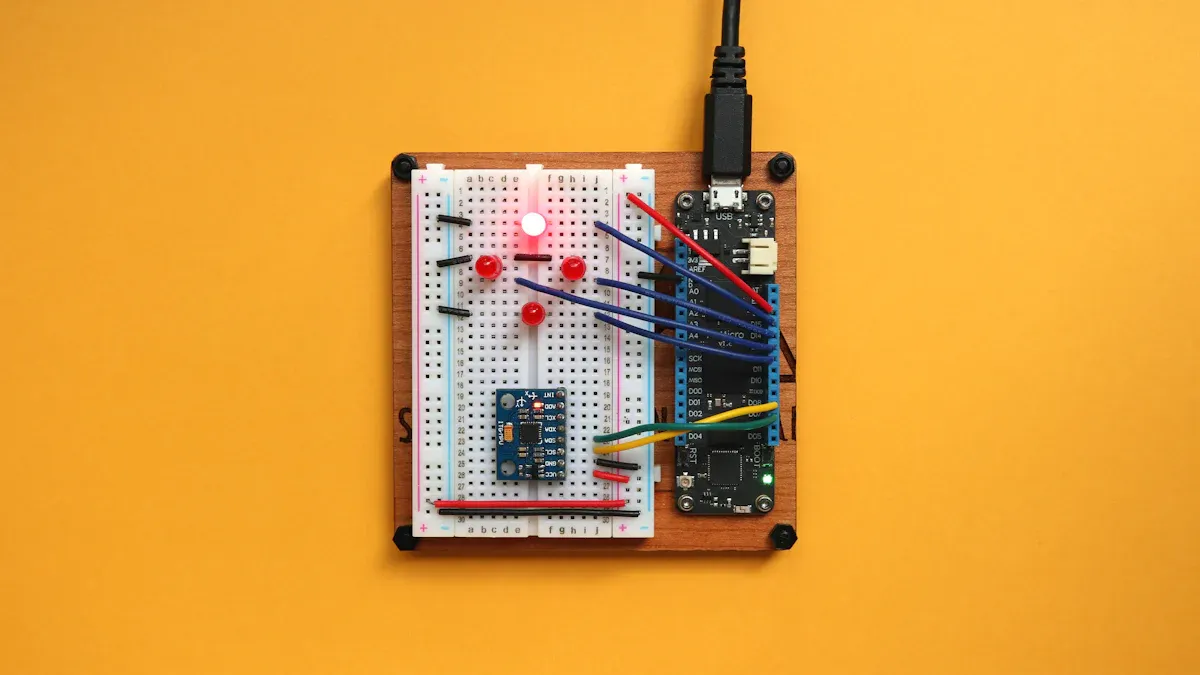
A light detecting resistor, also known as a light-dependent resistor, shows remarkable adaptability in electronic circuit design. Engineers use these components in many systems because their resistance changes in response to changes in light intensity. This property allows devices to sense and react to different lighting conditions. For example, automatic streetlights use light-dependent resistors to turn on when it gets dark and off when it becomes bright. Camera exposure controls rely on these resistors to adjust settings based on ambient light. Security alarms also use them to detect sudden changes in light, such as when someone enters a room.
Light-dependent resistors are made from semiconductor materials like cadmium sulfide. These materials change resistance when exposed to light, making the resistor sensitive to visible light. The simple design and low cost make them popular in many applications. Their versatility comes from the ability to work in different environments, including outdoor and indoor settings.
Environmental factors such as temperature and humidity can affect the performance of a light detecting resistor. Temperature changes may cause the resistance to vary, which can impact accuracy. High humidity can lead to water condensation, changing the sensor's readings. Advanced systems use calibration techniques to maintain stability and precision, even when environmental conditions fluctuate.
Common Factors Contributing to Flexibility
- Semiconductor materials respond to visible light.
- Simple construction allows easy integration.
- Low cost supports widespread use.
- Applications include streetlights, cameras, alarms, and solar trackers.
- Manual adjustment is possible with variable resistors.
Responsive to Light Sources
A light-dependent resistor responds to many types of light sources. Sunlight, lamps, and LEDs can all trigger changes in resistance. This responsiveness makes the sensor useful in a wide range of sensing applications. In a typical circuit, the resistor forms part of a potential divider. As the light intensity increases, the resistance drops. This change causes the current in the circuit to rise, which can be measured and used to control other devices.
| Light Source | Response Type | Common Application |
|---|---|---|
| Sunlight | High | Solar trackers |
| Lamps | Moderate | Indoor lighting |
| LEDs | Precise | Electronic displays |
Light detecting resistors adapt to different platforms, such as smartphones, laptops, and robotics systems. Their ability to sense visible and near-infrared light allows them to fit into automotive electronics and automation. Some systems use adaptive circuitry to monitor signals and adjust LED brightness in real time, ensuring optimal performance.
Despite their advantages, light-dependent resistors face challenges. They have limited spectral response, mainly detecting visible light. Their response time is slower than advanced sensors like photodiodes. Temperature changes can cause inaccurate readings, and chemical reactions may degrade the material over time. Designers often use calibration and compensation techniques to address these issues.
Tip: When designing circuits with light detecting resistors, consider environmental factors and choose calibration methods to improve accuracy.
Light Sensing Technology Basics
How LDRs Work
A light detecting resistor acts as a key component in many electronic circuits. This device uses photoresistor technology to sense changes in light. When light shines on the semiconductor material inside the light-dependent resistor, photons excite electrons. These electrons move from the valence band to the conduction band. As more electrons become free, the material’s conductivity increases and resistance drops. In darkness, fewer electrons get excited, so resistance rises. This process is reversible and allows the light-dependent resistor to respond quickly to changes in light.
Photoresistor technology helps convert optical signals into electrical signals. In a simple circuit, a constant voltage is applied across the light-dependent resistor. When light intensity increases, resistance decreases. More current flows through the circuit. Devices measure this current and use it to control other components, such as LEDs or alarms. For example, a light-dependent resistor can turn off an LED when the room is bright and turn it on when the room is dark. This makes the light-dependent resistor a key component in light sensing technology.
Engineers use light-dependent resistors because they offer reliable sensing and easy integration into many systems.
Types of Photoresistors
Photoresistor technology includes several types of light-dependent resistors. Each type has unique characteristics and uses. The table below shows common types and their features:
| Type of Photoresistor | Material Composition | Spectral Sensitivity | Key Component Characteristics | Typical Uses |
|---|---|---|---|---|
| Intrinsic | Silicon, germanium | Sensitive to broad spectrum | Stable, precise | Industrial control, scientific |
| Extrinsic | Doped CdS, CdSe | Sensitive to visible light | High sensitivity, cost-effective | Consumer electronics, lighting |
| Ultraviolet | CdS, CdSe | Sensitive to UV light | UV detection | UV sensors, monitoring |
| Visible Light | Selenium, CdS, CdSe | Sensitive to visible spectrum | Nonlinear response | Lighting, exposure equipment |
| Infrared | PbS, PbSe, InSb | Sensitive to infrared | Slower response | IR spectroscopy, guidance |
Photoresistor technology supports sensing in many fields. Intrinsic types work best in industrial and scientific settings where stability matters. Extrinsic types are common in consumer devices like smartphones and TVs. Ultraviolet and infrared photoresistors help with special sensing tasks, such as UV monitoring and infrared detection. Each light-dependent resistor acts as a key component in its application, making photoresistor technology vital for modern electronics.
Key Features of LDRs
Sensitivity
Light detecting resistors show high sensitivity to changes in light. Their resistance drops quickly as light intensity increases. This feature allows them to work in many lighting conditions, from almost total darkness to bright sunlight. The table below shows the typical lux range for different environments:
| Lighting Condition | Lux Range (From - To) | Typical Lux Value |
|---|---|---|
| Pitch Black | 0 - 10 | 5 |
| Very Dark | 11 - 50 | 30 |
| Dark Indoors | 51 - 200 | 125 |
| Dim Indoors | 201 - 400 | 300 |
| Normal Indoors | 401 - 1000 | 700 |
| Bright Indoors | 1001 - 5000 | 3000 |
| Dim Outdoors | 5001 - 10,000 | 7500 |
| Cloudy Outdoors | 10,001 - 30,000 | 20,000 |
| Direct Sunlight | 30,001 - 100,000 | 65,000 |
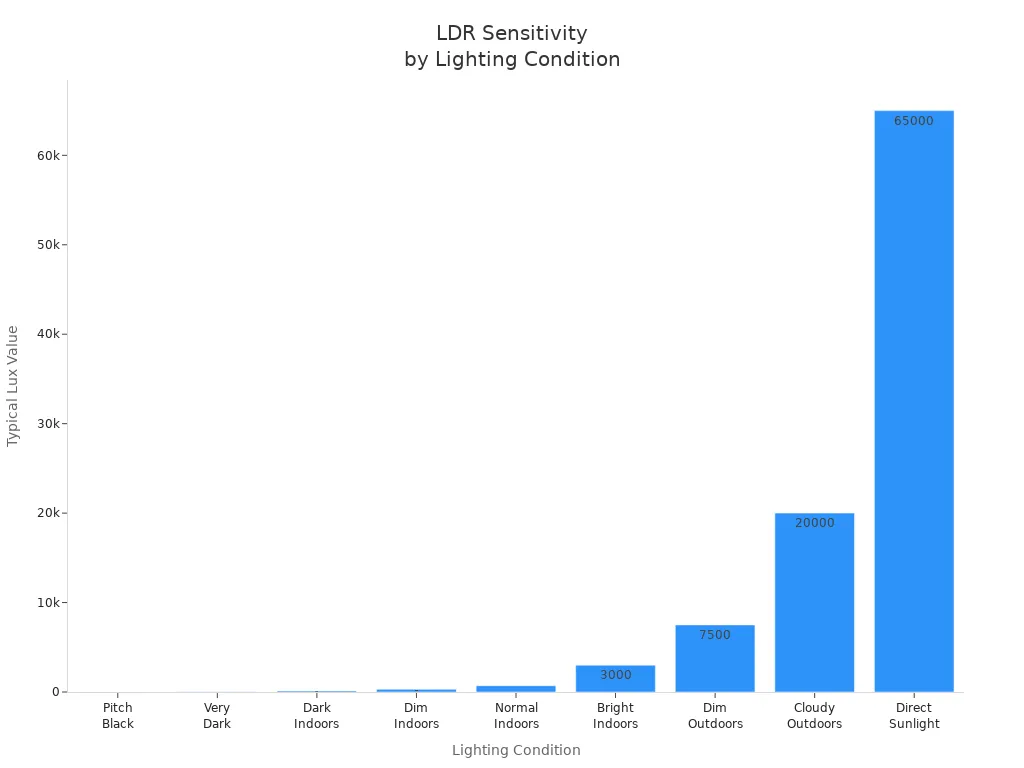
Photoresistors respond to a wide range of light, but their sensitivity is lower than phototransistors or photodiodes. Phototransistors can detect much weaker light and react faster, but LDRs remain a key component for basic light sensing tasks.
Low Power Use
LDRs use very little power. This makes them ideal for battery-powered devices. Devices like solar garden lights and automatic lamps use LDRs to save energy. The sensor only turns on the light when needed, which helps batteries last longer. Low power use also means less heat and longer device life.
Tip: LDRs help devices run longer on small batteries by using less energy.
Compact Design
Manufacturers make LDRs small and easy to fit into many devices. A common LDR sensor measures about 12mm in diameter. This compact size allows engineers to place them in tight spaces, such as inside smart gadgets or portable electronics. Their small size also helps reduce the overall weight of a device.
Non-Contact Operation
LDRs detect light without touching the light source. This non-contact feature increases durability because there is no physical wear. Devices can sense changes in light from a distance, making LDRs useful in sealed or hard-to-reach places. Their simple design also keeps costs low, with prices often less than $0.15 per unit.
- LDRs are easy to use with platforms like Arduino and Raspberry Pi.
- Simple wiring and clear instructions make them beginner-friendly.
Applications
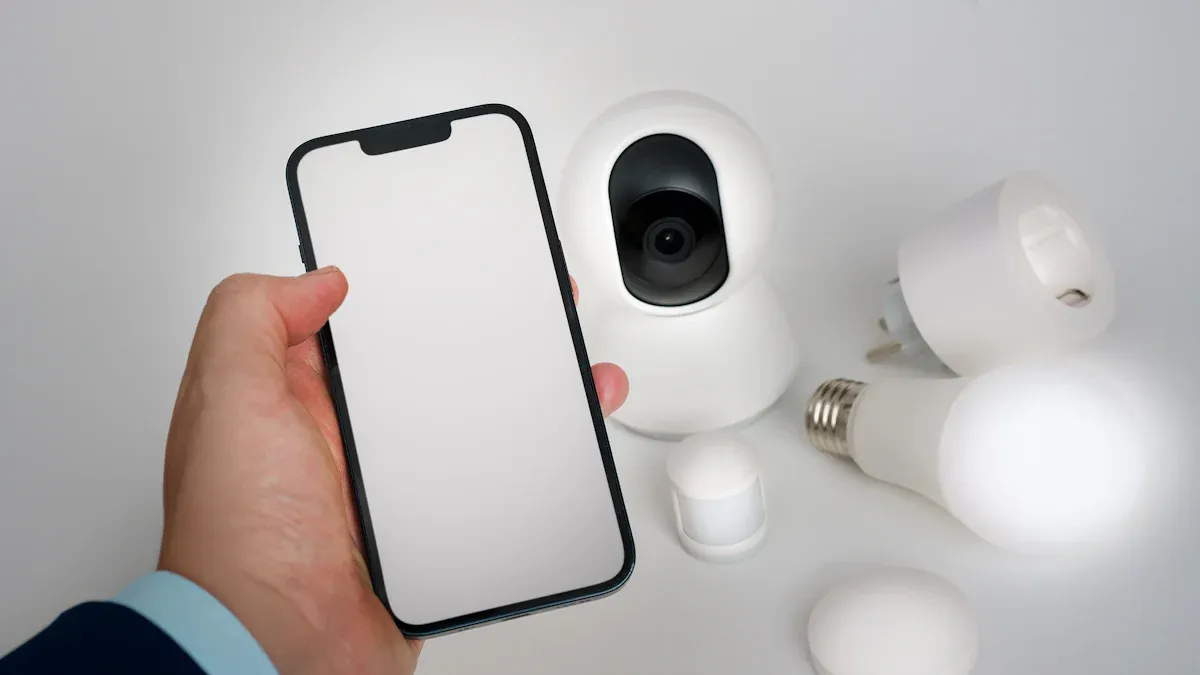
Light detecting resistors play a key role in many modern devices. Their flexibility allows engineers to use them in a wide range of applications. These include smart lighting, security systems, IoT devices, and dosimetric sensors. Each area benefits from the unique properties of this light sensor.
Smart Lighting
Smart lighting systems use light detecting resistors to control illumination automatically. These systems help save energy and improve comfort. Some common uses include:
- Automatic street lights that turn on at dusk and off at dawn, reducing electricity use and manual work.
- Smart home and office lighting that adjusts brightness based on natural light, making rooms more comfortable and efficient.
- Garden and outdoor lighting that switches on when it gets dark, improving safety and appearance.
- Devices like laptops and smartphones that change screen brightness to match the environment, helping users see better and avoid eye strain.
Smart lighting systems rely on the sensor’s ability to detect changes in light and trigger automatic lighting responses.
Security Systems
Security systems often use light detecting resistors to sense changes in light. When someone interrupts a beam of light, the sensor detects the change and triggers an alarm. For example, a laser beam can shine on the resistor. If a person walks through the beam, the resistance changes, and the system sounds a buzzer. This method helps protect homes and businesses by detecting movement or tampering.
IoT Devices
IoT devices use light detecting resistors to automate many tasks. These sensors measure ambient light and send signals to control other parts of the device. Common applications include:
- Automatic lighting in smart homes and gardens, which helps save energy.
- Devices that adjust brightness to extend battery life.
- Systems that improve safety by turning on lights when needed.
By responding to light, these sensors make IoT devices smarter and more efficient.
Dosimetric Sensors
In healthcare and industry, dosimetric sensors use light detecting resistors to measure radiation. CdS-based resistors change resistance when exposed to X-rays. This property allows the sensor to track radiation levels during treatments or inspections. These sensors are simple, low-cost, and portable, making them useful for basic radiation monitoring and education.
Light detecting resistors support many modern optoelectronics and continue to find new uses in emerging fields.
Pros and Cons
Advantages
Light detecting resistors offer several important benefits in electronic circuits.
- They provide variable resistance that changes with light intensity, making light measurement simple.
- Their low cost makes them more affordable than photodiodes or phototransistors.
- Engineers can easily integrate them into circuits without complex wiring or extra components.
- These resistors work well in both simple and complex applications, from streetlights to toys.
- When used properly, they have a long operational lifespan.
- They help save energy by enabling automatic control of lights based on ambient conditions.
- Their small size allows use in devices with limited space.
- Beginners and hobbyists find them accessible for projects and experiments.
LDRs are ideal for automatic lighting, garden lamps, and solar-powered systems. They help reduce energy waste and support energy-saving designs.
Limitations
Despite their strengths, light detecting resistors have some drawbacks.
- Their response time is slow, usually in milliseconds, which limits use in high-speed applications.
- They show less accuracy and sensitivity compared to photodiodes and phototransistors.
- High power or intense light can degrade their performance over time.
- Environmental factors like temperature and humidity may affect their readings.
- They mainly detect visible light and have limited spectral response.
- Their resistance can vary widely, leading to less precision in measurements.
| Feature/Aspect | Photoresistor (LDR) | Photodiode | Phototransistor |
|---|---|---|---|
| Sensitivity | Moderate | High | Higher than photodiode |
| Response Time | Slow (milliseconds) | Very fast (nanoseconds) | Fast (microseconds) |
| Power Consumption | Very low | Low | Low |
| Cost | Low | Moderate | Moderate |
| Reliability | Good for non-critical, long-term use | High accuracy and stability | High sensitivity but less linearity |
Alternatives
Other light sensors can replace LDRs in some applications.
- Photodiodes offer high speed and accuracy, making them suitable for communication and medical devices.
- Phototransistors provide higher sensitivity and faster response than LDRs, often used in remote controls and infrared receivers.
- These alternatives cost more and may need more complex circuits, but they deliver better performance for demanding tasks.
For basic, cost-sensitive projects, LDRs remain a practical choice. For advanced or high-speed needs, photodiodes and phototransistors work better.
Future Trends
Innovations
Recent years have brought many improvements to light detecting resistors. Manufacturers have developed new series that boost performance and reliability. The table below shows some of the latest innovations and their impact on applications:
| Innovation Series | Key Improvements | Performance/Application Impact |
|---|---|---|
| PDV Series | Fast response times, radial leads for easy PCB mounting, broad resistance range | Enables dynamic applications such as lighting control and flame detection with quick reaction and versatile performance |
| NORPS Series | Cost-efficient design, moisture-resistant plastic casing | Enhances durability and suitability for consumer and general-purpose ambient light detection |
| NSL Series | High stability and precision sensing, hermetically sealed or plastic-coated ceramic headers | Ensures reliability in precision light control, industrial sensing, audio and display applications |
| General Advances | Improved materials and sensor design expanding spectral response (including near-IR and flame detection) | Broadens application range to automatic lighting, security, and industrial monitoring systems |
These advances help LDRs work better in more environments. New materials and designs allow sensors to detect a wider range of light, including near-infrared. Some models now react faster, making them useful for safety and industrial systems. Improved casings protect sensors from moisture, so they last longer in outdoor or harsh settings.
Expanding Roles
Light detecting resistors will play a bigger part in next-generation electronics. Several trends point to a growing market and new uses:
- The market for photoresistors is growing as more people want energy-efficient solutions and smart devices.
- New high-sensitivity sensors can work in extreme environments, which increases their versatility.
- Many companies are adding LDRs to IoT and smart technology, helping devices manage energy better and respond to changing light.
- Partnerships between manufacturers and technology firms are leading to more innovation and better products.
- Governments support energy-saving technology, which increases demand for advanced sensors.
- LDRs now appear in more fields, such as automotive, consumer electronics, and automation.
- Manufacturers invest in research to create sensors with better performance and reliability.
As technology advances, LDRs will continue to adapt and find new roles in smart systems, energy management, and industrial monitoring.
Light detecting resistors help engineers create smart, energy-saving devices. Their flexibility supports both traditional and new technologies. LDRs offer low cost, easy use, and reliable sensing. Some limits include slower response and less accuracy than advanced sensors. Future designs may improve speed and sensitivity.
Readers can discover new ways to use LDRs in robotics, smart homes, and health devices. Exploring these options can lead to better and more efficient electronics.
FAQ
What is a light detecting resistor (LDR)?
A light detecting resistor, or LDR, is a sensor that changes its resistance when light shines on it. Engineers use LDRs to measure light levels in many electronic devices.
How do LDRs help save energy?
LDRs turn lights on or off based on the amount of light in a room or outside. This automatic control helps reduce electricity use and saves energy.
Where can someone find LDRs in everyday life?
People see LDRs in streetlights, garden lamps, alarm systems, and some smartphones. These sensors help devices adjust to changing light conditions.
Are LDRs safe to use in electronics?
Yes, LDRs are safe for most electronic projects. They do not get hot or use much power. Their non-contact design also makes them durable.
What are some alternatives to LDRs?
| Sensor Type | Main Feature | Common Use |
|---|---|---|
| Photodiode | Fast response | Remote controls |
| Phototransistor | High sensitivity | Light meters, displays |
Tip: Choose the sensor that matches the speed and accuracy needed for your project.