L293D vs L298N Performance Power and Price Compared
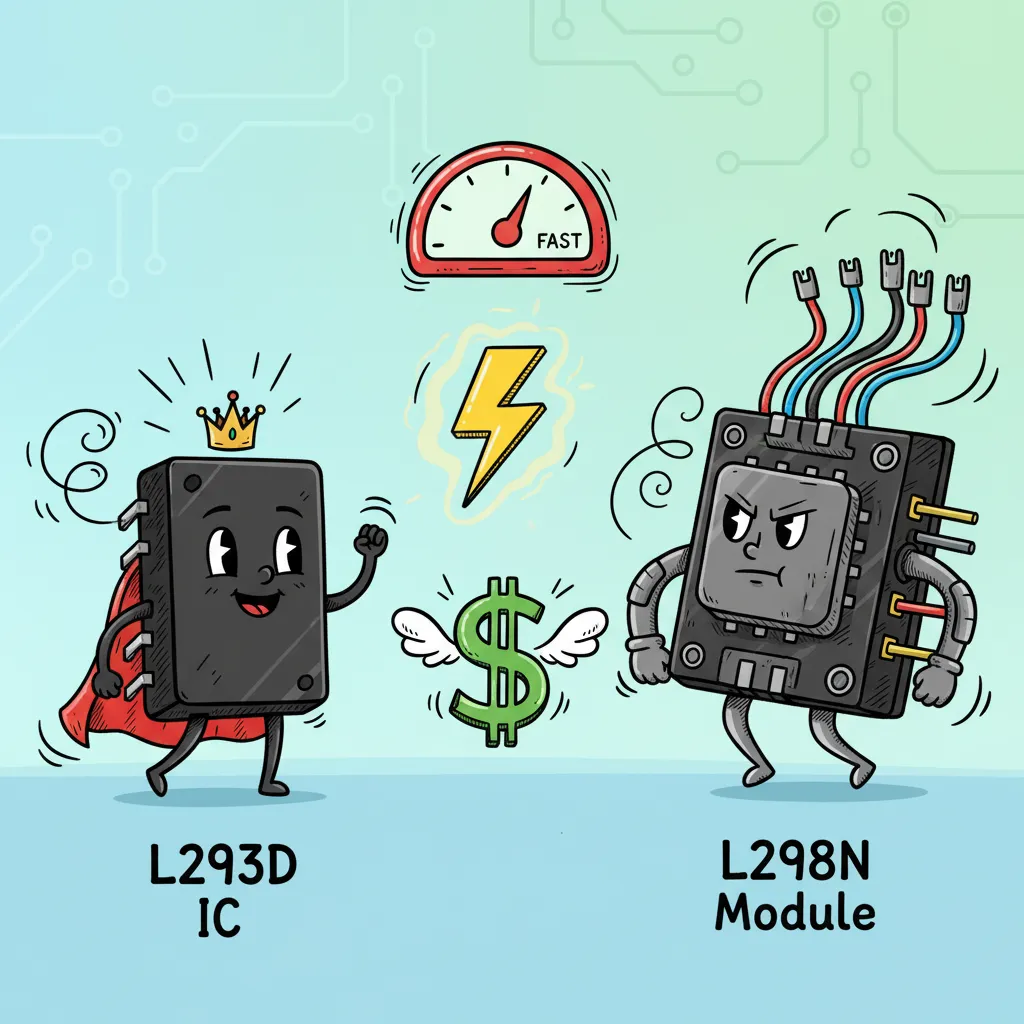
You face a common choice for your motor control project: selecting a motor driver. Understanding the difference between L293D and L298N is key to your success. This comparison will clarify their performance.
💡 The short answer: The powerful L298N is your choice for high-current projects. The compact L293D excels in smaller, budget-conscious applications where efficiency is important.
You can confidently select the right component for your specific needs.
Key Takeaways
The L293D is good for small projects. It handles motors that use less than 600mA of power. It is also cheaper and smaller.
The L298N is for bigger projects. It can power motors that use up to 2A of power. It needs a heatsink to stay cool.
Always check your motor's power needs. This helps you pick the right driver. The L293D is for low power, and the L298N is for high power.
Newer motor drivers use MOSFETs. They are more efficient. They create less heat and save battery power.
Quick Comparison: L293D vs L298N
Let's break down the key distinctions between these two popular components. This direct comparison will help you visualize their differences in performance and design before we dive deeper.
Core Specifications
You can see the most important specifications side-by-side in this table. It provides a quick reference for making your initial decision.
Feature | L293D | L298N |
|---|---|---|
Continuous Current | 600mA per channel | 2A per channel |
Peak Current | 1.2A per channel | 3A per channel |
Motor Voltage | 4.5V – 36V | 6V – 46V |
Internal Diodes | ✅ Yes | ❌ No (Requires external diodes) |
Form Factor | IC (Integrated Circuit) | Module (with heatsink) |
Power and Current
The most significant difference lies in power handling. Your motor's current needs will guide your choice here.
The L298N is a powerhouse. The official datasheet confirms it can manage a continuous current of up to 2A for each h-bridge channel. For brief moments, like a motor startup, the L298N can handle a peak non-repetitive current of 3A. This capability makes it the clear winner for larger motors. However, this high-current performance comes at a cost. The L298N can have a significant voltage drop, sometimes reaching up to 4V at higher loads. This lost voltage turns into heat, which is why the L298N module always includes a large heatsink.
In contrast, the L293D is designed for smaller tasks. It provides a continuous output of 600mA per channel. While it can deliver a peak current of up to 1.2A for very short bursts, you should not rely on it for motors that consistently draw more than 600mA. Its lower power rating results in better efficiency and less heat for small-scale projects, making it a great motor driver for simple robots and electronics.
Circuit and Form Factor
The physical shape and circuit needs of each motor driver are very different. These factors impact how you build your project.
👉 The L293D is simple and compact. It comes in a 16-pin DIP (Dual In-line Package) that is only about 0.300 inches (7.62mm) wide. You can plug it directly into a breadboard for easy prototyping. A key feature of the L293D is its internal protection diodes. These diodes protect your control circuit from voltage spikes generated by the motor, simplifying your wiring.
The L298N is almost always sold as a complete module. These modules are much larger, with typical board dimensions around 43mm x 43mm (1.7in x 1.7in). The module includes the L298N IC, a large heatsink, screw terminals for easy connections, and the external diodes that the IC lacks. This all-in-one package simplifies using the powerful L298N but takes up significantly more space. The module provides robust forward and reverse control for demanding applications.
Power and Performance of the L298N
The L298N motor driver stands out when your project demands more power and robust performance. You choose this component for its ability to handle demanding tasks that are beyond the L293D's capacity. Let's explore the key strengths that define the L298N.
Driving High-Current Motors
You will find the L298N is the ideal choice for larger motors. Its primary advantage is its higher current handling capability. Each h-bridge channel can supply up to 2A of continuous current. This makes the L298N perfect for robotics projects, CNC machines, and other applications using motors that require significant power. This powerful h-bridge gives you reliable control over your motor's speed and direction.
Superior Thermal Management
High current creates heat, and the L298N is built to manage it effectively. The L298N module's large, integrated heatsink is essential for its performance. This component draws heat away from the IC, preventing overheating during long periods of operation. This robust cooling is vital for maintaining stable performance in high-power projects. The IC itself has a high tolerance for heat dissipation.
Characteristic | Value | Unit |
|---|---|---|
25 | W |
💡 Pro Tip: You can even improve thermal performance further. Bolting multiple L298N modules to a larger, shared heatsink can boost their output current capability by helping them dissipate heat more efficiently together.
Wider Voltage Range
The L298N offers you greater flexibility with power supplies. It supports a motor supply voltage ranging from +5V up to +46V. This wide range allows you to power a diverse array of motors, from common hobby motors to more powerful industrial types. This versatility makes the L298N motor driver a valuable component for a broad spectrum of applications, ensuring you have the power and control you need for your ambitious project.
Simplicity and Efficiency of the L293D
When your project doesn't need the raw power of an L298N, you will find the L293D offers a simpler, more efficient, and compact solution. This motor driver shines in applications where space and budget are key considerations. Its design prioritizes ease of use, making it a favorite for many makers.
Cost-Effective for Hobby Projects
You can keep your project costs down with the L293D. The IC is significantly cheaper than a full L298N module. This affordability makes it an excellent choice for beginners, educational projects, or when you need to build multiple devices without breaking the bank. Its low price point encourages experimentation and learning.
Compact Size for Breadboarding
The L293D simplifies your circuit design, especially on a breadboard. It comes in a small Dual In-line Package (DIP) that you can plug directly into your board. This compact form factor is ideal for designs with limited space. The L293D also has built-in flyback diodes. These internal components protect your microcontroller from voltage spikes, reducing the need for external parts and simplifying your wiring. This makes it a very straightforward motor driver for quick prototyping.
Higher Efficiency in Low-Power Scenarios
You will achieve better performance in low-load situations with the L293D. Its Bipolar Junction Transistor (BJT) design is optimized for lower current tasks. This results in less voltage drop and less heat generation compared to an underutilized L298N, giving you high efficiency for long-duration operations. This superior performance makes the L293D a great choice for small robots that run on battery power.
💡 What does the 'D' in L293D mean? You should know the difference between the L293 and the L293D. The two chips share an identical pinout, but the 'D' is critical.
The L293D includes internal protection diodes for each h-bridge.
The base L293 does not have these diodes, so you must add them externally.
These diodes give your control circuit essential protection from inductive load spikes generated by the motor. Always choose the L293D for simpler and safer projects.
Choosing the Right Motor Driver
You have seen the technical details. Now you face the final decision. Choosing the right motor driver comes down to understanding your project's specific needs. This section will guide you to a confident choice between the classic L298N, the simple L293D, and newer options.
When to Select the L298N
You should select the L298N when your project demands significant power. Its ability to handle high current makes it the only choice for certain applications. If your motor's specifications exceed the limits of the L293D, the L298N is your go-to component.
Consider the L298N for these types of power-hungry projects:
Large robotic rovers or model cars with dual motors
Robotic arms that lift heavy objects
Small CNC machines or 3D printer axes
Obstacle-avoiding robots using 3-6V DC plastic gearbox motors
The L298N motor driver truly shines under demanding conditions. Its robust design and integrated heatsink are critical for thermal safety. You need this superior heat management when dealing with continuous high-torque operation or in high ambient temperatures.
Condition | Reason to Choose L298N |
|---|---|
High Current | |
High Torque | You are using Johnson motors or high-torque gear motors. |
Heat Concerns | Your project will run for long periods under heavy load. |
👉 The L298N's h-bridge is built to dissipate heat. This ensures stable performance and prevents thermal damage when you push your motors hard.
When to Select the L293D
You will find the L293D is the perfect fit for smaller, cost-sensitive, and battery-powered applications. Its simplicity and low cost make it a favorite for beginners and educators. You can save money and space by choosing this compact IC.
The L293D is ideal for many classic hobby projects, such as:
Small toy cars or bots
Basic automation tasks
For battery-powered devices, the L293D is often the preferred motor driver. It handles up to 600mA of continuous current, which is perfect for most small motors. Its design includes built-in flyback diodes and thermal protection. These features protect your control circuit and make your build simpler and safer. Its lower power consumption helps you get the most life out of your batteries.
A Note on Modern Alternatives
The L293D and L298N are classic components, but technology has advanced. You should know about modern motor drivers, which often provide better performance. Drivers based on MOSFETs (Metal-Oxide-Semiconductor Field-Effect Transistors) are far more efficient than the older BJT (Bipolar Junction Transistor) technology used in the L298N and L293D.
Two popular modern alternatives are the TB6612FNG and the DRV8833.
💡 Why go modern? MOSFET drivers waste less power as heat. This means more power goes to your motors, your driver runs cooler, and your batteries last longer.
The TB6612FNG is a great example. It offers double the current capacity of an L293D (1.2A vs 0.6A) in a much smaller package. Its efficient MOSFET h-bridge design means it does not need a large heatsink like the L298N. This makes it an excellent upgrade for projects that are too demanding for an L293D but where the size and inefficiency of an L298N are a problem.
Here are the key distinctions between these drivers:
Feature | L298N (BJT) | L293D (BJT) | TB6612FNG (MOSFET) |
|---|---|---|---|
Low | Low | High | |
Heat Output | High (needs heatsink) | Medium | Very Low |
Size | Very Large (Module) | Small (IC) | Very Small (IC) |
2A | 0.6A | 1.2A |
These newer chips are a better fit for modern motor control systems. They are designed to work well with microcontrollers and are ideal for a wide range of motor driver applications. While the L298N and L293D are still useful for learning, you should consider a modern driver for your next project to get the best performance.
You now understand that your project's needs dictate your choice of motor driver. The decision comes down to your motor's current requirements. You can use this simple guide for your selection.
Motor Driver | Output Current per Channel |
|---|---|
L293D | 600mA |
L298N | 2A |
If your motor needs more than 600mA, the L298N is the necessary choice for reliable control. For smaller tasks, the L293D is a more efficient and compact solution.
💡 Always check first! Before you buy, find your motor's datasheet on its product page. Look for the "stall current" to know its maximum power draw.
FAQ
Can you control motor speed with these drivers?
Yes, you can control motor speed with both the L293D and L298N. You send a PWM (Pulse Width Modulation) signal to the driver's enable pins. This signal rapidly turns the motor on and off, which changes its average speed.
Why does the L298N module need a big heatsink?
The L298N creates a lot of heat when handling high currents. The heatsink pulls this heat away from the chip. This prevents the driver from overheating and getting damaged. You need this for safe, reliable operation with powerful motors.
Can you use an L293D for a 12V motor?
Yes, you can use an L293D with a 12V motor. The L293D supports a motor voltage range of 4.5V to 36V. You must ensure your motor's current draw does not exceed the 600mA continuous limit of the L293D.
What happens if your motor draws too much current?
💡 Drawing too much current can damage your motor driver. The L293D has thermal shutdown protection that may save it. The L298N can overheat and fail permanently. Always match your driver to your motor's stall current to prevent this.