How You Can Determine Total Resistance in Parallel Circuits
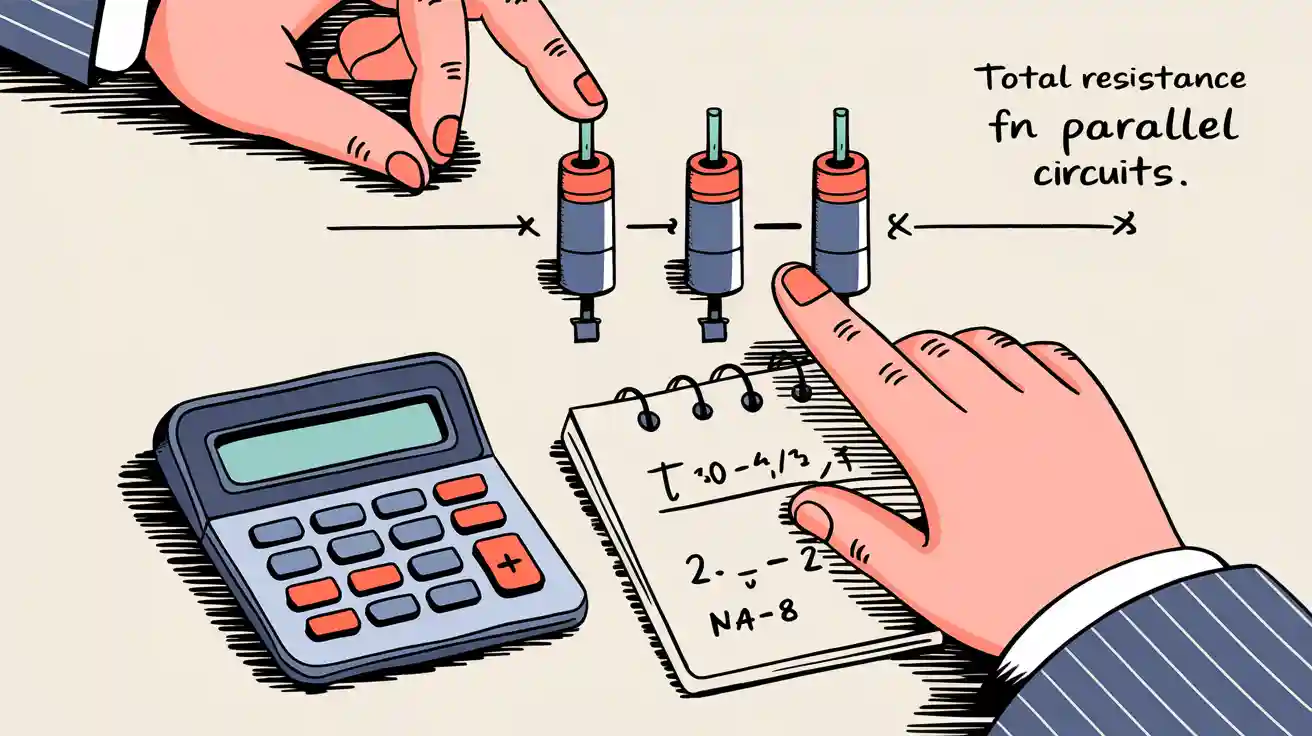
You can learn how to find resistance in a parallel circuit by using a simple formula. The main rule states that total resistance is always less than the smallest resistor in the group. According to All About Circuits, you need to use this formula: Rtotal = 1 / (1/R1 + 1/R2 + ... + 1/Rn). You just need to list each resistor value, plug them into the formula, and calculate. Anyone can learn this process with a little practice. Try following along with an example to see how easy it can be to find resistance in a parallel circuit.
Parallel Circuit Resistance Formula
Total Resistance Formula
You can find the total resistance in a parallel circuit by using a simple formula. In a parallel circuit, each resistor connects across the same two points. This setup lets current flow through more than one path. The main formula you use looks like this:
- ( \frac{1}{R_{\text{total}}} = \frac{1}{R_1} + \frac{1}{R_2} + \frac{1}{R_3} + \ldots )
This formula tells you that the total resistance is always less than the smallest resistor in the group. When you add more resistors in parallel, the equivalent resistance drops even lower. For example, if you have four resistors in parallel, the total resistance will be much less than any single resistor. This is important when you want to control how much current flows in a circuit.
You can see the difference between parallel and series circuits in the table below:
| Circuit Type | Total Resistance Formula | Key Point |
|---|---|---|
| Parallel | (1/R_{\text{total}} = 1/R_1 + 1/R_2 + 1/R_3 + ...) | Total resistance is less than the smallest individual resistance |
| Series | (R_{\text{total}} = R_1 + R_2 + R_3 + ...) | Total resistance is the sum of individual resistances |
Equal Resistors in Parallel
When all resistors in parallel have the same value, you can use a shortcut. Just divide the value of one resistor by the number of resistors. For example, if you have three 6-ohm resistors in parallel, the equivalent resistance is 6 divided by 3, which equals 2 ohms. This shortcut saves you time and helps you check your work.
If you only have two resistors in parallel, you can use another quick formula:
- ( R_{\text{total}} = \frac{R_1 \times R_2}{R_1 + R_2} )
This formula works best when you want to find the total circuit resistance quickly. If both resistors have the same value, the total resistance is half of that value.
If one path in a parallel circuit breaks, current still flows through the other paths. This means the circuit keeps working, which is a big advantage of using resistors in parallel.
How to Find Resistance in a Parallel Circuit
Understanding how to find resistance in a parallel circuit helps you design and troubleshoot electrical systems. You can follow a simple process to get accurate results every time. Let’s break down the steps so you can master this important skill.
List Resistor Values
Start by writing down the values of all resistors in your parallel circuit. You might see resistors labeled with numbers like 10Ω, 20Ω, or 50Ω. Listing each value makes it easier to organize your work and avoid mistakes. If you have a mix of resistors in parallel, make sure you include every one.
Tip: Double-check each resistor’s value before you start your calculations. This step helps you avoid errors that could affect the performance of your circuit.
Apply the Formula
Next, use the parallel resistance formula to find the total resistance. The formula looks like this:
1/R_total = 1/R1 + 1/R2 + 1/R3 + ...
You need to take the reciprocal of each resistor’s value, add them together, and then take the reciprocal of the sum. This method works for any number of resistors in parallel. If you have only two resistors, you can use a shortcut:
R_total = (R1 * R2) / (R1 + R2)
Applying the formula lets you combine resistors to reach a specific resistance. This skill is useful when you want to adjust the brightness of an LED or control the flow of current in your circuit.
- Understanding how to find resistance in a parallel circuit helps you choose the right resistors for your project.
- Using the formula ensures your circuit meets the desired electrical characteristics.
- You can use online tools like a Parallel Resistor Calculator to check your work and minimize errors.
Calculate Total Resistance
Now, calculate the total resistance for your parallel circuit. Follow these steps:
- Identify the smallest group of resistors that are only in parallel.
- Use the parallel resistance formula to find the equivalent resistance for that group.
- Replace the group with a single resistor whose resistance equals the value you calculated.
- Repeat the process if your circuit has more combinations, until you end up with one total resistance.
If you need to solve for an unknown resistor, rearrange the formula. For example, if you know the total resistance and two resistor values, you can find the third resistor:
- Start with the formula: Rt = 1/(1/R1 + 1/R2 + 1/R3).
- Take the reciprocal: 1/Rt = 1/R1 + 1/R2 + 1/R3.
- Substitute the known values and isolate the unknown: 1/R3 = 1/Rt - (1/R1 + 1/R2).
- Take the reciprocal again to solve for R3.
Note: The total resistance in a parallel circuit is always less than the smallest resistor. This property keeps your circuit working even if one path breaks, because current can still flow through the other resistors.
Here’s a table showing how calculation errors can affect your electronic devices:
| Aspect of Resistance Impact | Description |
|---|---|
| Internal Resistance | Defines cell performance under different conditions. |
| State of Health (SoH) | Helps assess battery health. |
| Power Delivery Capability | Unbalanced resistance limits power delivery. |
| Current Load Uniformity | Differences in parallel connections cause uneven current loads and temperature changes. |
You can use tools like the Parallel Resistor Calculator to make your calculations easier:
| Tool Name | Description |
|---|---|
| Parallel Resistor Calculator | Calculate the equivalent resistance of up to six resistors in parallel with ease. |
| Parallel Resistor Calculator | Use this FREE tool to calculate the total resistance of a circuit using multiple resistors in parallel. |
| Parallel Resistor Calculator | Learn how to calculate resistance in parallel and the parallel resistance formula. |
When you know how to find resistance in a parallel circuit, you can design circuits that work safely and efficiently. Practice with different resistor values to build your confidence and improve your skills.
Example with Resistors in Parallel

Problem Statement
Imagine you have three resistors in parallel. The values are 10 ohms, 20 ohms, and 50 ohms. You want to find the total resistance for this parallel circuit. This calculation helps you understand how current flows and how you can control devices in your home or school projects.
Step-by-Step Solution
Follow these steps to solve the problem:
-
List the resistor values:
- R1 = 10 ohms
- R2 = 20 ohms
- R3 = 50 ohms
-
Write the parallel circuit formula:
1/R_total = 1/R1 + 1/R2 + 1/R3 -
Calculate the reciprocals:
- 1/10 = 0.1
- 1/20 = 0.05
- 1/50 = 0.02
-
Add the reciprocals:
- 0.1 + 0.05 + 0.02 = 0.17
-
Find the total resistance:
- 1/R_total = 0.17
- R_total = 1 / 0.17 ≈ 5.88 ohms
You can see that the total resistance is much lower than any single resistor in the group. This shows how adding resistors in parallel reduces the overall resistance and lets more current flow through the circuit. When you add more resistors in parallel, you create more paths for current, just like adding more lanes to a highway.
Final Answer
The total resistance for three resistors in parallel (10 ohms, 20 ohms, and 50 ohms) is about 5.88 ohms. This value is less than the smallest resistor. You can use this method for any number of resistors in parallel. This feature gives you flexibility when you design circuits for different needs.
Adding resistors in parallel works like a symphony. Each new resistor enriches the flow of current, making your circuit more efficient. You can use parallel circuits in many real-life situations. Here are some common examples:
| Application Area | Description |
|---|---|
| Household Wiring | Used for electrical outlets and gadgets to ensure uniform voltage and reliability. |
| Transportation Industry | Powers vehicle components like headlights and radios, ensuring consistent voltage and safety. |
| Industrial Control Systems | Allows for maintenance without affecting other machinery, enabling isolated power down of equipment. |
| Hydraulic and Plumbing | Efficiently distributes fluid flow in systems. |
| Solar Fields | Increases current capacity and energy output of solar panels. |
Try using different resistor values to see how the total resistance changes. You will notice that the total resistance in a parallel circuit always stays below the smallest resistor. This property helps you build safe and reliable electronic devices.
You can master resistance calculations in a parallel circuit by following these steps:
- For two equal resistors, divide one value by two.
- For two different resistors, use ( R_t = \frac{R_1 \times R_2}{R_1 + R_2} ).
- For three or more, use ( \frac{1}{R_t} = \frac{1}{R_1} + \frac{1}{R_2} + \frac{1}{R_3} + ... ).
| Formula Description | Formula |
|---|---|
| Total Resistance in Parallel Circuits | ( R_{total} = \frac{1}{\frac{1}{R_1} + \frac{1}{R_2} + ... + \frac{1}{R_n}} ) |
Practice with different resistance values helps you understand circuit behavior and build troubleshooting skills. You gain confidence and prepare for success in electronics.
FAQ
What happens if you add more resistors to a parallel circuit?
You lower the total resistance when you add more resistors to a parallel circuit. More paths let more current flow. The total resistance always stays less than the smallest resistor.
Why is the total resistance in a parallel circuit always less than any single resistor?
Each resistor gives current another path. This makes it easier for current to move through the circuit. The total resistance drops below the value of the smallest resistor.
Can a parallel circuit still work if one resistor breaks?
Yes! If one resistor breaks, current keeps flowing through the other paths. This is a big reason why people use parallel circuits in homes and schools.
How do you check your answer when finding total resistance in parallel?
You can use a calculator or an online tool. Double-check your math. The answer should always be less than the smallest resistor in the group.
Where do you see parallel circuits in real life?
You find parallel circuits in house wiring, Christmas lights, and car electronics. These circuits help keep devices working even if one part fails.