Unlock the Secrets of Any Parallel Circuit Circuit

You are about to unlock the secrets of any parallel circuit circuit. Every parallel circuit follows three simple rules, and you will master them.
The Three "Secrets" of a Parallel Circuit 🤫
Voltage is constant across each parallel branch.
Total current is the sum of the individual currents.
Resistance is found using a special reciprocal formula.
You see parallel circuits in many common devices:
Holiday Lights
Flashlights with multiple LEDs
Home Wiring
With these rules, you will solve any basic parallel circuit problem with confidence.
Key Takeaways
Voltage stays the same across every part of a parallel circuit. Each branch gets the full power from the battery.
Adding more paths in a parallel circuit lowers the total resistance. More paths make it easier for electricity to flow.
The total electricity flowing from the battery splits among the paths. You can add up the electricity in each path to find the total.
You can use Ohm's Law (I = V/R) to find how much electricity flows through each path. Use the voltage of the battery and the resistance of that path.
Understanding Voltage in Parallel
Let's dive into the first secret of the parallel circuit: voltage. Imagine a water pump pushing water to the top of a hill. The height of that hill is like the voltage from a battery. Now, imagine several different paths the water can take to get back to the bottom. No matter which path the water chooses, it always drops the same total height.
A parallel circuit works the same way. The battery provides the "push," and every parallel path, or branch, gets that full push.
The Constant Voltage Rule
The most important rule for voltage in a parallel circuit is that it stays the same everywhere. Each component in a parallel setup connects to the same two points of the power source, like a battery. This direct connection means the voltage across each branch is identical to the total voltage of the battery.
The Golden Rule of Voltage: In any parallel circuit, the voltage is the same across every branch.
V_Total = V1 = V2 = V3...
This means if you have a 12-volt battery, the potential drop across each resistor in parallel will be 12 volts. The potential drop across each resistor is equal because the charge only passes through one branch.
Identifying Source Voltage
You can find the source voltage by looking at the power source itself. A common battery might be a 9V battery or a 12V car battery. Your home's electrical system is also a giant parallel circuit. Here are some common voltages you might see:
System/Device Type | |
|---|---|
Standard Household Outlets | 120V |
Heavy Appliances (Dryers, Ovens) | 240V |
Small Electronics Battery | 9V |
The voltage of the battery determines the voltage for the entire circuit.
Voltage in a Parallel Branch
Let's build a simple parallel circuit circuit in our minds. Picture a 9V battery. You connect three resistors in parallel to this battery.
The first resistor forms the first branch.
The second resistor forms the second branch.
The third resistor forms the third branch.
If you took a voltmeter and measured the voltage across the resistors, you would find that the voltage across each branch is 9V. The potential drop across each resistor is 9V. This happens because each path connects directly to the positive and negative terminals of the 9V battery. The potential drop across each resistor must equal the voltage of the battery. The amount of current or resistance in a branch does not change this fact.
Calculating Total Resistance
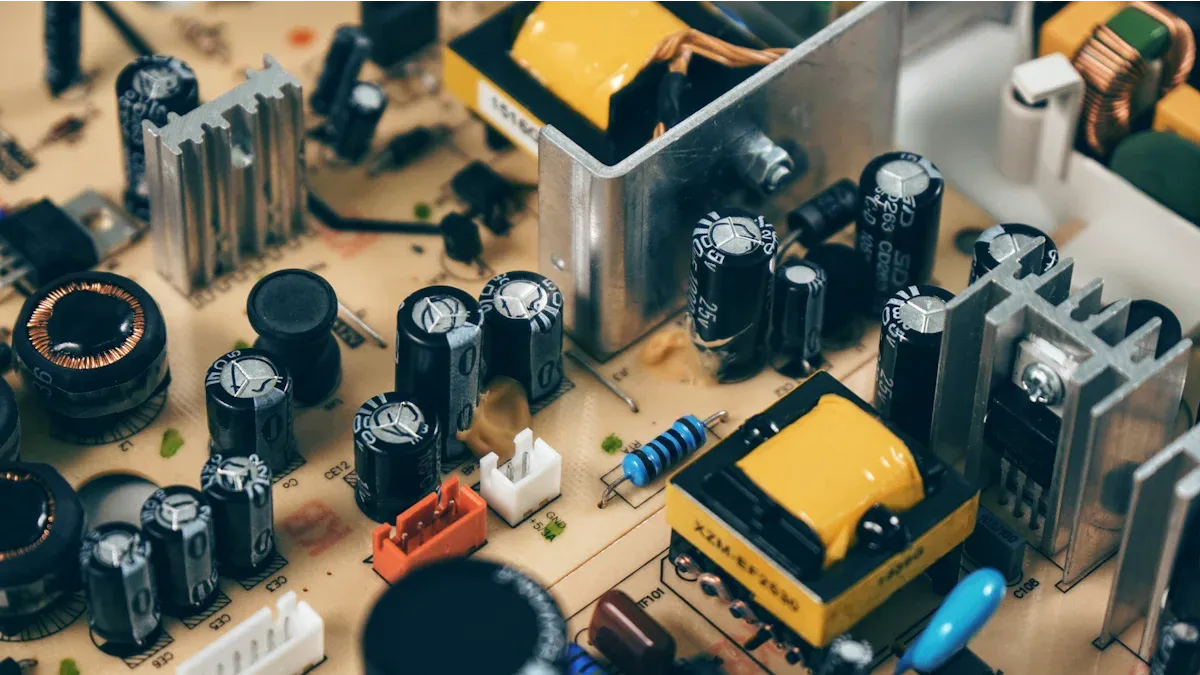
Now you will learn the second secret of the parallel circuit. This secret often surprises people. When you add more resistors in parallel, the total resistance of the circuit goes down, not up. This might seem strange, but it makes perfect sense when you think about it.
Why Resistance Decreases
Imagine a single-lane road. Only a certain number of cars can pass through at one time. This is like a single resistor limiting the flow of current. Now, imagine you open a second lane right next to it. You have not changed the first lane, but you have added a new path. More cars can now pass through in the same amount of time. The overall "resistance" to traffic flow has decreased.
A parallel circuit works the same way. Each new resistor you add in parallel creates a new path for the electric current to flow.
The first resistor is one path.
Adding a second resistor opens a second path.
Adding a third opens a third path.
With more paths available, it becomes easier for the total current from the battery to flow through the circuit. This ease of flow means the overall resistance is lower. The equivalent resistance of the entire parallel circuit circuit will always be less than the value of the smallest individual resistor in the circuit.
Formula for Resistors in Parallel
You can't just add the resistance values together like you do in a series circuit. For resistors in parallel, you must use a special reciprocal formula to find the equivalent resistance.
The Reciprocal Formula 🧮 The formula looks like this:
1/R_Total = 1/R1 + 1/R2 + 1/R3 + ...
This formula might look intimidating, but you can master it with a simple four-step process. Let's calculate the equivalent resistance for a parallel circuit with three resistors connected to a battery.
Example: A parallel circuit has three resistors: R1 = 20 Ω, R2 = 30 Ω, and R3 = 60 Ω. What is the equivalent resistance?
Find the reciprocal of each resistance.
1 / R1 = 1 / 20 = 0.05
1 / R2 = 1 / 30 = 0.033
1 / R3 = 1 / 60 = 0.017
Sum the reciprocals.
1/R_Total = 0.05 + 0.033 + 0.017 = 0.1
Take the reciprocal of the sum.
R_Total = 1 / 0.1
Calculate the final answer.
R_Total = 10 Ω
The equivalent resistance is 10 Ω. Notice how this value is smaller than the smallest resistor (20 Ω). This confirms the rule for resistors in parallel. Finding the equivalent resistance is a key step before you can calculate the total current from the battery.
Two-Resistor Shortcut
Sometimes, you will only have two resistors in parallel. For this common situation, a convenient shortcut exists called the "product over sum" method. Many technicians memorize this formula because it is so useful for finding the equivalent resistance of two resistors in parallel.
The formula is exactly what it sounds like: you multiply the two resistance values (the product) and divide by their sum.
R_Total = (R1 * R2) / (R1 + R2)
Let's say you have two resistors in parallel: a 100 Ω resistor and a 25 Ω resistor. Using the shortcut, the calculation for the equivalent resistance is simple:
R_Total = (100 * 25) / (100 + 25) = 2500 / 125 = 20 Ω
This method is specifically for two resistors at a time. If you have more than two, you can still use it by combining two resistors to find their equivalent resistance, and then combining that result with the next resistor. However, the main reciprocal formula is often faster for three or more resistors in parallel.
💡 Pro Tip: Equal Resistors When you have multiple resistors of the same value in parallel, the math gets even easier. The equivalent resistance is the value of one resistor divided by the number of resistors.
Two 100 Ω resistors in parallel have an equivalent resistance of 100 / 2 = 50 Ω.
Three 60 Ω resistors in parallel have an equivalent resistance of 60 / 3 = 20 Ω.
Four 200 Ω resistors in parallel have an equivalent resistance of 200 / 4 = 50 Ω.
Understanding these methods gives you the power to find the circuit resistance in any parallel setup, a crucial step for analyzing the circuit's voltage and current behavior.
Calculating Branch and Total Current
You have mastered voltage and resistance. Now you will learn the final secret: how current behaves in a parallel circuit. The total current from the battery splits up to travel down each path. Your job is to figure out how much current flows where.
Ohm's Law in Each Branch
You can find the current in any single branch using a familiar tool: Ohm's Law. The formula is I = V / R. The key is to use the values for that specific branch.
Remember the first secret? The voltage is the same across every parallel branch. This means the 'V' in your calculation is always the voltage of the battery. You will calculate the current through each resistor by dividing the battery voltage by that resistor's value.
Let's continue with our example circuit. It has a 9V battery and three resistors (R1 = 20 Ω, R2 = 30 Ω, R3 = 60 Ω). The equivalent resistance is 10 Ω.
Here is how you find the current through each resistor:
Branch | Voltage (V) | Resistance (R) | Calculation (I = V/R) | Branch Current (I) |
|---|---|---|---|---|
Branch 1 | 9 V | 20 Ω |
| 0.45 A |
Branch 2 | 9 V | 30 Ω |
| 0.30 A |
Branch 3 | 9 V | 60 Ω |
| 0.15 A |
This table shows the exact current through each resistor. You now know the individual branch currents.
Finding the Total Current
The total current is the amount of current that leaves the battery. This current flows to a junction, or node, where the parallel branches split. Think of it as a point where the current flow divides. After passing through the branches, the currents merge back together before returning to the battery.
A fundamental law governs this behavior. Developed by German physicist Gustav Kirchhoff in 1845, this principle helps you analyze complex circuits.
Kirchhoff's Current Law (KCL): The total current entering a junction must equal the total current leaving that junction. No charge is lost.
I_Total = I1 + I2 + I3 + ...
You have two reliable methods to find the total current in a parallel circuit. Both will give you the same answer.
Use Ohm's Law with Total Values: You can treat the entire parallel circuit circuit as one large resistor with an equivalent resistance. You already found the equivalent resistance is 10 Ω. With a 9V battery, the calculation is simple.
I_Total = V_Total / R_TotalI_Total = 9 V / 10 Ω = 0.9 AThe total current from the battery is 0.9 Amps.
Sum the Individual Branch Currents: KCL tells you that the total current is simply the sum of all the branch currents. You already calculated these.
I_Total = 0.45 A + 0.30 A + 0.15 AI_Total = 0.9 AAs you can see, both methods confirm the total current is 0.9 A. This proves your understanding of the equivalent resistance and the current flow.
How Current Divides
Current in a parallel circuit is not always shared equally. The division of current is inversely proportional to the resistance in each branch. This means the path of least resistance gets the most current.
A branch with low resistance provides an easy path for current. It will have a high current flow.
A branch with high resistance makes it harder for current to pass. It will have a low current flow.
Look back at our example. The 20 Ω branch has the lowest resistance and the highest current (0.45 A). The 60 Ω branch has the highest resistance and the lowest current (0.15 A). If you were to double the resistance in one branch, the current in that branch would be cut in half. This change would not affect the current in the other parallel branches. Your task is to find the current through each resistor.
💡 The Current Divider Rule For advanced problems, you can use a shortcut called the Current Divider Rule. This formula lets you find a branch current if you know the total current and the resistance values, even without knowing the voltage. For a simple parallel circuit with two resistors, the formulas are:
I1 = I_Total * (R2 / (R1 + R2))I2 = I_Total * (R1 / (R1 + R2))Notice how the formula for the current in one branch uses the resistance of the other branch in the numerator. This again shows the inverse relationship between current and resistance. This rule is very useful when you need to find the current through each resistor without the battery voltage. The equivalent resistance is key to this calculation.
You have now mastered the essential rules of any parallel circuit circuit. This knowledge gives you the power to analyze the flow of electricity in many common systems. Remember these three secrets for any parallel circuit:
Voltage: The voltage is the same across every parallel branch.
Current: The total current equals the sum of the currents in each path.
Resistance: The overall resistance is always less than the smallest individual resistor.
Quick Formula Reference 📝
Total Resistance:
1/R_Total = 1/R1 + 1/R2 + ...Ohm's Law:
I = V / RTotal Current:
I_Total = I1 + I2 + ...
You can now confidently tackle your own projects, from wiring lamps to understanding how your home's electrical system works.
FAQ
What happens if one bulb burns out in a parallel circuit?
The other bulbs in the circuit will stay lit. Each light bulb has its own separate path for electricity. When one path breaks, the current continues to flow through the other complete paths. This is a key advantage of parallel wiring.
Why is total resistance in parallel always smaller?
Think of it like adding more lanes to a highway 🛣️. Each new resistor you add creates another path for the current to travel. More paths make it easier for the total current to flow, so the overall resistance of the circuit goes down.
Do all branches get the same amount of current?
No, the current does not divide equally unless all resistors have the same value. Current follows the path of least resistance. A branch with a lower resistance value will draw more current from the source than a branch with higher resistance.