Series Capacitor Formulas and How to Use Them
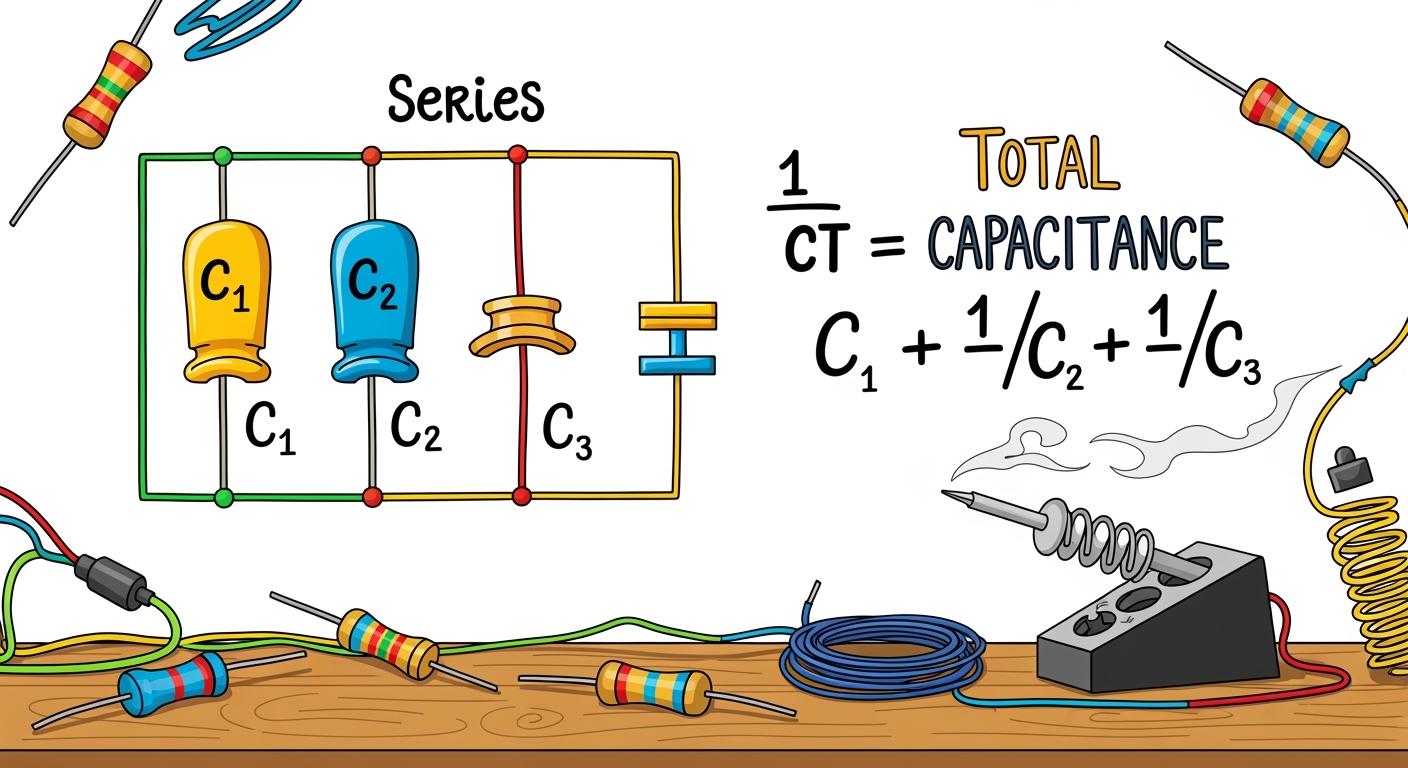
When you have a capacitor in series with others, you can find the total capacitance using one key formula. This equation is the foundation for calculating the equivalent capacitance of any circuit with capacitors connected in series.
The formula for the equivalent capacitance is:
1/C_Total = 1/C1 + 1/C2 + ... + 1/Cn
This series combination metoda is essential in many real-world systems, from power grids to electric vehicles. This guide provides the step-by-step methods you need. You can solve for the total capacitance in series, find the circuit's charge, and determine individual voltage drops. Mastering this series combination helps you analyze how capacitors in series work to find the final equivalent capacitance.
Key Takeaways
You can find the total capacitance of capacitors in series using a special formula. This formula adds the reciprocals of each capacitor's value.
The total capacitance in a series circuit is always smaller than the smallest individual capacitor. Adding more capacitors in series makes the total capacitance even smaller.
The electrical charge is the same on every capacitor in a series circuit. This is a very important rule to remember.
You can find the voltage across each capacitor. The smallest capacitor will have the largest voltage across it.
Calculating Total Capacitance in Series
Before you can find the charge or voltage in a circuit, you must first determine the total capacitance in series. This value, often called the equivalent capacitance, represents the single capacitor value that could replace the entire series combination without changing the circuit's overall characteristics.
The General Formula
The fundamental formula for any number of capacitors connected in series uses reciprocals (the number one divided by the value).
The formula for equivalent capacitance is:
1/C_Total = 1/C1 + 1/C2 + ... + 1/Cn
You might wonder why this formula is so different from a simple sum. It comes from two basic principles of physics. In a series combination, the electrical charge (Q) stored on each capacitor is identical. At the same time, the total voltage is the sum of the individual voltages across each capacitor. This relationship leads directly to the reciprocal formula.
Let's walk through an example to see how you can apply this formula.
Let's Practice: Calculating Total Capacitance
Imagine you have a circuit with three different capacitors connected in series:
C1 = 10 µF (microfarads)
C2 = 22 µF
C3 = 47 µF
Here is how you find the total capacitance in series:
Write the Formula: Start with the general formula for a capacitor in series.
1/C_Total = 1/C1 + 1/C2 + 1/C3Substitute Your Values: Place your capacitor values into the equation.
1/C_Total = 1/10 + 1/22 + 1/47Calculate the Reciprocals: Find the decimal value for each fraction.
1/C_Total = 0.1 + 0.04545 + 0.02128Sum the Values: Add the decimal values together.
1/C_Total = 0.16673Find the Final Equivalent Capacitance: To get C_Total, you must take the reciprocal of the sum. This is the most important step!
C_Total = 1 / 0.16673C_Total ≈ 5.998 µF
The equivalent capacitance for this circuit is approximately 6.0 µF.
Key Takeaway 📝 Notice that the total capacitance (6.0 µF) is smaller than the smallest individual capacitor in the circuit (10 µF). This is always true for a capacitor in series. The effective capacitance in series will always decrease as you add more capacitors.
The Two-Capacitor Shortcut
When you only have two capacitors in series, you can use a simpler formula to find the equivalent capacitance. This "product-over-sum" method helps you get the answer more quickly.
The shortcut formula for two capacitors is:
C_Total = (C1 * C2) / (C1 + C2)
This formula is a mathematical rearrangement of the general reciprocal formula, but it is limited to a series combination of exactly two capacitors.
Example: Using the Shortcut
Let's use the first two capacitors from our previous example (C1 = 10 µF and C2 = 22 µF) to calculate the equivalent capacitance.
Product (Multiply):
10 µF * 22 µF = 220Sum (Add):
10 µF + 22 µF = 32Divide:
C_Total = 220 / 32 = 6.875 µF
Using this shortcut, you can quickly find the equivalent capacitance without dealing with multiple decimal calculations. This makes it a very handy tool for analyzing simpler circuits. The total capacitance in series is found much faster.
💡 Pro Tip: Avoid Common Mistakes When you analyze circuits, remember a key rule. Capacitors in a series do not share a common voltage; they share a common charge. Assuming they have the same voltage is a frequent error that applies to parallel circuits, not series ones. Always use the correct formula for the total capacitance to get the right equivalent capacitance.
Finding Charge for Capacitors in Series
After you find the total or equivalent capacitance, your next step is to calculate the total charge stored in the circuit. This value is crucial because it is the key that unlocks the voltage across each individual capacitor.
Calculating Total Circuit Charge
You can find the total charge (Q_Total) in the circuit using a simple and powerful formula. This formula connects charge, capacitance, and voltage.
The formula for total charge is:
Q_Total = C_Total * V_Source
Here, C_Total is the equivalent capacitance you already calculated, and V_Source is the total voltage supplied by your power source (like a battery). You must use the equivalent capacitance to find the correct total charge for the entire circuit.
Let's imagine a circuit with a source voltage of 12V and an equivalent capacitance of 5 µF. You can calculate the total charge like this:
Write the formula:
Q_Total = C_Total * V_SourceSubstitute the values:
Q_Total = 5 µF * 12VCalculate the result:
Q_Total = 60 µC(microcoulombs)
The total charge stored by this series combination is 60 µC. This single calculation gives you the charge for the whole system.
The Constant Charge Principle
Here is the most important rule for a capacitor in series: the charge is the same on every single capacitor. The principle of charge conservation means the charge must be equal across all components. This is a fundamental property of any series combination.
The Golden Rule of Series Charge 🪙 In a series circuit, the total charge is equal to the charge on each individual capacitor.
Q_Total = Q1 = Q2 = Q3 = ...
Think of it like water flowing through a single pipe with different sections. The amount of water passing through each section must be the same. Similarly, for capacitors in series, the electric charge that accumulates on one capacitor directly affects the next. This forces the charge to be identical everywhere. Understanding this constant charge is essential for analyzing the circuit correctly and finding the voltage on each part. This principle is why using the equivalent capacitance is so effective.
Determining Individual Voltage Drops

Once you have the total charge, you can find the voltage drop across each capacitor. This is a critical step because in a series circuit, the voltage is not the same for every component. Instead, the source voltage divides among the capacitors. Understanding this division is key to analyzing circuit behavior.
Voltage Drop Across a Capacitor in Series
You can calculate the voltage drop across any individual capacitor using a rearranged version of the charge formula.
The formula for an individual voltage drop is:
Vn = Q_Total / Cn
Here, Vn is the voltage across a specific capacitor (like V1, V2, etc.), Q_Total is the constant charge you calculated for the whole circuit, and Cn is the capacitance of that specific capacitor.
Let's continue with our previous example. We found the equivalent capacitance was about 6.0 µF. If we connect this circuit to a 12V battery, we first find the total charge:
Q_Total = C_Total * V_SourceQ_Total = 6.0 µF * 12V = 72 µC
Now that you know the total charge is 72 µC, you can find the voltage drop for each capacitor. Remember, this charge is the same on C1, C2, and C3.
Voltage across C1 (10 µF):
V1 = 72 µC / 10 µF = 7.2VVoltage across C2 (22 µF):
V2 = 72 µC / 22 µF ≈ 3.27VVoltage across C3 (47 µF):
V3 = 72 µC / 47 µF ≈ 1.53V
To check your work, you can add the individual voltage drops. The sum should equal your source voltage.
7.2V + 3.27V + 1.53V = 12.0V
The numbers match! This confirms your calculations are correct. This process shows how the total voltage is shared across the series combination.
Important Rule: Inverse Relationship ⚖️ Did you notice that the smallest capacitor (C1 at 10 µF) has the largest voltage drop (7.2V)? This is always true for a capacitor in series. Because charge (Q) is constant, the voltage (V) is inversely proportional to the capacitance (C). A smaller capacitance value results in a larger voltage drop. Engineers must account for this, as it can cause overvoltage on smaller capacitors if a circuit is not designed properly.
The Voltage Divider Rule
For a circuit with just two capacitors, you can use a shortcut called the voltage divider rule. This rule lets you find the voltage across one capacitor without first calculating the total charge or the equivalent capacitance.
The formula looks a bit different from what you might expect. To find the voltage across one capacitor, you use the capacitance of the other capacitor in the numerator.
The formula for the voltage across C2 is:
V2 = V_Source * (C1 / (C1 + C2))
Let's use two capacitors, C1 = 10 µF and C2 = 20 µF, connected to a 9V source. We want to find the voltage across C2.
Write the formula:
V2 = V_Source * (C1 / (C1 + C2))Substitute the values:
V2 = 9V * (10 / (10 + 20))Simplify the fraction:
V2 = 9V * (10 / 30)or9V * (1/3)Calculate the result:
V2 = 3V
The voltage drop across the 20 µF capacitor is 3V. This rule is derived directly from the basic V = Q / C relationship and the formula for equivalent capacitance. It is a handy tool for quick analysis of a simple series combination. By using the correct formulas for equivalent capacitance, you can solve any circuit. The equivalent capacitance is the foundation for all these calculations.
You now have the essential tools to analyze any circuit with capacitors connected in series. You can solve these problems by following a simple, three-step process:
Calculate the total capacitance in series.
Find the total charge using the source voltage.
Determine the voltage drop across each capacitor.
Remember These Two Golden Rules! 🪙 The total capacitance is always smaller than the smallest capacitor in the series combination. Also, the charge (Q) is the same on every capacitor.
With these formulas and rules, you are ready to master even more complex circuits.
FAQ
Why does total capacitance decrease in a series circuit?
You can think of series capacitors as increasing the total distance between the plates. A larger distance reduces the overall ability to store charge. This is why your total capacitance is always less than the smallest capacitor in the series.
What happens if all the capacitors are identical?
When you connect identical capacitors in series, you can find the total capacitance easily. You just divide the value of one capacitor (C) by the number of capacitors (n) you have.
Formula for Identical Capacitors
C_Total = C / n
Can I use the two-capacitor shortcut for three or more capacitors?
No, you cannot use the "product-over-sum" shortcut for more than two capacitors. You must use the general reciprocal formula for circuits with three or more capacitors. Using the shortcut incorrectly will give you the wrong answer.
Which capacitor gets the most voltage in a series circuit?
The capacitor with the smallest capacitance value will have the largest voltage drop across it. This happens because the charge (Q) is the same for all capacitors. Since V = Q / C, a smaller C results in a larger V.