How Does a Capacitor Work and What Types Exist
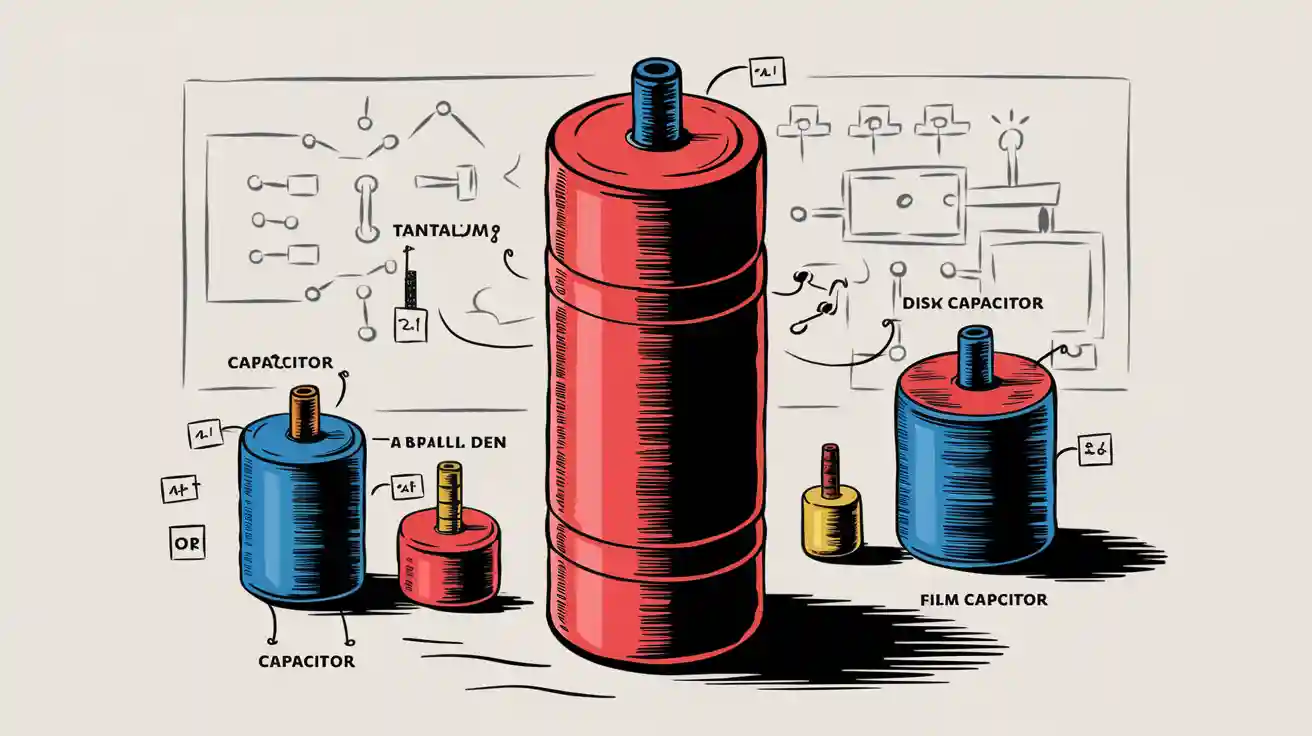
Imagine a water tank with a valve. You fill the tank, and when you open the valve, water flows out. A capacitor works in a similar way. You store electrical energy and release it when needed. A capacitor has two conductors separated by a dielectric material. You use capacitors in many electronics projects because they can manage energy and signals. Learning how does a capacitor work helps you choose the right one for your circuit.
Key Takeaways
- Capacitors store electrical energy by separating charges between two plates, creating an electric field that holds energy until needed.
- Different types of capacitors, like ceramic, electrolytic, and film, serve specific functions in circuits, so choose based on your project's requirements.
- Proper capacitor placement in circuits can enhance stability and reduce voltage spikes, improving overall performance by up to 30%.
- Understanding voltage ratings and capacitance values is crucial to avoid damaging components, especially with polarized capacitors.
- Supercapacitors offer rapid charge and discharge capabilities, making them ideal for applications requiring quick bursts of energy.
How Does a Capacitor Work
Basic Principle
You can think of a capacitor as a device that stores energy by separating electric charges. When you connect a capacitor to a battery or power source, electrons move onto one plate and leave the other plate. This movement creates a difference in charge between the plates. The space between the plates holds an electric field, which is where the energy stays until you need it.
- Capacitors store energy through charge separation and the creation of an electric field.
- This process is essential for understanding how does a capacitor work in any circuit.
If you want to know how does a capacitor work in terms of energy, you can use a simple formula. The energy stored in a capacitor equals half the product of the charge and the voltage:
E_cap = QV/2
Tip: The energy in a capacitor is called electrical potential energy. You can control this energy by changing the voltage or the amount of charge.
When you charge a capacitor, electrons move from the negative terminal to one plate. This plate becomes negatively charged, while the other plate loses electrons and becomes positively charged. Charging continues until the voltage across the capacitor matches the voltage of the power source. When you discharge the capacitor, the electrons flow back, and the stored energy releases into the circuit. The rate of discharge depends on how much charge is left, so the process slows down over time.
Structure and Materials
You will find that every capacitor has two main parts: the plates and the dielectric. The plates are made of metal and hold the electric charge. The dielectric sits between the plates and acts as an insulator. This material stops the flow of current but allows the electric field to form.
The physical structure of a capacitor affects how does a capacitor work. Larger plates can hold more charge, so they increase the capacitance. If you place the plates closer together, the electric field becomes stronger, and the capacitor stores more energy. The type of dielectric also matters. Materials with higher relative permittivity allow the capacitor to store more charge.
Here is a table showing common dielectric materials and their relative permittivity:
| Dielectric Material | Relative Permittivity |
|---|---|
| Vacuum | 1 |
| Teflon | 2.1 |
| Polyethylene | 2.25 |
| Polypropylene | 2.2 - 2.36 |
| Polystyrene | 2.4 - 2.7 |
| Bakelite | 4.9 |
| Fused quartz | 3.78 |
| Neoprene rubber | 6.7 |
| Nylon | 3.4 |
| Paper | 3.7 |
| Pyrex glass | 5.6 |
| Silicon oil | 2.5 |
| Strontium titanate | 233 |
| Water | 80 |
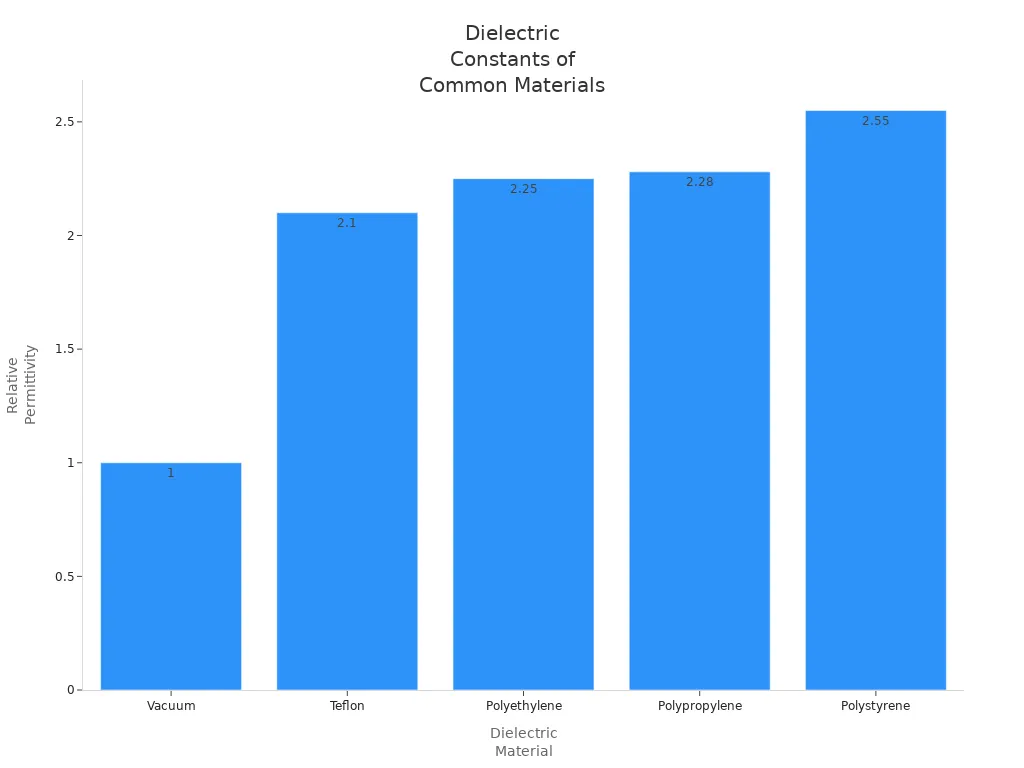
Note: Dielectrics are insulators that become polarized in an electric field. This property increases the capacitance and helps you store more energy in your capacitor.
You will see capacitors in many sizes and shapes. In consumer electronics, the capacitance can range from tiny picofarads to hundreds of farads. Voltage ratings can go up to 100 kilovolts, depending on the application.
| Capacitance Range | Voltage Rating |
|---|---|
| Picofarads to hundreds of farads | Up to 100 kilovolts |
Role in Circuits
You use capacitors in circuits for many reasons. They help stabilize voltage and smooth out ripples in power supplies. This function is important for devices like microcontrollers, which need steady voltage to work correctly. In high-speed digital circuits, capacitors with low equivalent series inductance (ESL) prevent voltage drops and noise. For radio frequency (RF) circuits, low-ESL and low-equivalent series resistance (ESR) capacitors filter signals and reduce losses.
- Capacitors act as energy buffers, storing energy when available and releasing it during peak usage.
- A well-designed capacitor system can reduce voltage spikes by up to 30%, protecting your components.
- Capacitive filtering can cut ripple voltage by over 60%, which keeps your electronics running smoothly.
- Capacitors provide immediate current support during dynamic load changes, improving response time by up to 75% in integrated circuits.
- Proper placement of capacitors minimizes inductive effects, which enhances circuit stability and signal integrity.
Capacitance tolerance tells you how much the actual value can differ from the rated value. This factor is important for making sure your circuit works as expected. Variations in capacitance can change how does a capacitor work in your project, sometimes causing unexpected results.
- Capacitive reactance measures how much a capacitor resists alternating current (AC). As frequency increases, reactance decreases. This property is vital for AC circuits.
- You can use capacitors in parallel to reach specific capacitance values that single components cannot provide.
Block Quote: Capacitors are essential for performance and stability in electronic circuits. You rely on them to keep voltage steady, filter signals, and protect sensitive components.
You should also know about common failure modes. Capacitors can fail due to leakage current, electrolyte dry-out, capacitance drift, internal short circuits, or bulging and venting. These problems can affect how does a capacitor work and may damage your circuit.
Types of Capacitors
You will find many types of capacitors in electronics. Each type has special features and uses. You can group them by how they are built, the material inside, and how you use them in circuits. Some have a fixed value, while others let you adjust the capacitance.
Here is a table showing the main categories and their common applications:
| Type of Capacitor | Description | Applications |
|---|---|---|
| Fixed Capacitors | Capacitors with a fixed capacitance value. | Used in various circuits, including tuning and coupling circuits. |
| Mica Capacitors | Use mica sheets and metal foils as dielectric material. | Common in tuning and coupling circuits of radio and TV systems. |
| Ceramic Capacitors | Use ceramic as a dielectric material, often in disc or tube form. | Found in tank circuits, matching circuits, and as coupling components. |
| Paper Capacitors | Employ paper as the dielectric material. | Used in filter circuits and as stators in single-phase motors. |
| Plastic Capacitors | Feature plastic as the dielectric material. | Common in timing circuits and integrated circuits. |
| Electrolytic Capacitors | Polarized capacitors that require correct polarity for operation. | Used in power supply smoothing and other applications requiring high capacitance. |
| Film Capacitors | Have an insulating plastic film as the dielectric. | Used in precision circuits and audio applications. |
| Adjustable Capacitors | Allow for manual or electronic adjustment of capacitance. | Common in tuning circuits for radios and RF applications. |
Tip: You can classify types of capacitors by polarity, adjustability, and dielectric material. Some are polarized, like electrolytic and tantalum. Others, such as ceramic and film, are non-polarized.
Fixed Value Capacitors
Fixed value capacitors have a set capacitance that does not change. You use them in most electronic devices because they are reliable and easy to use. Here is a table comparing fixed and variable capacitors:
| Type of Capacitor | Capacitance Characteristics |
|---|---|
| Fixed Capacitor | Fixed capacitance value that cannot be changed |
| Variable Capacitor | Capacitance value can be adjusted mechanically or electrically |
You will see several types of fixed value capacitors:
- Ceramic Capacitors: These use ceramic as the dielectric. You find them in tank circuits, matching circuits, and coupling components. Ceramic capacitors hold the largest market share at 30.54%. They cost less because manufacturers produce the ceramic material in-house.
- Film Capacitors: These use a thin plastic film as the dielectric. You use them in audio equipment and precision circuits. Film capacitors offer stable performance and low losses.
- Electrolytic Capacitors: These have a liquid or solid electrolyte. You use them for power supply smoothing and high-capacitance needs. Aluminum electrolytic capacitors are common. They cost more to make because of raw material prices and special manufacturing steps. You must connect them with the correct polarity.
- Tantalum Capacitors: These use tantalum metal and offer high capacitance in a small size. You use them in compact devices like smartphones.
- Polymer Capacitors: These use a solid polymer electrolyte. You find them in modern computers and devices that need long life and high reliability.
Note: Fixed value capacitors are non-adjustable. You pick the right value for your circuit and install it. You cannot change it later.
You should also know about mica, paper, and plastic capacitors. Mica capacitors work well in radio circuits. Paper capacitors are used in motors and filters. Plastic capacitors are common in timing circuits.
Variable Capacitors
Variable capacitors let you change the capacitance. You use them to tune circuits and adjust frequencies. You can turn a knob or move a slider to change the value. Variable capacitors are important in radios and lab equipment.
You will find two main types:
- Tuning Capacitors: You use these in radio tuners. You adjust the capacitance to select different radio stations. Tuning capacitors help you change the resonant frequency of the circuit.
- Trimmer Capacitors: You use these for fine adjustments. Trimmer capacitors are small and fit on circuit boards. You set them during assembly to make sure the circuit works as planned.
Variable capacitors play a key role in many applications:
- Radio communication equipment: You use variable capacitors in radio tuners to pick up different stations.
- Frequency synthesizers: You adjust the output signal frequency in communication systems.
- Filter circuits: You fine-tune the cutoff frequency in audio and radio equipment.
- Oscillator circuits: You help generate periodic signals by adjusting the oscillation frequency.
Block Quote: Variable capacitors are crucial for tuning frequencies in oscillators. You connect them to inductors or resistors to control the output. This lets you create sine, square, or triangle waves for waveform generators and test equipment.
You will see variable capacitors in radio tuning circuits and audio filters. They help you adjust resonance or cutoff points for better sound or signal quality.
Supercapacitors
Supercapacitors are a special type of capacitor. You use them when you need to store a lot of energy and release it quickly. Supercapacitors have much higher energy density than traditional capacitors. You can charge them in seconds or minutes, while normal capacitors take hours.
Here is a table comparing supercapacitors and traditional capacitors:
| Feature | Supercapacitors | Traditional Capacitors |
|---|---|---|
| Energy Density | Much larger capacity | Lower energy density |
| Charge Speed | 10 seconds to 10 minutes for >95% charge | Measured in hours |
| Power Density | Up to 300W/KG~5000W/KG | Lower than supercapacitors |
You use supercapacitors in electric vehicles, energy storage systems, and backup power supplies. They help you deliver quick bursts of energy and recharge fast. Supercapacitors also last longer than batteries in many cases.
Tip: Supercapacitors are ideal for applications that need fast charge and discharge cycles. You can use them in renewable energy systems and emergency backup units.
You should think about the environmental impact when you choose types of capacitors. Some, like aluminum electrolytic capacitors, need careful disposal and recycling. You can help the environment by using take-back schemes and zero-waste strategies. Some materials can be recycled, but others must be incinerated. Responsible disposal keeps your project eco-friendly.
You will see new advancements in capacitor design. Solid-state capacitors use solid electrolytes for longer life. Nanotechnology helps make ultra-compact capacitors with high energy density. Supercapacitors now offer rapid charge and discharge, which is perfect for electric vehicles and energy storage.
Block Quote: You can choose from many types of capacitors for your project. Each type has strengths and weaknesses. You should match the capacitor to your needs for best results.
Fixed Value Capacitors
Ceramic Capacitors
You use ceramic capacitors in many electronic devices. These capacitors have a ceramic dielectric between two metal plates. You find them in mobile phones, laptops, and LED displays. Ceramic capacitors help filter noise and stabilize voltage. You also see them in automotive systems like airbags and GPS modules. In industrial electronics, they regulate voltage and reduce noise in motor controls and robotics.
| Application Area | Examples of Use |
|---|---|
| Consumer Electronics | Mobile phones, tablets, laptops, LED displays, backlight systems |
| Automotive Electronics | ESC, airbags, ABS, ECUs, GPS modules, infotainment systems |
| Industrial Electronics | Robotics, motor control, inverters, VFDs |
| Telecommunications | Base stations, repeaters, RF filters, oscillators |
| Medical Devices | Imaging, monitoring, implanted devices |
| Aerospace and Defense | Radar, satellite, electronic warfare |
| Renewable Energy | Solar inverters, wind turbines, smart grid |
| Wearable Electronics | Smartwatches, fitness trackers |
Tip: Ceramic capacitors are small and reliable. You choose them for high-frequency and high-density circuits.
Electrolytic Capacitors
Electrolytic capacitors use a liquid or solid electrolyte and an aluminum or tantalum plate. You select them when you need high capacitance for power supply smoothing. These capacitors are polarized, so you must connect them correctly. Electrolytic capacitors have higher failure rates than other fixed value capacitors, especially at high voltage.
| Capacitor Type | Failure Rate (FIT) | Reference Conditions |
|---|---|---|
| Aluminium Electrolytic | 1 to 20 (low voltage) | 40 °C, 0.5 UR |
| 20 to 200 (high voltage) | 40 °C, 0.5 UR | |
| Tantalum | 0.01%/1000 h (85 °C, UR) | 85 °C, rated voltage UR |
Note: High temperature and humidity can shorten the lifespan of electrolytic capacitors. You should keep them in cool, dry places.
Film Capacitors
Film capacitors use a thin plastic film as the dielectric. You see them in audio equipment, industrial controls, and power electronics. These capacitors offer stable performance and low losses. You can choose from different materials like PET, PEN, PPS, and PP. Each material gives you a range of capacitance and voltage options.
| Material | Capacitance Range | Voltage Range |
|---|---|---|
| PET | 100 pF to 22 μF | 50V to 1000V |
| PEN | 100 pF to 1 μF | 16V to 250V |
| PPS | 100 pF to 0.47 μF | 16V to 100V |
| PP | 100 pF to 10 μF | 40V to 2000V |
| Capacitance Range | Voltage Range |
|---|---|
| 1nF to 30μF | 50V to 2KV |
Block Quote: You use plastic film capacitors for precise timing and filtering in industrial and audio circuits.
Tantalum Capacitors
Tantalum capacitors give you high capacitance in a small size. You use them in smartphones, medical devices, and compact electronics. These capacitors have long service life and resist high temperatures. You benefit from their stable performance and low inductance. You must insert them with the correct polarity to avoid failure.
-
Advantages:
- Long service life
- High temperature resistance
- Compact size
- Excellent electrical properties
- Low ESR for high-frequency use
-
Disadvantages:
- Smaller capacity than aluminum electrolytic capacitors
- Lower voltage and current ratings
- Higher cost
- Polarized, so incorrect insertion can cause failure
Tip: Tantalum capacitors work well in miniaturized devices, but you should check voltage ratings before use.
Polymer Capacitors
Polymer capacitors use a solid polymer electrolyte. You find them in computers and devices that need long life and high reliability. These capacitors last up to 200,000 hours, which is about 20 years. Polymer capacitors have lower ESR and better stability than aluminum electrolytic capacitors. You get higher ripple current capability and less temperature dependence. Polymer capacitors cost more and may have higher leakage current.
| Feature | Polymer Capacitors | Aluminum Electrolytic Capacitors |
|---|---|---|
| Lifespan | Up to 200,000 hours | Shorter lifespan |
| Stability under conditions | More stable | Less stable |
| ESR | Lower ESR values | Higher ESR values |
| Ripple current capability | Higher capability | Lower capability |
| Temperature dependence | Lower | Higher |
| Risk of failure | No burning or exploding | Risk of burning or exploding |
| Cost | More expensive | Generally cheaper |
| Leakage current | Higher leakage current | Lower leakage current |
| Damage from transients | More damageable | Less damageable |
Note: You use polymer capacitors for stable, long-lasting performance in modern electronics.
You learned how a capacitor stores and releases energy. Each type of capacitor works best for specific tasks. When you choose a capacitor, think about these factors:
- Application and capacitance value
- Voltage and temperature ratings
- Size, cost, and dielectric type
Common mistakes include overlooking voltage ratings or choosing the wrong capacitance. You can explore more with guides like the Capacitor Quick Reference Guide or try hands-on experiments to deepen your understanding.
FAQ
What happens if you connect a capacitor the wrong way?
You can damage polarized capacitors like electrolytic or tantalum types. The capacitor may leak, heat up, or even explode. Always check the markings for correct polarity before you install it.
How do you know which capacitor to choose for your project?
You should look at the voltage rating, capacitance value, and size. Check the application, such as filtering or timing. Use a table to compare types:
| Application | Best Capacitor Type |
|---|---|
| Power supply | Electrolytic |
| Audio circuits | Film |
| RF circuits | Ceramic |
Can you use capacitors to store energy like a battery?
You can store energy in capacitors, but only for short periods. Supercapacitors hold more energy than regular types, but batteries last longer. Use capacitors for quick bursts of power, not long-term storage.
Why do capacitors fail?
You may see failures from overheating, aging, or incorrect voltage. Leaks, bulging, or loss of capacitance signal problems. Replace faulty capacitors to keep your circuit safe.