GDDR6 vs HBM Unpacking GPU Memory for Gaming and AI
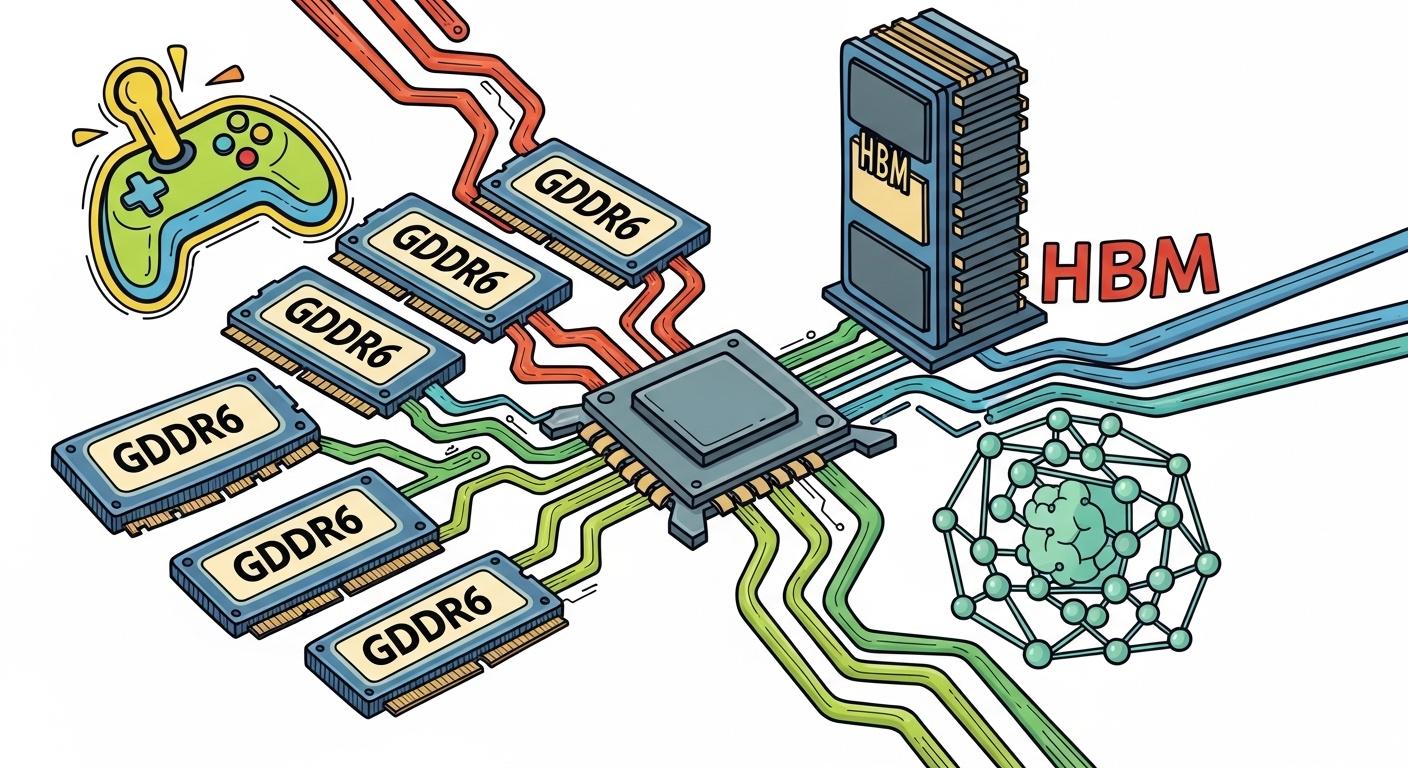
Most users find GDDR6 memory offers the best balance of performance and cost. This VRAM is the standard for a modern gaming GPU. In contrast, High Bandwidth Memory (HBM) is a premium technology. HBM memory serves users with extreme data needs, like AI training. Its massive memory bandwidth provides high performance where speed is critical. Understanding the differences between GDDR and this memory technology helps people select the right graphics processing units for their specific tasks. A powerful GPU depends on the right memory.
Key Takeaways
GDDR6 memory is good for gaming and content creation. It offers a balance of speed and low cost.
HBM memory is for AI training and supercomputers. It moves large amounts of data very fast.
GDDR6 has high clock speeds and low latency. This helps games run smoothly.
HBM has a wide data path and stacked design. This gives it huge bandwidth for big data tasks.
Choose GDDR6 for gaming and general use. Choose HBM for advanced AI and scientific work.
Understanding GDDR6: The Consumer Standard
Graphics Double Data Rate 6, or GDDR6, is the workhorse memory for modern consumer graphics processing units. Its design philosophy prioritizes high speed and manufacturing simplicity. This combination delivers excellent performance for everyday tasks without a premium price tag.
Architecture: Speed and Simplicity
Think of GDDR6 architecture as a narrow but extremely fast highway. Fewer lanes are available, but the speed limit is very high. This design allows individual data packets to travel quickly, which reduces latency. Low latency is crucial for a smooth experience in many applications. The high speed of GDDR comes from its impressive clock speeds. This memory technology operates at a very high frequency to achieve its performance goals.
Memory Type | Clock Speed (MHz) |
|---|---|
GDDR6 | ~1750–2500 |
This focus on raw speed makes GDDR6 an effective solution for tasks that need quick access to smaller, sequential data chunks. Some cards even use an evolution called GDDR6X memory, which pushes the gddr6x bandwidth even further.
Key Benefit: Cost-Effective Performance
The biggest advantage of GDDR6 is its cost-efficiency. The manufacturing process for GDDR6 RAM is mature and less complex than alternatives. Manufacturers solder the memory chips directly onto the main circuit board of the GPU. This straightforward integration keeps production costs down. The result is a powerful gddr6 graphics card that remains affordable for the average consumer. This balance of price and performance makes it the default choice for most of the market.
Ideal Use Cases: Gaming and Content Creation
GDDR6 shines in gaming and content creation. These applications depend on the GPU to quickly access textures, models, and frame data. Modern AAA games often recommend 12GB or even 16GB of VRAM for 4K resolution, a capacity that GDDR6 provides easily.
Tip: A GPU with ample GDDR6 VRAM, like an Nvidia RTX or AMD Radeon series card, ensures a smooth gaming experience. It prevents stuttering when loading high-resolution assets.
The high performance and sufficient memory bandwidth of GDDR6 handle these workloads with great efficiency. This makes it the practical standard for gamers and creators who need responsive and powerful graphics without the enterprise-level cost.
Exploring HBM Memory: The Data Specialist
High Bandwidth Memory (HBM) is an advanced memory technology built for one purpose: moving massive amounts of data. Unlike the consumer-focused GDDR, HBM memory prioritizes maximum data throughput for specialized, data-heavy workloads. This makes it the top choice for high-performance GPUs in data centers and research labs.
Architecture: Wide Bus and Stacked Design
If GDDR6 is a fast, narrow highway, HBM is a sprawling superhighway with many lanes. HBM memory uses an extremely wide memory bus—often 1024 bits or wider. This allows the GPU to move huge volumes of data simultaneously, even though the memory's clock speed is lower than GDDR.
The architecture also uses a unique 3D stacking method.
Memory chips are stacked vertically on top of each other.
Microscopic vertical wires called Through-Silicon Vias (TSVs) connect these layers.
Advanced tools like
Syndion® etch systemsare needed to create these precise connections.
This entire stack, along with the GPU, sits on a silicon base called an interposer. This complex design increases manufacturing costs but is essential for achieving HBM's incredible performance.
Key Benefit: Massive Bandwidth and Efficiency
The primary benefit of HBM is its enormous memory bandwidth. This wide-bus architecture delivers unparalleled data transfer rates, which is critical for feeding data-hungry processing cores. This high bandwidth directly improves overall performance in tasks limited by data access speed.
Beyond raw speed, HBM also offers superior power efficiency. The memory technology operates at a lower voltage, with HBM2 running at just 1.2V. This reduces power consumption and heat output, a significant advantage in dense computing environments. This efficiency, combined with its architecture, enables massive VRAM capacities. For example, the NVIDIA H100 GPU features 80GB of HBM, a capacity needed for cutting-edge AI.
Ideal Use Cases: AI Training and HPC
The unique strengths of High Bandwidth Memory make it perfect for Artificial Intelligence (AI) and High-Performance Computing (HPC). Training large language models requires both immense memory bandwidth and large VRAM capacity.
An 80GB VRAM capacity allows a single GPU to hold an entire large model, which speeds up training and improves stability.
This capability is why HBM is standard in top-tier accelerators. Supercomputers and AI clusters rely on this technology in hardware like:
AMD MI300X accelerators
For professionals whose work depends on maximum data throughput, the investment in HBM is a necessity.
HBM2 vs GDDR6: A Direct Performance Comparison
The choice between HBM2 vs GDDR6 involves a series of trade-offs. Each memory technology excels in different areas. A direct comparison of their performance metrics reveals why one is the standard for gaming and the other dominates the world of AI. Understanding these differences helps clarify the value proposition of each memory type.
Bandwidth and Throughput
Bandwidth is the most significant differentiator in the HBM2 vs GDDR6 debate. It measures how much data the VRAM can move in a given amount of time. High bandwidth memory achieves its goal with a very wide data path. HBM memory can have a bus width of 1024 bits or more. This massive highway allows a GPU to process huge datasets very quickly.
The NVIDIA A100 GPU, for example, uses HBM2e memory. This technology gives it a memory bandwidth of over 2 terabytes per second (TB/s). This incredible data throughput is essential for large-scale AI models.
In contrast, GDDR memory uses a narrower bus, typically between 128 and 384 bits. It compensates with much higher clock speeds. A top-tier consumer GPU like the NVIDIA RTX 4090 uses advanced GDDR6X RAM. This setup provides excellent performance for gaming and creative work.
Specification | |
|---|---|
Memory Type | GDDR6X |
Memory Bus Width | 384-bit |
Memory Bandwidth | 1.0 TB/s |
While 1.0 TB/s is an impressive speed, the HBM-equipped A100 offers double the bandwidth. This highlights the core difference. GDDR provides ample bandwidth for consumer needs, while HBM delivers the extreme bandwidth required by high performance GPUs in data centers.
Latency and Clock Speed
The HBM2 vs GDDR6 comparison also involves latency and clock speed. Latency refers to the time delay before a data transfer begins. GDDR6's design prioritizes high clock speeds. This high frequency gives it a significant advantage in latency-sensitive tasks.
GDDR6 can have a latency as low as 20 nanoseconds (ns), while HBM2's latency is closer to 100 ns. This lower latency makes GDDR more responsive for workloads like gaming, where quick access to individual assets is critical for a smooth experience.
HBM memory operates at a lower clock speed. Its strength lies in moving large, continuous blocks of data, not in fetching small, random pieces quickly. The lower clock speed is a deliberate design choice that contributes to its power efficiency. For AI training, the sheer volume of data moved outweighs the slightly higher initial delay. The HBM2 vs GDDR6 choice here depends entirely on the application's sensitivity to latency versus its need for raw bandwidth.
Cost, Power, and Form Factor
The final points of comparison in the HBM2 vs GDDR6 matchup are cost, power, and physical design. These factors often dictate which memory technology a GPU manufacturer will use.
Cost: HBM is significantly more expensive to produce. The 3D stacking process, use of an interposer, and complex assembly increase manufacturing costs. GDDR is a more mature and simpler memory technology, making it the cost-effective choice for consumer graphics cards.
Power: High bandwidth memory offers superior power efficiency. It operates at a lower voltage (around 1.2V for HBM2) compared to GDDR6 (1.35V). This results in less heat and lower power consumption per gigabyte of bandwidth, a crucial benefit in dense server racks.
Form Factor: HBM's stacked design creates a smaller physical footprint. Placing the memory chips vertically saves valuable board space. This allows engineers to place the VRAM closer to the GPU die, further improving efficiency and performance. GDDR chips are spread out on the main circuit board, requiring more physical space.
Ultimately, GDDR offers a fantastic balance of speed and affordability for the consumer market. HBM provides unmatched bandwidth and efficiency for specialized, high-stakes professional workloads where budget is a secondary concern to performance.
Choosing Your GPU: Gaming vs. AI
The right GPU memory depends entirely on your primary tasks. Gamers have very different needs compared to AI professionals. Understanding your workload is the first step to selecting a graphics card with the correct memory technology. This choice directly impacts performance, cost, and overall user experience.
For Gamers: The Case for GDDR6
For gaming, GDDR6 is the undisputed champion. Its design offers the perfect blend of speed, capacity, and affordability. Modern games require a GPU to load textures and assets quickly for a smooth experience. The low latency and high clock speed of GDDR6 excel at these tasks. This responsiveness is key to eliminating stutter and achieving high frame rates.
A powerful consumer GPU with GDDR6X, like the NVIDIA RTX 4080, demonstrates this capability. It delivers excellent performance for demanding resolutions.
A user with an RTX 4080 can expect over 140 frames per second (FPS) at 1440p resolution, even with advanced features like ray tracing enabled. Technologies like DLSS Frame Generation further boost this performance.
Game | RTX 4080 (FPS) |
|---|---|
Counter-Strike 2 | 309 (max), 229 (avg), 173 (min) |
Call of Duty: Modern Warfare III | 219 (max), 214 (avg), 168 (min) |
Forza Horizon 5 | 230 (max), 169 (avg), 154 (min) |
Shadow of the Tomb Raider | 286 (max), 270 (avg), 206 (min) |
This level of performance ensures a fluid and responsive gaming experience across various genres. The efficiency of GDDR6 RAM allows a single GPU to drive high refresh rate monitors effectively.
Ultimately, the cost-effective nature of the GDDR memory technology makes it the practical choice. Gamers get fantastic performance without the extreme cost associated with specialized hardware.
For AI Professionals: Inference vs. Training
AI workloads are not all the same. The memory requirements for AI training are vastly different from those for AI inference. This distinction is critical when choosing a GPU.
Training a large neural network is an incredibly demanding process. It requires immense memory bandwidth and a large VRAM capacity. The GPU must store not only the model's parameters but also gradients and optimizer states.
Model Parameters: The weights of the neural network.
Gradients: Values calculated during backpropagation to update the weights.
Optimizer States: Additional data stored by optimizers like Adam to guide the training process.
This multiplies the memory footprint significantly. For example, training a 7-billion-parameter model requires far more memory than simply running it.
This is where high bandwidth memory becomes essential. HBM's wide interface allows the GPU to access all this data simultaneously, preventing bottlenecks that would slow down training. The massive bandwidth of HBM memory ensures the processing cores are constantly fed with data, maximizing efficiency and reducing training times.
Inference, on the other hand, is the process of using a pre-trained model to make predictions. This task is much less memory-intensive. It primarily requires enough VRAM to hold the model's parameters. Because of this, high-end GDDR6 GPUs are often an excellent and cost-effective choice for inference workloads.
The NVIDIA RTX 4090 with 24GB of GDDR6X is a popular choice for AI developers.
The NVIDIA L4 uses 24GB of GDDR6 and is designed for efficient, low-power inference at scale.
The AMD Radeon RX 7900 XTX also offers 24GB of GDDR6 and dedicated AI accelerators, making it a strong competitor for certain models.
For AI professionals, the choice is clear. Training large models demands the superior bandwidth and capacity of HBM memory. Inference tasks can often be handled effectively and more affordably by a powerful GPU equipped with GDDR.
The choice between GDDR and HBM memory technology defines a GPU's purpose. GDDR offers cost-effective performance for consumer tasks like gaming. HBM provides maximum data throughput for specialized professional workloads. A user's budget and primary application are the main decision factors. The superior bandwidth and efficiency of HBM are essential for certain scientific fields.
Computational Fluid Dynamics
Weather Modeling
Molecular Dynamics
Gamers should confidently choose a GPU with GDDR memory. Professionals needing extreme performance for AI or HPC will find HBM a necessary investment.
FAQ
Can HBM be used for gaming?
Yes, but it is not practical. HBM GPUs are extremely expensive. GDDR6 offers fantastic gaming performance at a much lower cost. The high price of HBM makes it a poor value for most gamers, who will not benefit enough from the extra bandwidth.
What is GDDR6X?
GDDR6X is a faster version of GDDR6, created by NVIDIA and Micron. It improves performance in high-end consumer GPUs.
It uses a new signaling technology (PAM4).
This technology sends more data per cycle.
The result is a significant boost to memory bandwidth.
Why is HBM more power-efficient? ⚡️
HBM uses less power for two main reasons. It operates at a lower voltage compared to GDDR6. Its stacked design also places the memory very close to the GPU die. This short data path reduces the energy needed to move information.
Will HBM replace GDDR6 in consumer GPUs?
This is unlikely in the near future. The complex manufacturing and high cost of HBM are major barriers for the consumer market. GDDR technology continues to improve, providing an excellent balance of performance and price for gamers and creators.