Exploring the Versatility of Gyroscope Sensors in Modern Technology

Gyroscope sensors have become vital in daily life, powering features in smartphones, vehicles, and even drones. These sensors help with navigation and motion tracking, making devices smarter and more responsive. Over the past decade, companies have improved gyroscope technology, leading to rapid adoption worldwide. For example, smartphones now use gyroscope sensors for screen rotation and gaming.
| Region or Segment | Key Trend or Fact |
|---|---|
| Consumer Electronics | 58% of MEMS gyroscope market, with 3.8 billion units shipped in 2023 |
| Asia-Pacific | Leads production, with 47% growth in MEMS sensor output from 2020 to 2023 |
| Average Sensors/Device | Increased from 2.1 in 2020 to 3.4 in 2023 |
Gyroscopes in modern technology continue to shape the way people interact with digital tools.
Key Takeaways
- Gyroscope sensors measure rotation and help devices track movement and orientation accurately.
- MEMS gyroscopes are small, low-cost sensors widely used in smartphones, wearables, and gaming devices for motion sensing and stabilization.
- High-precision gyroscopes like fiber optic and ring laser types support navigation and control in aerospace, defense, and autonomous vehicles.
- Gyroscopes work with accelerometers to improve features like screen rotation, image stabilization, gesture control, and navigation.
- Future gyroscope technology focuses on miniaturization, integration with other sensors, and new applications in robotics, healthcare, and smart devices.
Gyroscope Sensor Basics
What Is a Gyroscope Sensor
A gyroscope sensor helps devices understand how they rotate or tilt. This sensor measures changes in angular momentum, which means it can sense when something spins or turns. Unlike an accelerometer, which detects straight-line movement, a gyroscope focuses on rotation. For example, when a person turns a smartphone to play a racing game, the gyroscope sensor detects the angle and speed of the turn. This ability to sense rotation makes gyroscopes important for many modern devices.
Gyroscopes stand out from other sensors because they measure angular velocity and orientation. Classical gyroscopes use a spinning mass that keeps its direction steady, even if the device moves. Modern gyroscope sensors, such as those found in microelectromechanical systems, use vibrating crystals to detect changes in rotation. This precise sensing of tilt and spin helps devices stay balanced and responsive.
Note: Gyroscopes and accelerometers often work together. While the accelerometer senses movement in a straight line, the gyroscope sensor tracks rotation. This teamwork gives devices a full picture of motion.
How Gyroscopes Work
Gyroscopes use different methods to sense rotation. Each type of gyroscope has a unique way of detecting angular velocity:
- Mechanical gyroscopes use a spinning rotor. The rotor’s axis stays steady, so when the frame turns, the gyroscope senses the change.
- Some gyroscopes, called rate gyroscopes, measure how fast something spins by detecting a force that appears when the device rotates.
- Optical gyroscopes use light. They split a beam into two paths that travel in opposite directions. When the device rotates, the light beams shift, and the gyroscope measures this change.
- MEMS gyroscopes, found in many microelectromechanical devices, use tiny vibrating parts. When the device spins, the vibration changes. The gyroscope senses this shift to measure rotation.
Gyroscopes rely on the conservation of angular momentum. This principle means that a spinning object keeps its direction unless something pushes it. Because of this, gyroscopes can sense even small changes in rotation. Devices use this sensing ability to keep images steady, guide robots, and help vehicles stay on course.
Types of Gyroscopes
Gyroscopes come in several types, each with unique features and uses. The table below shows the main categories, their operating principles, and key characteristics.
| Category | Operating Principle(s) | Key Characteristics and Notes |
|---|---|---|
| Mechanical | Spinning rotor mounted on gimbals; principles of rigidity in space, angular momentum, precession | Reliable; measures up to 6 axes; prone to drift due to mechanical friction |
| Optical | Two light beams traveling in opposite directions within a closed platform; based on the Sagnac effect | Small, lightweight; highly sensitive; solid-state; relatively expensive and complex to manufacture |
| Vibratory (MEMS) | Vibrating structure using Newton's law of inertia, Coriolis effect, and precession | Typically one axis; tiny size; low cost and power consumption; less stable under stress, temperature, humidity; prone to drift |
MEMS Gyroscopes
MEMS gyroscopes use tiny vibrating parts to sense rotation. These gyroscopes rely on the Coriolis effect, which causes a shift in the vibration when the device turns. MEMS sensors are very small and fit easily into smartphones, wearables, and gaming consoles. They work with the accelerometer to track movement and orientation. MEMS gyroscopes help with camera stabilization, gesture recognition, and motion sensing in many consumer electronics. MEMS sensors use little power and cost less than other types, but they can drift if exposed to heat or vibration. MEMS gyroscopes have transformed how people interact with devices by enabling advanced motion sensing and gesture-based controls.
- Smartphones use MEMS gyroscopes for screen rotation and stabilization.
- Gaming consoles rely on MEMS for motion tracking and control.
- Wearables use MEMS sensors for activity and health monitoring.
- Drones and cameras use MEMS gyroscopes for stabilization and navigation.
Fiber Optic Gyroscopes
A fiber optic gyroscope uses light to detect rotation. It sends two beams of light in opposite directions through a coil of optical fiber. When the gyroscope turns, the Sagnac effect causes a tiny phase shift between the beams. The device measures this shift to sense angular velocity. Fiber optic gyroscopes have no moving parts, so they do not wear out or suffer from vibration. These gyroscopes provide high precision and work well in harsh environments. Fiber optic gyroscopes are common in aerospace, satellites, and military navigation systems. MEMS gyroscopes cannot match the precision of a fiber optic gyroscope, especially for long-term navigation. Fiber optic gyroscopes use advanced signal processing to improve accuracy and reliability.
- Fiber optic gyroscopes operate in extreme temperatures and resist electromagnetic interference.
- These gyroscopes measure even the smallest changes in rotation.
- Fiber optic gyroscopes support critical navigation in aircraft and spacecraft.
Ring Laser and Atomic Gyroscopes
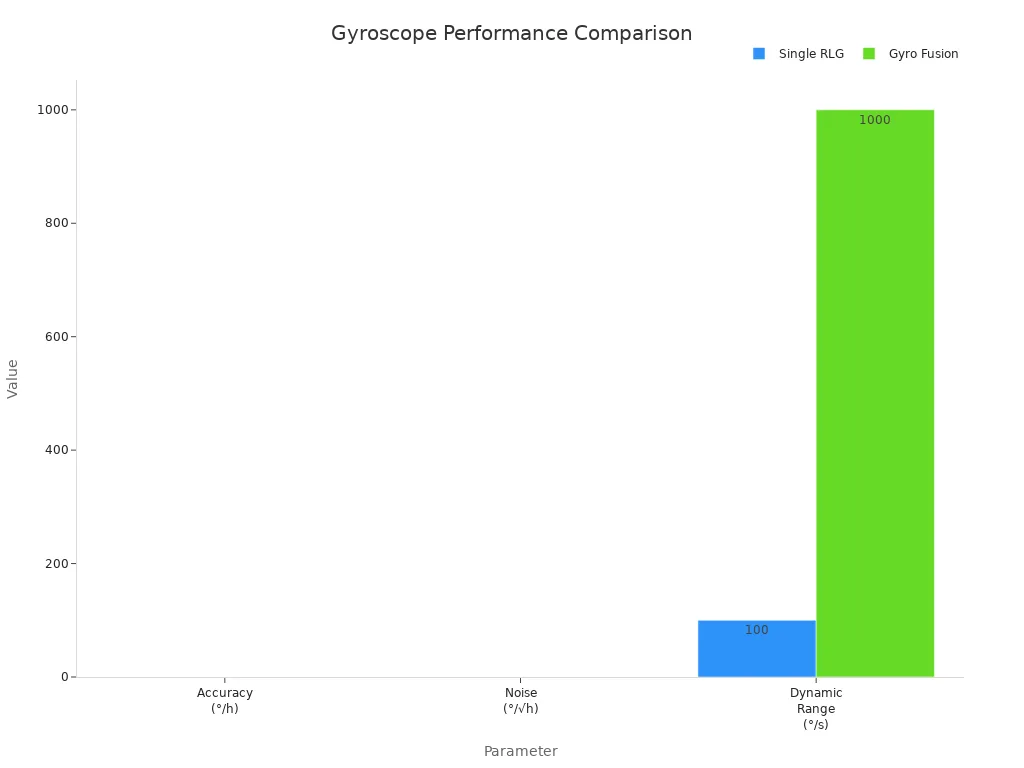
Ring laser gyroscopes use the Sagnac effect, like fiber optic gyroscopes, but with a laser beam inside a closed optical path. These gyroscopes have no moving parts except for minor components, which reduces drift and increases reliability. Ring laser gyroscopes offer high sensitivity and long operational lifetimes. They are used in aircraft, missiles, and satellites for precise navigation. The chart below compares the accuracy and performance of single ring laser gyroscopes and advanced gyro fusion systems.
Atomic gyroscopes use quantum effects to measure rotation. These gyroscopes achieve extremely high sensitivity and can be made very small. Atomic gyroscopes work well in harsh environments, such as space or high-radiation areas. They support advanced navigation in unmanned aerial vehicles and satellites. Ongoing research continues to improve atomic gyroscope technology for future defense and aerospace missions.
Note: Each type of gyroscope offers unique advantages for sensing rotation. MEMS gyroscopes provide compact, low-cost solutions for everyday devices. Fiber optic gyroscopes and ring laser gyroscopes deliver high precision for navigation in demanding environments. Atomic gyroscopes push the limits of sensitivity and miniaturization.
Applications of Gyroscopes
Consumer Electronics
Gyroscopes have become essential in consumer electronics. These sensors help devices like smartphones, tablets, cameras, and wearables sense rotation and movement. The global gyroscope sensor market reached about USD 3.8 billion in 2023, with consumer electronics as the main growth driver. Compact MEMS gyroscopes dominate this segment because they fit easily into small devices. The Asia Pacific region leads in production, supporting the rapid growth of these sensors in everyday gadgets.
Gyroscope sensors work with the accelerometer to improve user experience. They enable automatic screen rotation, motion-controlled gaming, and gesture recognition. For example, when a person tilts a phone to play a racing game, the gyroscope detects the angle and speed of the turn. The accelerometer senses straight-line movement, while the gyroscope tracks rotation. Together, they allow for smooth and responsive controls.
Gyroscopes also help stabilize images and videos. When someone takes a photo or records a video, the sensor detects small shakes and helps the camera software correct them. This results in clearer pictures and smoother videos.
The table below shows how gyroscope sensors enhance different areas in smartphones and wearables:
| Enhancement Area | Description |
|---|---|
| Gaming & Virtual Reality | Detects orientation changes for motion-controlled games and immersive VR. |
| Image & Video Stabilization | Reduces blur by correcting for hand shakes. |
| Screen Rotation & Orientation | Enables automatic screen rotation for better viewing. |
| Location & Navigation | Works with GPS and accelerometer for accurate navigation. |
| Motion & Gesture Recognition | Allows features like shake-to-undo or flip-to-mute. |
Popular apps such as AndroSensor and Sleep Time use gyroscope data for advanced features. The estimated market size for gyroscope sensors in consumer electronics reached about USD 1.125 billion in 2024, showing the importance of these applications.
Robotics and Aerospace
Robotics and aerospace rely on gyroscopes for precise movement, orientation, and stabilization. In robotic systems, gyroscope sensors provide real-time feedback on angular velocity and orientation. This data allows robots to adjust their movements quickly and stay balanced. The accelerometer works alongside the gyroscope to give a complete picture of motion. Together, they help robots walk, turn, and perform complex tasks with accuracy.
In industrial robots, MEMS gyroscopes are often embedded in joints and mobile platforms. These sensors offer high-speed feedback, which is important for tasks that require fast and precise control. For example, automated guided vehicles (AGVs) use gyroscopes for dead-reckoning navigation when GPS is not available. Humanoid robots use them to reduce falls and improve joint positioning.
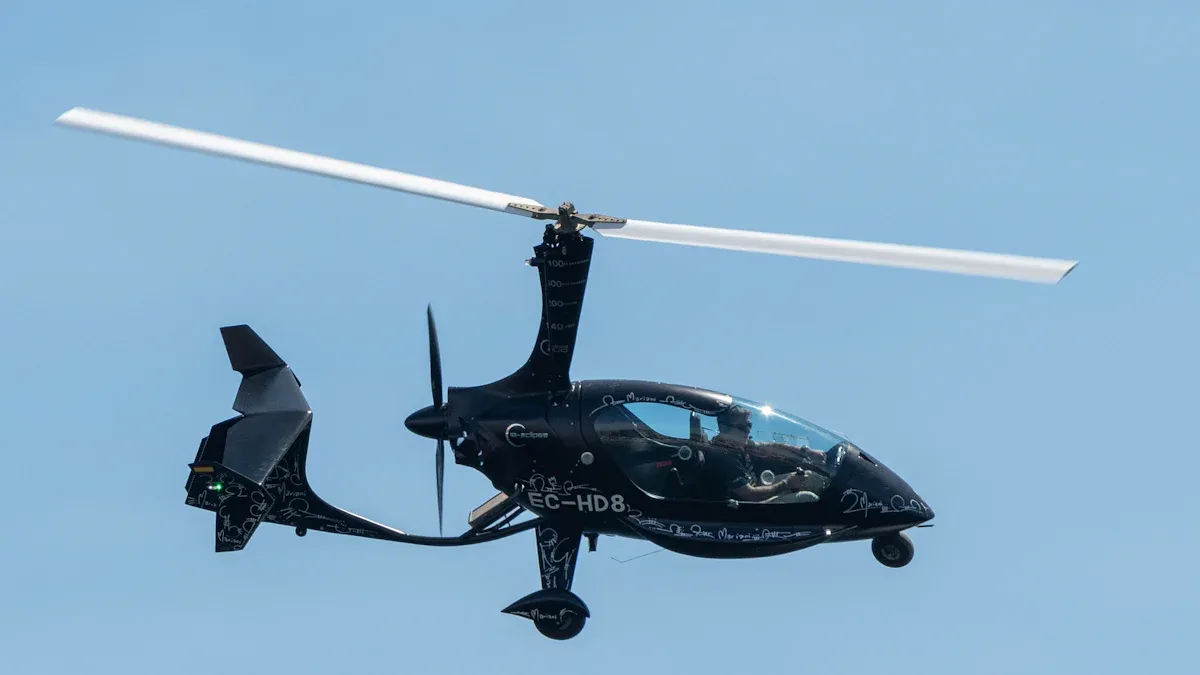
Gyroscopes also play a key role in aerospace. Drones and aircraft use gyroscope sensors as part of the Inertial Measurement Unit (IMU). The IMU combines the gyroscope, accelerometer, and sometimes a magnetometer to measure speed, orientation, and angular velocity.
Drones use gyroscopes to maintain balance and stability during flight. The IMU sends real-time data to the flight controller, which adjusts the motors to keep the drone steady. This allows drones to hover, make sharp turns, and fly autonomously. High-performance MEMS gyroscopes in UAVs and VTOL aircraft provide precise rotational measurement and fast response times, making them essential for safe and stable flight.
| Robotic Application | Gyroscope Role |
|---|---|
| Industrial Robots | Joint control, stability, and precise movement |
| AGVs | Navigation and heading correction |
| Humanoid Robots | Balance and fall reduction |
| Drones & Aircraft | Flight stabilization and navigation |
Automotive and Industry
The automotive and industrial sectors use gyroscope sensors for safety, control, and automation. In vehicles, gyroscopes are part of systems like electronic stability control (ESC), anti-skid braking, and rollover detection. These applications help keep vehicles stable and safe under different driving conditions. For example, gyroscopes detect when a car starts to skid or roll, and the system can adjust braking or deploy airbags to protect passengers.
Epson's gyro sensors use quartz crystal technology to stay stable even when temperatures or vibrations change. This improves safety and comfort for drivers and passengers. As cars become more autonomous, gyroscope sensors play a bigger role in navigation and motion tracking. They work with the accelerometer and other sensors to help vehicles understand their position and movement.
In industrial automation, gyroscopes support precise motion control in robotics and machinery. They help monitor and adjust the movement of robotic arms, conveyor belts, and automated systems. The integration of AI and automation technologies increases the use of gyroscope sensors in smart factories. These applications improve manufacturing efficiency and performance.
Gyroscopes and accelerometers together enable accurate monitoring and control, making industrial processes safer and more reliable.
Some key applications of gyroscopes in automotive and industry include:
- Electronic stability control and rollover detection in vehicles
- Anti-skid braking systems and side-impact airbags
- Motion control in industrial robots and automated machinery
- Navigation and stabilization in autonomous vehicles and drones
The applications of gyroscopes continue to expand as technology advances. Their ability to provide precise rotation and stabilization makes them vital in many fields, from consumer electronics to aerospace and industry.
Motion Tracking and Navigation
Gesture Control
Gyroscopes play a key role in gesture control. Devices use gyroscope sensors to measure orientation and angular velocity. This helps them recognize hand and arm movements. Many smart gloves now use gyroscopes along with accelerometers and other sensors. These gloves can detect finger bending and hand displacement. Machine learning algorithms process the sensor data and classify gestures in real time. This technology allows users to control virtual reality games, healthcare tools, and human-machine interfaces with simple hand motions.
Recent advances in gyroscope fusion technology combine data from multiple sensors. This improves the accuracy and robustness of gesture recognition. Applications include extended reality, robotics, and consumer electronics. MEMS gyroscopes offer high sensitivity and low power use, making them ideal for wearable devices. As technology improves, gesture control will become more precise and reliable in many applications.
- Gyroscopes and accelerometers work together for better motion tracking and navigation.
- AI and machine learning increase the precision of gesture-based controls.
- Gesture control supports new applications in healthcare, VR, and robotics.
Image Stabilization
Image stabilization uses gyroscopes to keep photos and videos clear. When a person moves a camera or smartphone, the gyroscope detects small shakes. The sensor sends this data to the device’s processor. The processor then shifts the camera lens or sensor in the opposite direction. This action reduces blur and keeps the image steady. Without gyroscopes, camera stabilization would not work well.
| Step | Description |
|---|---|
| 1 | Gyroscope detects rotational movement inside the camera. |
| 2 | Sensor sends motion data to a microcontroller. |
| 3 | Microcontroller calculates the direction and strength of movement. |
| 4 | Camera lens or sensor shifts to counteract the shake. |
| 5 | This reduces blur and shakiness in photos and videos. |
| 6 | Camera stabilization depends on gyroscope input. |
Gyroscopes and accelerometers both help with stabilization. The accelerometer senses straight-line movement, while the gyroscope tracks rotation. Together, they improve camera stabilization in smartphones and digital cameras. This technology supports many applications, such as sports photography and video calls.
Integrated Navigation Systems
Integrated navigation systems rely on gyroscopes and accelerometers to guide vehicles and mobile devices. These systems use gyroscopes to measure rotational motion, such as roll and pitch. The accelerometer tracks straight-line movement. Together, they provide accurate motion tracking and navigation, even when GPS signals are weak or lost.
| Gyroscope Type | Role in Navigation System | Key Applications and Features |
|---|---|---|
| MEMS Gyroscopes | Measure roll and pitch in vehicles and devices | Small, cost-effective; used in commercial navigation systems; often paired with accelerometers and magnetometers |
| Fiber-Optic Gyroscopes | Provide high-accuracy rotation and heading | Used in advanced navigation for aircraft and ships; resist drift; support stabilization and control systems |
| Ring Laser Gyroscopes | Offer reliable heading and rotation data | Common in aviation; precise stabilization and control systems |
| Hybrid Systems | Combine optical and MEMS gyros for balanced performance | Used in integrated navigation systems for vehicles and drones |
Gyroscopes help maintain navigation accuracy in dynamic environments. They support applications in autonomous vehicles, aviation, and mobile devices. Integrated navigation systems use sensor fusion algorithms to combine data from gyroscopes, accelerometers, and magnetometers. This fusion improves precision and reliability for motion tracking and navigation.
Tip: Calibration and synchronization of gyroscopes are important for accurate navigation and stabilization.
Inertial Navigation System
Inertial navigation systems help vehicles and machines find their way without outside signals. These systems use inertial measurement units, or IMUs, which have three gyroscopes and three accelerometers. The gyroscopes measure how fast something turns, while the accelerometers track straight-line movement. Together, they let the navigation system know the position, speed, and direction of a vehicle from a starting point. This means the navigation system can keep working even when GPS is lost or blocked. Some new gyroscopes, like the glass resonator type, make the navigation system more accurate by reducing errors over time.
Defense and Aerospace
Many defense and aerospace vehicles depend on the inertial navigation system for safe and accurate travel. IMUs play a key role in these fields. They help aircraft, helicopters, and unmanned aerial vehicles (UAVs) know their roll, pitch, and yaw. Land-based defense vehicles use the navigation system when GPS is jammed or unavailable. Spacecraft also use these systems because they need long-lasting and precise navigation. Some common applications include:
- Aircraft and helicopters for flight control and stability
- Missiles and UAVs for guidance and targeting
- Land vehicles for battlefield navigation
- Ships and submarines for underwater or open-sea travel
- Spacecraft for deep space missions
Both MEMS and fiber optic gyroscopes are used in these systems. They support precision navigation and guidance in tough environments.
Autonomous Vehicles
Autonomous vehicles rely on the inertial navigation system to move safely and accurately. IMUs measure changes in roll, pitch, and yaw, which helps the navigation system track the vehicle’s movement. When GPS or other sensors fail, the navigation system uses dead reckoning to keep the vehicle on course. Sensor fusion algorithms combine data from IMUs, cameras, and radar to improve accuracy. IMUs also help with safety by checking for sensor problems and alerting the system if something goes wrong. This makes sure the vehicle can keep moving safely, even in tunnels or bad weather.
| Feature | Role in Autonomous Vehicles |
|---|---|
| IMUs | Track orientation and movement |
| Sensor Fusion | Combine data for better navigation |
| Dead Reckoning | Maintain course without GPS |
| Safety Diagnostics | Monitor and report sensor health |
The inertial navigation system is a key part of every modern autonomous vehicle. It supports precision navigation and guidance, making travel safer and more reliable.
Benefits of Gyroscope Sensors
Precision and Reliability
Gyroscopes stand out for their high precision in measuring rotation. These sensors detect angular velocity by sensing Coriolis forces, which are directly linked to how fast something turns. This method allows gyroscopes to measure three-dimensional motion with great accuracy. Unlike accelerometers, which can be affected by gravity or sudden movements, gyroscopes remain stable and reliable. Magnetometers help with heading but do not track rotation during quick movements.
- Gyroscopes do not lose accuracy due to gravitational forces or vibrations.
- They provide consistent data even when other sensors might drift or lose signal quality.
- When combined in inertial measurement units, gyroscopes improve the overall precision of motion tracking.
Researchers have tested these sensors against advanced optical systems. The results show that gyroscopes deliver reliable and valid measurements for joint movement and orientation. Their ability to measure angular velocity makes them essential for accurate motion analysis in many fields.
Gyroscopes help devices maintain stability and control, even in challenging environments.
Compact and Efficient
Modern gyroscope sensors offer a compact and efficient design. Many MEMS gyroscopes fit into very small packages, sometimes as tiny as 3x3x1 mm. This small size allows engineers to place them inside smartphones, tablets, and wearables without making devices bulky. These sensors also use very little power, which helps extend battery life in portable electronics.
- Some gyroscopes, like the DS-GYRO3 IMU, are waterproof, shockproof, and dustproof.
- The lightweight design supports use in mobile and wearable devices.
- Low power consumption means devices can run longer between charges.
Gyroscopes also provide robust performance in harsh conditions. Their small form factor and energy efficiency make them ideal for consumer electronics, gaming devices, and industrial tools. As technology advances, gyroscopes continue to improve in both size and performance, supporting new applications every year.
Future Trends
Miniaturization
Miniaturization shapes the future of gyroscope technology. Advances in MEMS technology have made gyroscope sensors smaller, more accurate, and more energy efficient. This trend allows engineers to place gyroscopes in smartphones, wearables, and even medical devices. The miniaturization of fiber optic gyroscope sensors has also enabled their use in compact aerospace and automotive systems. Smaller sensors help create lighter, multifunctional devices that improve user experience in gaming, AR/VR, and healthcare. However, as gyroscopes shrink, designers must balance size with accuracy and reliability. Manufacturers now focus on improving sensor design and adding AI features for real-time data processing. The growing demand for compact devices in North America and Asia-Pacific drives innovation in the future of gyroscope technology.
| Aspect | Impact on Device Design |
|---|---|
| Miniaturization | Enables compact, multifunctional, and power-efficient products |
| Fiber optic gyroscope | Supports high-precision navigation in small devices |
| Power Efficiency | Extends battery life in wearables and portable electronics |
Integration
Integration stands at the core of the future of gyroscope technology. Engineers now combine gyroscopes with accelerometers and magnetometers in Inertial Measurement Units (IMUs). This integration allows devices to sense orientation, position, and velocity with high accuracy. Sensor fusion algorithms use data from each sensor to correct errors, such as gyroscope drift. The fiber optic gyroscope, when integrated with other sensors, improves navigation in drones, autonomous vehicles, and robotics. Advanced IMUs also include digital motion processing, which supports gesture recognition and environmental sensing. These integrated systems make devices smarter and more reliable, pushing the future of gyroscope technology forward.
Tip: Integrated IMUs with fiber optic gyroscope sensors deliver robust performance in dynamic environments.
New Applications
The future of gyroscope technology brings new applications across many fields. Autonomous vehicles, drones, and wearable health devices now rely on gyroscope sensors for precise motion tracking. The fiber optic gyroscope plays a key role in aerospace, supporting spacecraft navigation and deep space exploration. AR/VR headsets use gyroscopes to track head movements, creating immersive experiences. Industry 4.0 and smart manufacturing projects use fiber optic gyroscope sensors for automation and safety. Innovations such as quantum gyroscopes and new materials like silicon carbide will further expand the future of gyroscope technology. As governments invest in smart infrastructure, the demand for fiber optic gyroscope sensors will continue to grow in North America, Europe, and Asia-Pacific.
- Fiber optic gyroscope sensors support autonomous vehicles and drones.
- AR/VR, gaming, and healthcare wearables benefit from miniaturized gyroscopes.
- Quantum gyroscopes and advanced materials promise new breakthroughs.
Gyroscope sensors have transformed many industries through innovation and adaptability.
- Consumer electronics now feature advanced motion sensing, image stabilization, and gesture recognition.
- Automotive and aerospace sectors rely on gyroscopes for precise navigation, platform stabilization, and autonomous systems.
- Ongoing advancements in MEMS technology, miniaturization, and AI integration continue to expand their applications.
Experts predict that gyroscope sensors will shape the future of robotics, autonomous vehicles, and smart devices, driving new possibilities in technology and daily life.
FAQ
What is the main purpose of a gyroscope sensor?
A gyroscope sensor measures how fast something turns or rotates. Devices use this information to keep balance, track movement, and improve user experience in many applications.
How do gyroscopes help in smartphones?
Gyroscopes in smartphones detect rotation and tilt. They enable features like screen rotation, motion-based gaming, and image stabilization. Users get smoother controls and clearer photos.
Can gyroscope sensors work without GPS?
Yes. Gyroscope sensors track rotation and movement even when GPS signals are weak or lost. Many navigation systems use gyroscopes to keep accurate direction and position.
What types of devices use gyroscope sensors?
Many devices use gyroscope sensors, including smartphones, drones, cars, cameras, robots, and wearables. Each device uses the sensor to improve stability, navigation, or motion tracking.
Are gyroscope sensors accurate?
Gyroscope sensors provide high accuracy for measuring rotation. MEMS gyroscopes work well for most consumer devices. Fiber optic and ring laser gyroscopes offer even greater precision for aerospace and industrial uses.