Find the Best Online Stores for Electronic Components
Finding the best place to buy electronic components is simple. You have three main options for sourcing parts for your project:
Large Distributors: Browse massive catalogs at places like DigiKey.
Hobbyist Stores: Get project kits and tutorials from Adafruit.
Starter Kits: Find beginner-friendly deals on Amazon.
The market for online components grows about 5% annually, expanding your choices. This guide helps you buy electronic components online without confusion, ensuring you get the right parts for your next build.
Key Takeaways
Choose your store based on your project and skill level.
Large stores like DigiKey are best for specific parts and big orders.
Hobby stores like Adafruit help you learn with kits and tutorials.
Starter kits are great for beginners to learn electronics easily.
Marketplaces like Amazon offer low prices but have a risk of fake parts.
Best Place to Buy Electronic Components
Choosing the best place to buy electronic components depends on your project goals and experience. You can simplify your search by understanding the three main types of online stores. Each one serves a different need, from professional engineering to weekend tinkering. This overview will help you decide where to start.
Large-Scale Distributors
Large-scale distributors are the industry standard for professionals and serious hobbyists. These companies are the best place to buy electronic components when you need a specific part with guaranteed quality.
Who they are for: You should use a distributor if you know exactly what you need. They serve customers who require "ultra specific items" and understand electrical theory.
What they offer: You will find massive catalogs with millions of parts. They provide detailed datasheets, quality assurance, and reliable sourcing for everything from a single resistor to thousands of units for a production run.
Beginner-Friendly Hobbyist Stores
Hobbyist stores are perfect for learning and experimentation. These shops focus on making electronics accessible and fun. They are an excellent choice if you want to get excited about technology and find new project ideas.
Tip: Hobbyist stores offer premium kit builds with a curated component selection. They pair these kits with amazing "tutorial" style content to guide you through your build.
These stores sell individual parts, but their main strength is providing all the online components and instructions you need for a successful project.
General Online Marketplaces
General online marketplaces like Amazon or eBay are eCommerce websites where you can buy electronic components online from many different sellers. The marketplace owner acts as a middleman, connecting you with vendors who often offer very low prices. While convenient, these platforms present a higher risk of receiving counterfeit or mislabeled parts because they lack the strict quality control of distributors. This makes them a gamble for critical projects but useful for simple, non-essential parts.
Top Online Electronic Component Retailers
When you need specific parts, you should turn to the top online electronic component retailers. These stores are the backbone of the electronics industry. They provide access to millions of components for professionals and hobbyists alike. Understanding the key players helps you make the best choice for your project.
DigiKey and Mouser
DigiKey and Mouser are two of the largest and most respected distributors in the world. You can count on them for authentic parts and reliable service. They are ideal when you know the exact part number you need.
DigiKey: This retailer is famous for its enormous catalog. You can find almost any part imaginable. DigiKey's best feature is its parametric search engine. This powerful tool lets you filter components by very specific technical attributes. You can narrow down millions of options to find the perfect part for your design.
Mouser: This distributor focuses on getting the newest products to market quickly. You will often find the latest technologies here first. For example, Mouser was the initial distributor to stock the new Optical Finger Navigation Sensor from Avago Technologies. They are also known for fast shipping, helping you get your parts without delay.
Both companies are excellent choices when purchasing components in large quantities. They offer bulk discounts and volume pricing, which lowers your cost per unit on bigger orders.
LCSC
LCSC is a popular, budget-friendly distributor based in Asia. You can often buy electronic components online from LCSC at a lower price than from US-based distributors. This is especially true for generic parts or components made in Asia. Users report finding items like LEDs and popular ICs at exceptional prices.
Pro Tip: 💡 When ordering from LCSC, pay close attention to the shipping options. Faster couriers like DHL can deliver in days, while economy options may take a few weeks. Choose the method that best fits your project timeline and budget.
Many people wonder about the quality of these cheaper online components. Customer reviews show that LCSC has a strong reputation for quality. People receive genuine, fault-free parts from well-known brands like Murata, TDK, and Panasonic. The company also provides reliable international shipping. Customers report that LCSC helps them track their orders and even reships lost packages for free. Your final decision should balance part cost against shipping costs and times.
Recommended Hobbyist Stores
Hobbyist stores are your partners in learning and creativity. These shops do more than just sell parts. They build communities and provide the educational resources you need to succeed. You will find that they curate their products to work together, making your project-building experience smooth and fun.
Adafruit and SparkFun
Adafruit and SparkFun are two of the most respected names in the maker community. Both companies offer a fantastic selection of parts, but their real value comes from their commitment to education. 🎓
You can find extensive educational resources on both sites. Adafruit provides an enormous number of online tutorials for its products. Its famous 18-Step Learn Arduino Guide is a perfect "getting started" resource for beginners. The company focuses heavily on the educational side of making, offering detailed guides for its kits. You can explore unique projects in wearables and robotics, with specific kits designed for newcomers. SparkFun also provides a large number of tutorials and excellent videos that explain its kits and document community events. Both companies are essential hubs for anyone working with platforms like Arduino.
SparkFun simplifies project building with its innovative Qwiic Connect System. This system helps you connect different electronic modules without any soldering.
Tip: The Qwiic system is designed to connect I2C devices to a microcontroller. It drastically cuts down your setup time, letting you focus on coding and creating instead of wiring.
What makes it so simple?
No Soldering: You just use a cable to connect modules.
Polarized Connectors: The 4-pin JST connectors only fit one way. You can never plug them in wrong or swap the data and clock wires.
Easy Daisy-Chaining: Most Qwiic boards have multiple connectors. This lets you link several devices together on the same I2C bus with ease.
Simple Wiring: Each cable uses four wires for everything you need: 3.3V power, ground (GND), serial data (SDA), and serial clock (SCL).
Makershed
Makershed is the official online store for Make: Magazine and the Maker Faire. The people behind the magazine curate this shop's collection of books, kits, and tools. This makes it the perfect place to find items directly related to projects featured in the magazine.
You can buy electronic components online here, but the main attraction is the unique collection of kits and supplies. You will find items that are hard to get anywhere else. These products capture the creative spirit of the maker movement.
Some examples of their unique offerings include:
Make: Robotic Arms Premium KitOxocard Innovator KitMaker Faire Powerbase Medallion
If you read Make: Magazine and want to build a project you saw, Makershed is your best first stop. It offers a smart collection of electronics kits, robots, and microcontrollers designed to bring those projects to life.
Buy Electronic Components with a Starter Kit
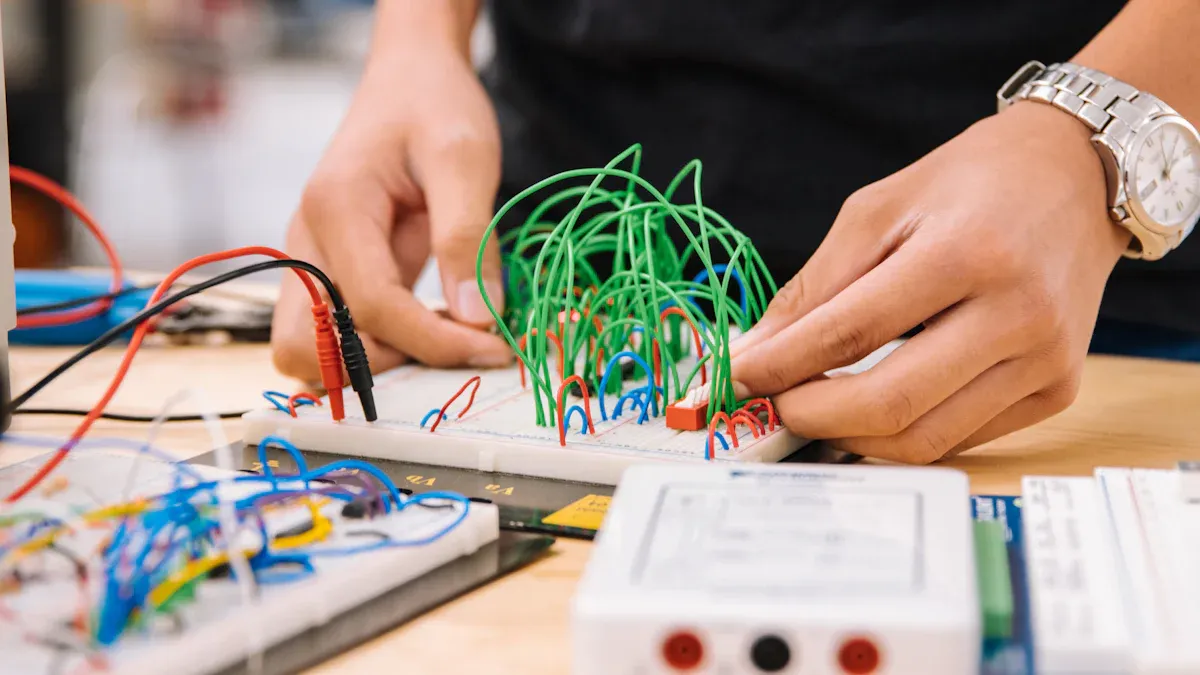
Starter kits are one of the best ways to begin your journey into electronics. They remove the guesswork and provide a clear path to learning. Instead of trying to buy electronic components one by one, you get a curated collection designed for success.
Why Start with a Kit
A starter kit gives you a major advantage as a beginner. You receive a box with all the necessary parts and clear instructions for specific projects. This hands-on experience helps you build confidence and understand how everyday gadgets work.
Kits offer many benefits for new makers:
Builds Problem-Solving Skills: You learn to plan your project, adapt to challenges, and see your creation through to the end.
Boosts Confidence: Successfully finishing a project is a great feeling. It encourages you to tackle more complex builds.
Provides Clear Guidance: Step-by-step instructions make complex ideas easy to understand.
Fosters Understanding: Kits explain the science behind the circuits, helping you learn core engineering concepts.
Enhances Coding Skills: Many kits include microcontrollers like Arduino, giving you a chance to program robots or create smart devices.
Recommended Books and Resources
Pairing a kit with a good book is a powerful learning strategy. The book Make: Electronics by Charles Platt is a classic for beginners. The author himself recommends the ProTechTrader Make: Electronics Kits, which are designed to go with the 3rd edition of the book. These kits simplify the learning process and are a popular choice for STEM programs.
You can also find amazing comprehensive learning guides on YouTube. These channels offer visual tutorials that work well with the parts from a starter kit.
Here are a few top channels to explore:
Paul McWhorter: His channel features excellent tutorials for Arduino and Raspberry Pi, perfect for learning to code with your kit.
How to Mechatronics: This channel provides detailed Arduino projects with circuit diagrams and source code.
DroneBot Workshop: You can explore a wide range of topics here, including Arduino, Raspberry Pi, and general electronics.
Buy Electronic Components Online via Marketplaces
You can buy electronic components online through general marketplaces like Amazon, eBay, or AliExpress. These platforms connect you with thousands of sellers, but you must be careful. Understanding the pros and cons helps you make smart purchasing decisions.
The Appeal of Low Prices
The biggest draw of online marketplaces is the low cost. You can find many common online components at prices much lower than traditional distributors. This makes these sites great for stocking up on basic parts for experiments where top quality is not essential. The opportunity for price comparison and bulk buying is a significant advantage.
You will often find great deals on items like:
Resistors
Capacitors
LEDs
Breadboards
You can also find entire kits of parts for a very low price. These often include resistor kits, capacitor kits, inductor kits, and transistor kits.
How to Avoid Counterfeit Parts
The main risk with marketplaces is the high chance of receiving a counterfeit part. A counterfeit component might look real but fail under pressure or not work at all. Your strategy for avoiding counterfeit electronic components should focus on product authenticity and seller reliability.
Be aware that scammers create convincing storefronts, so a good rating is not a guarantee. A counterfeit IC or a batch of counterfeit resistors can ruin your project.
Common counterfeit parts include:
Integrated Circuits (ICs)
Resistors
Capacitors
Connectors
To protect yourself, you must carefully check customer reviews and feedback. Look for listings with many reviews, as this is often safer than a listing with few or none. Read the reviews to see if buyers mention receiving a counterfeit item. A seller might switch the product but keep the old reviews, so check for consistency. While a high rating is not a perfect shield against a counterfeit product, it is a better sign than a low rating. Always be suspicious of a deal that seems too good to be true, as it might be a counterfeit.
Key Factors for Your Final Decision
Choosing the right store involves more than just price. You need to consider shipping, part availability, and the support you will receive. These factors ensure your project runs smoothly from start to finish.
Comparing Shipping and Costs
Your project's budget depends heavily on part prices and shipping fees. You should always compare the total cost before you buy. This includes looking at the shipping costs and times. A cheap part is not a good deal if shipping takes too long or costs too much.
You can use a free browser extension like Sourcengine to help. This tool lets you compare prices from over 3,500 suppliers. It also shows you risk scores to help you avoid a high-risk counterfeit part. The extension is available for Chrome and Edge browsers.
Sourcing Specific Online Components
Sometimes your project requires a rare or obsolete part. Large distributors may not stock these items. You will need to find a specialized supplier. Companies like Summit, 4 Star Electronics, and Win-Source are experts at finding hard-to-find online components. They are a great resource for repairing old equipment. When sourcing from less-known suppliers, always check customer reviews and feedback to avoid a potential counterfeit item. A bad part can ruin your project, so be wary of any seller offering a rare part at an unbelievable price, as it could be a counterfeit. A genuine but rare part will often have a higher price. Be cautious of any deal that seems too good to be true, as it might be a counterfeit component. A fake or counterfeit part is a common problem in this market.
Evaluating Support and Tutorials
Good support can save you a lot of time and frustration. Top suppliers offer detailed documentation to help you use their parts correctly. For example, a company like NXP provides extensive resources for its products.
You can find helpful materials like:
Application Notes
Simulation Models
Reference Designs
These documents explain how a component works and how to use it in a circuit. They are essential for both beginners and experienced engineers.
Choosing the best place to buy electronic components is easy when you match the store to your needs. Your project goals, budget, and experience level will guide your decision.
Remember these simple guidelines:
Use large distributors for specific, known parts.
Visit hobbyist stores for learning and project ideas.
Select a starter kit for a guided entry into electronics.
Now you are ready to start. Explore a site like Adafruit or get a kit for the Make: Electronics book to begin your journey. Happy building! 🛠️
FAQ
What is the best site for a total beginner?
You should start with a hobbyist store like Adafruit or SparkFun. They offer excellent tutorials and project kits. A starter kit, such as one paired with the Make: Electronics book, also provides a great guided learning experience for new makers.
When should I use DigiKey or Mouser?
You should use large distributors like DigiKey or Mouser when you need a specific component. These sites are best if you know the exact part number. Their powerful search tools help you find parts with precise technical specifications for your project.
Are the cheap parts on Amazon safe to use?
Cheap parts from marketplaces can be risky. You might receive a counterfeit or low-quality item.
It is safer to use these parts for simple experiments or non-critical projects. For important builds, you should buy from a trusted distributor.
What is a datasheet and why do I need it?
A datasheet is a document that explains everything about a component. It tells you how the part works and its technical limits. You need it to use the component correctly and safely in your circuits. It is your instruction manual for that part. 📄