Gas Discharge Tubes and Their Critical Function in 2025 Surge Protection
A gas discharge tube plays a vital role in surge protection by diverting dangerous surges away from sensitive electronics. These devices can handle high-energy bursts and help prevent common failures in systems such as lightning strikes or static electricity.
- Gas discharge tubes protect electronics from damage by absorbing transient overvoltages and stopping short-circuit failures that might cause combustion.
The global market for gas-discharge tube technology continues to grow, reflecting its importance in modern telecom, power, and data systems.
| Metric | Value |
|---|---|
| Gas Discharge Tubes Market Size (2024) | USD 1.3 billion |
| CAGR for Gas Discharge Tubes (2025-2031) | 6.3% |
Key Takeaways
- Gas discharge tubes protect electronics by safely diverting high-energy surges like lightning away from sensitive parts.
- They use a special gas that changes to conduct electricity during a surge, then quickly returns to normal, allowing repeated use.
- Gas discharge tubes handle much larger surges than other devices, making them ideal for harsh environments like telecom and power systems.
- Compared to MOVs and TVS diodes, gas discharge tubes last longer and protect better against big surges but respond a bit slower.
- Modern surge protection often combines gas discharge tubes with other devices to provide strong, reliable, and long-lasting defense.
Critical Function of Gas Discharge Tubes
Overvoltage Protection
A gas discharge tube acts as a strong barrier against dangerous overvoltage events. Inside the tube, a special gas sits between two electrodes. When a transient voltage spike appears, the gas ionizes and becomes conductive. This change creates a path for the surge to move safely to ground. The gas discharge tube then protects sensitive electronics by stopping the surge from reaching them. After the surge passes, the gas returns to its normal state, and the tube becomes nonconductive again. This process allows the gas discharge tube to provide reliable overvoltage protection and current spike protection in many systems.
Tip: Gas discharge tubes can be used many times because they return to their original state after each surge.
Crowbar Effect
Gas discharge tubes use a special method called the crowbar effect. When an overvoltage happens, the tube quickly switches from a high-resistance state to a low-resistance state. This action creates a short circuit across the power supply. The surge current moves directly to ground, and the output voltage drops close to zero. This method is different from clamp devices, such as TVS diodes or MOVs, which only limit the voltage to a safe level. The crowbar effect completely shuts down the circuit during an overvoltage event, which helps protect high-value equipment. This shutdown can also trigger fuses or thermal protection, making the system even safer.
High-Energy Surge Handling
Gas discharge tubes stand out for their ability to handle very large surges. They can protect against lightning strikes and switching transients that would damage other components. Some gas-discharge tube models can handle surge currents up to 20kA, and certain types can even reach 100kA. This high surge capacity makes them ideal for use in harsh environments, such as outdoor telecom lines or industrial power systems.
| GDT Model | Max Surge Current Rating |
|---|---|
| BTR 350/20 | 20kA |
| BTR 500/20 | 20kA |
Gas discharge tubes respond slower than some other surge protection devices, but their high surge handling makes them essential for transient protection. The following chart shows how their response time compares to other devices:
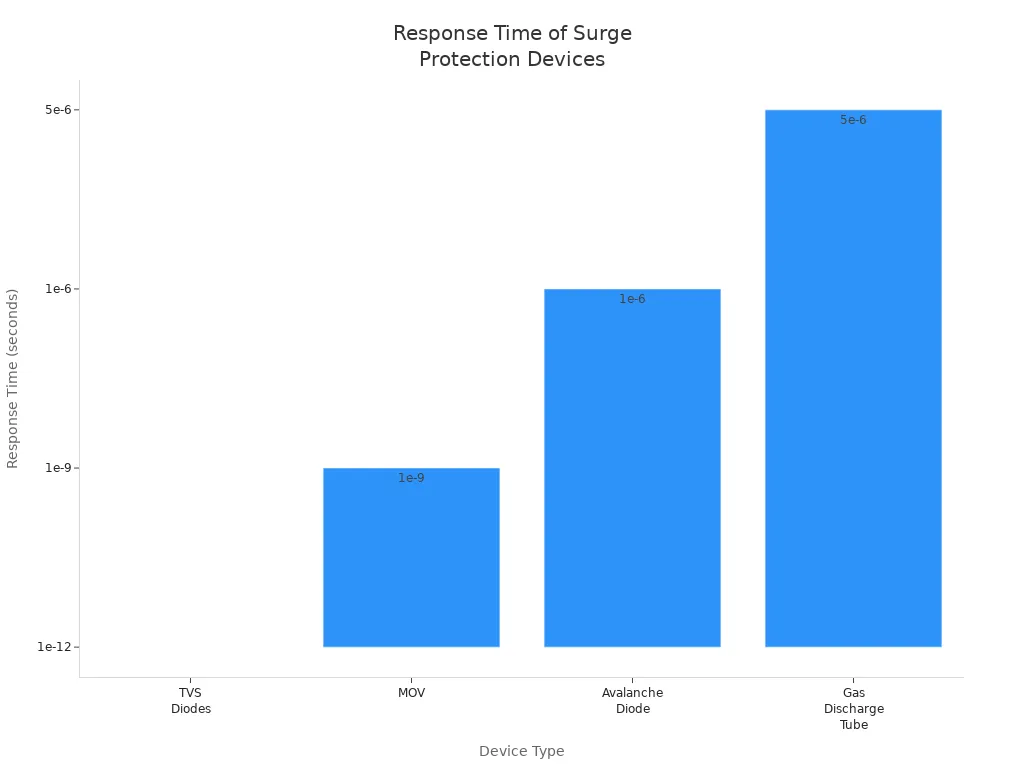
Gas discharge tubes may not react as quickly as TVS diodes or MOVs, but their ability to absorb massive surges ensures strong protection for critical systems. They play a key role in overvoltage protection, transient voltage control, and current spike protection, especially where high-energy surges are common.
Gas Discharge Tube Operation
Ionization Principle
A gas discharge tube uses a special process called ionization to protect circuits. The tube contains an inert gas sealed inside a ceramic or glass package. This gas acts as an insulator when the voltage is normal. The following steps show how the ionization principle works:
- The gas inside the tube blocks current flow under normal voltage.
- When a surge happens, the electric field between the electrodes becomes strong enough to ionize the gas.
- Ionization causes an avalanche effect, making the gas suddenly conduct electricity.
- The resistance inside the tube drops quickly, letting current flow through the tube instead of the protected circuit.
- This process starts at a specific voltage called the sparkover voltage.
The ceramic package keeps the gas pure and at the right pressure. This design helps the tube work the same way every time a surge occurs.
Conduction State
When the voltage across the gas-discharge tube rises above the sparkover voltage, the gas changes from an insulator to a conductor. The gas turns into plasma, which allows a large current to pass through the tube. The tube stays in this conduction state until the voltage drops below a lower level. This behavior protects sensitive equipment by sending the surge energy safely to ground. The ceramic body also helps the tube handle high temperatures and strong surges without damage. After the surge, the gas returns to its insulating state, and the tube is ready for the next event.
Low Shunt Capacitance
Gas discharge tubes have very low shunt capacitance, often less than 2 picofarads. This feature is important for high-frequency circuits, such as those in telecom and data systems. Low capacitance means the tube does not affect the normal signals passing through the circuit. Devices with higher capacitance can slow down signals or cause signal loss. A gas discharge tube keeps signal integrity high, even in fast data lines. Engineers choose these tubes for applications where both surge protection and high-speed performance matter.
Note: Low shunt capacitance helps maintain bandwidth and signal quality in modern communication systems.
Gas Discharge Tubes vs. Other Components
MOVs Comparison
Gas discharge tubes and metal oxide varistors (MOVs) serve as important surge protector components. Both act as a protection device in many surge protection device designs. However, they work in different ways and have unique strengths. MOVs use semiconductor materials that change resistance quickly when a surge appears. They respond in nanoseconds and absorb surge energy, but they can degrade after repeated surges. Over time, MOVs may need replacement because their protection weakens.
Gas discharge tubes, on the other hand, use a sealed tube filled with gas. When a surge reaches a certain voltage, the gas ionizes and creates a path for the surge to move safely to ground. GDTs can handle much higher surge currents, sometimes over 100,000 amperes. Their rugged design allows them to survive many high-energy surges without damage. However, their response time is slower than MOVs.
| Feature | Gas Discharge Tubes (GDTs) | Metal Oxide Varistors (MOVs) |
|---|---|---|
| Pulse Current Rating | Up to 100kA or more | Thousands of joules, lower current |
| Ruggedness | Handles repeated surges, long life | Degrades with use, limited lifespan |
| Response Time | Microseconds | Nanoseconds |
| Energy Absorption | High, best for lightning and large surges | Good, but limited by aging |
| Capacitance | Very low, good for high-frequency circuits | Higher, not ideal for fast data lines |
TVS Diodes Comparison
TVS diodes are another common surge protector component. They act as a protection device for fast, low-energy surges. TVS diodes respond in less than one nanosecond, making them perfect for protecting sensitive electronics from quick spikes like electrostatic discharge. However, their surge current capability is much lower than gas discharge tubes. TVS diodes can handle tens to hundreds of amps, while GDTs can manage surges up to 100,000 amps. TVS diodes work well in circuit protection for data lines and control circuits, but they cannot replace GDTs in high-energy surge environments.
| Device | Response Time | Surge Current Capability |
|---|---|---|
| TVS Diode | Less than 1 nanosecond | Tens to hundreds of amps |
| GDT | 25 to 100 nanoseconds+ | 10kA to 100kA |
Hybrid Protection Circuits
Many modern surge protection device designs use hybrid protection circuits. These combine gas discharge tubes with MOVs or TVS diodes to create stronger surge protector components. In these circuits, the GDT handles the largest surges, such as lightning, while the MOV or TVS diode clamps smaller, faster spikes. This layered approach improves circuit protection and extends the life of each protection device.
Hybrid protection circuits appear in places where failure is not an option. Examples include tower lights, emergency communications, medical devices, and 5G equipment. These circuits offer several advantages:
- Improved surge protection performance by combining the strengths of each component.
- Extended device life, since the GDT reduces stress on the MOV or TVS diode.
- Smaller size, as hybrid surge protector components fit into compact spaces.
- Ultra-low leakage current, which increases safety.
- Compliance with safety standards, reducing fire and shock risks.
Hybrid protection circuits help engineers build reliable systems that keep working even during severe surges. They use the best features of each surge protector component to provide strong, long-lasting protection.
Gas-Discharge Tube Applications

Telecom and Data Lines
Gas discharge tubes play a key role in the protection of telecom and data lines. These lines often face risks from lightning and switching events. Engineers use gas discharge tubes in surge protection devices to clamp high voltages and send excess energy to ground. This keeps sensitive equipment safe and prevents outages.
- Remote telecom towers, which use DC power systems, rely on gas discharge tubes for reliable circuit protection.
- Surge protection is critical in telecom infrastructure to ensure long-term safety and reliability.
- Many data centers and communication networks use gas discharge tubes as a main protection device against surges.
Telecom and data line protection helps maintain service and prevents costly downtime.
Power Circuits
Industrial power circuits need strong surge protection. Gas discharge tubes act as voltage-dependent switches. They form an arc discharge when voltage rises too high, quickly diverting surge current away from sensitive electronics.
- Surge protection devices for power supplies often combine gas discharge tubes with varistors.
- These tubes protect both single-phase and three-phase AC power lines.
- Industrial and instrumentation equipment use gas discharge tubes for circuit protection and to limit overvoltage.
Gas discharge tubes offer low capacitance and high surge current handling. This makes them ideal for protecting power circuits without affecting normal operation. Surge arrestors with gas discharge tubes provide line-to-ground and line-to-line protection.
Modern Surge Protection Systems
Modern surge protection systems use advanced gas discharge tubes. These systems follow the IEEE C62.31-2020 and IEC 61643-11 standards. The standards classify surge protection devices by their ability to handle different types of surges.
- Type 1 devices withstand direct lightning strikes.
- Type 2 devices protect against transient overvoltages.
- Type 3 devices provide point-of-use protection.
Recent innovations include miniaturized and multifunctional gas discharge tubes. New products, such as the Bourns GDT28H Series, offer higher surge current handling, faster response, and low capacitance. These features support protection in 5G telecom, electric vehicles, and renewable energy systems. Modern surge protection device designs often use hybrid technology, combining gas discharge tubes with other components for better circuit protection and longer device life.
| Feature | Gas Discharge Tube (GDT) | MOV | TVS Diode |
|---|---|---|---|
| Surge Absorption | Very strong | Moderate | Weak |
| Static Capacitance | Very low | Higher | Highest |
| Nominal Voltage Range | 60 V to 30 kV | Tens of volts to 10 kV | Several to hundreds of volts |
Gas discharge tubes remain vital for surge protection in modern infrastructure. They offer high surge handling, low capacitance, and strong reliability.
- Engineers should follow standards like IEEE C62.42.1-2016 and use hybrid designs for better surge protection.
- Smart monitoring and new standards help improve surge protection as technology changes.
- Key sectors such as telecom, power, and automotive rely on these devices for ongoing safety.
Regular review of surge protection strategies ensures systems stay safe and effective.
FAQ
What is the main advantage of using a gas discharge tube?
A gas discharge tube can handle very large surges. It protects sensitive electronics from damage caused by lightning or power spikes. Its low capacitance also keeps data signals clear.
Can a gas discharge tube be reused after a surge?
Yes. A gas discharge tube returns to its normal state after a surge. It can protect equipment many times without losing effectiveness.
Where do engineers install gas discharge tubes?
Engineers often place gas discharge tubes in telecom lines, power circuits, and data networks. These locations face high risks from surges and need strong protection.
How does a gas discharge tube differ from a TVS diode?
A gas discharge tube handles higher surge currents but reacts slower than a TVS diode. TVS diodes respond quickly to small spikes. Engineers often use both for layered protection.
Do gas discharge tubes need regular maintenance?
No. Gas discharge tubes require little to no maintenance. They work reliably for many years if used within their ratings.