How Field Effect Transistors Changed Electronics Forever
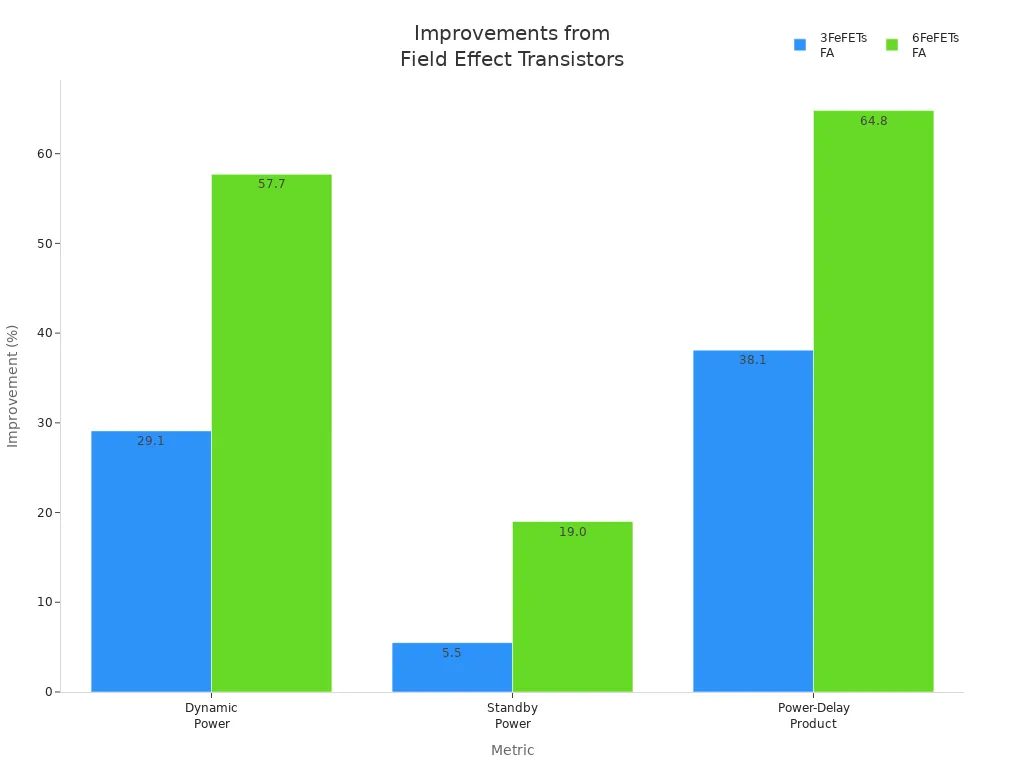
A field effect transistor changed electronics forever. Imagine a world where computers filled entire rooms. Now, a smartphone fits in your pocket and works faster than those old machines. This leap happened because engineers found a way to make devices smaller, quicker, and more energy-efficient. The chart below shows how new FET designs cut power use by up to 57.7% and boost speed by 64.8%.
The invention and evolution of this technology matter because they shape every electronic device people use today.
Key Takeaways
- Field effect transistors (FETs) made electronic devices smaller and more powerful, allowing millions of transistors to fit on a single chip.
- FETs improve speed and efficiency by using a weak signal to control larger currents, leading to faster electronics and longer battery life.
- The invention of the MOSFET in 1959 revolutionized technology, enabling the digital age and the development of compact, reliable circuits.
- FETs are essential in modern devices like smartphones and computers, helping them run efficiently and effectively.
- Recent advancements in FET technology promise exciting future developments in areas like quantum computing and artificial intelligence.
Transformative Impact
Miniaturization
The field effect transistor made it possible to shrink electronic devices. Before this invention, electronic components were large and bulky. The Metal-Oxide-Semiconductor Field-Effect Transistor, or MOSFET, allowed engineers to pack more transistors into a smaller space. This high scalability and lower power use helped create high-density integrated circuits. These circuits are the reason why modern devices, like smartphones and laptops, can be so small and powerful. The field effect transistor stands as the cornerstone of modern electronics because it enables the miniaturization that drives today’s technology.
Miniaturization changed the world. Now, millions of transistors fit on a single chip, making devices lighter, faster, and more affordable.
Speed and Efficiency
Field effect transistors also improved the speed and efficiency of electronic devices. They use a weak electrical signal to control a larger current, which makes them more efficient than earlier technologies. This ability to modulate current led to faster and more powerful electronics.
- Single SBSD SWCNT FETs reached a mean charge carrier mobility of 2817 cm²V⁻¹S⁻¹.
- Single LBLD SWCNT FETs achieved a mean value of 5378 cm²V⁻¹S⁻¹, one of the highest ever reported.
- Both types of FETs showed on-off ratios up to 10⁸, which means they can switch quickly and handle advanced tasks.
Energy savings also play a big role. New types of FETs, like GaN and SiC transistors, help reduce energy use in important areas:
- GaN FETs are popular in automotive and data centers because they save energy.
- SiC transistors work at high voltages and temperatures, making them efficient for electric vehicles and renewable energy.
- High-efficiency power transistors cut energy losses and improve battery life in devices.
These improvements mean that modern electronics run faster and last longer on a single charge.
Modern Electronics
Field effect transistors power almost every device people use today. They appear in many forms and serve many roles:
- High-input impedance amplifiers in oscilloscopes and voltmeters
- RF amplifiers in FM tuners and communication equipment
- Voltage-controlled resistors in operational amplifiers
- Mixer circuits in FM and TV receivers
- Digital circuits, such as microprocessors and memory chips
The field effect transistor has shaped the development of smartphones and computers. Engineers have created low-power FETs that extend battery life, so users charge their devices less often. New materials allow for even smaller and more efficient transistors. This progress follows Moore’s Law, which says that the number of transistors on a chip doubles every two years. As a result, computers and smartphones become more powerful and energy-efficient with each generation.
The field effect transistor transformed electronic components from simple switches into the brains of modern technology.
Invention of the Field Effect Transistor
Early Concepts
The invention of the field effect transistor began with early ideas in the 1920s. Julius Lilienfeld filed a patent in 1926 for a device that could control electric current using a third potential. He described how a thin film could switch and amplify currents, which is the basic idea behind modern transistors.
| Date | Patent Description |
|---|---|
| 1926 | Julius Lilienfeld's patent for controlling electric current flow using a third potential between two terminals. |
| Application | Describes amplification of oscillating currents, particularly in radio communication. |
Lilienfeld explained how a thin-film device could act as a switch and amplifier, which matches the function of today’s field effect transistors.
Other inventors, like Oskar Heil, also worked on similar concepts. These early ideas were mostly theoretical because scientists could not build working devices at that time.
Key Milestones
The invention of the field effect transistor moved forward in the 1940s. Researchers at Bell Laboratories, including John Bardeen, Walter Brattain, and William Shockley, tried to make working devices. They found that surface states trapped electrons and stopped the device from working well. Shockley later patented a way to use an inversion layer to control conductivity. Mohamed Atalla showed that a thin layer of silicon oxide could fix the surface state problem. This discovery made it possible to build better transistors.
- In 1947, Bardeen, Brattain, and Shockley studied field effect devices and found issues with surface states.
- In 1948, Shockley patented the use of an inversion layer.
- In the late 1950s, Atalla used silicon oxide to improve device performance.
MOSFET Breakthrough
The biggest step in the invention of the field effect transistor came in 1959. Dawon Kahng and Mohamed Atalla invented the first metal-oxide-silicon field effect transistor, or MOSFET. This new device used a silicon oxide layer to separate the gate from the channel. The MOSFET allowed engineers to make smaller, faster, and more reliable circuits. It became the most common transistor in electronics and started the digital revolution. The MOSFET made it possible to put millions of transistors on a single chip, which changed the world of technology.
The oxide layer in MOSFETs stops DC current from flowing through the gate. This reduces power use and allows one output to control many inputs, making digital circuits possible.
Field Effect Transistor Technology
Operating Principle
A field effect transistor works by using voltage at the gate terminal to control the flow of current between the source and drain. This process is called controlling electric currents. When a voltage is applied to the gate, it creates an electric field. This field changes the width of the channel inside the transistor. In enhancement mode, a higher gate voltage makes the channel wider, allowing more current to flow. In depletion mode, a reverse voltage narrows the channel, reducing the current.
MOSFET devices use this principle to switch and amplify signals. The gate does not draw current, so MOSFETs have high input impedance. This feature makes them sensitive to small voltage changes. Junction field effect transistors also use a gate to control current, but they use a different structure. Both types rely on one kind of charge carrier, either electrons or holes, which makes them unipolar devices.
MOSFETs and junction field effect transistors both excel at controlling electric currents with very little power loss.
FETs vs. Previous Devices
Field effect transistors differ from earlier devices like bipolar junction transistors. The table below shows some key differences:
| Feature | Field Effect Transistor (FET) | Bipolar Junction Transistor (BJT) |
|---|---|---|
| Control Method | Voltage applied to the gate controls current flow | Current input controls output current |
| Charge Carriers | Unipolar (either electrons or holes) | Bipolar (both electrons and holes) |
| Input Impedance | High | Lower than FET |
| Operation Type | Voltage-operated | Current-operated |
MOSFETs and junction field effect transistors use voltage to control current, while BJTs use current to control current. FETs have higher input impedance, which means they do not load down circuits. They also work better at high frequencies and have excellent thermal stability. MOSFETs and metal oxide field effect transistors can handle high power and remain stable at different temperatures. This makes them reliable for many uses.
Why FETs Prevail
MOSFETs and junction field effect transistors have become the top choice for modern electronics. Several factors explain their success:
- The demand for high-performance, low-noise electronic components keeps rising in communication, aerospace, and defense.
- 5G technology needs high-frequency RF components, which MOSFETs provide.
- IoT devices and smart sensors require low power and high sensitivity, which junction field effect transistors deliver.
- Consumer electronics and cars need energy-efficient and miniaturized systems. MOSFETs and junction field effect transistors meet these needs.
- New materials and designs, like wide-bandgap semiconductors, improve junction field effect transistor performance for power electronics and renewable energy.
The market for field effect transistors continues to grow. The chart below shows the increase in market value from 2023 to 2034:

MOSFETs and junction field effect transistors help create smaller, faster, and more reliable electronic components for everyday life.
100 Years of the Field Effect Transistor
Evolution and Advancements
The story of 100 years of the field effect transistor began with Julius Lilienfeld’s patent in 1925. Over the decades, engineers improved the design and materials, leading to the modern devices seen today. The first phase of rapid innovation slowed between 1970 and 2000 as Moore’s Law reached its limits. Recently, new inventions have sparked another wave of progress. MOSFETs made it easier to add transistors to circuits, which helped electronics become more powerful and compact. Today, the versatility and efficiency of these devices shape computing, memory, and communication technologies.
Recent advancements include the development of ferroelectric field effect transistors (FeFETs). These new devices use HfO2-based materials, which offer thin profiles, strong polarization, and better data retention. FeFETs also solve problems like gate leakage and work well with CMOS technology. These improvements make electronic components more reliable and flexible for modern needs.
Over 100 years of the field effect transistor, engineers have built devices that are not only powerful but also user-friendly and dependable.
- The average mobility of 4H–21DNTT devices exceeds 5 cm² V⁻¹ s⁻¹ across different channel lengths.
- For longer channels, the mean mobility reaches 11.1 cm² V⁻¹ s⁻¹, showing strong performance and reliability.
Integrated Circuits
Engineers have used the 100 years of the field effect transistor to transform integrated circuits. The move to MOSFETs allowed for easier integration and mass production. Three-dimensional integration of two-dimensional FETs, using materials like MoS2 and WSe2, has opened new possibilities for multifunctional circuits. These advances support the creation of smaller, faster, and more energy-efficient electronic components.
Integrated circuits based on these devices power smartphone processors, memory chips, and power management systems. Their stability in temperature and compact size make them essential for consumer electronics. High input impedance and low noise also help in analog circuit design, such as audio preamplifiers and sensor interfaces.
Everyday Applications
Electronic components built over the 100 years of the field effect transistor appear in many everyday devices. The table below shows some common uses and their benefits:
| Application | Benefit |
|---|---|
| Low-noise amplifiers | Ideal for sensitive uses like radios and medical equipment due to low noise. |
| Operational amplifiers | Provide high input impedance for precise measurements. |
| Analog switches | Control current with low resistance and high reliability. |
| Voltage-controlled resistors | Allow easy adjustment for tasks like volume control. |
| Oscillator circuits | Generate signals for digital circuits and communication systems. |
| Audio equipment | Keep sound clear for high-quality listening. |
| Instrumentation | Offer low leakage and high precision for signal processing. |
These electronic components help people enjoy better sound, clearer signals, and more reliable devices every day.
Field effect transistors have shaped modern technology by making devices smaller, faster, and more reliable. New trends show exciting possibilities for the future:
- Quantum computing could bring much greater power, but stability and scaling remain challenges.
- Advanced materials and 3D transistors help boost performance for AI and the Internet of Things.
- Neuromorphic computing uses designs inspired by the brain to improve artificial intelligence.
These advances promise to drive innovation for years to come.
FAQ
What is a field effect transistor?
A field effect transistor is a tiny switch that controls the flow of electricity. Engineers use it to turn signals on and off in electronic circuits. This device helps make computers, phones, and other gadgets work faster and use less energy.
How do field effect transistors help with miniaturization?
Field effect transistors allow engineers to fit millions of switches onto a single chip. This process makes devices smaller and lighter. Miniaturization lets people carry powerful technology in their pockets every day.
Miniaturization changed how people use technology. Smaller devices mean more convenience and better performance.
Where do people find field effect transistors in everyday life?
People find field effect transistors inside smartphones, computers, cars, and even kitchen appliances. These switches help control signals, manage power, and store information. Most modern semiconductor devices rely on field effect transistors.
Why are field effect transistors important for energy efficiency?
Field effect transistors use very little power to operate. They help devices run longer on batteries and reduce energy waste. Engineers choose these switches to build electronics that save energy and work reliably.
| Device Type | Benefit of FETs |
|---|---|
| Smartphones | Longer battery life |
| Laptops | Faster processing |
| Cars | Efficient power control |