What Sets Circuit Breaker Classes Apart in Features and Uses
You need to understand the differences between the classes of circuit breakers to keep electrical systems safe and efficient. When you pick the right class, you improve how well your equipment runs and reduce the risk of fire or damage. Circuit breaker malfunctions can cause unsafe conditions, but regular testing and condition-based maintenance help prevent failures and keep operations smooth. In homes, businesses, and factories, the right choice can mean the difference between costly downtime and reliable power.
Key Takeaways
- Understanding circuit breaker classes helps you choose the right protection for your electrical system, improving safety and efficiency.
- Regular testing and maintenance of circuit breakers prevent malfunctions, reducing the risk of costly downtime and ensuring reliable power.
- Different classes of circuit breakers serve unique purposes, such as overload protection, short-circuit protection, and earth fault protection.
- Selecting the right circuit breaker involves considering current ratings, breaking capacity, and compliance with safety standards.
- Miniature circuit breakers (MCBs) are ideal for homes and small businesses, while molded case circuit breakers (MCCBs) suit larger commercial and industrial applications.
Classes of Circuit Breakers
Understanding the different classes of circuit breakers helps you choose the right protection for your electrical system. Each class has a unique purpose and set of features. The table below gives you a quick overview of the main classes of circuit breakers and their definitions:
| Class Type | Description |
|---|---|
| Electrical Endurance Class | Measures how well a breaker handles electrical stress over time. |
| - E1 Class | Needs maintenance on interrupter parts during its life. |
| - E2 Class | Does not need interrupter maintenance for its whole life. |
| Capacitor Switching Class | Handles switching of capacitive loads, like capacitor banks. |
| - C1 Class | Low chance of restriking when breaking capacitive current. |
| - C2 Class | Very low chance of restriking during capacitor switching. |
| Mechanical Endurance Class | Shows how many times a breaker can operate without major repairs. |
| - M1 Class | Can perform 2,000 no-load operations without major maintenance. |
| - M2 Class | Can perform 10,000 no-load operations without major maintenance. |
| Specific System Application Class | Matches breakers to network types, like cable or line networks. |
| - S1 Class | Best for cable networks. |
| - S2 Class | Best for line networks. |
Electrical Endurance
You can judge electrical endurance by how many times a breaker can open and close under load without needing repairs. E1 class breakers handle fewer operations before maintenance, while E2 class breakers last longer without service. This difference matters when you want a breaker that will last in tough conditions.
Note: The IEC 62271-100 standard does not set a fixed number of cycles for E classes, but it does show that modern vacuum circuit breakers can handle many operations.
Mechanical Endurance
Mechanical endurance tells you how many times you can operate a breaker without load before it needs major work. M1 class breakers offer 2,000 cycles, and M2 class breakers give you up to 10,000 cycles. This feature helps you pick the right breaker for systems that need frequent switching.
- M1 class: 2,000 no-load operations
- M2 class: 10,000 no-load operations
Capacitor Switching
Capacitor switching classes focus on breakers that control capacitor banks. These breakers must handle high inrush currents and avoid false trips. Devices like CapSwitcherⓇ work well for medium and high-voltage capacitor banks. They use special resistors to reduce voltage spikes and can perform up to 10,000 operations. You need this class when your system has many capacitors or faces frequent switching.
Thermal Device
Thermal devices protect your system from overheating. They use a bimetallic strip that bends when the current gets too high. This action interrupts the circuit and keeps your equipment safe. You find thermal devices in many classes of circuit breakers, especially in thermal-magnetic types.
- Thermal protection stops damage from overheating.
- The bimetallic strip reacts to high current and opens the circuit.
Molded Case Circuit Breakers
Molded case circuit breakers (MCCBs) stand out because they handle a wide range of currents, from 10 to 2,500 amps. You can adjust their trip settings, which makes them useful for many applications. MCCBs have high interrupting ratings, so they work well in both commercial and industrial settings. Their strong construction and flexible design set them apart from other classes of circuit breakers.
Tip: MCCBs protect motors, welding machines, and large electrical panels. Their adjustable settings help you match protection to your system’s needs.
You can see that the classes of circuit breakers each serve a special role. Knowing these differences helps you make smart choices for safety and performance.
Features of Circuit Breaker Classes
Overload Protection
You rely on overload protection to keep your electrical system safe when too much current flows for too long. Different circuit breaker classes use unique mechanisms to detect and stop overloads. The table below shows how each class handles this important feature:
| Circuit Breaker Class | Overload Protection Mechanism |
|---|---|
| Thermal-Magnetic | Uses a bimetallic strip for overloads and an electromagnet for short circuits. |
| Magnetic-Hydraulic | Uses a solenoid with a hydraulic delay, allowing brief surges but tripping on true overloads. |
These mechanisms help you prevent overheating and damage to your wiring or devices. The characteristics of each class determine how quickly and accurately they respond to overloads.
Short-Circuit Protection
Short-circuit protection is a key feature in every circuit breaker class. You need this protection to stop dangerous currents that can cause fires or equipment failure. Here is how you can approach short-circuit protection for different classes:
- Calculate the maximum short-circuit current in your system.
- Choose the breaker class, such as Class A or Class B, based on your need for selectivity.
- Make sure your breaker meets all required standards.
- Pick a breaker with enough breaking capacity for possible future system growth.
Short-circuit protection works fast to disconnect power when a fault occurs. The characteristics of each breaker class affect how well it handles these sudden events.
Earth Fault Protection
Earth fault protection helps you detect and stop current that leaks to the ground. This feature keeps people and equipment safe from electric shock. Many circuit breaker classes include earth fault protection as a standard option. You should always check if your chosen class offers this feature, especially in areas where safety is a top concern.
Endurance Ratings
Endurance ratings show how long a circuit breaker can perform under real conditions. You want a breaker that lasts through many operations without failing. UL 489 sets the main standard for endurance in both industrial and residential settings. This standard tests for overcurrent protection, mechanical strength, and environmental toughness. Industrial breakers handle higher loads and tougher conditions, while residential breakers focus on protecting home wiring and appliances. Always check the endurance ratings to match the breaker to your needs.
Tip: Choosing the right endurance rating helps you avoid unexpected breakdowns and keeps your system running smoothly.
Applications
Residential
You use circuit breakers in your home to protect wiring and appliances from overloads and short circuits. The most common applications include lighting, outlets, and kitchen equipment. Type B and Type C circuit breakers work best for these needs. Type B breakers handle lighting and small appliances, while Type C breakers suit circuits with higher inrush currents, such as refrigerators and HVAC units.
| Circuit Breaker Type | Common Applications in Residential Environments |
|---|---|
| Type B | Lighting, small appliances, general outlets |
| Type C | Kitchen appliances, HVAC, fans, refrigerators |
You should always check the breaking capacity of each breaker to match your home’s electrical demands. This ensures safe and reliable operation for all residential applications.
Commercial
In commercial settings, you need circuit breakers that can handle larger loads and more complex systems. Applications include office lighting, HVAC systems, and equipment rooms. Miniature circuit breakers (MCBs) protect individual circuits, while molded case circuit breakers (MCCBs) cover larger circuits. Air circuit breakers (ACBs) are used for high-current application points. Ground fault circuit interrupters (GFCIs) add extra safety in areas with water or moisture.
| Circuit Breaker Type | Application Description |
|---|---|
| Air Circuit Breakers (ACB) | High-current applications, main distribution panels |
| Miniature Circuit Breakers | Individual circuit protection, lighting, outlets |
| Molded Case Circuit Breakers | Large equipment, HVAC, elevators |
| GFCI | Bathrooms, kitchens, outdoor outlets |
You must select breakers with the right breaking capacity for each application to prevent hazards and meet code requirements.
Industrial
Industrial applications demand circuit breakers with high breaking capacity and durability. You often find medium voltage circuit breakers, such as vacuum circuit breakers (VCB) and oil circuit breakers (OCB), in factories and plants. High voltage circuit breakers, like SF6 and air blast types, control power distribution in large facilities. Type D circuit breakers are common in areas with heavy machinery and high inrush currents.
- Medium voltage circuit breakers: Used in distribution networks, reliable and space-saving
- High voltage circuit breakers: Manage power grids, offer strong insulation and fast operation
- Type D circuit breakers: Handle high inrush currents from motors and industrial machines
You should always match the breaking capacity to the application to ensure safety and efficiency in all industrial applications.
Specialized Uses
Some applications require specialized circuit breakers. For example, capacitor switching breakers manage capacitor banks in power factor correction systems. Thermal devices protect sensitive electronics from overheating. In renewable energy systems, you use breakers with high breaking capacity to handle sudden surges. Each specialized application needs a breaker class designed for its unique demands.
Tip: Always review the application and breaking capacity before choosing a breaker for specialized uses. This helps you avoid failures and keeps your system safe.
Miniature Circuit Breakers
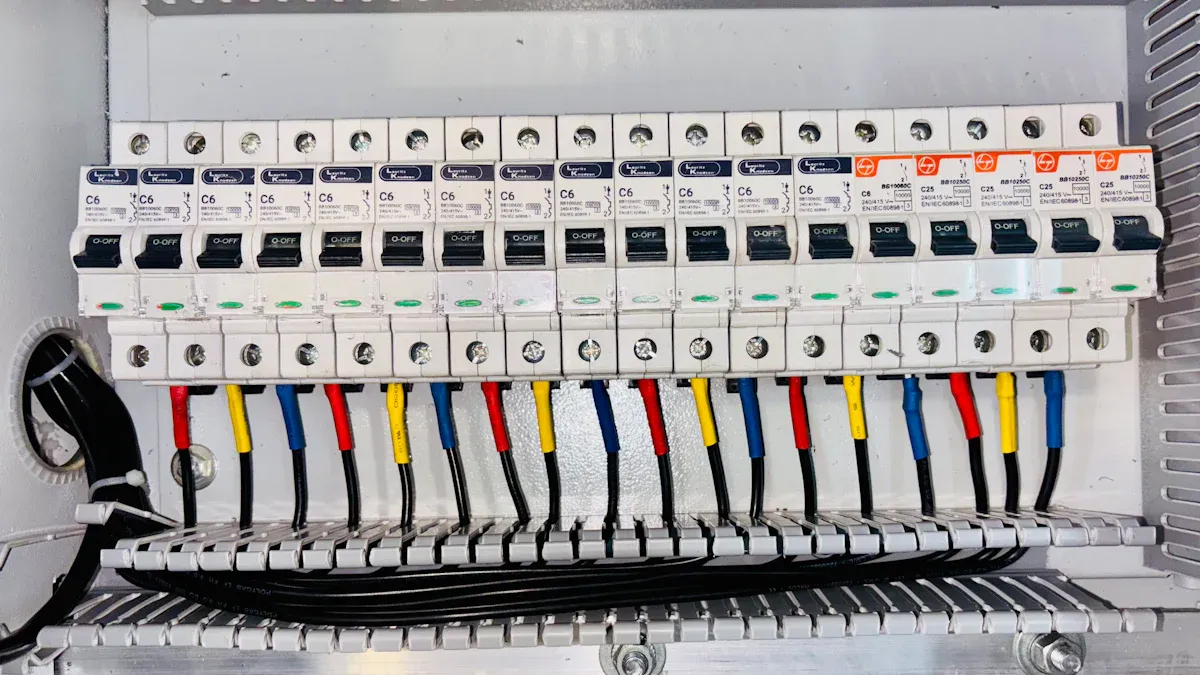
Miniature circuit breakers play a key role in keeping your electrical systems safe. You use these devices to protect against overloads and short circuits in many settings. MCBs stand out because they use both thermal and electromagnetic protection. This means you get fast and reliable action when something goes wrong. Miniature circuit breakers come in different trip classes, such as A, B, C, D, H, K, and Z. Each class gives you a different level of sensitivity to overloads. You can find miniature circuit breakers with current ratings from 0.5A to 125A. They handle voltages up to 400V, making them perfect for homes, offices, and small businesses.
Type C Miniature Circuit Breakers
Type C miniature circuit breakers are very popular for many reasons. You often choose this type when you need to protect circuits with moderate inrush currents. For example, you might use them with lighting systems or small motors. Type C MCBs have a current rating that shows the maximum current they can handle without tripping. They also have a breaking capacity, which tells you the highest fault current they can safely interrupt. Most Type C miniature circuit breakers work with voltages up to 230 or 400 volts. Their tripping characteristics allow them to react quickly to short circuits but also handle brief surges without tripping.
Tip: Use Type C MCBs for circuits with devices that draw a bit more current when starting, like fans or pumps.
General Uses
You see miniature circuit breakers in many places because they offer strong protection and easy installation. Here are some common uses:
- In homes, miniature circuit breakers protect wiring, lights, and appliances from too much current or short circuits.
- In offices and stores, you use MCBs to keep lighting and equipment safe from power surges.
- In factories, miniature circuit breakers help protect machines and production lines from damage during faults.
- In solar power systems and smart grids, MCBs guard important parts from overloads and short circuits.
Miniature circuit breakers give you peace of mind because they act fast and reset easily. You can trust them to keep your electrical systems running safely in many different applications.
Comparing Circuit Breaker Classes
Feature Comparison
You need to compare circuit breaker classes side by side to choose the right one for your system. Each class has different tripping characteristics, current handling, and overcurrent trip units. The table below shows how the main types stack up:
| Circuit Breaker Type | Current Handling | Tripping Characteristics | Overcurrent Trip Units | Key Features | Typical Installation Areas |
|---|---|---|---|---|---|
| Miniature Circuit Breakers (MCB) | Up to 100 amps | Fixed, fast response | Fixed thermal-magnetic | Simple, easy to use, compact | Homes, small offices |
| Molded Case Circuit Breakers (MCCB) | Up to 2,500 amps | Adjustable, wide range | Adjustable thermal-magnetic | Robust, tunable, high breaking capacity | Commercial, industrial panels |
| Medium-Voltage Circuit Breakers | 1,000 to 72,000V | Customizable, fast arc interruption | Electronic or mechanical | Air, vacuum, or SF6 types | Substations, factories |
| High-Voltage Circuit Breakers | Above 72,000V | Specialized, very fast | Electronic | Oil, SF6, or air blast for arc control | Power grids, large plants |
| Magnetic Circuit Breakers | N/A | Instant magnetic trip | Magnetic | Solenoid-based, quick action | Specialized equipment |
| Thermal-Magnetic Circuit Breakers | N/A | Dual: thermal for overload, magnetic for short-circuit | Thermal-magnetic | Common in distribution boards | Residential, commercial |
| Magnetic-Hydraulic Circuit Breakers | N/A | Delayed magnetic trip | Magnetic-hydraulic | Handles short surges, avoids nuisance trips | Industrial, marine |
| Residual Current Device | N/A | Detects current imbalance | N/A | Prevents shocks, not for overcurrent | Wet areas, bathrooms |
| Recloser | N/A | Automatic reclosing after fault | Electronic | Restores power after temporary faults | Overhead lines, utilities |
You see that each breaker class offers unique tripping characteristics and overcurrent trip units. You must match these features to your installation needs for the best protection.
Tip: Always check the tripping characteristics and overcurrent trip units before installation. This ensures your system gets the right level of protection.
Unique Advantages
Every circuit breaker class brings its own strengths to your electrical system. You should look at these unique advantages when planning your installation:
- Miniature circuit breakers give you reliable protection from short circuits and overloads. Their simple tripping characteristics make them perfect for homes and small businesses.
- Molded case circuit breakers offer adjustable overcurrent trip units. You can fine-tune them for different loads, which helps in commercial and industrial settings.
- Medium-voltage and high-voltage breakers use advanced tripping characteristics to handle large surges and protect critical infrastructure.
- Magnetic circuit breakers react instantly to high currents. You use them in equipment that needs fast protection.
- Thermal-magnetic circuit breakers combine two tripping characteristics. They protect against both slow-building overloads and sudden faults.
- Magnetic-hydraulic breakers let you avoid nuisance trips from short surges. Their tripping characteristics suit heavy machinery and marine installations.
- Residual current devices protect people from electric shock. Their tripping characteristics focus on current imbalances, not overcurrent.
- Reclosers restore power automatically after a temporary fault. Their tripping characteristics help keep utility lines running with less downtime.
You should always consider the unique tripping characteristics and overcurrent trip units of each class. This helps you get the right protection for your installation.
Selection Scenarios
You face many choices when selecting circuit breakers for new projects. You must match the tripping characteristics, overcurrent trip units, and installation needs to your environment. Here are some common scenarios:
- Panelboard Installations: You use MCBs and MCCBs for overcurrent protection in commercial buildings. Their tripping characteristics and overcurrent trip units ensure safety and allow for future upgrades.
- Switchgear Design: You select ACBs or VCBs based on load and short-circuit ratings. Smart breakers with advanced tripping characteristics improve diagnostics and protection.
- Motor Control Centers (MCCs): You rely on MCCBs and electronic breakers with adjustable overcurrent trip units. These breakers handle varying startup currents and protect motors from damage.
- Temporary Power Systems: You choose durable, field-resettable breakers for portable panelboards and generator hookups. Their tripping characteristics and overcurrent trip units provide reliable protection in changing conditions.
You also need to consider high-risk environments. For example, data centers require breakers with fast tripping characteristics and reliable overcurrent trip units to prevent downtime. Manufacturing lines need breakers that minimize false trips and protect expensive machinery. Hotels and high-rise buildings benefit from breakers that isolate faults without shutting down essential services.
Note: Always review the tripping characteristics and overcurrent trip units for each installation. This ensures you get the right protection and avoid costly mistakes.
Choosing a Class
Key Factors
When you choose a circuit breaker class, you need to look at several important factors. These help you protect your electrical system and keep everything running smoothly. Here are the main things you should consider:
- Current Rating: Make sure the circuit breaker matches the amount of current your system uses. If you pick the wrong rating, your breaker might trip too soon or not at all.
- Breaking Capacity: Check that the breaker can stop the highest fault current your system might face. This keeps your equipment safe during a short circuit.
- Tripping Characteristics: Select a breaker that reacts the right way to overloads and short circuits. Some breakers trip faster, while others allow brief surges.
- Protection Features: Look for extra features like adjustable settings or added protection. These can improve safety and make your system more reliable.
- Compliance and Standards: Always check if the breaker meets local and international rules. This ensures your installation passes inspections and follows safety codes.
You also need to think about safety regulations in your area. The table below shows how some common standards affect your choice:
| Regulation/Standard | Description | Impact on Circuit Breaker Selection |
|---|---|---|
| IEC 60364 | Mandates selectivity for safety service installations | Ensures reliability and safety in electrical systems |
| UL 489 | Essential for primary circuit protection in North America | Compliance with local safety regulations |
| UL 1077 | Recognized for supplementary protection needs worldwide | Influences choice based on regional compliance requirements |
Local rules may require certain certifications. Following these rules helps you achieve the highest level of safety for your system.
Practical Tips
You can use these expert tips to make sure you pick the right circuit breaker class for your needs:
- Match the breaker to your system’s voltage and current.
- Check for safety ratings and certifications before you buy.
- Choose breakers made from quality materials for better durability.
- Pick trusted brands to avoid fake or low-quality products.
- Ask a professional for help if your system is complex.
By following these steps, you improve safety, boost efficiency, and make sure your electrical system meets all requirements.
You can see that each circuit breaker class offers unique features and serves different applications. The table below highlights these differences:
| Circuit Breaker Type | Key Features | Applications |
|---|---|---|
| Miniature Circuit Breaker (MCB) | Protects against overloads and short circuits | Homes, offices |
| Molded Case Circuit Breaker (MCCB) | Handles higher currents | Factories, large buildings |
| Residual Current Circuit Breaker (RCCB) | Prevents electric shocks | User safety, homes |
| Air Circuit Breaker (ACB) | Protects low and medium-voltage systems | Industry |
| Vacuum Circuit Breaker (VCB) | Strong arc control | High-voltage systems |
| Oil Circuit Breaker | Uses oil for insulation | Power networks |
To choose the right breaker, follow these steps:
- Identify your system’s voltage and current needs.
- Select a trip curve that matches your load.
- Pick a breaker type for your environment.
- Check code compliance and maintenance options.
Matching the right features to your application keeps your system safe and reliable.
FAQ
What does the term "curve" mean in circuit breakers?
You see the term curve when you look at circuit breaker types. The curve shows how fast the breaker reacts to faults. Each type has a unique curve. The curve tells you the time it takes for the breaker to trip during an overload or short circuit.
How do I choose the right type of circuit breaker for my home?
You should check the type of load and the curve needed. For homes, you often use Type B or Type C. These types match common mcb trip curves. Always check the short-circuit trip level and the trip curve for your safety.
Why is the short-circuit trip level important?
The short-circuit trip level tells you how much current causes tripping. You need to match this to your system. If the short-circuit trip level is too low, the breaker may trip too soon. If it is too high, it may not protect your wiring.
What is the difference between a trip curve and a tripping characteristic?
A trip curve is a graph that shows the time it takes for the breaker to trip at different currents. Tripping characteristic describes how the breaker reacts to overloads and short circuits. Each type has a unique curve and tripping style.
Can you explain the most common mcb trip curves?
You find three main types: Type B, Type C, and Type D. Each type has a different curve. Type B trips quickly at low currents. Type C handles higher inrush currents. Type D is for heavy loads. The curve shows the time it takes for the breaker to trip.