The Rise of Electrical Relays and Their Lasting Impact
Imagine a relay as a traffic controller for electricity, guiding currents to keep systems safe and efficient. You see electrical relays at work in industries like manufacturing, energy, and automotive, where automation and smart devices drive growth.
- The electronic relay market is projected to reach USD 5.8 billion by 2033.
- Automation trends boost demand in robotics, process control, and consumer electronics.
Modern relays improve safety in hospitals, factories, and power plants, helping you rely on stable and secure technology every day.
Key Takeaways
- Relays act as control switches, allowing low-power signals to manage high-power circuits, enhancing safety and automation in various industries.
- Modern relays improve system reliability by preventing overcurrent and short circuits, ensuring consistent performance in homes, factories, and transportation.
- The evolution from electromechanical to solid-state relays offers faster response times and longer lifespans, making them ideal for demanding environments.
- Digital microprocessor-based relays and PLCs provide advanced control and flexibility, improving fault detection and system performance in automation.
- Relays play a crucial role in power systems and telecommunications, ensuring efficient signal routing, monitoring, and protection against faults.
Relay Importance
Role in Electrical Systems
You depend on relays every day, even if you do not see them. These devices act as control switches in complex circuits. When you use a low-power signal, a relay can manage a high-power circuit. This function is essential for automation and safety in homes, factories, and cars.
Relays work by energizing a coil, which creates a magnetic field. This field moves an armature, switching contacts to open or close circuits. After the task, a spring resets the relay. You find relays in home automation, industrial machinery, and automotive electronics.
Here is a table showing the main functions of relays in electrical systems:
| Function | Description |
|---|---|
| Safeguarding systems | Protects electrical systems from excessive voltage or current, ensuring safe operation. |
| Remote-controlled switches | Allows control of high-power circuits using low-power signals, enabling various operations. |
| Circuit protection | Prevents damage to circuits by interrupting the flow of electricity when necessary. |
| Signal amplification | Enhances the strength of signals within a circuit for better performance. |
| Motor control | Manages the operation of motors, allowing for efficient control of machinery. |
| Circuit control | Controls the flow of electricity by opening or closing contacts based on low-power signals. |
| Remote operation | Enables remote management of high-power circuits, enhancing operational flexibility. |
Relays make your devices smarter and safer. You can control machines from a distance, protect circuits, and improve performance.
Safety and Automation
Relays play a key role in keeping you safe and making systems work automatically. In factories, relays help automate production lines and control machinery. In energy plants, relays monitor and manage power distribution. You also see relays in transportation, such as railway signaling and traffic management. Buildings use relays for HVAC, lighting, and security systems.
- Relays prevent overcurrent and short circuits.
- You get centralized control to monitor many processes.
- Reliable relays ensure consistent performance.
Safety relays check for faults and malfunctions. They can stop machines safely and act as emergency shutdown devices. Relays monitor movable guards and interrupt closure during access. You benefit from integrated diagnostics and constant monitoring, which help detect problems early.
Tip: Control relay panels automatically disconnect faulty parts of a system. This reduces risks for people and equipment. Reliable relays help keep power running without interruption.
Relays make automation possible and keep you safe in many environments. You rely on them for protection and smooth operation.
Relay History
Early Invention
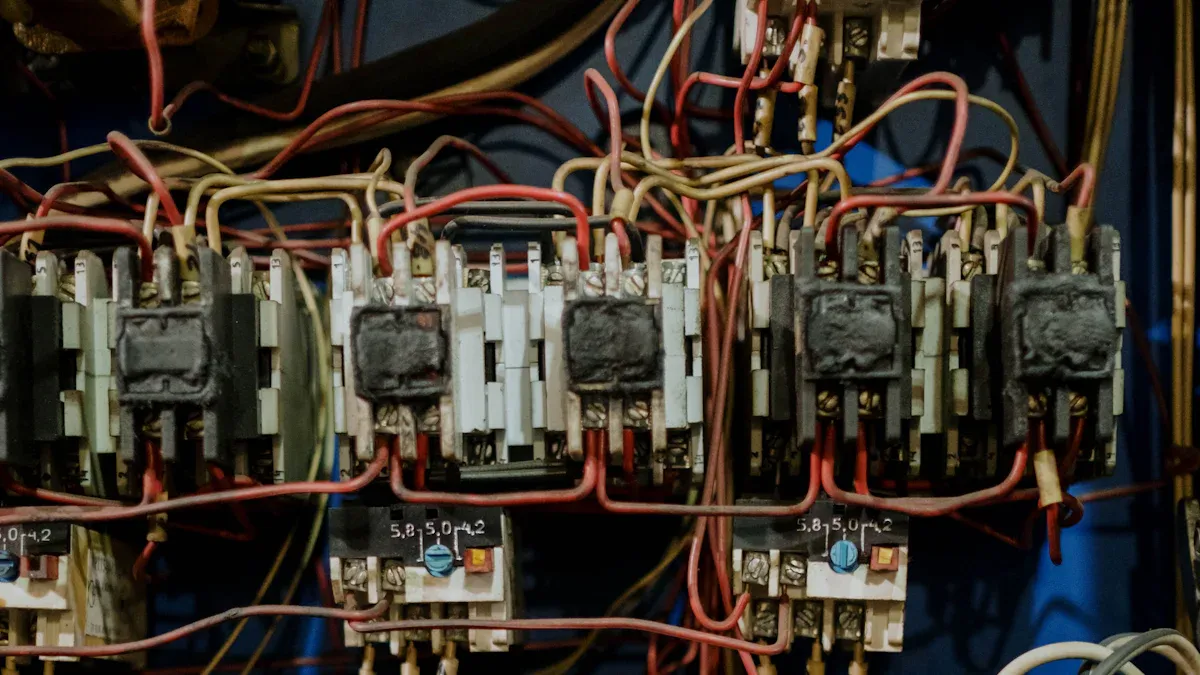
You can trace the relay development history back to the early 1800s. Joseph Henry, an American physicist, invented the first electrical relay in 1835. He used a self-made electromagnet to control a larger magnet. This experiment showed how a small electrical force could control a bigger one. Henry’s work laid the foundation for the electromagnetic relay. You see his invention as a turning point in electrical engineering.
Henry’s relay was more than a simple device. He connected two circuits using electromagnetism. You could use a small signal to trigger a larger mechanical response. His demonstration proved that long-distance communication was possible. Henry’s arrangement of magnets showed how you could send signals over great distances. This idea helped create the practical electrical telegraph.
Early inventors faced many challenges.
- You needed a reliable source of electrical power, which was hard to find.
- You saw that manufacturing processes were not standardized, so relays did not always work well.
- You had to adapt mechanical designs for fast switching in electrical systems.
Telegraph Era
You entered the telegraph era with new inventions that changed communication. Relays became essential for sending signals over long distances. You saw inventors like Edward Davy improve relay designs. Davy’s metallic make-and-break relay became the preferred choice for telegraph systems. You could renew and amplify signals, making communication more reliable.
Here is a table showing key milestones in relay development during the telegraph era:
| Year | Inventor(s) | Invention Description |
|---|---|---|
| 1835 | Joseph Henry, Edward Davy | Mercury dipping electrical relay, which allowed for signal amplification. |
| 1837 | Edward Davy | Metallic make-and-break relay, which became the preferred relay for telegraph systems and improved signal renewal. |
You relied on relays to transmit telegraph signals across continents. Relays made long-distance communication possible. You could send messages faster and more reliably than ever before.
- Relays allowed signals to travel over long wires without losing strength.
- You saw telegraph systems become more dependable and efficient.
Protection Relay Breakthroughs
You witnessed major breakthroughs in protection relays around 1901. These advances improved the safety and reliability of power systems. Charles Proteus Steinmetz invented the frequency relay. You could monitor generator operations during underfrequency conditions. Selective protection systems like IDMT and DEFT made electrical systems safer. You saw these systems operate only during faults, preventing unnecessary shutdowns.
Here is a table showing key protection relay breakthroughs:
| Breakthrough | Description | Influence on Power System Safety |
|---|---|---|
| Frequency Relay | Invented by Charles Proteus Steinmetz | Improved monitoring of generator operations in underfrequency conditions |
| Selective Protection Systems | Development of IDMT and DEFT | Enhanced reliability and safety by ensuring selective operation during faults |
You benefited from these innovations.
- The frequency relay helped you monitor generators more effectively.
- Selective protection systems increased reliability and safety in electrical grids.
You saw protection relays evolve as electrical grids expanded. Software-defined relays now provide scalability. You can update and reconfigure them easily. This flexibility helps you avoid expensive hardware replacements. You keep your systems stable and efficient as the energy sector grows.
You experienced another leap in relay technology with Schweitzer’s digital relay. In 1977, Schweitzer invented the digital microprocessor-based relay. You gained new standards for reliability, safety, and efficiency. The SEL-21 relay, released in 1982, improved fault detection and isolation. In 2016, the SEL-T400L relay increased fault detection speed and system stability.
| Year | Event | Impact |
|---|---|---|
| 1977 | Invention of digital microprocessor-based relay | Set new standards for utility reliability, safety, and efficiency |
| 1982 | Commercialization of SEL-21 relay | Enhanced fault detection and isolation capabilities |
| 2016 | Release of SEL-T400L | Improved fault detection speed and system stability |
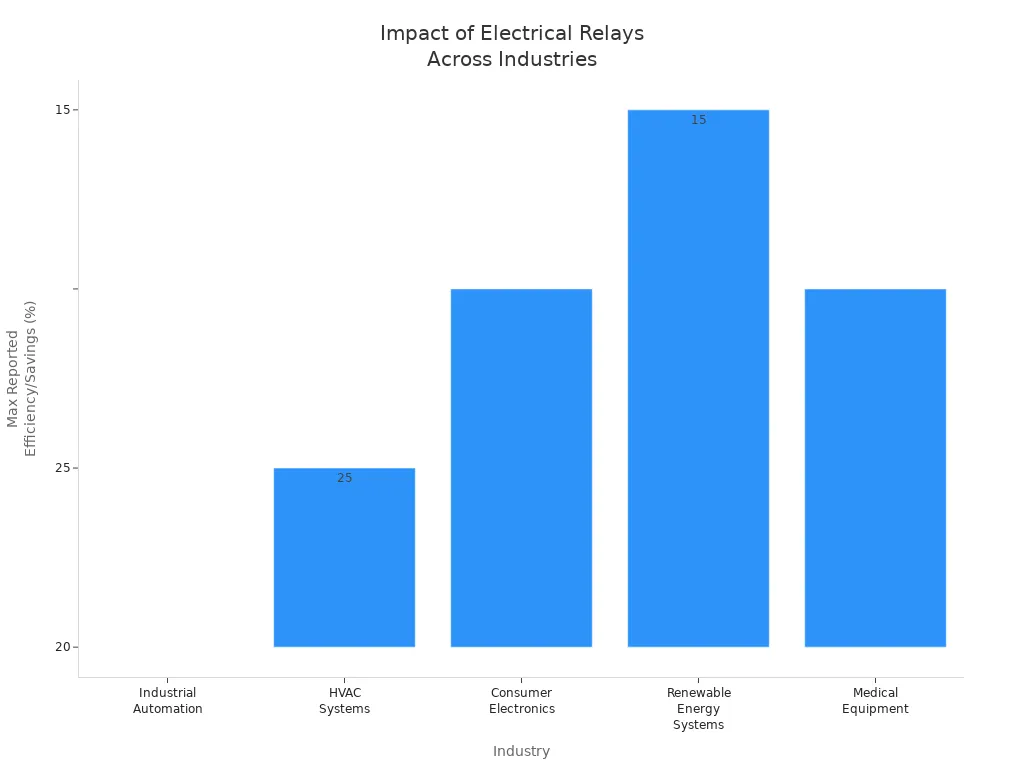
You see relays in many industries today.
- In industrial automation, relays control machinery and robots, making production lines faster and more efficient.
- HVAC systems use relays for reliable switching, saving energy.
- Consumer electronics rely on relays for power control, improving device longevity.
- Renewable energy systems use relays for switching and protection, boosting energy conversion efficiency.
- Medical equipment uses relays for precise control, improving safety and reducing maintenance.
You have seen the relay development history shape modern technology. The journey from the first electromagnetic relay to advanced electromechanical and digital relays has changed how you live and work. Relays continue to evolve, meeting the needs of expanding electrical grids and new industries.
Electrical Relay Evolution
Electromechanical to Solid-State
You have seen a major transformation in relay technology over the past decades. The shift from electromechanical relays to solid-state relays (SSRs) changed how you control and protect electrical systems. Electromechanical relays use moving parts and magnets to switch circuits. Solid-state relays rely on semiconductors, such as LEDs and phototransistors, to perform switching without any moving parts.
Here is a table that shows the main differences between electromechanical relays and solid-state relays:
| Feature | Electromechanical Relay | Solid-State Relay |
|---|---|---|
| Moving Parts | Yes | No |
| Switching Mechanism | Electromagnet | Semiconductor (LED and phototransistor) |
| Control Method | Mechanical operation | Optical coupling via LED |
| Isolation Method | Electrical isolation through mechanical means | Electrical and optical isolation |
| Response Time | Slower due to mechanical movement | Faster due to electronic switching |
| Lifespan | Limited by mechanical wear | Longer lifespan due to no moving parts |
You notice that SSRs offer faster response times and longer lifespans. SSRs do not suffer from mechanical wear, so they last longer and work better in harsh environments. You can use SSRs at higher temperatures without losing performance. Large enterprises invest in SSRs for reliability and durability, even though the initial cost is higher.
The transition to SSRs is clear in global manufacturing. You see industrial automation leading the demand, with 34% of the market choosing SSRs for their reliability. Building automation follows with 22%, and automotive applications account for 18%. Asia-Pacific dominates relay consumption, with 42% of demand, showing rapid SSR adoption in emerging economies. North America and Europe also show steady growth.

| Category | Percentage (%) | Description |
|---|---|---|
| Industrial Automation | 34% | Largest demand segment, valuing reliability and longevity of SSRs despite higher initial costs. |
| Building Automation | 22% | Significant market share, reflecting the shift towards SSRs for efficiency. |
| Automotive Applications | 18% | Growing sector for SSR adoption, emphasizing performance benefits. |
| Asia-Pacific Demand | 42% | Dominates global relay consumption, with rapid SSR adoption in emerging economies. |
| North America Demand | 28% | Significant market, showing steady transition towards SSRs. |
| Europe Demand | 21% | Important region for relay technology, with ongoing shifts towards SSRs. |
| Large Enterprises | 68% | Willing to invest in premium SSR solutions despite higher costs. |
| SSR Adoption Rate | 8-10% annually | Reflects the growing market share of SSRs over EMRs. |
| Future Cost Premium | 1.9x by 2025 | Expected decrease in cost premium for SSRs as manufacturing scales improve. |
Note: SSRs have a reliability advantage over electromechanical relays. You can expect SSRs to last longer and perform better, especially in demanding environments.
Microprocessor and PLCs
You now use digital microprocessor-based relays and programmable logic controllers (PLCs) in modern automation systems. These devices bring new levels of flexibility, speed, and intelligence to your control systems. Digital microprocessor-based relays use advanced chips to process signals and make decisions quickly. You can detect faults faster and respond to problems before they cause damage.
Here is a table that highlights how microprocessor-based relays improve fault detection and reliability:
| Evidence Type | Description |
|---|---|
| Fault Detection | Advanced technologies in microprocessor-based relays enhance fault detection, addressing risks like SEEs. |
| Reliability Assessment | Methods such as Monte Carlo simulations and software fault injection help you evaluate and improve reliability. |
| Mitigation Techniques | Techniques like ECC and triple voting systems increase reliability under single event effects. |
PLCs work with relays to control machines and processes. You can program PLCs to handle simple or complex tasks. PLCs send output signals to relays, which then switch high-power devices. You benefit from the flexibility and scalability of PLCs in automation. Both PLCs and electromechanical relays often work together to improve system performance.
- Microprocessor-based relays and PLCs provide advanced logic and control.
- You can scale your automation systems easily.
- PLCs offer reliability and flexibility for many applications.
Here is a table showing PLC advantages in automation:
| Evidence Type | Description |
|---|---|
| PLC Applications | PLCs work in automation, offering flexibility and reliability in control systems. |
| Advantages | PLCs have more advantages than limitations, making them suitable for both simple and complex tasks. |
Tip: You can combine PLCs and digital microprocessor-based relays to create smart automation systems. This integration helps you achieve better fault detection, reliability, and control.
You see the evolution of the electrical relay from mechanical switches to smart digital devices. You now rely on advanced relays and PLCs to keep your systems safe, efficient, and ready for the future.
Relay Applications

Power Systems
You see relays as essential tools in power systems. They protect circuits from overloads and faults. You use relays to monitor the status and performance of electrical systems. Control relays help you manage power distribution and generation. Smart grids rely on advanced control relays for better integration and efficiency.
| Application Type | Description |
|---|---|
| Protection | Relays provide protection against overloads and faults in electrical circuits. |
| Monitoring | They are used for monitoring the status and performance of electrical systems. |
| Control | Control relays are essential for managing the operation of power distribution and generation systems. |
| Integration with Smart Grids | Advanced control relays are increasingly important due to the integration of smart grid technologies. |
You benefit from real-time monitoring of the power grid. Relays help you identify abnormal situations quickly. You improve grid stability and security by controlling the running state of the grid. Relays allow you to detect faults and isolate them before they cause bigger problems.
Note: Relays also support renewable energy systems. When you add new sources like solar or wind, relays help manage short-circuit currents and prevent protection issues.
Telecommunications
You rely on relays to keep communication networks running smoothly. Relays route signals between different paths. You use them for call connections and forwarding. Relays oversee network access and control data flow. They connect calls to emergency responders automatically. You check communication lines for faults using relays. Relays also control data transmission connections.
- Signal routing and switching
- Call routing
- Network control and management
- Emergency services
- Line testing and monitoring
- Switching and modem control
Relays make sure your calls and data reach the right place. You get reliable service and quick response in emergencies.
Automation
You use relays in industrial automation to make processes safer and more efficient. Input relays collect signals from sensors and switches. These signals help programmable logic controllers (PLCs) decide what actions to take. Output relays control devices like motors and lights. You manage tasks such as switching devices on or off and adjusting settings in real time.
| Component | Function |
|---|---|
| Main Switch | Controls the overall power supply of the panel. |
| Fuses / Circuit Breakers | Provide protection against overcurrent and short circuits. |
| Power Supply Unit | Converts main voltage into 24V DC or other required levels for control circuits. |
| PLC | Processes inputs and outputs. |
| Contactors and Relays | Switch motors and other loads. |
| Terminal Blocks | Organize connections for wires. |
| HMI | Lets operators monitor and control the system. |
You see relays as the backbone of automation. They help you collect information, make decisions, and control machines. You improve safety and productivity in factories and plants.
You have seen electrical relays change from simple inventions to advanced tools in modern technology. Relay innovations drive new applications and improve reliability. Miniaturization makes devices smaller and more affordable. You benefit from these changes every day.
- Advancements in relay design boost communication and intelligent features.
- Smaller relays help create modern electronics.
- Improved reliability and efficiency support many industries.
You will notice smart relays and IoT integration shaping the future. Real-time monitoring and network connectivity become standard. Remote diagnostics and management grow in power generation, automation, and automotive fields.
FAQ
What is relay protection and why do you need it?
Relay protection keeps your electrical systems safe. You use relay protection to detect faults and disconnect damaged parts. Relay protection uses devices like an electromagnet to sense problems. Relay protection helps you avoid fires, equipment damage, and power outages.
How does an electromagnet work in relay protection?
An electromagnet creates a magnetic field when you run electricity through a coil. In relay protection, the electromagnet pulls a switch to open or close a circuit. You rely on the electromagnet for fast and accurate relay protection.
Where do you find relay protection in daily life?
You see relay protection in your home, school, and city. Relay protection works in power grids, factories, and hospitals. Relay protection uses an electromagnet to control circuits. You depend on relay protection for safe and reliable electricity.
What is the difference between a relay and a protective relay?
A relay switches circuits on or off. A protective relay detects faults and triggers relay protection. You use a protective relay for safety. Relay protection uses an electromagnet to sense problems and protect your devices.
How does relay protection improve power system safety?
Relay protection monitors your power system. When a fault happens, relay protection uses an electromagnet to trip the circuit. Relay protection acts fast to stop damage. You trust relay protection to keep your lights on and your equipment safe.
Tip: Always check your relay protection system. You can prevent accidents and keep your power running smoothly.