Essential Tips for Using a Parallel Circuit Calculator

A parallel circuit calculator helps you quickly solve problems with electricity, making learning less stressful. Schools often use these tools to teach about parallel circuits in hands-on labs and theory classes.
| Course Example | Course Objectives |
|---|---|
| Fundamental Properties of DC Circuits and Lab (ET105) | Calculate voltage, current, and resistance values in a parallel circuit. |
| Circuit Analysis (ET310) | Find unknown voltages and currents in circuits. |
Key Takeaways
- A parallel circuit calculator simplifies calculations for voltage, current, and resistance, saving you time and reducing errors.
- Always double-check your resistor values and circuit type before calculating to avoid common mistakes.
- Understanding that voltage remains constant across branches while total current is the sum of branch currents is crucial for designing effective circuits.
Parallel Circuit Calculator Basics
What Is a Parallel Circuit Calculator?
A parallel circuit calculator is a handy online tool that helps you figure out important values in parallel circuits. You can use it to find total resistance, current, and voltage for each branch. This tool makes it easy to work with circuits that have more than one path for electricity to flow.
Here are some main functions you will find in a parallel circuit calculator:
- Power distribution: It checks if power spreads evenly across all parts.
- Voltage management: It keeps the voltage the same for each resistor.
- Circuit protection: It helps you avoid too much current in any part.
- Amplifier circuits: It helps control sound systems.
- Pull-up and pull-down resistors: It sets voltage levels for logic gates.
You can also use the calculator for different types of calculations. Take a look at this table:
| Calculation Type | Formula |
|---|---|
| Total Resistance for Parallel Resistors | 1/Rtotal = 1/R1 + 1/R2 + 1/R3 + ... |
| Total Resistance for Two Resistors | Rtotal = (R1 * R2) / (R1 + R2) |
| General Use | Lets you skip hard math and get answers fast |
Why Use a Parallel Circuit Calculator?
You might wonder why you should use a parallel circuit calculator instead of doing math by hand. The answer is simple: it saves you time and helps you avoid mistakes. When you use this tool, you get quick and accurate results for current, voltage, and resistance in your parallel circuit.
Here are some big advantages for beginners:
| Advantage | Description |
|---|---|
| Ease of Use | You can find answers fast without tough math. |
| Accuracy | You get the right results every time. |
| Educational Benefits | You learn how parallel circuits work step by step. |
| Error Reduction | You make fewer mistakes in your circuit designs. |
| Circuit Design Safety | You keep your components safe from too much current. |
A parallel circuit calculator also helps you understand that voltage stays the same across each branch, while the total current is the sum of all branch currents. This makes it easier to design and test circuits without worrying about errors. Just remember, if your circuit gets very complex, the calculator might not handle every situation perfectly. For most beginner projects, though, it works great!
How to Use a Parallel Circuit Calculator
Step-by-Step Tutorial
Ready to try a parallel circuit calculator? You can follow this simple tutorial to get started. You don’t need to be a math whiz. The calculator does the hard work for you!
- Pick the "Calculate equivalent resistance" mode. This is the main feature you’ll use in most tutorials.
- Enter the number of resistors in your parallel circuit. You can add up to ten.
- Type each resistor’s resistance value. You can enter them one at a time or as a list separated by commas.
- Choose the unit for resistance. Most calculators let you pick from Ohms (Ω), Kilo Ohms (KΩ), or Mega Ohms (MΩ).
Here’s a quick look at the units you’ll see:
| Unit Type | Symbol |
|---|---|
| Ohms | Ω |
| Kilo Ohms | KΩ |
| Mega Ohms | MΩ |
- Hit the "Calculate" button. The calculator shows the total resistance for your parallel circuit right away.
- If you want to check current or voltage, enter those values too. The calculator will show results for each branch.
Tip: Always double-check your resistor values before you start the tutorial. A small mistake can change your results!
Interpreting Results in Parallel Circuits
After you finish the tutorial, you’ll see numbers for resistance, current, and voltage. Let’s break down what these results mean for your parallel circuit.
Suppose you have three resistors in your circuit. Here’s a practical example using the parallel resistance formula:
| Resistor | Resistance (Ω) | Current (A) |
|---|---|---|
| R_1 | 10 | 0.30 |
| R_2 | 25 | 0.12 |
| R_3 | 15 | 0.20 |
| Total | 4.84 | 0.62 |
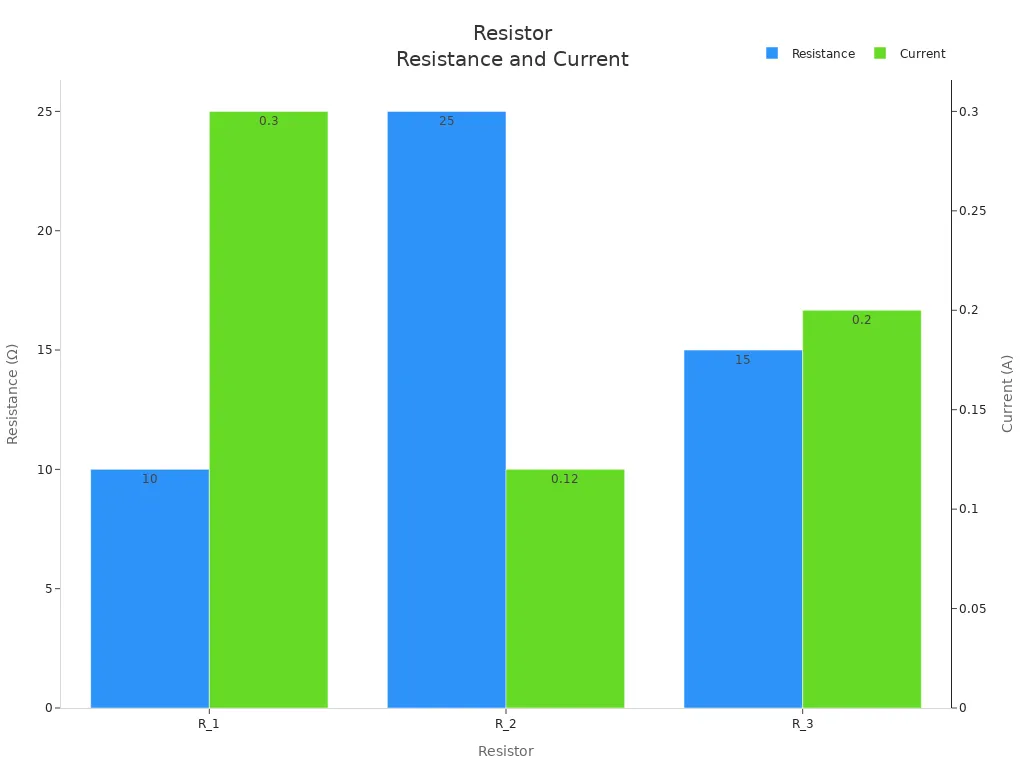
You’ll notice that the total resistance is less than the smallest resistor in your parallel circuit. This happens because each resistor gives electricity a new path. More paths mean more current flow, so the total resistance drops.
- Each resistor works independently. If one stops working, the others keep going.
- The voltage stays the same across every branch. You don’t need to worry about voltage dropping from one resistor to the next.
- The total current is the sum of the current in each branch. You can add up the numbers to see how much current flows through the whole circuit.
Note: When you use a parallel circuit calculator, you can see how changing one resistor affects the whole circuit. Try different values in your tutorial to see what happens!
If you’re working on a real electronics project, remember these safety tips:
| Safety Measure | Purpose | Guideline |
|---|---|---|
| Turn Off Power | Prevents electric shock | Disconnect power before changes or repairs |
| Wear Safety Gear | Protects against injuries | Use insulated gloves and safety glasses |
| Maintain Safe Workspace | Reduces risk of accidents | Keep workspace bright, clean, and organized |
| Have a Buddy for Live Circuits | Ensures assistance if needed | Never work on live circuits alone |
- Use fuses and circuit breakers to protect your circuit from too much current.
- Pick the right fuse or breaker for your project.
- Check and replace fuses often to keep your circuit safe.
With this tutorial, you can use a parallel circuit calculator to design circuits, check your work, and learn how parallel circuits behave. You’ll see how resistance, voltage, and current change when you adjust the values. Try different setups and see how each component operates on its own. You’ll build confidence and get better at electronics every time you use the calculator!
Common Mistakes in Parallel Circuit Calculations
Data Entry Errors
You might feel excited to use a parallel circuit calculator, but small mistakes can sneak in and mess up your results. One of the most common problems is mixing up series and parallel circuits. Many users enter values for a series circuit when they really have parallel circuits. This mix-up can lead to big errors in your calculations.
Here are some mistakes you should watch out for:
- Entering the wrong type of circuit in the calculator.
- Typing resistor values in the wrong order or skipping one by accident.
- Using the wrong unit, like Ohms instead of Kilo Ohms.
- Forgetting to double-check your numbers before hitting "Calculate."
Tip: Always make sure you select the correct circuit type before you start. Double-check each resistor’s value to avoid simple errors.
Troubleshooting Tips
If your results look strange, don’t worry! You can fix most problems with a few easy steps. Try these troubleshooting tips to get accurate answers:
- Check if the total resistance is less than the smallest resistor. In parallel circuits, this should always be true.
- Add up the current in each branch. The total current should match the sum of all branch currents.
- If you suspect a problem, use an ammeter or ohmmeter to check for open branches in your circuit.
- Look for open or short circuits by visually inspecting your setup.
- Recalculate your circuit parameters and see if the numbers make sense.
- Try changing one resistor value and see how it affects the total current and resistance.
If you keep getting unexpected results, experiment with different values. Practice helps you spot mistakes faster and understand how parallel circuits work.
Series and Parallel Circuits Comparison

Key Differences
You might wonder how series and parallel circuits really differ. Let’s break it down so you can see what makes each one special. In a series circuit, the same current flows through every part. The voltage splits up across each component. In a parallel circuit, the voltage stays the same for all branches, but the current divides between them.
Here’s a quick table to help you compare:
| Feature | Series Circuit | Parallel Circuit |
|---|---|---|
| Voltage Distribution | Divided among components | Same across all components |
| Current Flow | Same through all components | Divided among branches |
When you add more resistors to a series circuit, the total resistance goes up. You just add the numbers together. In parallel circuits, you use a special formula. The total resistance is always less than the smallest resistor. That’s because each resistor gives the current a new path to travel.
If you want all your devices to work independently, parallel circuits are the way to go. If you need to control current or split voltage, series circuits might be better.
When to Use Each Type
You see series and parallel circuits everywhere. Each type has its own job. Here are some places where you might use them:
Parallel Circuits:
- Power distribution in homes. Every outlet and light gets the same voltage.
- Car systems. Headlights and sensors work on their own, even if one fails.
- Electronics projects. You want each part to run without affecting the others.
Series Circuits:
- Voltage divider networks. You can create reference voltages for sensors.
- LED protection. Put a resistor in series to limit current and keep your LED safe.
- Battery packs. Connect batteries in series to get higher voltage.
- Holiday lights. Some strings use series wiring to split voltage between bulbs.
You get to choose which type fits your project. If you want steady voltage for each device, go with parallel. If you need to control current or split voltage, try series. Knowing when to use series and parallel circuits helps you build safer and smarter electronics.
You can master parallel circuit calculators by practicing with different values and exploring new scenarios.
- Understand how parallel circuits work
- Try advanced strategies to save time
- Use simulation tools to test your ideas
By using these calculators, you build real skills and boost your confidence in electronics. Keep experimenting! 🚀
FAQ
How do you know if you have resistors in parallel?
You see resistors in parallel when each resistor connects across the same two points. This setup lets current flow through different paths in your circuits.
Why does total resistance drop in parallel circuits?
When you add more resistors in parallel, you give current flow more paths. This lowers total resistance. The basic rules say total resistance always gets smaller than the smallest resistor.
What is the best way to avoid mistakes when calculating parallel circuits?
You should double-check resistor values and follow the basic rules. Make sure you enter each resistor correctly. This helps you get the right total resistance for your circuits.