From UV Light to Electrical Signals The EPROM vs EEPROM Story
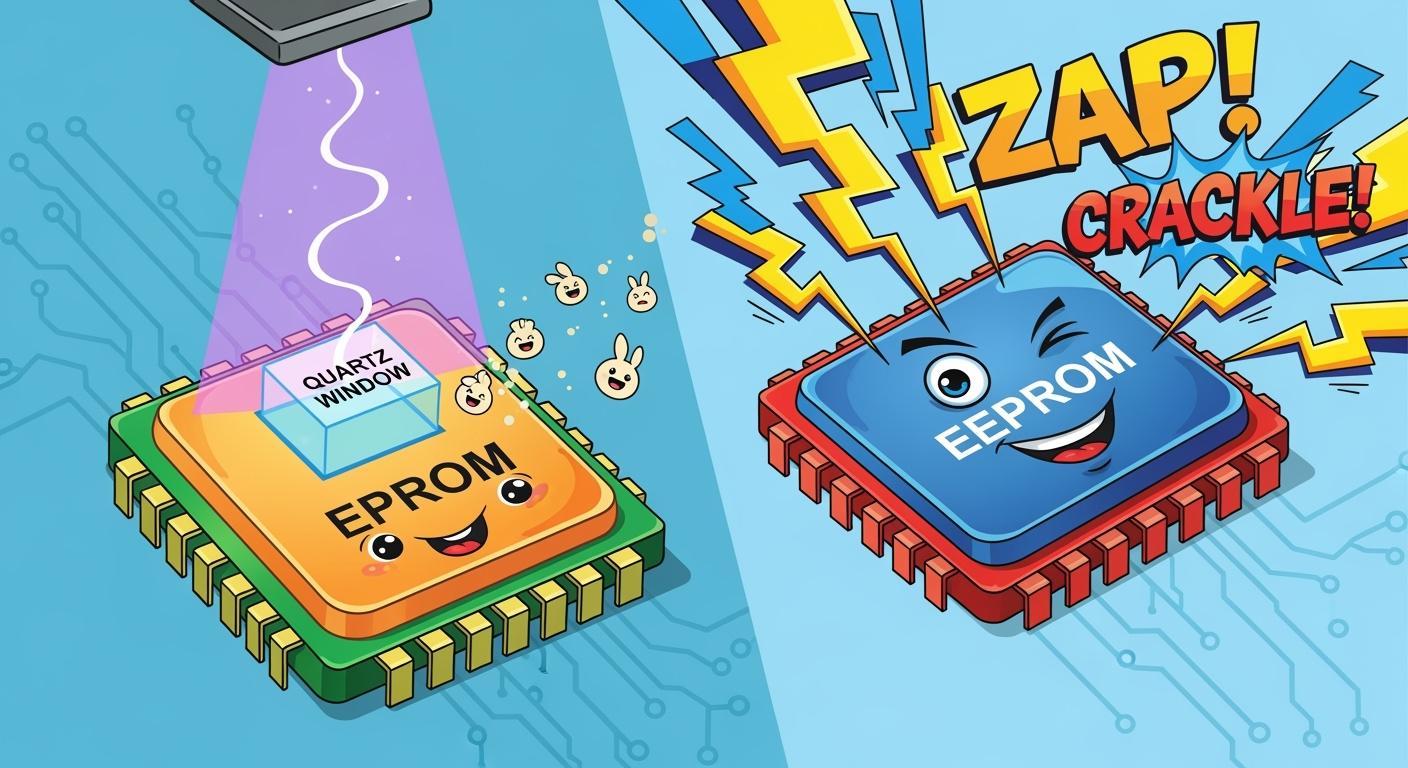
The main difference between eprom and eeprom is the erasure method. An erasable programmable read only memory (EPROM) requires ultraviolet light to erase its data. This process happens outside of a device's circuit. In contrast, an EEPROM uses simple electrical signals. This design allows an EEPROM to erase information while remaining inside the circuit.
Analogy Time 📸: Think of EPROM as photo film needing special development (UV light). An EEPROM is like a digital camera's memory card, ready to be rewritten instantly.
Key Takeaways
EPROM uses ultraviolet light to erase data. This process requires removing the chip from a device.
EEPROM uses electrical signals to erase data. This allows it to stay in the device for updates.
EPROM erases the whole chip at once. EEPROM can erase data one byte at a time.
EEPROM is more flexible and faster for updates. It is good for small, changing data.
Flash memory is a newer type of memory. It stores large amounts of data, but EEPROM is still useful for specific tasks.
Understanding EPROM: The UV Era
Before the convenience of modern flash memory, developers relied on a groundbreaking but cumbersome technology: the EPROM. This memory chip was a critical step in the evolution of electronics.
What is Erasable Programmable Read Only Memory?
An erasable programmable read only memory (EPROM) is a type of non-volatile memory chip. It retains its data even when the power is turned off. Its invention was a major breakthrough. In 1971, Dov Frohman of Intel created the first EPROM. Intel then released the first commercial version, the Intel 1702.
The technology works using a special component called a floating-gate transistor. Engineers program the chip by applying a higher voltage. This forces electrons onto the floating gate, storing a bit of data. These trapped electrons define the chip's stored information, making it a reliable form of ROM.
The UV Erasure Process
The most distinct feature of an EPROM is its erasure method. You cannot erase just one part of the chip. Instead, you must erase the entire memory at once.
Note: To erase an EPROM, a technician must first remove it from the circuit board. The chip is then placed inside a special UV eraser box.
This box exposes the chip's quartz window to a specific ultraviolet light. The light has a wavelength of 253.7 nm. This UV energy excites the electrons trapped on the floating gate, allowing them to escape and effectively resetting the chip to a blank state. The process is not instant. Depending on the eraser's power, it can take 10 to 20 minutes to completely erase the chip. After the erase cycle, a user can program the chip again.
Core Characteristics
EPROMs were essential for firmware development and prototyping before EEPROM and flash memory became popular. They allowed developers to test and program code without manufacturing a new ROM chip for every change. Key characteristics include:
One-Time Programmability (per cycle): You can program the chip once after each full erasure.
Bulk Erasure: The entire chip must be erased; selective byte erasure is not possible.
Physical Handling: The chip requires removal from the device to erase and program its contents.
Limited Capacity: During their peak, common EPROMs offered capacities like 2M-bit (256KB), which is small by today's flash memory standards.
These traits made EPROM a revolutionary but labor-intensive solution in the history of digital storage.
The Rise of EEPROM: Electrical Flexibility
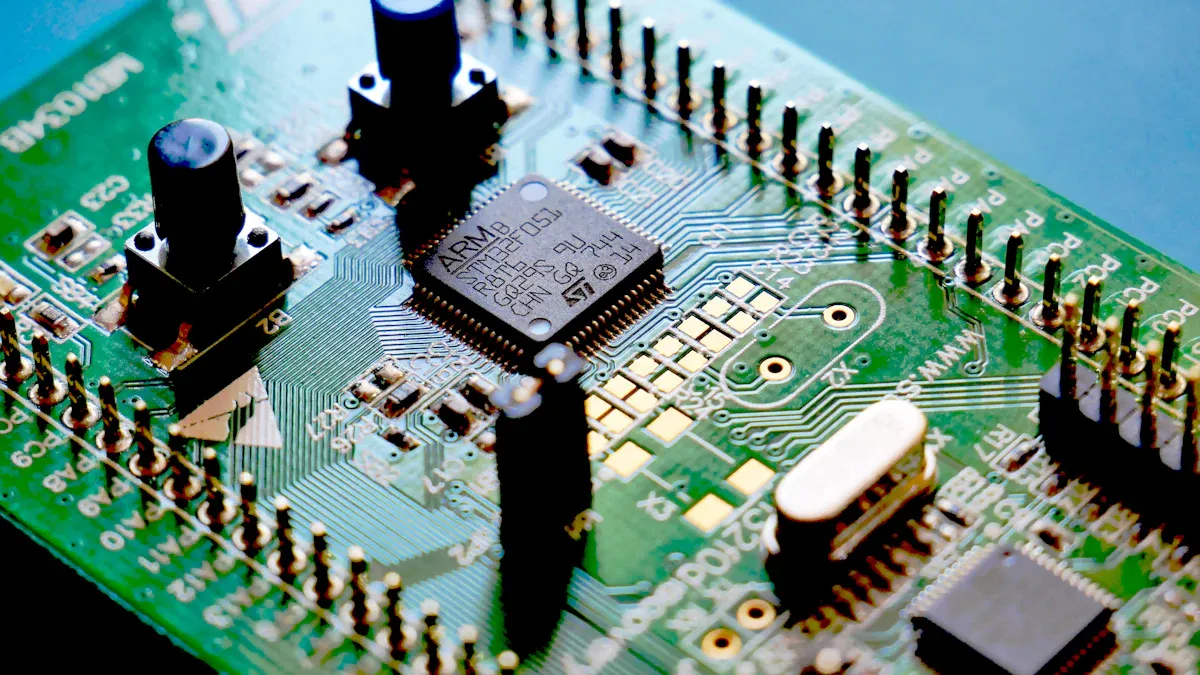
The limitations of EPROM paved the way for a more convenient and flexible technology. The next major step in non-volatile memory was the Electrically Erasable Programmable Read-Only Memory, or EEPROM. This innovation removed the need for UV light and physical handling, revolutionizing how electronic devices stored data.
Defining the Modern EEPROM
An electrically erasable programmable read only memory (EEPROM) is a type of non-volatile memory that a user can erase and reprogram using electrical signals. Eli Harari developed the foundational technology at Hughes Microelectronics after his research on electronic tunneling. Hughes later commercialized the first EEPROM in 1980. This invention meant developers could finally update firmware and configuration data without removing the chip from the circuit board, a massive leap in efficiency. The modern EEPROM became a cornerstone for storing small amounts of data that needed occasional updates.
The Electrical Erasure Process
The EEPROM uses a quantum mechanical process called Fowler-Nordheim tunneling to erase and program data. Instead of using UV light to excite electrons, an EEPROM applies a controlled voltage to a transistor. This voltage creates a strong electric field, allowing electrons to "tunnel" through an insulating layer and onto or off of the floating gate. This process allows a user to erase data with a simple electrical pulse.
Key Advantage ⚡: The most significant benefit is that an EEPROM does not require bulk erasure. A user can erase and program data byte by byte, leaving the rest of the memory untouched. This makes small, targeted updates fast and simple.
Core Characteristics
The design of the EEPROM gives it several distinct advantages over its predecessor. These features made it the go-to choice for many applications where data needed to be changed on the fly. Key characteristics include:
In-Circuit Reprogrammability: An EEPROM allows a user to program its contents while it remains installed in a device.
Byte-Level Erasure: Users can erase single bytes of data, which is far more flexible than the all-or-nothing approach of EPROM.
Standard Interfaces: Modern EEPROM chips often use simple serial interfaces like I²C or SPI, requiring only a few pins to communicate with a microcontroller.
Durability: While not infinite, an EEPROM can endure tens of thousands to millions of erase/write cycles, making it a reliable form of ROM.
Head-to-Head Comparison
While both EPROM and EEPROM are forms of non-volatile memory, their operational differences are significant. The main difference between eprom and eeprom lies in how they erase and reprogram data. These distinctions determined their roles in the history of electronics. The following table summarizes the important differences between eprom and eeprom.
Feature | EPROM | EEPROM |
|---|---|---|
Erasure Method | Ultraviolet (UV) Light | |
Erasure Unit | Entire Chip | Byte-by-Byte |
In-Circuit Modification | No | Yes |
Erasure Time | Milliseconds (e.g., ~5 ms per byte) | |
Physical Casing | Ceramic with a Quartz Window | Opaque Plastic or Ceramic |
Erasure Method and Unit
The most fundamental contrast is the erasure process. An erasable programmable read only memory (EPROM) requires a full-chip wipe. A technician must expose the entire chip to UV light. This process clears all existing data at once, making partial updates impossible.
An EEPROM, on the other hand, offers far greater precision. It uses electrical signals to erase data. This allows for byte-level erasure, meaning a developer can change a single byte of information without affecting the rest of the memory.
A Note on Modern Memory: While a traditional EEPROM can erase a single byte, some modern microcontrollers use Flash memory to emulate EEPROM functionality. In these cases, the smallest erasable unit is often a 'page' or 'block', which can be 1KB or larger.
Reprogramming and Speed
The difference in erasure methods directly impacts speed and convenience. The EPROM erase and reprogramming cycle is slow and labor-intensive.
A technician must power down the system.
They must carefully remove the chip from its socket.
The chip then sits in a UV eraser for several minutes.
Finally, they use a special device to program the chip before reinstalling it.
This entire process introduces significant system downtime. In contrast, the in-circuit reprogrammability of an EEPROM is a game-changer. A user can erase and reprogram an EEPROM chip while it remains on the circuit board. Erasing a byte takes only about 5 milliseconds. This efficiency eliminates downtime and allows for on-the-fly updates, a critical feature for modern electronics.
Physical Design and Cost
The physical features of these chips also differ, which affects their cost. An EPROM is easily identifiable by its ceramic package and the small, circular quartz window on top. This window allows UV light to reach the silicon die to erase it. The ceramic material is necessary because it expands and contracts at a similar rate to the quartz, preventing damage from temperature changes. This specialized packaging makes the EPROM more expensive to manufacture.
An EEPROM does not need a window. It can be housed in a standard, inexpensive opaque plastic package. This simpler design lowers manufacturing costs, making the EEPROM a more economical choice for many applications.
Typical Applications
The unique features of each ROM type led them to different uses. EPROMs were very common in the 1980s for prototyping and for products with firmware that rarely changed.
Arcade Games: Classic games like Defender and Stargate used EPROMs to store game code and graphics.
Early Computers: The BIOS on many early personal computer motherboards was stored on an EPROM.
Development: Engineers used them to test code before committing to a mass-produced, non-erasable ROM.
The flexibility of the EEPROM made it essential for devices that need to store configuration settings or data that changes periodically.
Consumer Electronics: Smart TVs, routers, and washing machines use an EEPROM to remember user preferences.
Automotive Systems: Vehicles store engine parameters, fault codes, and calibration data on an EEPROM.
Embedded Systems: Microcontrollers use the EEPROM to hold vital settings that persist after a power cycle.
Practical Use and Modern Alternatives
The journey from EPROM to EEPROM set the stage for modern data storage. While one technology is now a relic, the other still holds a valuable place. Both paved the way for their powerful successor, Flash memory.
The Legacy of EPROM
EPROMs were vital for early computer BIOS firmware. They allowed manufacturers to update a computer's basic startup instructions without replacing the hardware. This ability to erase and reprogram the ROM was a major step forward. Although largely obsolete, EPROMs are still produced for specific purposes.
Maintenance of Legacy Systems: Technicians use them to repair older industrial and automotive equipment.
Hobbyist Electronics: Retro-computing fans use EPROMs to fix vintage systems or create custom game cartridges.
Long-Term Reliability: The technology is valued for its excellent data retention in applications where reprogramming is rare.
Companies like STMicroelectronics and Microchip Technology still manage some EPROM product lines, while smaller suppliers cater to the hobbyist market.
The Niche for EEPROM Today
The EEPROM still thrives in applications that require frequent, small data updates. Its ability to write a single byte of data makes it more efficient than Flash for certain tasks. An EEPROM can endure up to one million write cycles, far more than most Flash memory.
This durability makes it perfect for:
Automotive Systems: Storing diagnostic trouble codes and engine calibration data in ECUs.
Consumer Electronics: Saving user settings in smart devices.
Industrial Equipment: Holding configuration parameters that change periodically.
The Successor: Flash Memory
Flash memory is the true successor in the world of non-volatile memory. It combines high density with low cost, making it the standard for modern devices.
The architecture of Flash memory allows for much more compact storage than an EEPROM. However, this comes with a trade-off. Flash memory erases data in larger blocks instead of single bytes. This design is perfect for storing large files like photos, videos, and operating systems. You can find Flash technology in:
Solid-State Drives (SSDs)
USB Flash Drives
Smartphones and Digital Cameras
While Flash dominates large-scale storage, the precision of EEPROM ensures it remains essential for specific, small-scale data tasks. The evolution from EPROM to EEPROM and finally to Flash shows how storage technology adapted to meet new demands.
The evolution from the cumbersome UV-erased EPROM to the flexible, electrically-erased EEPROM marked a huge technological leap. This shift was critical for developing modern electronics that can be easily updated. The ability to modify firmware in the field allows manufacturers to:
Apply security patches and fix bugs without product recalls.
Adapt to market changes by adding new features instantly.
While the erasable programmable read only memory was a vital step, today's non-volatile storage solutions are defined by the precision of EEPROM and the high capacity of its successor, flash memory.
FAQ
What does the window on an EPROM do?
The quartz window on an EPROM has a special purpose. It allows ultraviolet (UV) light to reach the silicon chip inside. This exposure to UV light erases all the stored data, preparing the chip for reprogramming. The window is essential for the erasure process.
Why use EEPROM if Flash memory is more common?
EEPROM remains useful for specific tasks. It allows a user to change single bytes of data. Flash memory erases data in larger blocks.
This makes EEPROM more efficient for storing small configuration settings that change often, like user preferences in a smart device.
Can people still buy EPROMs today?
Yes, EPROMs are still available. Technicians and hobbyists use them for specific needs.
Repairing older industrial machines.
Restoring vintage computers and game consoles.
Projects where data retention is more important than frequent updates.
How many times can someone rewrite an EEPROM?
An EEPROM offers excellent durability. A user can typically erase and rewrite it up to one million times. This high endurance makes it very reliable for data that needs frequent updates, far exceeding the lifespan of most Flash memory for such tasks. ⚡