Electrolytic Capacitor Choices Made Simple for You
Choosing the right capacitor for your circuit starts with understanding what your project needs. You must check the specifications for the electrolytic capacitor, including voltage rating, capacitance, and polarity. Many professionals look at power storage and transformation, but beginners often make mistakes.
Common mistakes include:
- Connecting the capacitor backward
- Using a voltage rating that is too low
- Ignoring ripple current
You can avoid these problems by matching the type to your application and reading the datasheet carefully.
Key Takeaways
- Always check the specifications of electrolytic capacitors, including voltage rating, capacitance, and polarity, to avoid common mistakes.
- Select the correct capacitance value based on your circuit needs. Too low may cause failure, while too high can waste resources.
- Ensure the voltage rating exceeds the maximum voltage in your circuit. This prevents damage and enhances safety.
- Pay attention to the tolerance of capacitors. Tighter tolerance is crucial for precision applications like timing circuits.
- Read the datasheet carefully when selecting capacitors. It contains vital information that helps you avoid costly errors.
Circuit Requirements
Capacitance Value
You must select the correct capacitance for your circuit. Capacitance tells you how much charge a capacitor can store. If you choose a value that is too low, your circuit may not work as expected. If you pick a value that is too high, you might waste space and money.
Here are the main factors you should consider when deciding on the capacitance value for your capacitor applications:
- Required Capacitance (pF, µF, mF): Check your circuit diagram or design notes for the needed value.
- Voltage Rating: Make sure the voltage rating matches or exceeds the highest voltage in your circuit.
- Capacitor Type: Use an electrolytic capacitor for larger capacitance values, especially in power supply circuits.
- Temperature Stability: Pick a capacitor that works well in your operating temperature range.
- Tolerance: Decide if you need a precise capacitance or if some variation is acceptable.
- Frequency Response: Think about how the capacitor will behave with AC signals or high-frequency circuits.
- Size and Package: Make sure the capacitor fits your board and matches your layout.
- Reliability and Quality: Choose capacitors from trusted brands for long-lasting performance.
Tip: Always check the datasheet for the recommended capacitance and tolerance for your specific capacitor applications.
Voltage Rating
The voltage rating is one of the most important specifications for any capacitor. You must make sure the voltage rating is higher than the maximum voltage your circuit will see. If you use a capacitor with a voltage rating that is too low, you risk damaging the capacitor and your circuit.
- Exceeding the voltage rating can cause the capacitor to fail. This failure may result in short circuits, explosions, or even fire hazards.
- The dielectric inside the capacitor can break down if the voltage is too high. This breakdown releases energy quickly and can damage other parts nearby.
| Safety Margin | Description |
|---|---|
| Rated Voltage | The maximum voltage the capacitor can handle continuously. |
| Overvoltage | Using a capacitor above its voltage rating can cause catastrophic failure. |
| Voltage Spikes | For circuits with spikes, choose a capacitor with a higher voltage rating than the supply voltage. |
| Lifespan | Lowering the applied voltage can help your electrolytic capacitor last longer. |
Note: For safety-critical capacitor applications, always follow industry standards and use capacitors with a voltage rating at least 20% higher than your circuit’s maximum voltage.
Polarity
Electrolytic capacitors have polarity. You must connect the positive and negative leads correctly. If you reverse the polarity, the capacitor will not work. Worse, it can overheat, leak, or even explode.
- Incorrect polarity causes high leakage current and damages the dielectric film.
- Reverse voltage can build up hydrogen gas inside the capacitor, which may rupture the case.
- The capacitor may act like a short circuit, causing failure in your circuit.
⚠️ Always check the markings on the capacitor before soldering. The longer lead is usually positive, and the shorter lead is negative.
Matching the capacitance, voltage rating, and polarity to your circuit is essential. These steps help you avoid common mistakes and keep your capacitor applications safe and reliable.
Capacitor Specifications
Tolerance
You need to pay close attention to the tolerance of each capacitor you select. Tolerance shows how much the actual capacitance can differ from the value printed on the capacitor. Manufacturers express tolerance as a percentage. This number tells you how much the capacitance can vary.
If you use a capacitor with wide tolerance, your circuit may not work as planned. Wider tolerance can cause unexpected behavior, especially in timing circuits and filters. You may see problems with stability and performance. Sensitivity to temperature and frequency can also affect how well your capacitor works.
- Wider tolerance can lead to unexpected circuit behavior.
- Precision applications like timing circuits and filters need tight tolerance.
- Sensitivity to temperature and frequency can impact reliability and efficiency.
Electrolytic capacitors work well for low-frequency applications because they offer high capacitance in a small package. However, their sensitivity to temperature and frequency makes them less effective in high-frequency circuits. You should always check the tolerance before you choose a capacitor for your project.
Tip: For stable and reliable circuits, select capacitors with tighter tolerance when precision matters.
ESR
Equivalent Series Resistance (ESR) is another important specification. ESR measures how much resistance is inside the capacitor. High ESR means more energy loss as heat. This heat can damage the capacitor and nearby parts. You need to choose a capacitor with low ESR for circuits that handle high currents or fast switching.
Here is a table showing typical ESR ranges for different types of capacitors:
| Capacitor Type | ESR Range (Ω) for 22 µF | ESR Range (Ω) for 100 µF | ESR Range (Ω) for 470 µF |
|---|---|---|---|
| Standard Aluminum | 7–30 | 2–7 | 0.13–1.5 |
| Low-ESR Aluminum | 1–5 | 0.3–1.6 | N/A |
| Solid Aluminum | 0.2–0.5 | N/A | N/A |
| Sanyo OS-CON | 0.04–0.07 | 0.03–0.06 | N/A |
| Standard Solid Tantalum | 1.1–2.5 | 0.9–1.5 | N/A |
| Low-ESR Tantalum | 0.2–1 | 0.08–0.4 | N/A |
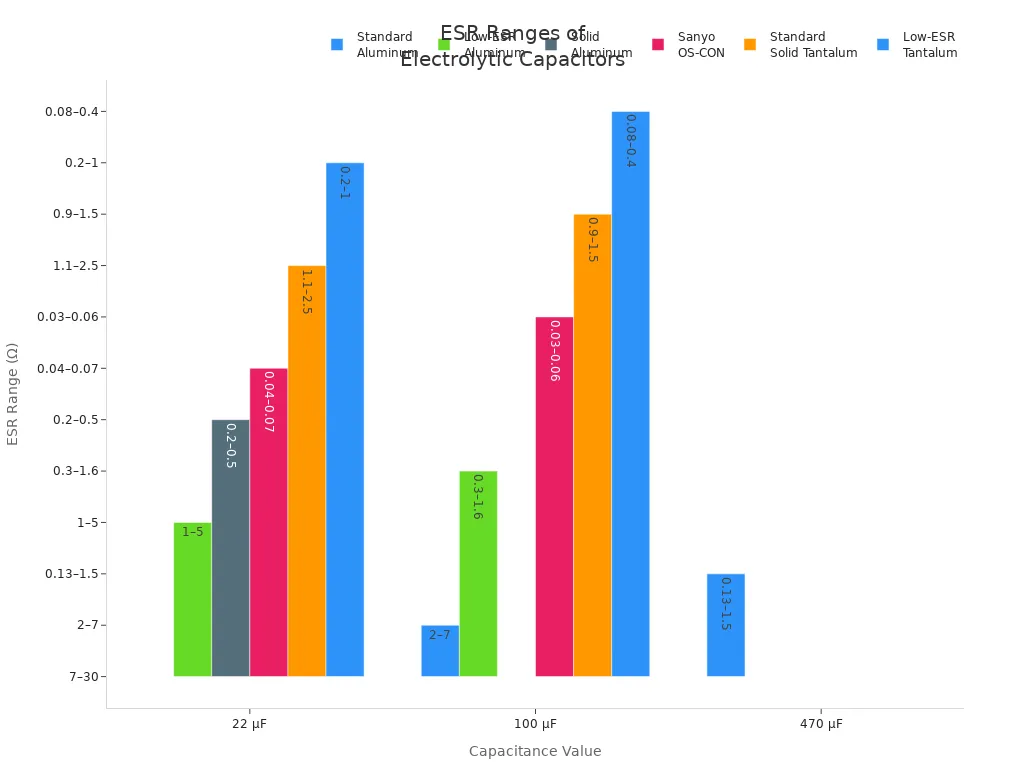
If you use a capacitor with high ESR, you will see more heat in your circuit. For example, in a switching power supply, a capacitor with an ESR of 0.1 ohm and a ripple current of 1 amp will generate 0.1 watt of heat. This heat can shorten the lifespan of your capacitor and reduce efficiency.
Note: Low ESR capacitors are best for switching power supplies and circuits with high ripple current.
Ripple Current
Ripple current is the maximum AC current a capacitor can handle without overheating. You must check this rating before you choose a capacitor for power supply circuits. If you exceed the ripple current rating, the capacitor will overheat. This can cause reduced reliability and early failure.
- Overheating
- Reduced reliability
- Premature failure
Ripple current comes from voltage ripple on the DC source. This ripple causes heating and stress inside the capacitor. If you ignore the ripple current rating, your capacitor may fail much sooner than expected. You should always match the ripple current rating to your circuit needs.
The selection of electrolytic capacitors for switching power supplies depends on ESR and ripple current specifications. Aluminium electrolytic capacitors offer high capacitance and acceptable ripple current. Polymer capacitors handle more ripple current but cost more. You need to understand these specifications to choose the right capacitor for reliable power supply circuits.
Temperature Rating
Temperature rating tells you the range in which your capacitor can work safely. Most industrial electrolytic capacitors have a temperature rating from -40°C to +105°C. You must check this rating before you install a capacitor in your circuit.
If you use a capacitor outside its temperature rating, you risk failure and reduced lifespan. High temperature can speed up aging and cause the electrolyte to dry out. Low temperature can reduce capacitance and increase ESR. You should always match the temperature rating to your operating environment.
⚠️ Always choose capacitors with a temperature rating that matches your application. This helps prevent failures and keeps your circuit running smoothly.
Lifespan
Lifespan shows how long a capacitor will last under normal conditions. Manufacturers test capacitors using several methods:
| Testing Method | Description |
|---|---|
| Burn-in Testing | Capacitors face higher stress than normal to find defects. |
| Voltage Conditioning | Testing at set voltage and temperature for a fixed time to check reliability. |
| Additional Performance Tests | Includes dielectric withstanding voltage, thermal shock, and solderability tests. |
If you use a capacitor within its rated voltage, temperature, ESR, and ripple current, you will get the longest lifespan. If you push any of these limits, the capacitor will age faster and may fail early. Always check the datasheet for lifespan information and choose capacitors from trusted brands.
Tip: For long-lasting circuits, select capacitors with proven reliability and match all specifications to your application.
Choosing the Right Capacitor
General Purpose vs. Low ESR
You need to decide between general purpose and low ESR electrolytic capacitors for your project. General purpose capacitors work well in basic circuits with low frequency and low ripple current. Low ESR capacitors perform better in demanding applications, such as switch-mode power supplies. They handle high ripple currents and reduce temperature rise, which improves reliability.
Here is a comparison to help you choose the right capacitor:
| Aspect | Low ESR Capacitors | General Purpose Capacitors |
|---|---|---|
| Frequency Response | Better performance in high frequency | Adequate for low frequency |
| Ripple Current Handling | Handles high ripple currents effectively | May struggle with high ripple currents |
| Temperature Rise | Reduced temperature rise | Higher temperature rise |
| Voltage Ripple | Lower voltage ripple | Higher voltage ripple |
| Application Suitability | Ideal for SMPS and similar applications | General use, less critical applications |
Low ESR capacitors improve reliability and performance. You should use them in circuits that need high efficiency and stability.
Size and Lead Spacing
Physical size and lead spacing affect how well a capacitor fits on your printed circuit board. You must check the size to avoid crowding other components. Lead spacing matters for proper placement and soldering. Standard lead spacing helps prevent short circuits and mechanical stress.
- Proper lead spacing protects capacitors and reduces risk of short circuits.
- Mismatched lead spacing can cause mechanical stress and circuit problems.
- Different capacitor types have varying lead spacings, so you need to match them to your PCB design.
You should always consider the specific requirements of your application when selecting the size and lead spacing.
Special Features
Modern electrolytic capacitors offer special features that improve performance. Aluminum electrolytic capacitors provide decent capacitance in a compact size, though other capacitor types like ceramic and tantalum offer higher volumetric efficiency.
| Capacitor Type | Volumetric Efficiency | Notes |
|---|---|---|
| Aluminum Electrolytic | Lower | Decent capacitance in compact size |
| Tantalum | Higher | Better volumetric efficiency |
| Ceramic | Higher | Superior volumetric efficiency |
| Film | Higher | Generally offers better performance |
Recent advancements use nanotechnology and new materials like graphene. These innovations allow for smaller designs and higher capacitance. Some new series, such as FN capacitors, are much smaller and offer higher capacitance than older models. Low ESR features also boost efficiency in power supply circuits.
Tip: Miniaturized capacitors help you save board space and give you more options for high-capacitance applications.
Selecting an Alternate Capacitor
Reading Datasheets
When you start selecting an alternate capacitor, always read the datasheet carefully. The datasheet gives you the most important information about the part. You should check these key parameters:
- Capacitance
- Voltage rating
- Tolerance
- ESR (equivalent series resistance)
- Ripple current
- Operating temperature
- Temperature coefficient
The ripple current rating is very important, especially in power supply circuits. If you choose a capacitor with a ripple current rating that is too low, it can overheat and fail. Always make sure the datasheet value matches your circuit needs.
Tip: Never skip the datasheet when finding alternate components. It helps you avoid costly mistakes.
Sourcing Quality Parts
You want to use high-quality parts in your projects. When you look for suppliers, keep these best practices in mind:
- Work with suppliers who have a strong reputation and the right certifications, such as ISO or IPC.
- Check if the supplier delivers on time and responds quickly to your questions.
- Build good relationships with suppliers and stay updated on industry trends.
- Make quality assurance a top priority during the sourcing process.
Counterfeit parts can cause big problems. About 15% of components from unauthorized sources may be fake. These counterfeits can lead to early failures, overheating, fire hazards, and even product recalls.
| Evidence Type | Description |
|---|---|
| Prevalence of Counterfeits | An estimated 15% of components sourced through unauthorized channels may be counterfeit. |
| Financial Impact | About $5 billion in electronic failures each year come from counterfeit components. |
| Key Risks | Early field failures, overheating, fire hazards, product recalls, non-compliance, and legal liabilities. |
Common Pitfalls
When replacing an electrolytic capacitor, you might face some common problems:
- Ripple current can create heat inside the capacitor, causing thermal stress. This is a big issue in power supply circuits.
- Overvoltage can break down the internal layers, leading to short circuits and sudden failure.
- You may see signs like high temperatures, burn marks, or unstable power delivery.
- Failures often include leakage, reduced capacity, breakdown, or electrolyte leaks.
- The failure rate for electrolytic capacitors is higher than for other types.
⚠️ Always double-check the ratings and quality when selecting an alternate capacitor. Careful choices help you avoid these pitfalls and keep your circuits safe.
You can simplify your selection process by following a checklist. Review manufacturer options and compare key specs:
| Manufacturer | Capacitance Range | Voltage Range | Lifetime | ESR | Temperature Range | Linearity | Leakage Current |
|---|---|---|---|---|---|---|---|
| SUNCON | Up to 6800uF | Up to 400V | -10°C 2X longer | Quite high for standard | Up to 125°C (new series 135°C) | Nonlinear over f and T | Low |
| PANASONIC | Up to 1500uF | Up to 35V | -20°C 10X longer | Ultra low | Up to 125°C | Linear and stable over f and T | High |
Understanding specifications helps you boost reliability and minimize risk. Choose the right capacitor for your application, and you will build circuits with confidence.
FAQ
What happens if you connect an electrolytic capacitor backward?
If you connect the capacitor backward, it may overheat, leak, or even explode. Always check the polarity before you install it. The longer lead is usually positive.
How do you read the value and voltage rating on a capacitor?
You can find the capacitance value and voltage rating printed on the body. For example, “100µF 25V” means 100 microfarads and 25 volts. Always match these numbers to your circuit needs.
Can you replace an electrolytic capacitor with a ceramic one?
- You should not swap them directly.
- Ceramic capacitors have lower capacitance and no polarity.
- Electrolytic capacitors work better for power supply and filtering.
Why does ESR matter in your circuit?
| ESR Level | Effect on Circuit |
|---|---|
| Low | Less heat, better performance |
| High | More heat, possible failure |
Low ESR helps your circuit run cooler and last longer.