Why Are Electrolytic Capacitors Essential in Electronic Circuits
You rely on electrolytic capacitors in electronic circuits because they offer high capacitance in a small, affordable package. This unique feature lets you stabilize power supplies, store energy, and filter out noise.
- Electrolytic capacitors can reach up to 2,700,000 μF at 6.3 V, giving you a high capacitance-to-volume ratio.
- They cost less per unit of capacitance and voltage than other capacitor types, making them efficient for many uses.
- Their compact size works well in power supplies and audio amplifiers.
Key Takeaways
- Electrolytic capacitors provide high capacitance in a small size, making them ideal for stabilizing power supplies and filtering noise.
- Always connect electrolytic capacitors with the correct polarity to avoid failure or damage.
- These capacitors act as energy reservoirs, supplying instant current during spikes and helping to stabilize voltage in circuits.
- Electrolytic capacitors are cost-effective, making them a popular choice in consumer electronics like smartphones and laptops.
- For high-frequency applications, consider using ceramic capacitors instead, as electrolytic capacitors are less effective in those situations.
Electrolytic Capacitor Basics
Structure and Materials
When you look inside an electrolytic capacitor, you find a unique design that sets it apart from other capacitors. You see metal foil, usually aluminum, tantalum, or niobium, rolled up with a thin oxide layer. This oxide layer acts as the dielectric. The electrolyte, which is a special liquid or gel, touches the oxide layer and helps the capacitor store charge.
Here is a table that shows the main materials used in electrolytic capacitors and how they affect performance:
| Material | Dielectric Oxide | Relative Permittivity (εr) | Key Characteristics |
|---|---|---|---|
| Aluminum | Al₂O₃ | 8–9 | Cost-effective, widely available, good performance |
| Tantalum | Ta₂O₅ | ~27 | High permittivity, thermal stability, compact circuits |
| Niobium | Nb₂O₅ | ~41 | High permittivity, more abundant alternative |
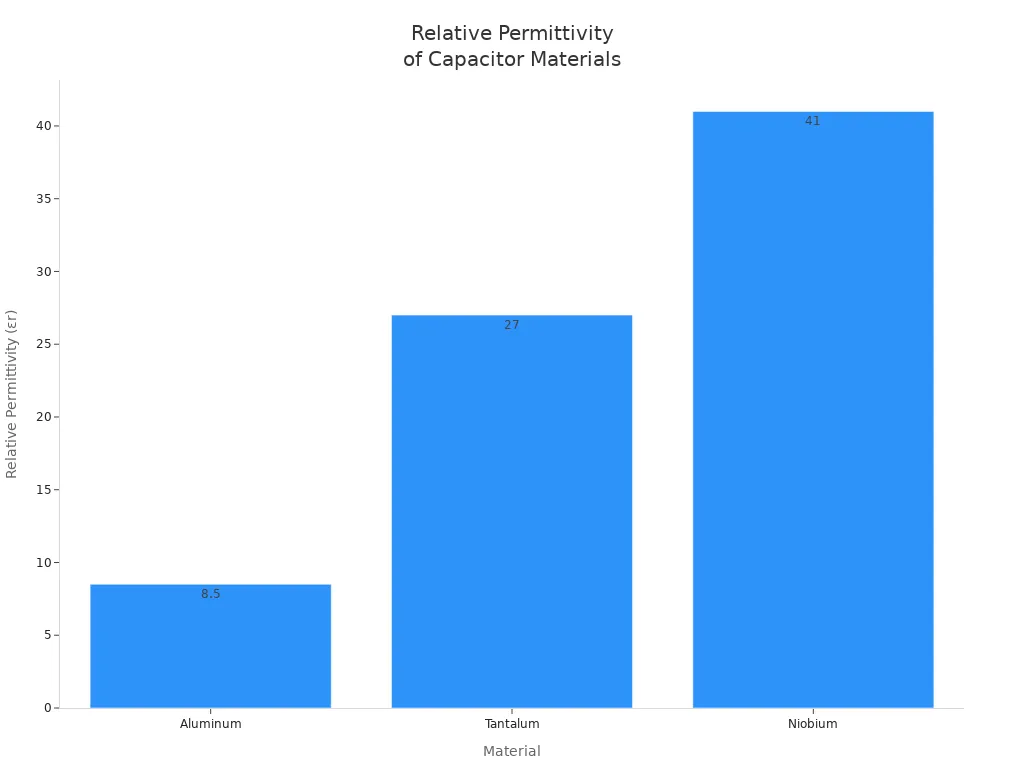
You notice that the dielectric layer in electrolytic capacitors is very thin. This thin layer lets you get high capacitance in a small size. Unlike other capacitors, you must connect electrolytic capacitors with the correct polarity. If you reverse the connection, the capacitor can fail.
- Electrolytic capacitors use metal foil as the anode and an oxide film as the dielectric.
- The thin dielectric layer allows for high capacitance in a compact form.
- You must connect them with the correct polarity.
How Electrolytic Capacitors Work
You use electrolytic capacitors because they can store a lot of energy. The secret lies in how they work. When you apply voltage, ions from the electrolyte move toward the oxide layer. This creates a double layer of charge. The thin distance between these layers gives you high capacitance.
Here is how the process works:
- Manufacturers etch the aluminum foils to increase surface area.
- They grow a thin layer of aluminum oxide on the anode foil.
- The electrolyte touches the oxide layer and acts as the second electrode.
This structure lets you pack a lot of capacitance into a small space. The electrolyte plays a key role by forming the second electrode and helping the capacitor recharge quickly. You find that this design makes electrolytic capacitors perfect for circuits that need high energy storage and fast response.
Electrolytic Capacitor Functionality
Energy Storage
You often use electrolytic capacitors as energy reservoirs in electronic circuits. When your circuit needs a sudden burst of current, these capacitors step in and supply it instantly. This action helps stabilize current and prevents voltage drops that could harm sensitive components. The electrolyte inside the capacitor allows it to store a large amount of energy in a small space.
Here is a table showing the typical capacitance range for electrolytic capacitors used in power supply circuits:
| Type of Capacitor | Typical Capacitance Range |
|---|---|
| Electrolytic | 1µF to 100,000µF |
You can see that electrolytic capacitors offer much higher capacitance than many other types. This high capacitance means they can store more energy and release it quickly when your circuit demands it. You rely on this energy storage to manage current spikes and keep your devices running smoothly.
- Electrolytic capacitors act as local energy reservoirs.
- They supply instantaneous current during transient conditions.
- These capacitors help stabilize voltage supplies for sensitive integrated circuits.
Voltage Smoothing
You use electrolytic capacitors to smooth out voltage fluctuations in power supply circuits. When you convert AC power to DC, the output often has ripples or small changes in voltage. These ripples can cause problems for your electronic devices. By adding an electrolytic capacitor, you reduce these voltage fluctuations and create a more stable DC output.
The ripple voltage in a circuit is inversely proportional to the capacitance. This means that when you increase the capacitance, the ripple voltage decreases. Larger electrolytic capacitors can suppress voltage ripple more effectively, which improves voltage regulation and circuit performance.
Tip: If you want to improve smoothing voltage in your circuit, choose an electrolytic capacitor with higher capacitance.
You often find these capacitors in power supply filters, where they keep the output voltage steady and protect your devices from sudden changes.
Noise Filtering
You also use electrolytic capacitors as filtering devices to filter out noise in electronic circuits. They help remove unwanted signals and high-frequency noise that can interfere with your devices. In power supply and DC link circuits, these capacitors act as decoupling components. They provide local energy storage and help maintain a clean voltage supply.
However, you should know that electrolytic capacitors have higher equivalent series resistance (ESR) and inductance compared to ceramic or film capacitors. This means they are less effective at filtering out high-frequency noise. For high-frequency signal filtering, you might choose ceramic capacitors instead. Still, electrolytic capacitors work well for low-frequency noise and general power supply filtering.
- Electrolytic capacitors have a large capacitance-to-volume ratio.
- Higher ESR can increase high-frequency noise across the capacitor.
- You use them mainly for low-frequency noise filtering and voltage smoothing.
You depend on electrolytic capacitors to filter out noise, stabilize voltage, and improve overall circuit performance. Their unique combination of high capacitance and energy storage makes them essential for voltage regulation and reliable operation in many electronic devices.
Comparing Capacitors
Electrolytic vs. Ceramic Capacitors
You often choose between electrolytic capacitors and ceramic capacitors for your projects. Both types have strengths and weaknesses. Electrolytic capacitors give you high capacitance in a small size. Ceramic capacitors work better at high frequencies and high voltages. You can see the differences in the table below:
| Capacitor Type | Capacitance Characteristics | Performance Under Voltage | Other Properties |
|---|---|---|---|
| Electrolytic | High capacitance in small size | Poor performance under high voltage | Prone to failure, polarizing issues |
| Ceramic | Capacitance drops with bias voltage | Better performance at high frequencies | Low ESL and ESR, can vibrate or act as microphones |
You notice that ceramic capacitors handle high voltages and temperatures better. Electrolytic capacitors need you to watch the polarity. Ceramic capacitors do not have this issue.
Tip: Use ceramic capacitors for high-frequency circuits and high-voltage needs. Choose electrolytic capacitors when you need high capacitance and low cost.
Electrolytic vs. Film Capacitors
You also compare electrolytic capacitors with film capacitors. Film capacitors last longer and work well in tough conditions. Electrolytic capacitors have a shorter lifespan, especially at high temperatures. Here are some facts:
- Electrolytic capacitors usually last about 10 years.
- Film capacitors, like the MKP1848, can last up to 100,000 hours at 70°C.
- Rubycon BXC series wet electrolytic capacitor is rated for 12,000 hours at 105°C.
- Film capacitors do not need you to worry about polarity.
- Film capacitors work well in audio crossovers, A/D converters, pulsed lasers, and power electronic devices.
Film capacitors give you stable electrical parameters and low energy loss. You use them for precision and reliability. Electrolytic capacitors work best when you need high capacitance and low cost.
Unique Benefits of Electrolytic Capacitors
You get several unique benefits when you use an electrolytic capacitor:
- High nominal capacitance lets you store more energy.
- Low cost makes your projects affordable.
- Good stability helps your circuits run smoothly.
- Long lifespan if you avoid high temperatures and voltages.
- Ability to handle large currents for power supply circuits.
Despite these benefits, you should know the limitations. Electrolytic capacitors have poor load capacity and reliability. You need an external DC power supply during use. They do not work well for high voltage or high current conditions. You should avoid using them in circuits that need high-frequency filtering or very stable performance.
Note: Always check the requirements of your circuit before choosing a capacitor. Sometimes, ceramic or film capacitors fit your needs better.
Applications of Electrolytic Capacitors
Power Supply Circuits
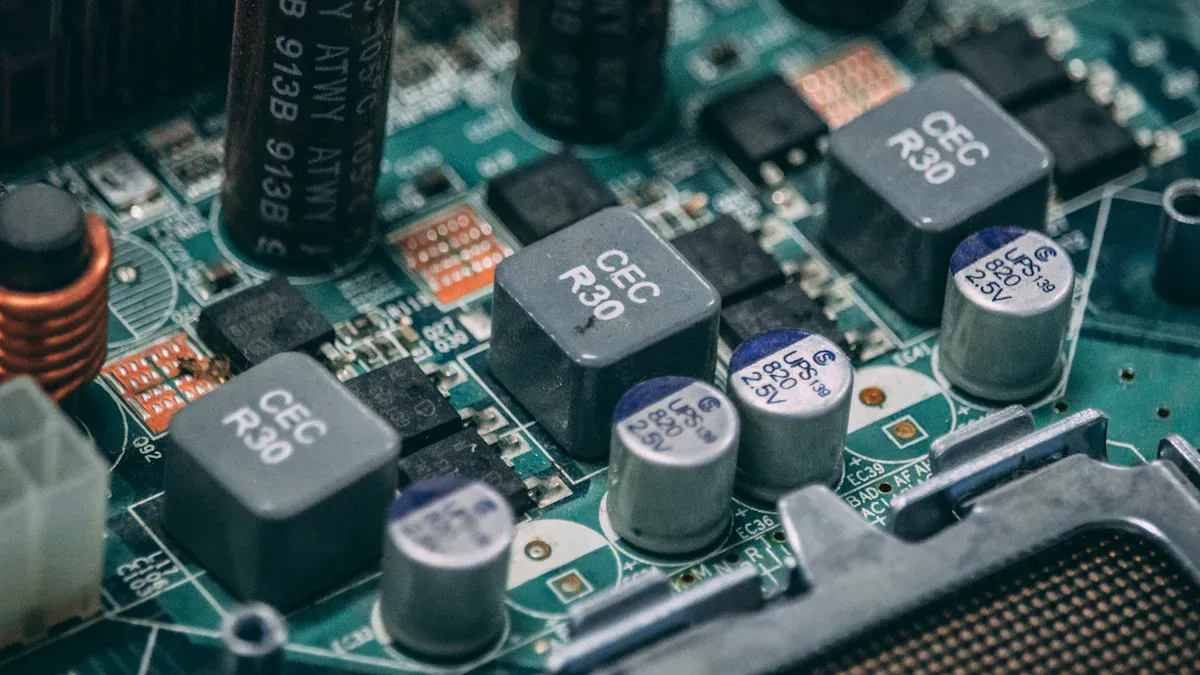
You see electrolytic capacitors in almost every power supply circuit. These capacitors help you regulate and stabilize power delivery to sensitive components. When you use an electrolytic capacitor, you get high capacitance and low equivalent series resistance. This combination improves performance and helps your devices last longer. The reliability of your power supply often depends on the quality of the electrolytic capacitors you choose. Temperature and ripple current can affect how long these capacitors work. If you want your circuit to run smoothly, you need to pick the right capacitor for your design.
- Electrolytic capacitors determine the service life of power supply circuits.
- They enhance performance by providing high capacitance and low ESR.
- These capacitors are the only parts in power supplies that wear out over time.
Filtering and Decoupling
You use electrolytic capacitors to filter and decouple signals in electronic circuits. These capacitors act as energy reservoirs, preventing quick voltage changes that could harm your devices. When you add a decoupling capacitor, you keep your circuit stable and protect sensitive parts. Bypass capacitors absorb AC noise, giving you a cleaner DC signal. Aluminium electrolytic capacitors work well in low-frequency and medium-frequency circuits because they offer a high capacitance-to-volume ratio and cost less. For high-frequency circuits, you might use ceramic capacitors instead. Tantalum capacitors give you more stability in critical applications.
- Decoupling capacitors prevent voltage spikes.
- Bypass capacitors absorb unwanted noise.
- Aluminium electrolytic capacitors are common in low and medium-frequency circuits.
Tip: Choose the right type of capacitor for your circuit to improve stability and reduce noise.
Consumer Electronics
You find electrolytic capacitors in many consumer electronics. These capacitors help your smartphone, laptop, television, and gaming console run smoothly. In audio equipment, electrolytic capacitors store and release energy to keep sound quality consistent. LED lighting systems use these capacitors to maintain stable current and brightness. Medical devices rely on them for stable power. You depend on electrolytic capacitors for noise suppression and voltage smoothing in audio and communication equipment. They remove hums and background noise, making sound clearer. In communication systems, they filter interference and help you get reliable signals.
- Smartphones, laptops, and televisions use aluminium electrolytic capacitors for power supply smoothing and energy storage.
- Audio equipment uses these capacitors to improve sound clarity.
- LED lighting and medical devices depend on them for stable operation.
You see electrolytic capacitors everywhere because they offer high capacitance, low cost, and reliable performance in electronic circuits.
You rely on the electrolytic capacitor for high-volume energy storage and signal conditioning in electronic circuits. This capacitor offers improved capacitance in a compact size, making it ideal for power supply smoothing and audio amplification.
- Electrolytic capacitors help you manage voltage gaps and current spikes.
- You benefit from their cost-effectiveness, which supports large-scale manufacturing.
- Engineers choose electrolytic capacitors for their versatility and reliability.
When you design or troubleshoot a circuit, you should always consider the operating lifespan, voltage rating, and thermal properties of each capacitor. Advancements in electrolytic technology continue to improve energy density and performance, shaping the future of electronics.
FAQ
What happens if you connect an electrolytic capacitor with the wrong polarity?
If you reverse the polarity, the capacitor can fail or even explode. Always check the markings before you connect it.
Tip: The longer lead is usually the positive terminal.
Can you use electrolytic capacitors for high-frequency filtering?
You should not use electrolytic capacitors for high-frequency filtering. Their higher ESR and inductance make them less effective. Ceramic capacitors work better for these applications.
How do you know when an electrolytic capacitor needs replacing?
Look for bulging, leaking, or a drop in performance. You may notice unstable voltage or noise in your circuit.
- Common signs:
- Swollen case
- Leaking fluid
- Unusual sounds
Are all electrolytic capacitors polarized?
Yes, almost all electrolytic capacitors are polarized. You must connect them correctly. Non-polarized types exist, but you rarely see them in most circuits.
What is the main advantage of using electrolytic capacitors in power supplies?
You get high capacitance in a small size. This helps you smooth voltage and store energy efficiently.
Note: Electrolytic capacitors keep your devices running smoothly by managing current spikes.