Understanding Different Modulator Types
Modulation is a foundational process in communication. It encodes information onto a carrier signal by altering the signal's amplitude, frequency, or phase. The various techniques for this modulation are broadly classified into two main types: analog and digital.
The global market for RF modulator devices, valued at over USD 1.2 billion in 2023, highlights the importance of these transmission techniques.
Analog modulation handles a continuous analog signal, while digital modulation processes discrete digital data. The complete communication cycle involves both modulation and demodulation. Demodulation recovers the original information from the modulated signals. Understanding these types of modulation, including amplitude modulation, frequency modulation, and phase modulation, is essential.
Key Takeaways
- Modulation changes a signal to send information. It uses analog or digital methods.
- Analog modulation changes a signal's strength, frequency, or phase. AM, FM, and PM are examples.
- Digital modulation sends data as 0s and 1s. ASK, FSK, PSK, and QAM are common types.
- FM radio sounds clear because it ignores noise. QAM sends data very fast for Wi-Fi and 5G.
- Choosing a modulation type depends on speed, noise, and cost. Each type has its own best use.
Key Types of Modulation: Analog
Analog modulation is a group of techniques used to encode information from a continuous analog signal onto a carrier wave. This process is essential for broadcasting audio and other real-world information. The three primary types of analog modulation are amplitude, frequency, and phase modulation. Each method alters a different property of the carrier signal to carry the message. These types of analog modulation form the basis for many communication systems we use daily.
Amplitude Modulation (AM)
Amplitude modulation (AM) is one of the oldest and simplest types of modulation. This technique works by varying the amplitude (strength) of the carrier signal in direct proportion to the message signal. The frequency and phase of the carrier wave remain constant. The process of modulation and demodulation in AM is relatively straightforward, making it a cost-effective choice for certain applications.
The mathematical relationship in amplitude modulation is defined by the formula s(t)=[Ac+m(t)]cos(2πfct). Here, the final modulated signal s(t) is a combination of the carrier amplitude Ac and the message signal m(t).
Fun Fact 📻: The most common use of amplitude modulation is in AM radio broadcasting. Its ability to travel long distances makes it ideal for talk radio and news stations.
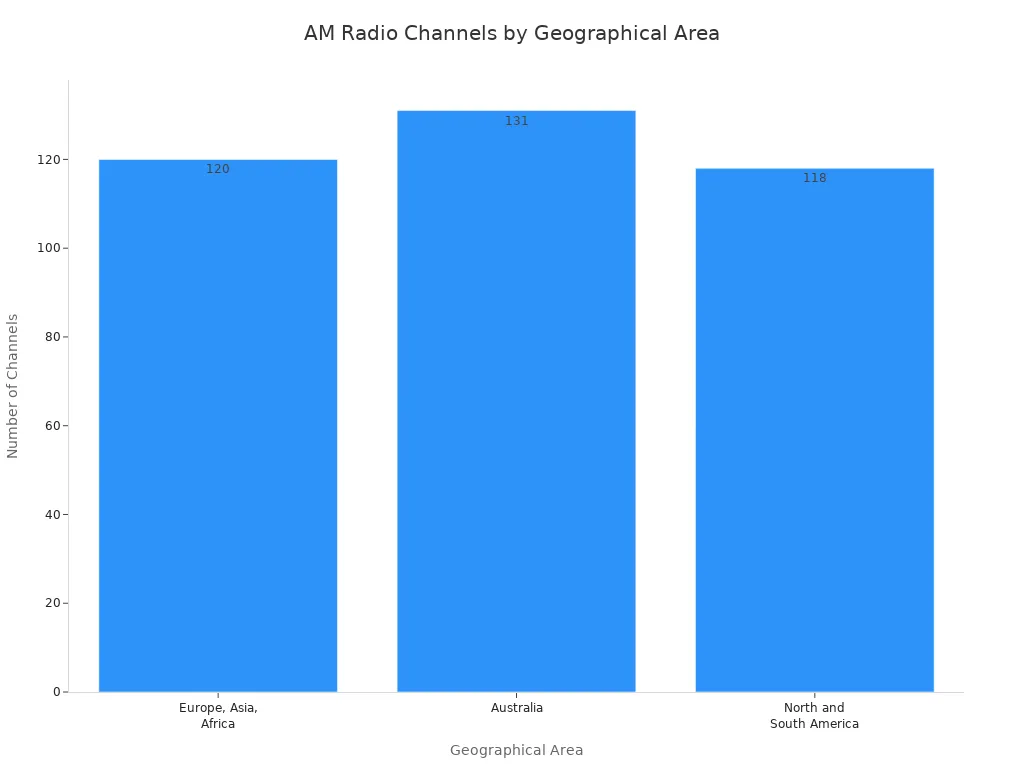
Different regions around the world allocate specific frequency bands for commercial AM radio transmission. The spacing between channels varies, which determines the total number of available channels.
| Area | kHz (centre/carrier frequency) | Spacing | Channels |
|---|---|---|---|
| Europe, Asia, Africa | 531–1602 kHz | 9 kHz | 120 |
| Australia | 531–1701 kHz | 9 kHz | 131 |
| North and South America | 530–1700 kHz | 10 kHz | 118 |
Frequency Modulation (FM)
Frequency modulation (FM) takes a different approach. Instead of changing the amplitude, this modulation technique varies the frequency of the carrier signal according to the message signal. The amplitude of the carrier remains constant. This method provides higher fidelity and greater resistance to noise compared to AM, which is why it is preferred for music broadcasting.
The behavior of an FM signal can be described with a few key equations:
- The instantaneous frequency of the modulated signals is
F(t) = F_c + K_f . m(t), showing how the messagem(t)directly changes the carrier frequencyF_c. - The general form of an FM wave is
s(t) = A_c cos(2πf_c t + 2πk_f ∫_0^t m(τ)dτ).
While FM radio is its most famous application, frequency modulation is used in many other systems. Its high-quality signal transmission makes it valuable for various types of communication. Some other uses include:
- Two-way radio systems, like those in taxis and handheld transceivers.
- Telemetry for monitoring seismic activity.
- Medical monitoring of newborns using EEG.
- Storing audio information on magnetic tapes for VCRs.
- Continuous-wave (CW) radars for detecting close-range targets.
Phase Modulation (PM)
Phase modulation (PM) involves changing the phase, or the starting angle, of the carrier signal to encode the information. In analog communication, PM is closely related to frequency modulation. However, its true power is unlocked in the world of digital communication. Phase modulation serves as a foundational concept for many advanced digital modulation techniques.
PM is the basis for a digital modulation method called Phase-Shift Keying (PSK). In PSK, a modulator assigns a unique phase to a specific pattern of binary data (0s and 1s). The receiver performs demodulation by detecting the phase of the incoming signal and mapping it back to the original data. This allows for efficient data transmission.
Key implementations of this concept include:
- Binary Phase Shift Keying (BPSK): Uses two phase states (e.g., 0° and 180°) to represent a single bit (0 or 1).
- Quadrature Phase Shift Keying (QPSK): Uses four phase states (e.g., 0°, 90°, 180°, 270°) to represent two bits per symbol, doubling the data rate of BPSK.
These RF modulation types show how a simple analog concept can be adapted to create powerful digital techniques. The evolution from analog PM to digital PSK is a perfect example of how engineers build upon foundational ideas to improve communication technology.
Common Digital Modulation Techniques
Digital modulation techniques encode discrete data, such as binary 0s and 1s, onto a carrier signal. These methods are the backbone of modern digital communication, from Wi-Fi to 5G. Unlike analog modulation, which handles continuous signals, digital modulation uses a finite number of states to represent information. This approach allows for greater data capacity and more precise results.
The fundamental differences between analog and digital modulation are important. The following table highlights these key distinctions.
| Characteristic | Analog Modulation | Digital Modulation |
|---|---|---|
| Definition | A continuous signal that can change over time. | A discrete signal carrying binary information. |
| Waveform | Follows a sine wave. | Employs a square wave. |
| Signal Distinction | Signals are difficult to separate. | Signals can be easily separated. |
| Data Capacity | Lower data capacity. | Greater data capacity. |
| Noise/Interference | Less susceptible to noise and interference. | More susceptible to noise and interference. |
| Precision | Less precise results. | More precise results. |
Understanding these types of digital modulation is key to appreciating how our devices transmit data. The most common digital modulation techniques include ASK, FSK, PSK, and QAM.
Amplitude Shift Keying (ASK)
Amplitude Shift Keying (ASK) is a type of digital modulation that represents data using different amplitude levels. The frequency and phase of the carrier signal remain constant during this process. Each amplitude level corresponds to a specific pattern of binary digits. This makes ASK one of the simpler types of modulation.
The most basic form of ASK is On-Off Keying (OOK). This method works like a light switch. The presence of a carrier wave at a set amplitude represents a binary '1'. The absence of the signal represents a binary '0'.
More advanced ASK techniques use multiple amplitude levels to send more data. For example, a system with four amplitude levels can represent two bits with each shift (e.g., '00', '01', '10', '11'). This increases the efficiency of the data transmission. Due to its simplicity, ASK is used in many low-power and cost-effective applications.
- Infrared (IR) Communications: Many remote controls for consumer electronics use ASK for sending commands.
- Radio Frequency Identification (RFID): ASK modulation and demodulation are common in RFID tags for short-range communication.
- Optical Communications: This modulation is used in some fiber-optic systems because it is simple and inexpensive.
Frequency Shift Keying (FSK)
Frequency Shift Keying (FSK) is a digital modulation technique that encodes data by changing the frequency of the carrier signal. The amplitude remains constant. In its simplest form, binary FSK uses two distinct frequencies. One frequency, the "mark frequency," represents a binary '1'. The other frequency, the "space frequency," represents a binary '0'.
An FSK modulator generates the signal based on the incoming binary data.
- The modulator contains two oscillators. One produces the mark frequency, and the other produces the space frequency.
- A switching circuit selects which oscillator's output to transmit based on the input bit.
- The receiver performs demodulation by detecting these frequency changes to reconstruct the original data.
FSK is known for its reliability in noisy environments. It has been used in various communication systems for decades.
Historical and Current Uses 📞: FSK was essential for early computer modems and mechanical teleprinters. Today, it is still used for low-bandwidth applications that require high reliability, such as caller ID, utility metering, and paging systems.
Phase Shift Keying (PSK)
Phase Shift Keying (PSK) is a robust digital modulation method that encodes data by altering the phase of the carrier signal. This technique is highly resistant to noise and interference. In PSK, each phase shift corresponds to a specific binary pattern. For example, a 0° phase might represent a binary '1', while a 180° phase shift represents a binary '0'.
There are several types of PSK, each offering different trade-offs between data rate and complexity.
- Binary Phase Shift Keying (BPSK): This is the simplest form of PSK. It uses two phase states (0° and 180°) to transmit one bit per symbol. BPSK is very robust and works well in low-power applications like Bluetooth.
- Quadrature Phase Shift Keying (QPSK): This technique uses four phase states (e.g., 0°, 90°, 180°, 270°). It can transmit two bits per symbol. QPSK effectively doubles the data rate of BPSK without needing more bandwidth.
PSK is one of the most important RF modulation types for wireless communication. For instance, the popular 802.11b Wi-Fi standard uses both BPSK and QPSK modulation techniques to manage data transmission.
Quadrature Amplitude Modulation (QAM)
Quadrature Amplitude Modulation (QAM) is a highly efficient digital modulation technique. It combines the principles of both ASK (amplitude modulation) and PSK (phase modulation) to send more data. QAM works by modulating two separate carrier signals that are 90 degrees out of phase with each other. These are known as the in-phase (I) and quadrature (Q) carriers.
The modulator combines these two amplitude-modulated signals into a single channel. This process creates a signal with variations in both its amplitude and phase. By using both dimensions, QAM achieves very high spectral efficiency, allowing many bits to be transmitted per symbol. This makes QAM one of the most powerful digital modulation techniques for high-speed communication.
Powering Modern Networks 📶: QAM is essential for modern high-speed data services. Different levels of QAM exist, with higher levels offering faster data rates.
- Cable Modems: Use 16-QAM, 64-QAM, and 256-QAM for high-speed internet.
- 5G Networks: Support QPSK, 16-QAM, 64-QAM, and 256-QAM to deliver ultra-fast mobile broadband.
The choice of QAM level depends on the quality of the RF signal. Higher-order QAM requires a cleaner signal to avoid errors during demodulation.
Comparing RF Modulation Types
Choosing the right modulation technique depends on the specific needs of a communication system. Different RF modulation types offer unique advantages in how they handle the signal, resist noise, and balance performance with complexity. Understanding these comparisons is key to appreciating why certain techniques are used for specific applications.
Signal and Information
In RF modulation, a signal is the information encoded onto a carrier wave. This process allows a low-frequency message, like voice or digital data, to travel long distances on a high-frequency carrier. The modulation impresses the information onto the carrier by changing its amplitude, frequency, or phase.
Digital modulation techniques are often compared by their bandwidth efficiency, which measures how many bits are sent per hertz of bandwidth. This is also called spectral efficiency.
- Higher-order modulation schemes like 16-QAM can transmit more bits per symbol (e.g., 4 bits), achieving higher spectral efficiency.
- Simpler types of modulation like BPSK transmit fewer bits per symbol (e.g., 1 bit).
- The use of error correction can reduce spectral efficiency but improves the reliability of the transmission.
Noise Resistance and Fidelity
Noise and interference can corrupt a signal during transmission, leading to errors in demodulation. The ability of a modulation scheme to resist noise is crucial for reliable communication.
Frequency modulation (FM) offers excellent noise resistance compared to amplitude modulation (AM). Most natural and man-made RF noise affects a signal's amplitude. Since FM receivers focus only on frequency changes, they can ignore most amplitude-based noise, resulting in a cleaner output.
Many digital modulation techniques also provide strong performance in noisy environments. For example, Phase Shift Keying (PSK) is very robust because phase changes are less affected by common types of interference than amplitude changes are. This makes digital modulation a reliable choice for data transmission.
Choosing the Right Modulator
Selecting the best modulator involves balancing several competing factors. There is no single "best" type of modulation for every situation. Engineers must consider the specific requirements of the RF system.
Key factors include:
- Data Rate: How much information needs to be sent per second.
- Bandwidth: The amount of spectrum available for the transmission.
- Power: The energy consumption of the transmitter and receiver.
- Complexity: The difficulty and cost of building the hardware for modulation and demodulation.
Higher-order digital modulation, such as 256-QAM, provides very high data rates but requires a strong, clean signal and more complex, power-hungry hardware. In contrast, simpler analog modulation or lower-order digital types are less efficient but are cheaper, use less power, and work well over noisy channels.
Modulation is a vital process for all communication. It encodes information onto a signal for transmission, whether the data is analog or digital. The choice between different types of modulation depends on the application's needs for data speed, noise resistance, and efficiency.
- Quadrature Amplitude Modulation (QAM) leads in broadband systems like 5G.
- Phase-Shift Keying (PSK) is common in wireless communications and satellite links.
- Frequency modulation remains dominant for its quality in audio broadcasting.
- Amplitude modulation is simple and still used in some legacy systems.
These invisible modulation techniques power our modern world. Researchers are now developing new RF modulation types for future 6G wireless communication systems.
FAQ
What is the main difference between analog and digital modulation?
Analog modulation encodes continuous signals, like a human voice. Digital modulation encodes discrete data, like binary 0s and 1s. This difference makes digital methods better suited for computer data and modern communication systems.
Why is FM radio clearer than AM radio? 📻
FM radio provides better sound quality because it resists noise. Most interference affects a signal's amplitude. FM receivers only detect frequency changes, so they can ignore most amplitude-based noise, resulting in a cleaner audio signal.
Which modulation is used for Wi-Fi?
Wi-Fi systems use several digital modulation types. Common standards like 802.11b use Phase Shift Keying (PSK). Newer, faster standards often use Quadrature Amplitude Modulation (QAM) to achieve higher data speeds for streaming and downloads.
What makes QAM so fast?
QAM achieves high speeds by combining two modulation methods. It changes both the amplitude and the phase of the carrier signal. This technique allows it to pack more data into each symbol, significantly increasing the overall data rate.