Current Division Rule Made Easy for Electrical Engineering Students

You can use the current division rule to quickly find out how much current flows through each branch in parallel circuits. This rule helps you solve problems without doing long calculations. Many engineers use current division in real-world circuits, such as LED lights and battery chargers. When you understand how current splits in parallel circuits, you can design and fix electrical systems with confidence. You will see that current division makes circuit analysis much easier.
Key Takeaways
- The current division rule helps you quickly find how current splits in parallel circuits without long calculations.
- Use the rule only when resistors are connected in parallel, as the voltage across each branch stays the same.
- The branch with lower resistance carries more current, following Ohm’s Law and Kirchhoff’s Current Law.
- Follow clear steps: check parallel branches, find total current, calculate total resistance, apply the formula, and verify your results.
- This rule saves time, reduces mistakes, and is useful in real-world circuits like LED arrays, sensors, and power supplies.
Current Division Rule
Definition
You use the current division rule to find out how current splits between different branches in a parallel circuit. This rule gives you a simple formula to calculate the current in each branch without long calculations. The current divider rule works because the voltage across each branch in parallel circuits stays the same. You can use the formula:
Ix = (Rtotal / Rx) × Itotal
Here, Ix is the current through the branch you want to find, Rx is the resistance of that branch, Rtotal is the total resistance of all parallel branches, and Itotal is the total current entering the parallel network. The current divider rule follows Ohm’s Law and Kirchhoff’s Current Law. These laws state that the total current entering a node splits among the branches so that the sum of branch currents equals the total current.
When to Use
You should use the current divider rule when you see parallel resistors in a circuit. The rule helps you quickly find out how much current flows through each resistor. The current divider rule applies only to parallel circuits with linear components that follow Ohm’s Law. You will often use this rule in circuits where you need to control or measure current, such as in current divider circuits for sensors, power supplies, or electric meters. Textbooks often introduce the current divider rule in chapters about parallel circuits, making it a key topic in electrical engineering courses.
Tip: Always check if the resistors are in parallel before using the current divider rule.
Why It Matters
The current divider rule makes your work much easier. You do not need to calculate equivalent resistances or voltages step by step. Instead, you use a direct formula to get the answer. This saves time and reduces mistakes. The current divider rule helps you:
- Simplify calculations in circuits with parallel branches.
- Analyze complex networks more easily.
- Understand how current splits in a circuit.
You will find the current divider rule essential in real-world applications, such as setting the operating point for transistors, distributing current safely in power supplies, and designing reliable electronic systems. Using the current divider rule gives you a clear and fast way to solve problems in parallel circuits.
Current Division in Circuits

Principle
You can understand the current divider rule by looking at what happens in parallel circuits. When you connect resistors in parallel, the voltage across each branch stays the same. The current splits at the nodes where the branches meet. The amount of current in each branch depends on the resistance. If a branch has lower resistance, it lets more current flow. If a branch has higher resistance, it lets less current flow. This happens because of Ohm’s Law, which says current equals voltage divided by resistance. The total current entering a node always equals the total current leaving it. This is like water splitting into different pipes—wider pipes (lower resistance) carry more water (current). The current division in parallel circuits follows this physical principle.
Identifying Parallel Paths
You need to spot parallel branches to use the current divider rule. In a circuit diagram, look for components that connect across the same two points or nodes. If you see wires branching off from one node and reconnecting at another, those branches are in parallel. Each branch shares the same voltage. You can also look for nodes where wires split and then join again. If components are connected end-to-end, they are in series, not parallel. Sometimes, circuit diagrams use net names to show connections, even if the wires do not touch. Always check for these visual cues before applying the current divider.
Tip: In complex circuits, highlight the nodes and trace the paths between them to find all parallel branches.
Key Terms
- Total current: This is the sum of all the currents flowing through each branch in the parallel network. The total current enters the parallel section and splits among the branches.
- Branch current: This is the current flowing through a single branch or resistor. The branch current depends on the resistance of that branch. Lower resistance means higher branch current.
- Total resistance: In parallel circuits, you find the total resistance by taking the reciprocal of the sum of the reciprocals of each branch resistance. The total resistance is always less than the smallest branch resistance.
You use these terms when working with the current divider rule. Knowing them helps you solve problems and understand how current division works in real circuits.
Applying the Rule

Formula Steps
You can solve parallel circuits quickly by following a clear process. The current divider rule gives you a shortcut to find the current in each branch. Here are the steps you should use:
-
Check the Circuit
Make sure the resistors connect in parallel. Each branch must have the same voltage across it. -
Find Total Current
Measure or calculate the total current entering the parallel section. You can use Ohm’s Law if you know the total voltage and equivalent resistance. -
Calculate Equivalent Resistance
Use the formula for parallel resistors:1/R_total = 1/R1 + 1/R2 + 1/R3 + ...Then, find R_total.
-
Apply the Current Divider Rule
For each branch, use the formula:Ix = (R_total / Rx) × I_totalOr, if you have only two resistors:
I1 = I_total × (R2 / (R1 + R2)) I2 = I_total × (R1 / (R1 + R2)) -
Repeat for Each Branch
Calculate the current for every branch in the parallel network. -
Check Your Work
Add up all the branch currents. The sum should equal the total current entering the circuit. This step confirms you used the current divider rule correctly.
Tip: Lower resistance branches always carry more current. This matches the principle behind the current division.
Example
Let’s look at a real example. You have two resistors in parallel: R1 = 2Ω and R2 = 4Ω. The total current entering the parallel section is 10A. You want to find the current through each resistor.
| Step | Calculation | Result |
|---|---|---|
| 1. Check parallel | Both resistors connect across the same two points | Yes |
| 2. Total current | Given | 10A |
| 3. Equivalent resistance | 1/R_total = 1/2 + 1/4 = 0.5 + 0.25 = 0.75 → R_total = 1/0.75 | R_total = 1.33Ω |
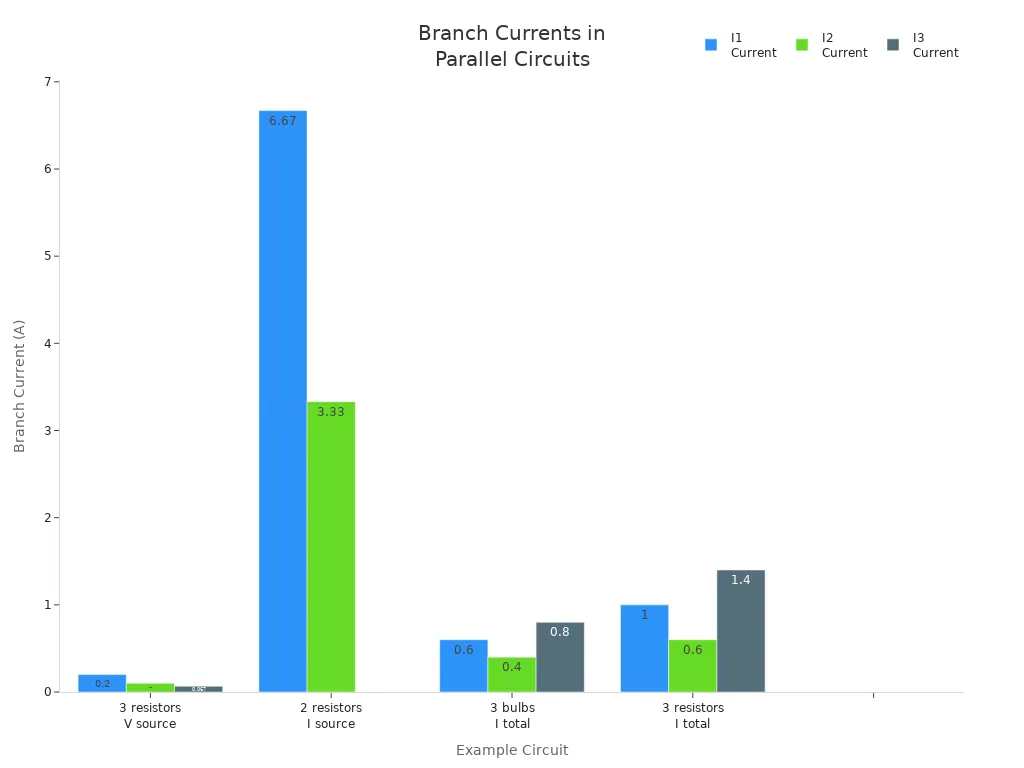
| 4. Current through R1 | I1 = 10 × (4 / (2 + 4)) | I1 = 6.67A |
| 5. Current through R2 | I2 = 10 × (2 / (2 + 4)) | I2 = 3.33A |
| 6. Check sum | I1 + I2 = 6.67A + 3.33A | 10A |
You can see that the branch with lower resistance (R1) carries more current. The sum of the branch currents matches the total current. This confirms you used the current divider rule correctly.
Here is another example with three resistors in parallel:
| Example Description | Circuit Parameters | Calculations | Results |
|---|---|---|---|
| Three resistors in parallel with total current | R1=2Ω, R2=4Ω, R3=6Ω, It=3A | I1=(43)/(2+4+6)=1A; I2=(23)/(2+4+6)=0.6A; I3=(6*3)/(2+4+6)=1.4A | I1=1A, I2=0.6A, I3=1.4A |
You can compare branch currents for different circuits in the chart below:
Note: The current divider rule gives you the same results as more complex methods like Kirchhoff’s Current Law, but much faster for parallel circuits.
Practical Uses
You will find current dividers in many real-world circuits. Here are some common uses:
- You can adjust LED brightness by splitting current between different LED branches. This helps you set the right brightness for each LED in an array.
- You can control current in sensors, such as thermistors or photodetectors. This ensures you get accurate temperature or light readings.
- Battery management systems in electric vehicles use current dividers to send the right amount of current to each battery cell. This prevents overcharging and keeps the system safe.
- You can use a current divider circuit to set the bias current for transistors in amplifiers or microprocessors.
- Measurement devices often use current dividers with shunt resistors. This lets you measure high currents without damaging your meter.
- Power distribution networks use current division to balance loads and reduce energy loss.
- Telecommunications systems use current division to manage current in transmission lines. This keeps signals strong over long distances.
Tip: When you design or troubleshoot circuits, look for places where current splits. Using the current divider rule saves you time and helps you avoid mistakes.
Tips and Mistakes
Common Errors
You might run into some common mistakes when you use the current division rule. Watch out for these:
- Mixing up series and parallel circuits. Sometimes, you may use the formula for series circuits instead of the one for parallel circuits.
- Forgetting to include all branches or components when you apply Kirchhoff’s Laws. This can lead to wrong answers.
- Confusing the current division rule with voltage division. Each rule works for different situations, so make sure you use the right one.
Always double-check your circuit type before you start your calculations.
Pro Tips
You can improve your accuracy and speed with a few helpful strategies:
- Use conductance (G = 1/R) to remember the formula more easily. This method makes the calculation similar to other circuit rules.
- Remember that the branch with the smallest resistance carries the most current. This quick check helps you avoid mistakes.
- Test your understanding with special cases. For example, if a branch has zero resistance, all the current flows through it.
- For two resistors, use the formulas I1 = (R2 / (R1 + R2)) × I_total and I2 = (R1 / (R1 + R2)) × I_total. These come from basic circuit laws.
- Always add up all branch currents. The total should match the current entering the parallel section.
- In complex circuits, use tools like multimeters to measure current and confirm your calculations.
- Label your circuit clearly and keep notes. Good organization helps you avoid missing any branches.
Tip: Highlight parallel paths in your circuit diagram to spot where current splits.
When Not to Use
The current division rule works best for parallel resistor circuits. You should not use it in these cases:
- Series circuits. The rule does not apply because current stays the same in all series components.
- Circuits with only one path for current. There is no division, so the rule is not needed.
- Circuits with inductors or capacitors, unless you use impedance instead of resistance. Inductors and capacitors change their behavior with frequency, which makes calculations more complex.
- Real-world circuits with temperature changes or component differences. These factors can affect current and make the rule less accurate.
Note: For AC circuits with inductors or capacitors, you must use impedance and consider phase angles. The rule becomes more complex in these cases.
You now know that the current division rule helps you find how current splits in parallel circuits. Remember these key points:
- The rule works only for parallel branches.
- The voltage across each branch stays the same.
- Kirchhoff’s Current Law supports the rule.
- Practice with different circuits to build your skills.
Try using familiar tools and apps to solve problems. Always check for parallel paths before you start. When you master this rule, you make circuit analysis faster and more reliable.
FAQ
What is the difference between current division and voltage division?
Current division helps you find how current splits in parallel branches. Voltage division lets you calculate voltage across series resistors. You use current division for parallel circuits and voltage division for series circuits. Both rules make circuit analysis easier.
Can I use the current division rule in a voltage divider circuit?
You should not use the current division rule in a voltage divider. A voltage divider uses series resistors to split voltage, not current. Use the voltage division rule for these circuits. Always check if your resistors are in series or parallel.
Why does the branch with lower resistance get more current?
A branch with lower resistance allows more current to flow because it opposes the flow less. This follows Ohm’s Law. In current division, the branch with the smallest resistance always carries the largest share of the total current.
How do I check if I applied the current division rule correctly?
Add up all the branch currents after using the current division rule. The total should match the current entering the parallel section. If the numbers do not add up, review your calculations and check your circuit connections.