Crystal Oscillator Applications for Precision Timing in Electronics
You rely on crystal oscillators every time you use a smartphone, a computer, or even a digital watch. These tiny devices use a quartz crystal to create precise timing signals that keep your electronics running smoothly. Accurate timing helps synchronize signals, so you do not lose data or experience failures. Crystal oscillators use the unique properties of quartz to generate stable frequencies.
Timing devices, like a crystal oscillator, regulate operations by controlling signal timing. They are vital for applications that need precise synchronization.
| Year | Market Value (USD) | CAGR (%) |
|---|---|---|
| 2024 | 7.5 billion | 6.1 |
| 2034 | 11.2 billion |
The crystal market keeps growing, showing how important these components are in electronics today.
Key Takeaways
- Crystal oscillators are essential for precise timing in electronics, ensuring devices like smartphones and computers run smoothly.
- Different types of crystal oscillators, such as XO, TCXO, VCXO, and OCXO, serve various applications based on their stability and features.
- Temperature and humidity can affect the performance of crystal oscillators, so choosing the right type for your environment is crucial.
- Using crystal oscillators in communication systems and data centers helps maintain synchronization, reducing errors and improving efficiency.
- Understanding specifications like frequency stability and aging helps you select the best crystal oscillator for your project.
Precision Timing with Crystal Oscillators
Stable Clock Signals
You need a stable frequency to keep your electronic devices working correctly. Crystal oscillators give you this by using the unique properties of quartz. When you apply voltage to a quartz crystal, it vibrates at a precise frequency. This vibration creates a stable clock signal that controls how fast your device works. Since the 1940s, the timing industry has relied on quartz-based devices because they offer excellent frequency stability and low phase noise. These features help you achieve precise data transmission, especially in advanced systems like 5G and Wi-Fi.
Crystal oscillators stand out because they maintain their frequency even when the temperature changes. Other timing solutions, like MEMS resonators, cannot match the accuracy and temperature stability of a quartz crystal oscillator. You can see how important this is in the table below:
| Factor | Specification Example |
|---|---|
| Temperature | ±20 ppm over -40°C to 85°C |
| Supply Voltage | ±5 ppm/V over 3V to 3.6V |
| Load Capacitance | Frequency shift with different load capacitance |
| Aging | ±1 ppm/year |
This table shows how a crystal oscillator keeps its frequency stable in different conditions. You get reliable performance and precise frequency control for your electronics.
Signal Synchronization
You depend on crystal oscillators to keep signals in sync across your devices. These oscillators provide accurate clock signals that affect the speed and quality of data transmission. In communication networks, you need every part to work together at the same time. Crystal oscillators help you achieve this by offering excellent frequency stability and interference resistance.
- Crystal oscillators ensure coordinated operation of device modules, which is essential for precise data synchronization.
- In high-speed data transmission, they reduce latency and improve bandwidth use.
- They help avoid external interference, so your information stays clear and accurate.
- In IoT systems, crystal oscillators give you a unified time base, making sure all devices work together smoothly.
You get the best performance and reliability when you use a quartz crystal oscillator for signal synchronization. The stable frequency and high frequency stability make these crystals the top choice for high-performance applications.
Crystal Oscillator Basics
How Crystal Oscillators Work
You might wonder how a crystal oscillator keeps your devices running on time. The working principle of crystal oscillator relies on the mechanical resonance of a vibrating quartz crystal. When you apply an electric field to quartz, it vibrates at a specific frequency. This vibration creates an electrical signal that stays steady and accurate.
- The crystal oscillator uses the piezoelectric effect, which means quartz produces electricity when you squeeze or stretch it.
- Quartz oscillator designs use quartz because it offers excellent stability and precision.
- Unlike other oscillation circuits, such as LC circuits or relaxation oscillators, crystal oscillators provide much better accuracy.
- You find crystal oscillators in high-speed communication networks and 5G systems because they deliver stable clock signals.
- The mechanical properties of quartz make these oscillators perfect for keeping digital circuits in sync.
You get reliable timing in your electronics because the crystal keeps vibrating at the same frequency, even when conditions change.
Frequency Determination
You need to know what affects the frequency of a crystal oscillator. Several factors can change how steady the frequency stays over time. The table below shows the main things you should watch:
| Factor | Description |
|---|---|
| Temperature | Changes in temperature can cause the crystal to drift by tens of parts per million. |
| Load | Different loads can affect how stable the frequency remains. |
| Power Supply Variations | Unstable voltage can lead to incorrect frequency output. |
| Aging | The crystal’s frequency slowly changes as it gets older. |
You can use special types of crystal oscillators to control these changes. Temperature-compensated crystal oscillators (TCXOs) adjust their frequency using internal sensors. Voltage-controlled crystal oscillators (VCXOs) let you change the frequency with an outside voltage. Oven-controlled crystal oscillators (OCXOs) keep the quartz at a constant temperature to reduce drift.
Frequency stability means your oscillator keeps the same frequency over time. You measure this stability in parts per million (PPM). The crystal, the circuit, and the environment all play a role in how well your quartz oscillator performs. You get the best results when you choose the right crystal and design for your needs.
Types of Crystal Oscillators
You can choose from several types of crystal oscillators for your electronics. Each type uses a quartz crystal to create a stable frequency, but they work in different ways. You need to know how each oscillator performs before you select one for your project.
XO
You often see the basic crystal oscillator, called XO, in many devices. This type uses a quartz crystal to produce a fixed frequency. You get good stability for most consumer electronics. XOs work well in clocks, microcontrollers, and programmable crystal oscillator circuits. You do not get extra features like temperature compensation or voltage control, but you can rely on their simple design.
TCXO
You may need better stability when temperature changes. The temperature compensated crystal oscillator, or TCXO, uses sensors to adjust the frequency as the environment shifts. TCXOs use quartz and special circuits to keep the frequency steady. You find these in mobile phones, IoT devices, and GPS receivers. TCXOs offer frequency stability from ±0.05 ppm to ±5 ppm. These temperature compensated oscillators help you maintain accuracy in compact, energy-efficient systems.
VCXO
You might need to change the frequency for some applications. The voltage controlled crystal oscillator, or VCXO, lets you adjust the frequency by changing the voltage. VCXOs use quartz crystals and special circuits for this purpose. You see VCXOs in broadcast equipment, phase-locked loops, and sync systems. The frequency stability ranges from ±50 ppm to ±200 ppm, sometimes up to ±3200 ppm. VCXOs give you flexibility, but the stability is lower than other types.
OCXO
You want the highest stability for critical systems. Oven controlled crystal oscillators, or OCXO, keep the quartz crystal at a constant temperature inside a tiny oven. This design gives you exceptional frequency stability, sometimes as good as ±0.01 ppm or even 0.05 ppb. OCXOs use more power and take up more space, but you need them for satellite navigation, telecom infrastructure, and aerospace. These oscillators work best when you need ultra-high precision.
Tip: Use the table below to compare the main features of these types of crystal oscillators.
| Feature | OCXO | TCXO | VCXO |
|---|---|---|---|
| Frequency Stability | ±0.01 ppm or better | ±0.01 ppm or better | Variable, lower stability |
| Phase Noise | Low | Moderate | Moderate |
| Power Consumption | High | Low | Moderate |
| Size | Larger | Compact | Moderate |
| Temperature Performance | Exceptional (oven-controlled) | Good (temperature-compensated) | Dependent on design |
| Frequency Adjustability | Fixed, highly stable | Fixed, moderately stable | Voltage-controlled |
| Cost | High | Low | Moderate |
| Applications | Satellite, 5G, test systems | IoT, mobile, consumer devices | Broadcast, PLL, sync systems |
You see that each type of crystal oscillator fits different needs. You should match the oscillator to your application for the best results.
Crystal Oscillator Applications in Electronics
Communication Systems
You depend on crystal oscillators every time you make a phone call or send a message. These devices keep your communication networks running smoothly. Quartz oscillator modules deliver high precision in data transmission, which helps minimize errors. You get uniform service quality in telecommunications because the crystal keeps the frequency stable. Oven controlled crystal oscillators provide clean and stable clock signals, which are essential for reliable data transmission. They maintain exceptional frequency stability, reducing timing errors in high-speed systems.
- Quartz oscillators maintain signal integrity by keeping the frequency steady.
- High stability minimizes phase noise and jitter, which is critical for high-speed data communication.
- Advanced temperature compensated oscillators enhance stability, leading to better synchronization and less interference.
- OCXOs reduce jitter and provide ultra-low phase noise, ensuring fewer timing errors.
- The oven-controlled design keeps the crystal at a constant temperature, improving performance across changing conditions.
You see crystal oscillator applications in 5G networks, satellite communication, and fiber-optic systems. These are applications that reward better clocks, where reliability and precision matter most.
Data Centers
You rely on crystal oscillators to keep data centers synchronized. These centers handle huge amounts of information every second. Precise timing ensures that all nodes work together, which keeps your network running efficiently. If timing drifts, you may see increased latency and reduced efficiency. This can lead to system failures and delays in data transmission.
Crystal oscillators are essential for maintaining synchronization and optimal network performance. As data centers grow faster and more complex, you need better timing solutions to avoid problems. The choice of oscillator type, such as temperature compensated crystal oscillator or OCXO, impacts reliability and performance. You get better frequency stability and lower phase noise, which helps prevent signal degradation.
Consumer Electronics
You use crystal oscillators every day in devices like smartphones, watches, clocks, and radios. These electronics rely on the mechanical resonance of quartz to create an electrical signal with an exact frequency.
A Crystal Oscillator is an electronic oscillator circuit that uses a vibrating crystal’s mechanical resonance to create an electrical signal with an exact frequency.
This frequency can be used to keep track of time, in order to provide a clock signal for digital integrated circuits.
You find crystal oscillator modules in wristwatches, cell phones, and radios. These are real-world use of crystal oscillator modules that keep your devices accurate and reliable. Programmable crystal oscillator circuits allow manufacturers to set the frequency for different applications. You get precise timing and stable performance, which is vital for everyday electronics.
Embedded Devices
You see crystal oscillators in embedded devices like wireless sensors, wearables, and smart meters. These systems need low power consumption and high timing accuracy. Crystal oscillator modules synchronize timing and energy scheduling, which helps save power. They operate with minimal current, usually between 1-5 mA during use and less than 1 μA in standby mode. This supports long-term use in battery-powered devices.
- Fast startup times and support for deep-sleep protocols help maintain clock accuracy while optimizing power efficiency.
- Low-power crystal oscillators support seamless transitions across power states, which is vital for maintaining timing accuracy and minimizing energy use.
You get high reliability and stable frequency in embedded systems. These are applications that reward better clocks, especially when you need both precision and energy savings.
Industrial and Medical Equipment
Crystal oscillator applications extend to industrial and medical equipment. You find quartz oscillator modules in MRI machines, ultrasound equipment, pacemakers, and laboratory analyzers. These devices need high frequency stability and low phase noise for accurate operation.
| Medical Device | XO Application | Electrical Specifications |
|---|---|---|
| MRI Machines | Provide precise timing for synchronization of radiofrequency pulses and gradients | High frequency stability (±0.5 ppm), low phase noise |
| Ultrasound Equipment | Control frequency of ultrasonic transducers for accurate imaging | Frequency accuracy (±0.2 ppm), low phase noise |
| Pacemakers and Defibrillators | Regulate timing of electrical impulses to the heart | Extremely low power consumption, high stability (±0.1 ppm) |
| Portable Patient Monitoring Systems | Timing in processing and transmission of vital signs data | Low power consumption, good frequency stability (±0.5 ppm) |
| Infusion Pumps | Ensure accurate timing for controlled medication delivery | Stability (±0.5 ppm), low power consumption |
| Laboratory Analyzers | Provide timing accuracy for sensors and data processing units | High precision and stability, low phase noise |
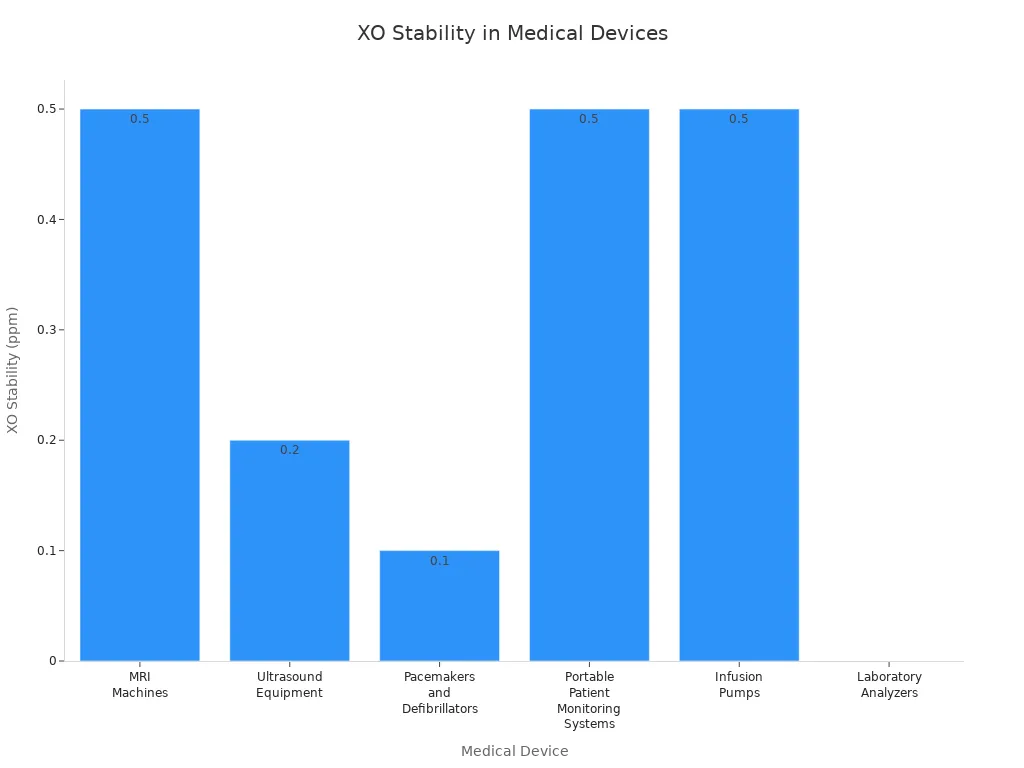
You see real-world use of crystal oscillator modules in these critical applications. The choice of types, such as XO, TCXO, and OCXO, depends on the need for frequency stability, low power, and reliability. Quartz and crystal oscillator modules help maintain performance in harsh environments and demanding conditions.
Choosing Crystal Oscillators
Selection Criteria
You need to choose the right crystal oscillator for your electronics project. The selection process involves looking at several important factors. Each factor affects how well your device keeps time and how reliable it stays over years of use.
| Criteria | Description |
|---|---|
| Frequency Range | Defines the range within which the oscillator can generate frequencies reliably. |
| Load Capacitance | Represents the total capacitance in the oscillator's circuit, impacting frequency accuracy. |
| Frequency Tolerance | Refers to the acceptable deviation from the specified frequency, crucial for performance. |
| Operating Temperature Range | Specifies the range of temperatures within which the oscillator can function effectively. |
| Aging | Refers to slight frequency drift over time, important for long-term stability applications. |
| Package Type | Different package types affect assembly processes and size constraints. |
| Drive Level | The amount of power applied to the crystal, important for preventing overheating. |
You should pay close attention to frequency tolerance. This shows how accurate the oscillator is when you first use it. Frequency temperature stability tells you how well the crystal keeps its frequency when the temperature changes. Aging rate measures how much the frequency drifts as the crystal gets older. These factors help you decide which oscillator fits your timing needs.
Tip: If you need high stability for precision time base applications, select oscillators with better frequency tolerance and aging rates. For GPS or navigation, OCXO or MCXO types work best.
Environmental Factors
You must consider the environment where your crystal oscillator will operate. Temperature and humidity can change how your oscillator performs. Temperature-induced drift affects phase noise and jitter, which can lower signal quality in high-speed systems.
| Environmental Factor | Impact on Performance |
|---|---|
| Temperature | Frequency drift due to sensitivity to changes, mitigated by TCXOs achieving accuracies of ±0.5 ppm or better. |
| Humidity | Causes frequency instability and reduced reliability, with moisture degrading performance and increasing stray capacitance. |
Humidity can cause frequency drift because water molecules affect the surface of the crystal. Increased stray capacitance leads to errors, sometimes as much as 8ppm for every 1pf. Changes in surface properties from humidity can make the frequency unstable. High humidity can speed up aging and cause internal corrosion, which lowers reliability.
- Humidity changes can lead to small frequency variations in crystal oscillators.
- It can cause frequency instability, affecting accuracy and reliability.
- High humidity environments may accelerate aging of crystal components.
- Internal corrosion can occur in wet conditions, impacting performance.
Manufacturers test crystal oscillators for harsh conditions. They use mechanical shock testing, vibration testing, temperature cycling, and drop tests. Most models survive shocks up to 10,000g, while specialist crystals can handle up to 125,000g. Environmental testing helps improve durability and longevity.
Note: Always check the operating temperature and humidity ratings before you choose a quartz oscillator for your electronics. This ensures reliable performance in your application.
Design Considerations
You need to think about oscillator circuit design when you add a crystal oscillator to your system. The key components of crystal oscillator circuits include the crystal, amplifier, and feedback loop. The amplifier type, such as transistor, op-amp, or FET, depends on the frequency you want to generate. The loop gain must equal unity, and the phase shift must meet specific conditions for the oscillator to work well.
- Crystal oscillators require an amplifier and positive feedback for operation.
- The choice of amplifier affects the frequency and stability.
- Quartz crystals are preferred for their frequency stability and temperature stability.
You should avoid common mistakes. Overspecifying components adds cost and complexity. Ignoring load capacitance can cause detuning and poor performance. Inadequate grounding and shielding can lower reliability and increase signal errors.
Tip: For high-speed serial interfaces, low timing jitter is crucial. Use SO oscillators when you need isolation from shock and vibration. Consider cost, size, and power requirements for your application.
Oscillators are more cost-effective for small production runs because they reduce engineering time. Crystals may cost less per unit but need more work to fix startup issues and EMI problems. For large volumes, MEMS oscillators help lower EMI compliance costs and reduce the need for extra shielding.
You get the best results when you match the oscillator type to your application. For precision timing, choose high-stability quartz oscillator modules. For rugged environments, select models tested for shock and vibration. Always balance performance, reliability, and cost.
You rely on crystal oscillators for precise timing in electronics. Understanding the specifications of each crystal, such as frequency stability, temperature stability, and phase noise, helps you select the best oscillator for your project. Always check datasheets and technical guides to learn about new quartz oscillator technologies.
Crystal oscillator advancements, like MEMS and integrated solutions, support miniaturization and improve reliability. Stay curious about trends in crystal design to keep your electronics performing at their best.
FAQ
What is a crystal oscillator used for?
You use a crystal oscillator to keep time in electronic devices. It helps your smartphone, computer, and watch run on schedule. The oscillator creates a stable frequency, which controls how fast your device works and keeps everything in sync.
How do you choose the right crystal oscillator?
You look at frequency stability, temperature range, and power needs. You check the datasheet for each model. You pick an oscillator that matches your device’s timing requirements and works well in your environment.
Why does temperature affect crystal oscillators?
You see changes in frequency when temperature shifts. Quartz crystals react to heat or cold. Temperature-compensated oscillators help you keep the frequency steady. You get better accuracy if you use the right type for your conditions.
Can crystal oscillators fail over time?
You may notice small changes in frequency as the crystal ages. Humidity, shock, and vibration can cause problems. You reduce risks by choosing tested models and keeping your device in safe conditions.
What is the difference between XO, TCXO, VCXO, and OCXO?
| Type | Key Feature | Best Use |
|---|---|---|
| XO | Basic stability | Everyday electronics |
| TCXO | Temp compensation | Mobile, IoT, GPS |
| VCXO | Voltage control | Broadcast, sync systems |
| OCXO | Oven control | Telecom, satellites |
Tip: You match the oscillator type to your device’s needs for best results.