How Circuit Board Components Shape Modern Electronic Technology

Circuit board components serve as the building blocks for nearly all modern electronic devices. A pcb, or printed circuit board, acts as the backbone, offering both support and connections for these components. Almost every electronic device, from smartphones to medical equipment, depends on a pcb to function. Over recent decades, the evolution of pcb technology has enabled devices to become smaller, faster, and more reliable.
The growing demand for advanced electronics, such as 5G and IoT devices, highlights how vital circuit board components remain in today’s world.
Understanding the types and roles of each component helps explain how these parts work together to power innovation.
Key Takeaways
Printed circuit boards (PCBs) form the strong base that holds and connects all electronic parts, making devices work reliably and efficiently.
Passive components like resistors and capacitors control and store energy, while active components like transistors and ICs amplify signals and process data.
Electromechanical parts such as relays and connectors help devices switch power safely and connect to other devices easily.
Sensors allow electronics to detect changes in the environment, enabling smart features and real-time responses in modern gadgets.
Choosing the right components ensures devices last longer, work better, and support innovation like smaller, faster, and more powerful electronics.
PCB Basics
What Is a PCB?
A pcb, or printed circuit board, forms the foundation of most modern electronics. It consists of several layers and materials that work together to support and connect electronic components. The core of a pcb is a solid, nonconductive substrate, often made from materials like FR-4 or polyimide. This layer provides mechanical strength and electrical insulation. Thin copper foils are laminated onto the substrate, creating the pathways for electrical signals.
A standard pcb includes several important layers:
Core: The base layer, made from a sturdy, nonconductive material.
Copper Foil: Conductive sheets that form the circuit’s traces.
Signal Plane: Layers that carry electrical signals between components.
Power Plane: Layers that distribute power across the board.
Ground Plane: Layers that act as reference points and help with heat dissipation.
Prepreg: Insulating sheets that bind layers and protect against damage.
Solder Mask: A protective coating that prevents oxidation.
Silkscreen: Markings that help identify component placement.
Manufacturers use different types of pcbs, such as rigid, flex, and rigid-flex boards. Rigid pcbs use resin and glass laminates, while flex pcbs use thin polymer films. Rigid-flex pcbs combine both types to save space and improve design.
Role in Electronics
A pcb plays a vital role in electronics by providing both mechanical support and electrical connections for components. Printed circuit boards hold parts like resistors, capacitors, and chips in place. Copper traces etched onto the board create pathways for electrical signals to travel between these parts. Vias, or metal-lined holes, allow signals to move between different layers of the pcb, making complex designs possible.
The substrate, usually fiberglass, gives the pcb its strength and keeps electrical signals from leaking. Solder masks protect the copper traces from short circuits and corrosion. Silkscreen labels help engineers place components accurately.
Components attach to the pcb using either through-hole or surface-mount technology. Through-hole mounting involves inserting leads through drilled holes and soldering them, which creates a strong bond. Surface-mount technology places components directly on the board, allowing for smaller and more compact devices.
Printed circuit boards make it possible for electronics to be reliable, compact, and efficient. They serve as the backbone for everything from simple gadgets to advanced computers.
Common Circuit Board Components
Modern electronic devices rely on a wide range of circuit board components. These parts work together to control, process, and manage electrical signals. Identifying circuit board components helps engineers design, repair, and improve devices. The most common circuit board components include resistors, capacitors, inductors, diodes, transistors, integrated circuits (ICs), connectors, relays, switches, and sensors. Each plays a unique role in the performance and reliability of electronic systems.
Passive Components
Passive components do not require an external power source to operate. They cannot amplify signals but perform vital functions such as storing, filtering, and resisting energy. The most essential pcb components in this group are resistors, capacitors, and inductors.
Resistors limit the flow of electric current. They protect sensitive circuit board parts and help divide voltage in a circuit. Engineers use resistors to set the correct operating conditions for active circuit board components.
Capacitors store and release electrical energy. They smooth out voltage changes, filter noise, and help maintain signal clarity. Capacitors also play a key role in timing and frequency control.
Inductors store energy in magnetic fields. They resist sudden changes in current and help filter signals. Inductors are important for noise suppression and energy storage in power supplies.
Tip: When learning how are pcb components identified, look for color bands on resistors and markings on capacitors and inductors. These codes show their values and ratings.
Primary Function(s) | |
|---|---|
Resistors | Limit current flow, dissipate power as heat |
Capacitors | Store and release electrical energy, stabilize voltage |
Inductors | Store energy in magnetic fields, resist current changes |
Transformers | Transfer energy between circuits, change voltage levels |
Diodes | Allow current in one direction, protect against surges |
Thermistors | Change resistance with temperature, sense heat |
Varactors | Act as voltage-dependent capacitors, tune circuits |
Passive circuit board parts stabilize voltage and current, support proper operation of transistors, and enable precise control in devices like power supplies and audio amplifiers. Together, these common circuit board components ensure safe and reliable operation.
Active Components
Active circuit board components require an external power source. They can amplify signals, control current flow, and perform complex tasks such as switching and signal processing. The most important active circuit board components include transistors, diodes, and integrated circuits.
Transistors act as switches and amplifiers. A transistor uses a small input current or voltage to control a larger current. This ability allows transistors to amplify signals and perform logic operations in computers and smartphones. Transistors form the core of most active circuit board components.
Diodes allow current to flow in only one direction. They protect other circuit board parts from voltage spikes and help convert alternating current (AC) to direct current (DC).
Integrated circuits (ICs) combine millions of transistors and other components on a single chip. ICs handle complex processing, amplification, and signal conversion. They enable advanced features in modern devices, such as wireless communication and real-time data processing.
Active circuit board components depend on passive parts like resistors and capacitors for support. For example, resistors set the operating points for transistors, and capacitors filter out unwanted noise. This teamwork allows electronic devices to perform dynamic functions, from simple switching to advanced computing.
Note: Active circuit board components make modern electronics possible by enabling amplification, switching, and signal processing.
Electromechanical Components
Electromechanical circuit board parts bridge the gap between electrical signals and physical actions. The most common circuit board components in this group are relays, switches, and connectors.
Relays act as electrically operated switches. They allow a low-power signal to control a high-power circuit. Relays provide isolation and safe switching for high voltages and currents. There are two main types: electromechanical relays, which use moving parts, and solid-state relays, which use semiconductor devices for silent, fast switching.
Switches make or break connections between circuit paths. They control power and signal routing in devices. Types of switches include pushbutton, toggle, slide, and rotary switches.
Connectors join different circuit board parts or link the PCB to external devices. They allow easy assembly, repair, and upgrades.
Electromechanical components play a key role in device flexibility and reliability. Solid-state relays improve reliability by eliminating mechanical wear. Compact relays and connectors save space and support multi-functionality, making devices more adaptable.
Table: Impact of Relays and Connectors
Aspect | Impact on Devices |
|---|---|
Reliability | Fewer moving parts, less wear, longer device life |
Flexibility | Easy upgrades, multiple functions, compact size |
Safety | Isolation between high and low voltage circuits |
Speed | Fast switching improves system response |
These essential pcb components enable manual control, safe power management, and reliable operation in many electronic systems.
Sensors
Sensors are special circuit board parts that detect changes in the environment and convert them into electrical signals. They allow electronic devices to sense and respond to their surroundings.
Common sensors include temperature sensors, light sensors, humidity sensors, motion sensors, and sound sensors. These sensors often come as compact integrated circuits, making them easy to add to modern PCBs.
Sensors act as transducers. They detect physical changes, such as heat or movement, and send signals to other circuit board components for processing.
Sensors have transformed smart devices. For example, wearables now track heart rate, steps, and sleep patterns using multiple sensors. In cars, sensors support advanced driver assistance systems. In factories, sensors monitor equipment for predictive maintenance.
Sensors improve device efficiency and user experience by enabling real-time feedback and automation. Advances in PCB technology, such as flexible boards, have made it easier to embed sensors in small, portable devices.
Sensors, together with other common circuit components, expand the capabilities of electronic systems. They help devices interact with the world, making technology smarter and more responsive.
Importance of Circuit Board Components
Device Functionality
Circuit board components play a key role in how every electronic device works. Each type of circuit board part has a special job. For example, connectors let users attach or remove cables and other devices. Sensors help devices notice changes in the environment, like temperature or light. Actuators turn electrical signals into actions, such as moving a motor. Crystal oscillators keep timing precise, which is important for computers and watches.
The right mix of circuit board components gives each device its unique abilities. For example, a computer motherboard uses many different parts to handle power, process data, and connect to other devices. A simple flashlight uses fewer parts but still depends on them to work safely and reliably. Engineers use schematics and datasheets to choose the best parts for each job. They also use testing tools to make sure every part works as it should.
The importance of circuit board components also shows in how they affect device quality. High-quality parts help devices last longer and work better. In medical devices, for example, good parts can mean the difference between safe and unsafe operation. Maintenance teams check and replace parts to keep devices running smoothly.
Miniaturization and Innovation
Miniaturization has changed the world of electronics. Smaller pcb parts let engineers build tiny, powerful devices. High-density interconnect (HDI) pcbs use microvias and stacked layers to fit more parts into less space. Rigid-flex pcbs bend without breaking, which is perfect for wearables like smartwatches and fitness trackers.
Miniaturized pcb parts make devices lighter and easier to carry.
Smaller parts use less power, which helps batteries last longer.
More parts in less space means devices can do more things at once.
Advances in pcb design have led to many new products. For example, smartwatches and medical implants use tiny, reliable parts to track health and send data. Automotive electronics use advanced pcbs for safety and entertainment. New materials and 3D printing help make even smaller and more complex circuit board parts.
The importance of circuit board components lies in their ability to drive both miniaturization and innovation. These advances allow engineers to create smarter, faster, and more reliable devices for everyday life.
ICs and Integration
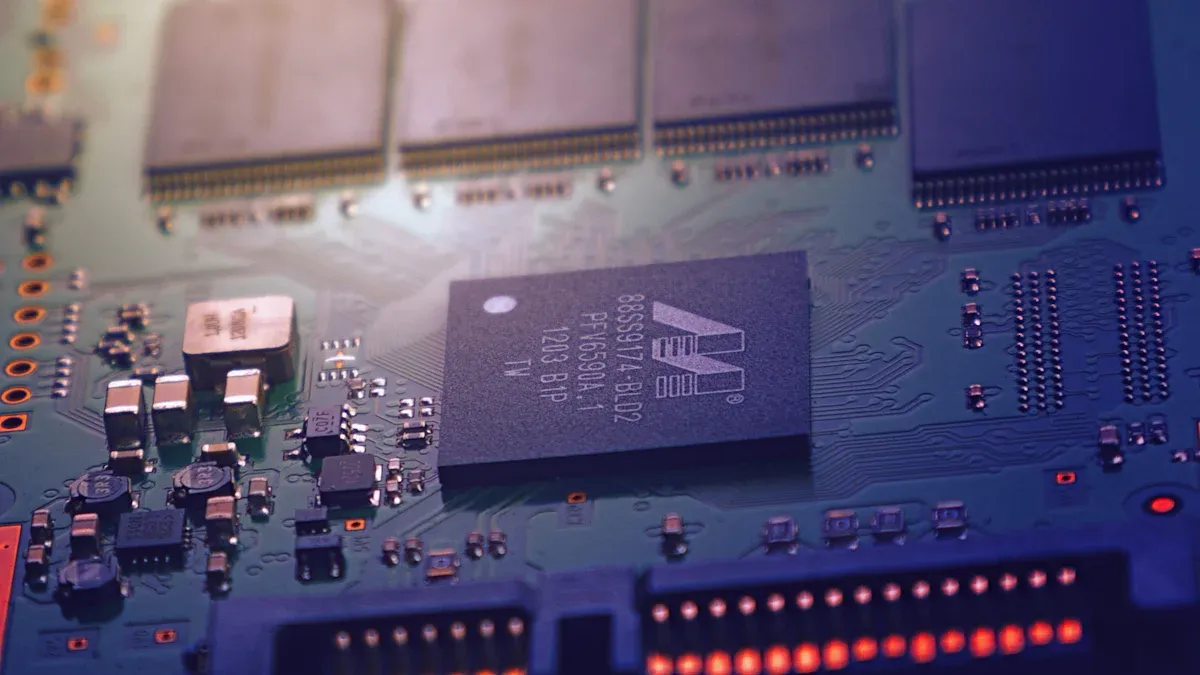
What Are ICs?
ICs, or integrated circuits, are tiny chips that hold many electronic parts like transistors, resistors, capacitors, and diodes on a single piece of silicon. These chips form complete circuits that can process, store, or control signals. Unlike discrete components, which are separate parts placed on a circuit board, ICs combine everything into one small package. This makes devices smaller, faster, and more reliable.
Integrated Circuits (ICs) | Discrete Components | |
|---|---|---|
Composition | Many parts on one chip | Separate parts on a board |
Size | Very small, compact | Larger and bulkier |
Reliability | High, due to automated manufacturing | Lower, due to manual assembly |
Power Consumption | Low, uses less energy | Higher, less efficient |
Cost | Low in mass production | Higher, more labor needed |
Flexibility | Fixed once made | Easy to change or replace |
Best Use | Phones, computers, microcontrollers, microprocessors | Prototypes, custom circuits |
ICs power many devices, including microcontrollers and microprocessors. A microcontroller is a small computer on a chip, often found in appliances and toys. A microprocessor is the main brain of computers and smartphones. Both use ICs to work quickly and efficiently.
Impact on Modern Devices
The invention of integrated circuits changed electronics forever. Before ICs, devices used vacuum tubes and separate parts, which made them large, slow, and easy to break. When engineers like Jack Kilby and Robert Noyce created the first ICs, they made it possible to fit more power into smaller spaces.
ICs allow engineers to build microcontrollers and microprocessors that run everything from smartwatches to cars. These chips make devices smaller, lighter, and cheaper to produce. They also use less power, which helps batteries last longer.
ICs reduce device size, making gadgets like phones and tablets easy to carry.
Mass production of ICs lowers costs, so more people can afford technology.
Shorter signal paths inside ICs speed up data processing and improve performance.
Low power use means longer battery life and less heat.
ICs also let designers put many functions into one chip. For example, a microcontroller can read sensors, control motors, and store data all at once. Mixed-signal ICs combine digital and analog features, making devices smarter and more useful.
Note: The move from separate parts to ICs made modern electronics possible. Today’s microcontrollers and microprocessors rely on ICs to deliver high performance in a small package.
Component Selection and Reliability
Choosing the Right Components
Selecting the best parts for a circuit board shapes how well a device works and how long it lasts. Engineers start by reviewing requirements documentation. This documentation lists the electrical, physical, and environmental standards each part must meet. Teams often use requirements management software to keep everyone updated and to match parts with supplier catalogs quickly.
When choosing components, engineers look at several factors to consider when choosing circuit board components:
Performance: Each part must support the device’s function. For example, resistors and capacitors must handle the right voltage and current.
Compatibility: Parts must fit together. Matching voltage, current, and communication protocols helps avoid common issues with circuit board components.
Reliability: High-quality parts last longer and need less replacement or repair.
Cost: Teams compare prices to find the best value without losing quality.
Size and shape: Components must fit the design and allow for future upgrades.
Collaboration between design and engineering teams helps select parts that balance quality and price. Digital tools let teams check manufacturer inventories and compare options. Engineers also create a Bill of Materials (BOM) to track chosen parts and estimate costs.
Tip: Identifying circuit board components early in the design process helps prevent compatibility problems and makes troubleshooting easier later.
Reliability and Performance
The choice of components affects device reliability and performance. Poor-quality parts can lead to common issues with circuit board components, such as overheating or early failure. Environmental factors like heat, dust, and moisture can also cause damage. Using a multimeter helps with identifying faulty components and checking for problems like broken traces or bad solder joints.
Frequent causes of failure include manufacturing defects, aging, and physical damage. Engineers improve reliability by selecting parts from trusted suppliers, designing for proper spacing, and using conformal coatings. Regular cleaning and careful handling reduce the need for repair and replacement. When troubleshooting, using a multimeter and visual checks help with identifying faulty components quickly.
Replacement and repair tips include keeping spare parts on hand and following safe handling practices. Teams should replace aging parts before they fail and use professional repair services for complex problems. Good component selection and regular maintenance extend device life and make troubleshooting and repair easier.
Note: Knowing how are pcb components identified and understanding replacement and repair tips help engineers keep devices running smoothly.
Circuit board components and the pcb form the foundation of modern electronics. They enable devices to work reliably and support new technology. Engineers who understand each pcb part can design smaller, smarter, and more efficient products. As pcb technology advances, trends like miniaturization and flexible designs will shape future devices.
Careful selection and integration of components drive innovation and ensure long-lasting performance.
Recognizing the complexity behind each device helps everyone appreciate the engineering that powers daily life.
FAQ
What is the main purpose of a PCB?
A PCB holds and connects electronic components. It provides a strong base and creates paths for electricity to flow. Devices like phones and computers use PCBs to work properly.
How do engineers identify circuit board components?
Engineers look for labels, color codes, and markings on each part. They often use a table or chart to match these codes with the correct values.
Component | Marking Example |
|---|---|
Resistor | Color bands |
Printed value | |
Diode | Stripe |
Why do devices need both passive and active components?
Passive components control and store energy. Active components amplify signals and switch currents. Devices need both types to process information and perform tasks.
Can damaged components be replaced easily?
Many components can be replaced if they break. Engineers use tools like soldering irons to remove and attach new parts. Some tiny parts may need special equipment.
How do sensors help modern electronics?
Sensors detect changes like heat, light, or movement. Devices use this information to adjust settings or send alerts. For example, a phone screen turns off when it senses a face nearby.