Understanding the Versatility of Capacitive Sensors in Today’s Applications

Capacitive sensors shape modern technology by enabling non-contact detection and high sensitivity across many industries. Asia Pacific leads the market, driven by rising demand for consumer electronics and manufacturing. In 2024, capacitive sensors hold 44% of the consumer electronics market, showing their dominance in devices that rely on capacitive touch sensors for reliable touch interactions and detecting the touch of a finger. These sensors work with various materials and power a wide range of applications, from healthcare to automotive. Capacitive touch sensors improve automation and user interfaces, delivering fast, accurate responses.
Capacitive sensor technology continues to evolve, making capacitive touch sensors essential for flexible, smart devices and wearables.
Key Takeaways
- Capacitive sensors detect touch and proximity without physical contact, making them sensitive, durable, and energy-efficient.
- These sensors adapt to many materials and environments, working well on flexible, curved, or flat surfaces in devices like wearables and smartphones.
- Capacitive sensors power key applications in consumer electronics, industrial automation, medical devices, automotive systems, and environmental monitoring.
- They offer high accuracy and fast response but can be affected by humidity, temperature, and electrical noise, so proper design and maintenance matter.
- Innovations in materials and integration with smart technologies are expanding capacitive sensors’ roles in health, robotics, and smart environments.
Capacitive Sensor Versatility
Core Features
Capacitive sensors stand out in modern technology because they offer non-contact measurement and high sensitivity. These sensors detect changes in touch or proximity without physical contact, making them ideal for hygienic or delicate environments. Capacitive sensor designs allow for non-contact proximity detection, which helps prevent wear and tear and extends device lifespan. The table below highlights the main features that contribute to their versatility:
| Feature | Contribution to Versatility |
|---|---|
| High Sensitivity | Detects a wide range of materials, including liquids, solids, and granular substances. |
| Non-Contact Operation | Senses without physical contact, suitable for sensitive or clean environments. |
| Adaptability | Customizable for different materials, sizes, and shapes. |
| Durability | Longer lifespan due to less wear from non-contact sensing. |
| Energy Efficiency | Low power consumption fits battery-operated and energy-conscious applications. |
| Minimal Maintenance | Fewer moving parts reduce failure points and operating costs. |
| Simple Integration | Compact size and easy interface allow quick incorporation into devices. |
| High-Speed Response | Rapid sensing supports real-time touch and proximity applications. |
| Immunity to EMI | Shielding and design reduce interference, improving reliability. |
| Flexibility | Conforms to complex shapes, useful in ergonomic and wearable applications. |
| Wide Dynamic Range | Detects light to heavy loads, broadening application scope. |
| High Precision | Accurate measurement across different media and conditions. |
Capacitive sensors also show cost-effectiveness. For example, body-area capacitive sensors cost much less and use far less power than inertial measurement units. Capacitive soil moisture sensors improve irrigation efficiency and work well with affordable microcontrollers. These sensors require minimal maintenance and offer simple setup, making them practical for many applications.
Adaptability
Capacitive sensing technology adapts to many environments and device types. Sensors detect changes in conductive or dielectric properties, allowing them to sense through glass, plastic, and hybrid materials. Flexible substrates like PDMS, Ecoflex, and PET support ergonomic and wearable designs. Capacitive sensors can work on flat, curved, or flexible surfaces, enabling multi-touch and proximity features.
- Capacitive sensors function reliably in wet, dry, or electrically noisy environments due to moisture resistance and EMI shielding.
- Ultra-thin designs fit space-constrained applications, such as smartwatches or medical patches.
- Customization options let engineers adjust sensing range and form factor for specific needs.
- Capacitive sensors integrate easily into consumer electronics, industrial controls, medical devices, and automotive systems.
- Real-world studies show capacitive sensors in textile-based wearables, joint motion tracking, and gesture recognition.
Note: Advances in capacitive sensor readout circuits and energy-efficient designs support high sensitivity and low power use, making these sensors suitable for battery-powered and portable applications.
Capacitive sensors support touch and proximity detection in many fields. Their adaptability and compatibility with various materials make them essential for modern applications, from environmental monitoring to smart devices.
How Capacitive Sensors Work
Operating Principle
A capacitive sensor works by measuring changes in capacitance between two conductive surfaces. The sensor uses one surface as a probe and the other as the target object. When an object comes close, it changes the distance or the material between these surfaces. The sensor creates an electric field. Any change in the gap or the type of material affects the capacitance. The formula for capacitance is C = ε₀εᵣA/d. Here, ε₀ stands for the permittivity of free space, εᵣ is the relative permittivity of the material, A is the area, and d is the distance between the plates. The sensor detects these changes and converts them into a voltage signal. This signal shows the presence or position of the object. Capacitive sensing technology allows for non-contact measurement, so the sensor does not need to touch the object. This method works for both conductive and non-conductive materials, making capacitive sensors very flexible.
Key Factors
Several factors affect the accuracy, sensitivity, and resolution of capacitive sensors. These factors help determine how well the sensor performs in real-world situations.
- The dielectric constant between the sensor and the target must stay steady for accurate readings.
- Clean and dry environments help prevent drift caused by oil, moisture, or dirt.
- Guard rings and special cables keep the electric field focused and reduce interference from nearby objects.
- The thickness of the sensing layer changes how sensitive the sensor is and how fast it responds.
- The operating frequency affects the resolution and noise level. Lower frequencies can increase capacitance but may also add noise.
- Calibration is important for measuring different liquids or materials, as each has its own dielectric constant.
- Good sensor design reduces parasitic currents and leakage, which improves accuracy and resolution.
- Both conductive and insulating materials can be measured, but insulators may need extra circuitry.
Tip: Keeping the sensor clean and using proper guarding techniques can greatly improve measurement stability and accuracy.
Capacitive sensing technology uses these principles to deliver high resolution and accuracy in many applications. Engineers can adjust the design to fit different needs, making capacitive sensors a top choice for precise and reliable measurements.
Applications of Capacitive Sensors
Consumer Electronics
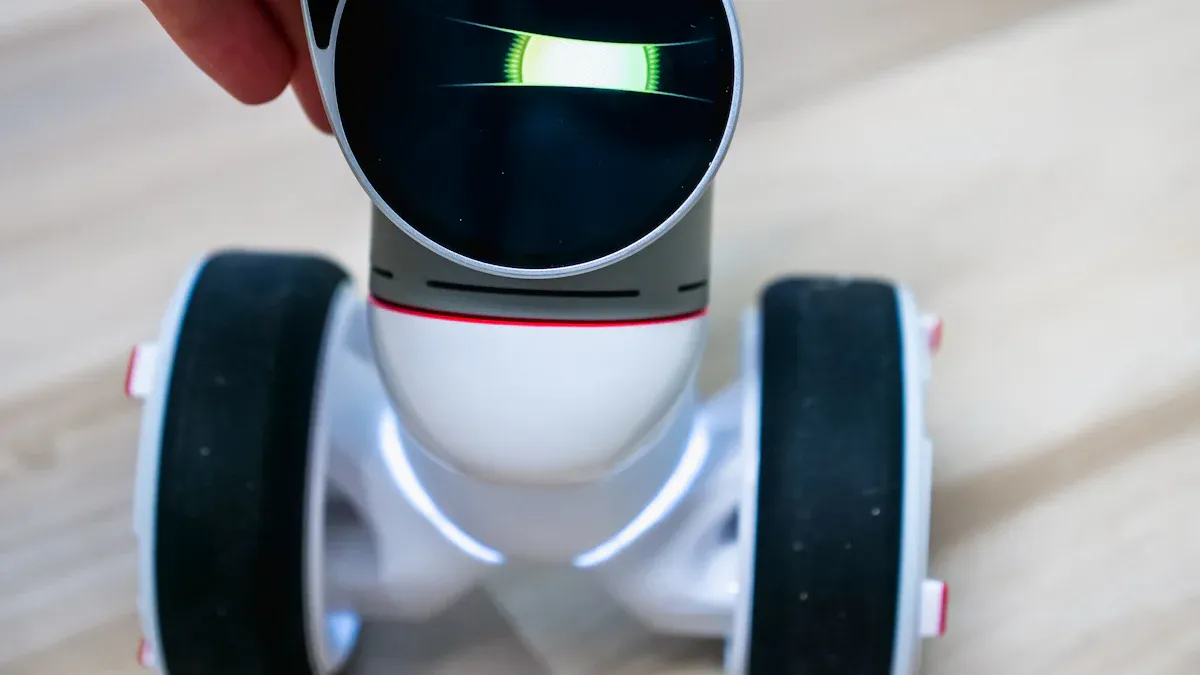
Capacitive touch sensors have transformed consumer electronics. Smartphones, tablets, and laptops use capacitive sensor switches to detect finger movements and gestures. These sensors allow users to swipe, tap, and zoom with ease. Smartwatches and fitness trackers rely on capacitive touch sensors for quick access to features and notifications. Home appliances, such as microwave ovens and washing machines, use capacitive sensor switches for simple, reliable controls. Capacitive displacement sensors help measure small changes in position, improving the accuracy of touchscreens and styluses. The applications of capacitive sensing technology in consumer devices continue to grow, making everyday interactions smoother and more intuitive.
Tip: Capacitive touch sensors work through glass and plastic, so manufacturers can design sleek, durable surfaces for devices.
Industrial Automation
Factories and warehouses depend on capacitive sensors for object detection in industrial automation. These sensors identify items on conveyor belts, measure liquid levels in tanks, and monitor powders or grains in storage bins. Capacitive displacement sensors provide precise measurements for robotic arms and automated machinery. The sensors offer high sensitivity and accuracy, detecting small changes in materials and positions. Their robust design allows them to work in harsh environments, including high temperatures and corrosive conditions. Capacitive sensor switches enable quick, non-contact activation of machines, reducing wear and maintenance. The versatility of capacitive sensors means they can handle many materials, simplifying inventory and lowering costs.
- Capacitive sensors detect objects and measure levels in real time.
- They resist temperature changes, humidity, and pressure extremes.
- Low maintenance and stable performance improve efficiency.
- Non-invasive measurement protects equipment and products.
- Capacitive displacement sensors support distance sensing applications and proximity sensing applications.
Medical Devices
Medical devices use capacitive touch sensors and capacitive displacement sensors for patient monitoring and diagnostics. Wearable health monitors track heart rate, movement, and hydration without direct skin contact. Implantable devices use capacitive sensors to monitor bone healing and tissue changes. Clinical studies show that capacitive sensors provide reliable and valid data, matching gold standard methods. The sensors offer continuous, non-invasive monitoring, which helps doctors track recovery and adjust treatments. Capacitive sensor switches allow patients to control devices easily, even with limited mobility. The miniaturization and biocompatibility of capacitive sensors make them ideal for modern medical applications.
Capacitive sensors in medical devices demonstrate high accuracy and low power use. They support personalized care by providing real-time data and adapting to patient needs. Regulatory bodies recommend strong evidence for sensor reliability and data quality, ensuring safe and effective use in clinical settings.
Automotive
Automotive systems use capacitive touch sensors and capacitive sensor switches for safety and comfort. Tire Pressure Monitoring Systems (TPMS) rely on capacitive sensors to alert drivers about underinflated tires, reducing accident risks. Climate control systems use capacitive displacement sensors to regulate air pressure and maintain comfort. Touch-sensitive controls in dashboards and steering wheels improve user experience. Capacitive sensors offer medium accuracy and high sensitivity, with low power consumption compared to other sensor types.
| Aspect | Details |
|---|---|
| Implementation | Capacitive sensors consist of two electrodes separated by a dielectric; capacitance changes with pressure. |
| Common Applications | TPMS, climate control systems, other low power applications. |
| Safety Improvements | TPMS alerts drivers to underinflated tires, reducing risk of blowouts and accidents. |
| Efficiency Improvements | Support climate control and comfort features with low power consumption. |
| Sensor Characteristics | Medium accuracy, high sensitivity, low power consumption compared to other sensor types. |
Key applications include TPMS for safety and climate control for comfort. Capacitive displacement sensors help measure small changes in pressure and position, supporting advanced automotive features.
Environmental Monitoring
Capacitive sensors play a vital role in environmental monitoring. They measure soil moisture, air quality, and fluid pressure in real time. Capacitive displacement sensors detect small changes in fluid flow, providing early warnings for blockages or leaks. Sensor arrays in prosthetic liners monitor pressure and force, showing the adaptability of capacitive sensors to complex environments. Integration with machine learning and image processing allows for advanced data interpretation and adaptive responses.
- Capacitive sensors offer high sensitivity and flexibility.
- Real-time monitoring supports quick decision-making.
- MEMS capacitive sensors detect fluid pressure changes with high repeatability.
- Sensors provide early warnings for environmental changes, such as flow blockages.
- Capacitive sensors work reliably in harsh, particle-laden environments, where other technologies may fail.
- They identify materials and objects even in challenging conditions, supporting autonomous robotic systems.
Capacitive sensors remain insensitive to lighting, noise, and surface properties, making them ideal for environmental monitoring in construction, agriculture, and research. Their broad electric field coverage enables sensing over large areas with a single sensor.
Note: The multifunctional capabilities of capacitive touch sensors and capacitive displacement sensors support a wide range of applications, from consumer electronics to industrial automation and environmental monitoring.
Capacitive Tactile Sensor and Displacement Sensors
Tactile Capacitive Sensors
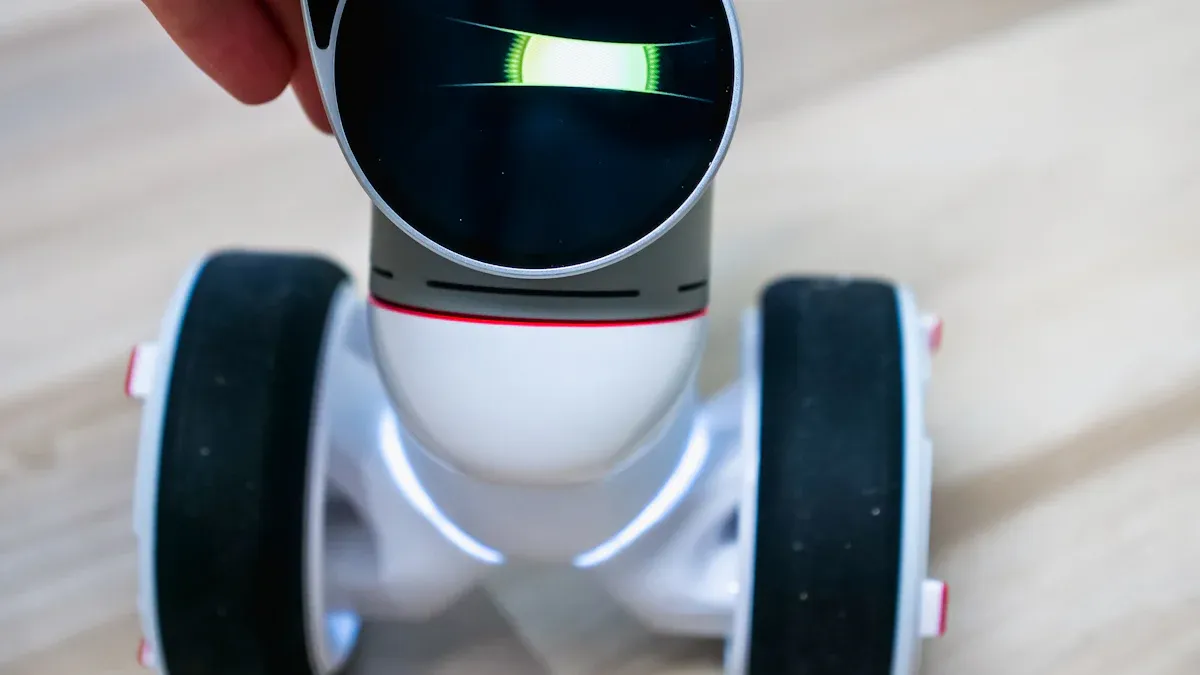
Tactile capacitive sensors play a key role in modern user interfaces and robotics. These sensors detect even the smallest pressure changes, which helps devices respond quickly to a user’s touch. Many smartphones and wearable devices use capacitive touch sensors to create smooth and comfortable interactions. Tactile capacitive sensors can be thin, stretchable, and flexible. Designers use them on curved or soft surfaces, making them perfect for ergonomic products and wearables.
Robots use capacitive tactile sensors as artificial skin. These sensors help robots grip fragile objects without breaking them. In factories, robots with tactile capacitive sensors can assemble small parts and handle delicate materials. The RoboTouch system shows how these sensors improve grip control and allow robots to sense their environment. Tactile capacitive sensors also increase safety by detecting unexpected contact and helping robots adjust their movements. User feedback often mentions better comfort and fit in products that use tactile capacitive sensors, especially in wearables.
Tip: Integration with AI lets tactile capacitive sensors help robots tell the difference between textures and materials, making robotic touch more like human touch.
Capacitive Displacement Sensors
Capacitive displacement sensors provide high-resolution measurements for precision tasks. These sensors measure tiny changes in position or distance with sub-micron accuracy. In automation, capacitive displacement sensors give real-time feedback, which helps machines keep parts aligned and in the right place. Factories use capacitive displacement sensors to measure distances under 10 millimeters and up to 100 millimeters, supporting both small and medium-scale tasks.
Capacitive displacement sensors work well in electronics, automotive, and healthcare industries. Their compact size and MEMS technology make them easy to fit into tight spaces. These sensors support non-contact thickness measurement, which means they can check the thickness of materials without touching them. This feature helps protect delicate parts and ensures quality. Capacitive displacement sensors also support non-contact thickness measurement in high-speed production lines, where accuracy and resolution matter most.
Note: The growing use of capacitive displacement sensors in Asia Pacific shows their value in smart manufacturing and Industry 4.0. Their stability, sensitivity, and precision measurement abilities make them essential for modern automation.
Comparing Sensor Technologies
Advantages
Capacitive sensors offer unique benefits in many applications. They provide non-contact detection, which helps maintain device longevity and hygiene. These sensors work with both metallic and nonmetallic objects, unlike inductive sensors that only detect metals. Capacitive sensors deliver high resolution performance, making them suitable for tasks that require precise measurement. Their compact size and low cost allow easy integration into modern devices. Proximity sensing becomes reliable because capacitive sensors respond quickly to changes in the environment.
Optical sensors use light to detect objects and measure distance. They excel in environments with clear visibility and provide excellent resolution and accuracy. Ultrasonic sensors use sound waves to measure distance and detect objects. These sensors perform well in dusty or dark environments where optical sensors may fail. Mechanical sensors rely on physical contact to measure position or movement. They offer high channel capacity and fast response, which supports applications that demand quick and precise feedback.
| Sensor Type | Detection Method | Key Strengths | Common Uses |
|---|---|---|---|
| Capacitive | Electrostatic | Non-contact, high resolution, compact | Proximity, touch, position |
| Optical | Light | High accuracy, fast response | Barcode, alignment |
| Ultrasonic | Sound waves | Works in dust/dark, medium accuracy | Level, distance |
| Mechanical | Physical contact | High channel capacity, fast feedback | Position, limit switches |
Limitations
Capacitive sensors face several challenges. Their accuracy depends on the dielectric constant of the measured material. Humidity and temperature can change the dielectric properties, which affects sensor resolution and accuracy. Electrical interference may disrupt sensor signals, reducing reliability. Manual sensitivity adjustment is often needed to avoid false detection, especially in environments with variable materials. Operating distance depends on the material type and sensor configuration, which can limit consistent proximity sensing.
Ultrasonic sensors experience interference from vapor, foam, and physical obstructions. These factors can delay response and introduce noise. Mechanical sensors require physical contact, which leads to wear and damage over time. They cannot provide non-contact detection, making them less suitable for delicate or hygienic tasks.
- Capacitive sensors are prone to fouling and environmental sensitivity.
- Ultrasonic sensors show comparable but noisier performance and response delays.
- Mechanical sensors outperform others in channel capacity but lack non-contact capability.
- Both capacitive and ultrasonic sensors need filtering to reduce noise and improve resolution.
Environmental factors such as humidity and electrical interference impact capacitive sensor performance. Studies show that humidity alters the dielectric properties of sensing materials, which changes capacitance and sensor sensitivity. Residual moisture and inconsistent vapor flow introduce variability and reduce measurement accuracy. Advanced designs improve sensitivity and sensing distance, but further research is needed to fully address these environmental challenges.
Tip: Controlled environments and automated data collection help improve the reliability of capacitive sensors, especially in applications that require high resolution performance.
Future Trends
Innovations
Capacitive sensors continue to evolve with new materials and designs. Researchers have created flexible capacitive sensors using silver nanowires, gold, and graphene. These sensors work well in wearable devices and medical detection. Their simple structure and low power consumption make them ideal for electronic skin and soft robotics. Stanford engineers developed a low-cost, robust capacitive 6-axis force-torque sensor. This sensor uses printed circuit boards and silicone pillars, making it durable and affordable for robotic hands and surgical tools. Another innovation uses graphite pencils on wood to build eco-friendly capacitive sensors. These sensors respond to touch, pressure, humidity, and temperature, offering a sustainable solution for green electronics.
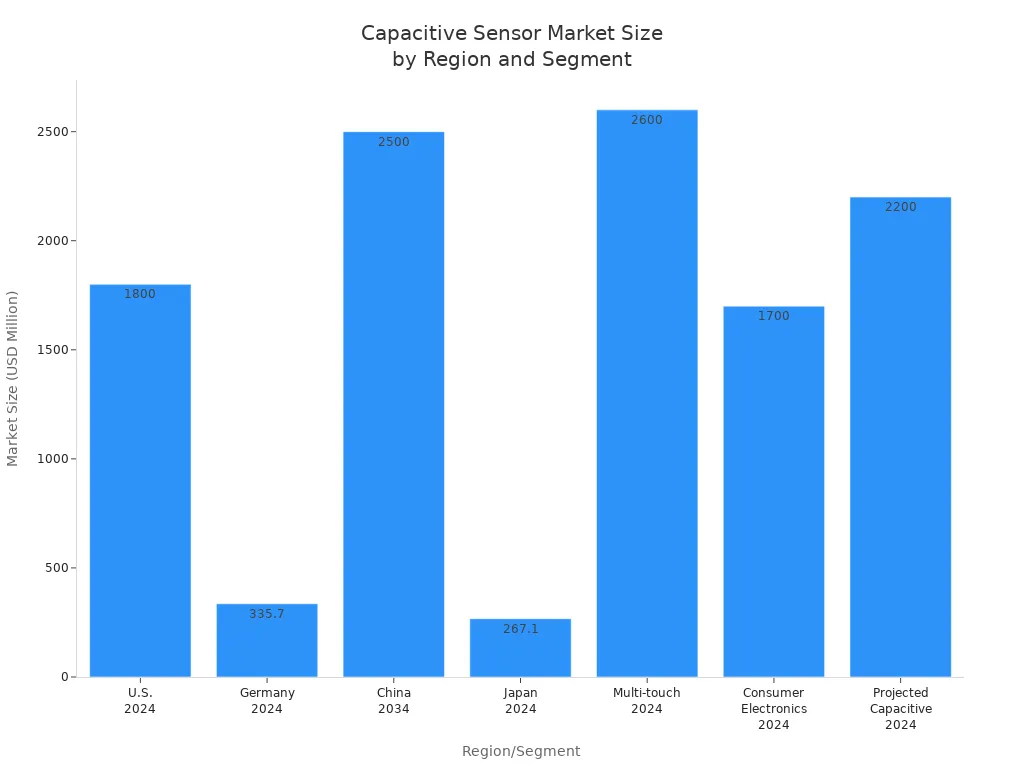
Capacitive sensors now integrate with IoT and smart devices. They enable touchless controls, gesture recognition, and environmental monitoring in homes, cars, and factories. Companies like Philips and Siemens use capacitive sensors for medical imaging and smart elevators. The market for capacitive sensors is growing quickly, especially in Asia-Pacific, North America, and Europe. The automotive sector shows strong growth, with capacitive sensors supporting driver assistance and safety features.
Emerging Applications
Capacitive sensors play a key role in new applications. Wearable capacitive strain sensors track body motion and health by detecting stretching. Electrochemical biosensors use capacitive sensing to monitor biomarkers in fluids like sweat and saliva. These sensors help manage diseases such as diabetes and cancer. Skin-integrated temperature sensors allow early fever detection, which is important for infants and healthcare.
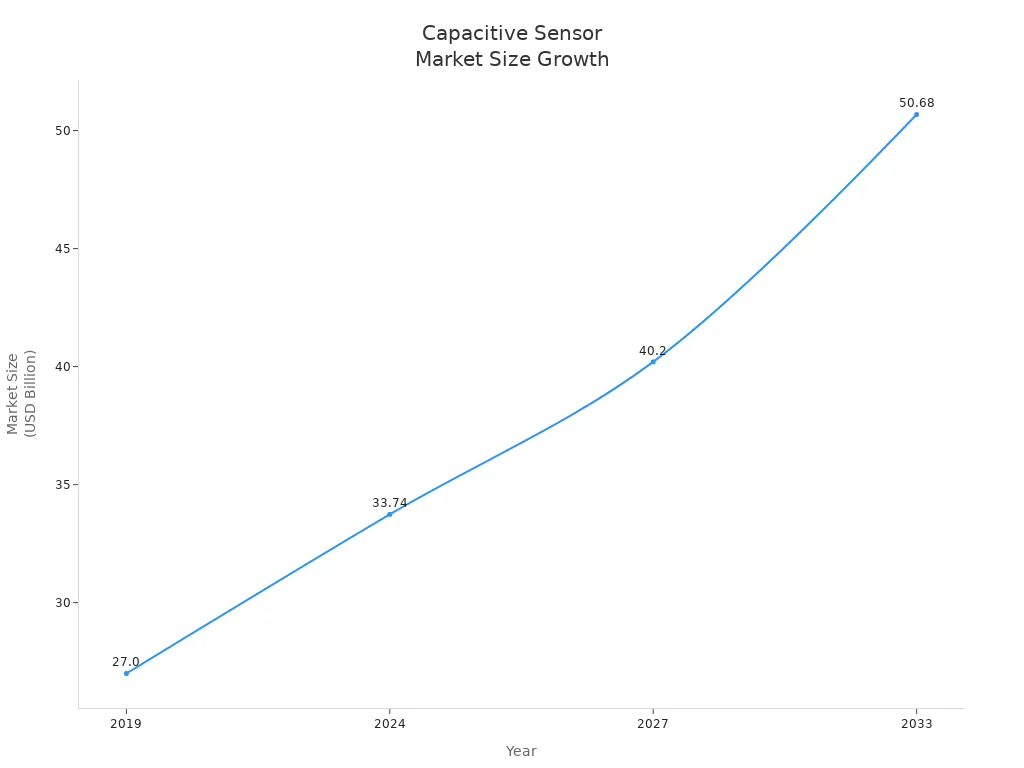
Capacitive sensors also support environmental monitoring. They measure soil moisture and air quality, helping farmers and researchers make better decisions. In smart homes and cities, capacitive sensors enable energy-efficient solutions and touchless interfaces. The market for capacitive sensors is expected to reach $57.2 billion by 2030, with strong growth in automotive, consumer electronics, and industrial automation. Future trends include AI-powered touch prediction, adaptive sensitivity, and multi-modal sensing for temperature, vibration, and humidity.
Capacitive sensors have transformed many industries with their adaptability, cost-effectiveness, and wide range of applications. The table below highlights their impact across key areas:
| Area | Impact Example |
|---|---|
| Consumer Electronics | Reliable touch sensing and battery-saving proximity features |
| Industrial Automation | Precise object detection and improved safety |
| Biomedical Sensing | Noninvasive monitoring and wearable health devices |
| Environmental | Fast, accurate humidity and moisture monitoring |
| Precision Engineering | High-accuracy, non-contact measurement |
Ongoing advances in flexible materials and smart designs support new uses in health monitoring and robotics. Capacitive sensor technology will continue to shape future innovations and smarter touch experiences.
FAQ
What materials can capacitive sensors detect?
Capacitive sensors can detect both conductive and non-conductive materials. They sense objects like glass, plastic, metal, water, and even the human body. This wide range makes them useful in many industries.
How do capacitive sensors differ from inductive sensors?
Capacitive sensors detect changes in capacitance, so they work with many materials. Inductive sensors only detect metals because they sense changes in magnetic fields. Capacitive sensors offer more flexibility for different applications.
Can capacitive sensors work in wet or dirty environments?
Yes, many capacitive sensors work well in wet or dirty environments. Designers often add protective coatings or use special materials. This helps the sensors resist moisture, dust, and other contaminants.
Why do touchscreens use capacitive sensors?
Touchscreens use capacitive sensors because they respond quickly and accurately to finger touches. They allow for multi-touch gestures and work through glass or plastic surfaces. This makes devices easy and fun to use.
What are some common problems with capacitive sensors?
Capacitive sensors may face issues with humidity, electrical noise, or changes in temperature. These factors can affect accuracy. Regular cleaning and proper installation help reduce these problems.
Tip: Always check the sensor’s environment and follow the manufacturer’s guidelines for best results.