Buck vs Boost Converter Which One Do You Need?
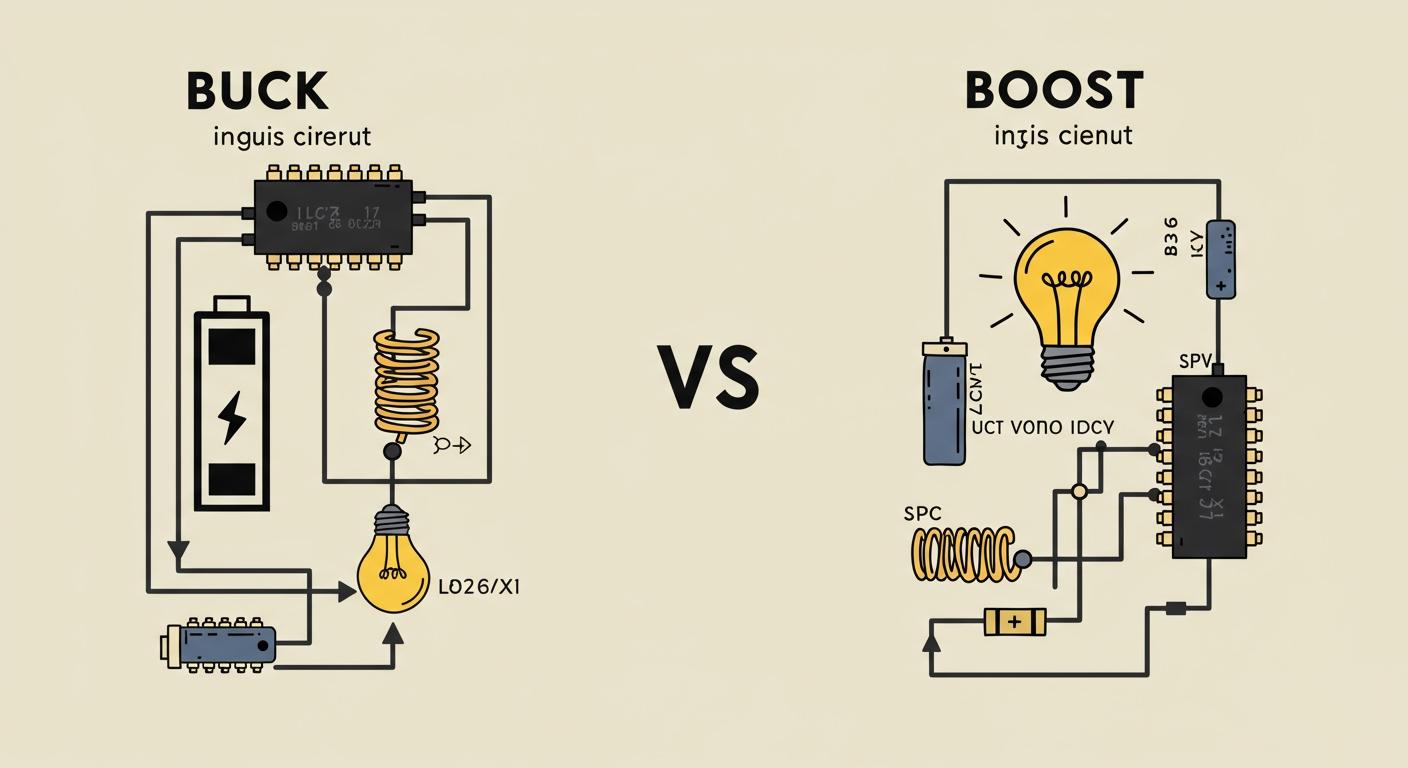
The global market for the dc-dc converter is significant, valued at USD 12.21 billion in 2024. A person chooses a buck converter, which uses a buck circuit, to decrease voltage. A boost converter is selected to increase it. This choice depends entirely on the source and the load.
Source vs. Load 💡
- A source is the power supply, like a battery or solar panel.
- A load is the device needing power, like a small motor or an Arduino.
Key Takeaways
- Use a buck converter to lower voltage. It takes a higher input voltage and makes it a lower output voltage.
- Use a boost converter to raise voltage. It takes a lower input voltage and makes it a higher output voltage.
- Choose the right converter by comparing your power source voltage to the voltage your device needs.
- Buck-boost converters are useful when your input voltage changes a lot, like with a draining battery.
- Both buck and boost converters are very efficient. They help save battery life in devices.
UNDERSTANDING THE BUCK CONVERTER:
A buck converter is a type of dc-dc converter. It efficiently steps down voltage from a power supply to a load. This converter takes a higher input voltage and produces a lower, stable output voltage. A key advantage of the buck converter is its high efficiency. It often exceeds 95%, wasting very little energy as heat. This makes the buck converter ideal for battery-powered devices.
HOW IT STEPS DOWN VOLTAGE:
The buck converter uses a switching process to lower voltage. The buck circuit inside the converter rapidly turns a switch on and off.
How It Works ⚙️
- When the switch is on, energy is stored in an inductor.
- When the switch is off, the inductor releases this energy to the load.
An output capacitor helps smooth the voltage. This process ensures the load receives a constant, lower voltage from the power supply. The buck converter is a very effective dc-dc converter. This converter can also handle a wide range of input voltages from an unstable power supply.
THE BASIC BUCK CIRCUIT:
A basic buck circuit contains a few essential components. These parts work together inside the buck converter to manage power. The main components of the buck circuit are:
- A controllable switch (like a MOSFET)
- A diode
- An inductor
- A capacitor
This simple buck circuit design makes the buck converter a reliable choice. The buck circuit is fundamental to this type of converter. The converter provides a stable output from the power supply. This converter is a popular choice for many designs.
COMMON USE CASES:
The buck converter is found in many electronic devices. Its efficiency makes it perfect for portable electronics like smartphones and tablets. The buck converter helps extend battery life in these devices. For example, a project might need to power a 5V Arduino from a 12V power supply. A buck converter is the perfect converter for this task.
Industrial uses are also common for this converter. They appear in motor drives, solar power systems, and 24V industrial bus conversion. The buck converter is a versatile converter for any application that needs to step down voltage. The buck circuit is also used in high reliability applications. This converter is a go-to solution.
EXPLORING THE BOOST CONVERTER:
A boost converter is a dc-dc converter that steps up voltage. This converter takes a lower input voltage and produces a higher, regulated output voltage. While the boost converter increases voltage, this action often results in a decrease in the available output current. The boost converter is an essential tool for many electronics projects. This specific converter transfers energy between its components to achieve the voltage increase.
HOW IT STEPS UP VOLTAGE:
The boost converter uses a switching cycle to store and release energy, which effectively increases the output voltage. The converter accomplishes this through a few key steps.
- Switch Closed: Current flows through an inductor. The inductor stores energy by creating a magnetic field.
- Switch Opened: The inductor's magnetic field collapses to keep the current flowing. This action reverses the inductor's polarity. The combined voltage from the source and the inductor flows to the load.
- Capacitor Charging: A capacitor connected to the load charges to this new, higher voltage.
- Capacitor Discharging: When the switch closes again, the capacitor supplies this steady, higher voltage to the load.
This rapid process makes the boost converter a highly effective dc-dc converter.
WHEN TO USE A BOOST CONVERTER:
A person should use a boost converter whenever the load requires a higher voltage than the source can provide. This converter is the perfect solution for bridging that voltage gap.
Practical Example ⚡ Imagine needing to power a 24V LED light strip using a 12V car battery. A boost converter is the ideal converter for this job. It will take the 12V input and step it up to the required 24V, allowing the LEDs to shine brightly.
KEY APPLICATIONS:
The boost converter appears in many modern technologies. In renewable energy, this converter is crucial for solar-powered systems. It can step up the low voltage from solar panels to a level sufficient for powering an electric vehicle's motor. The boost converter ensures excellent performance with low energy loss.
Automotive electronics also rely heavily on this converter. A boost converter can elevate a car's battery voltage to power high-demand systems like audio amplifiers. It also maintains a stable power supply for sensitive electronics, protecting them from voltage drops that occur during events like a cold engine crank. This makes the boost converter a versatile and necessary component.
BUCK VS. BOOST: A QUICK COMPARISON:
Choosing between a buck converter and a boost converter is straightforward. The decision depends entirely on the project's voltage needs. A person must compare the source voltage to the required load voltage. This comparison determines the correct converter for the job. The buck converter and the boost converter serve opposite functions, making the choice clear.
PRIMARY FUNCTION:
The primary function of each converter defines its use. A buck converter is a step-down converter. It reduces a higher input voltage to a lower output voltage. A boost converter is a step-up converter. It increases a lower input voltage to a higher output voltage. This fundamental difference is the most important factor in selecting the right converter.
A simple table can help a person visualize this choice.
| Your Goal | Converter You Need |
|---|---|
| Decrease Voltage (Step-Down) | Buck Converter |
| Increase Voltage (Step-Up) | Boost Converter |
VOLTAGE RELATIONSHIP:
The output voltage of each converter is controlled by its duty cycle. The duty cycle is the percentage of time the internal switch inside the converter is on. Adjusting this timing changes the output voltage.
What is Duty Cycle? ⚙️
Imagine flicking a light switch on and off very quickly. The duty cycle is the fraction of time the switch stays in the "on" position. A higher duty cycle means the switch is on longer.
For a buck converter, the output voltage is directly proportional to the duty cycle. A higher duty cycle results in a higher output voltage, but it will never exceed the input voltage. The ideal formula shows this simple relationship.
- Ideal Buck Converter Formula:
D = Vo / VinDis the Duty CycleVois the Output VoltageVinis the Input Voltage
For a boost converter, the relationship is different. A higher duty cycle on a boost converter produces a much higher output voltage. The ideal formula for a boost converter shows how it achieves this voltage increase.
- Ideal Boost Converter Formula:
D = 1 – (Vin / Vout)
This formula highlights how the boost converter manipulates energy to create a higher potential at the output. Both the buck converter and the boost converter rely on this principle to regulate voltage. The specific converter chosen depends on whether the goal is to decrease or increase that voltage.
TYPICAL EFFICIENCY:
Efficiency is a critical measure for any DC-DC converter. It tells a person how much power makes it to the load versus how much is lost as heat. A more efficient converter wastes less energy.
Both the buck converter and the boost converter are highly efficient. Traditional designs for each converter typically achieve efficiencies between 85% and 90%. However, modern technology has pushed these numbers even higher. Advanced designs for a buck converter or boost converter can reach a peak efficiency of 96%. Many integrated circuits, like the LTC3532 buck-boost converter, maintain efficiency above 90% under normal loads.
High efficiency is especially important for battery-powered devices. A highly efficient buck converter or boost converter will extend battery life. This makes the selected converter a better choice for portable electronics. The right converter ensures power is used effectively. The buck converter is an excellent choice for stepping down voltage efficiently. The boost converter is the superior option for stepping up voltage with minimal loss. Each converter is optimized for its specific task.
CHOOSING THE RIGHT CONVERTER:
Selecting the correct DC-DC converter involves a clear, three-step process. A person must analyze the power source, the device's needs, and the total power required. Following these steps ensures the chosen converter will perform reliably and efficiently for any project.
STEP 1: IDENTIFY INPUT VOLTAGE:
The first step is to identify the input voltage, also known as the source voltage. This is the voltage provided by the power supply. Common power sources in electronics projects have different standard voltages.
A person can find the input voltage by checking the label on the power source. Common sources include:
- Batteries: A LiPo battery might be 3.7V, while a car battery is 12V.
- AC to DC Wall Adapters: These are common for laptops and often provide 19V or 20V.
- USB Power: A standard USB port supplies 5V.
- Variable DC Benchtop Power Supply: This source allows a user to set a specific voltage.
Knowing this starting voltage is the essential first piece of information for selecting the right converter.
STEP 2: DETERMINE OUTPUT VOLTAGE:
The second step is to determine the required output voltage for the load. The load is the component or device that needs power. Different electronic components operate at specific standard voltages.
For example, many microcontrollers and sensors that once used 5V now commonly operate at 3.3V, and some run on voltages as low as 1.7V. Even small motors can operate on voltages like 1.2V. A person can find this required voltage in the component's datasheet or user manual.
Decision Point ⚖️
- If the input voltage is higher than the output voltage (e.g., 12V source to 5V load), a buck converter is needed.
- If the input voltage is lower than the output voltage (e.g., 3.7V source to 5V load), a boost converter is needed.
This simple comparison makes the choice between a buck converter and a boost converter clear.
STEP 3: CALCULATE POWER NEEDS:
The final step is to calculate the total power the load requires. Power is measured in Watts (W). This calculation helps a person choose a converter that can handle the electrical demand safely and efficiently.
First, a person must know the current the load will draw. Current is measured in Amperes (A). If the datasheet does not list the current, a person can calculate it using Ohm's Law.
- Ohm's Law Formula:
Current (Amps) = Voltage (Volts) / Resistance (Ohms)
Once the voltage and current are known, calculating the output power is simple. A person multiplies the output voltage by the output current.
Power Formula 💡
Power (Watts) = Voltage (Volts) x Current (Amps)For example, a 5V device that draws 2A of current requires 10W of power (5V x 2A = 10W).
However, no converter is 100% efficient. A portion of the input power is always lost as heat. A 90% efficient converter turning 3330W of input power into 3000W of output power will waste 330W as heat. This means the input power must always be higher than the required output power. A person must select a buck converter or boost converter with a power rating that exceeds the calculated output power to account for this inefficiency.
Finally, a person must consider safety features. A DC-DC converter draws a large inrush current when first powered on. This can damage the converter or the load. To manage this, many designs use an NTC thermistor to create a soft start, allowing current to increase gradually. Some advanced converters, like the ADP5070, also include overcurrent protection, such as a hiccup mode, to prevent damage from excessive current draw. Choosing a converter with these protections is a critical final step. This ensures the buck converter or boost converter operates safely. The right converter will protect the entire system.
BEYOND BUCK AND BOOST:
Sometimes, a project's needs are more complex than simply stepping voltage up or down. The world of DC-DC converters offers solutions for these special cases. A person might need a converter that can handle a variable input or one that provides electrical safety. Understanding these advanced options helps a person make the best choice.
THE BUCK-BOOST CONVERTER:
A buck-boost converter is a single, versatile module. This converter can produce a stable output voltage even when the input voltage is higher, lower, or equal to the output. It combines the functions of a buck converter and a boost converter. This makes it an ideal converter for specific situations.
Practical Example 🔋
Consider a device powered by a lithium-ion battery. A fully charged battery might supply 4.2V, but it drops to 3.0V as it discharges. If the device needs a constant 3.3V to operate, neither a standard buck converter nor a boost converter will work for the entire battery life. A buck-boost converter is the perfect solution. It steps the voltage down when the battery is full and steps it up as the battery drains.
This type of converter is essential for battery applications that need a consistent voltage. Buck-boost converters are also used in systems with multiple power sources, like a wall adapter and a USB input. While a buck-boost converter is more complex and slightly less efficient than a simple buck converter, its flexibility is invaluable.
ISOLATED VS. NON-ISOLATED DESIGNS:
DC-DC converters are also categorized by their circuit design. The standard buck converter and boost converter are non-isolated. This means the input and output circuits share a common ground connection. A non-isolated converter is simple and efficient for most low-voltage applications.
An isolated converter uses a transformer to create a physical electrical barrier between the input and output. This isolation is critical for safety, especially when dealing with high voltages. It prevents dangerous input voltage from reaching the load or the user. There are several types of DC-DC converter designs.
- Cuk converter: Can step voltage up or down.
- Flyback converter: An isolated converter that can step voltage up or down.
- Forward converter: An isolated converter that only steps voltage down.
Choosing an isolated converter is a key safety decision in high-power systems. For most hobbyist projects, a non-isolated buck converter or another simple converter is sufficient.
Choosing the right DC-DC converter is simple. A person's choice between a buck converter and a boost converter depends on one factor. The project's voltage needs determine the correct converter. A person can confidently select the proper converter by comparing the source and load voltages. This knowledge ensures a person picks the best converter for any electronic project.
The Final Choice 🎯
- If the output voltage must be lower, a buck converter is the needed converter.
- If the output voltage must be higher, a boost converter is the required converter.
Now you know exactly which converter you need.
FAQ
What happens if a person uses the wrong converter?
Using the wrong converter causes problems. A buck converter will not supply enough voltage for a step-up task, so the load may not work. A boost converter will supply too much voltage for a step-down task. This high voltage can permanently damage the load.
Is a buck or boost converter more efficient?
Both converters are highly efficient. A buck converter is often slightly more efficient than a boost converter. Its circuit design is simpler, which can lead to lower power losses. Modern designs for both types can exceed 95% efficiency, making the difference very small in practice.
When should a person choose a buck-boost converter?
A person needs a buck-boost converter when the input voltage can be both higher and lower than the required output voltage.
Example Use Case 🔋 It is perfect for a battery-powered project. It provides a stable 3.3V output as the battery drains from 4.2V down to 3.0V.
Can a buck converter increase current?
Yes, a buck converter increases the available output current. Power is conserved between the input and output, minus efficiency losses. When the converter steps down the voltage, the output current must increase to maintain the power balance. This is a fundamental part of its operation.