The Top 10 Semiconductor Giants by Market Cap Today
The top semiconductor companies leading the market today include industry giants like NVIDIA, Broadcom, and TSMC.
The 2025 semiconductor landscape is overwhelmingly shaped by the demand for AI computing. This trend has dramatically inflated the market cap in 2025 for the biggest semiconductor companies.
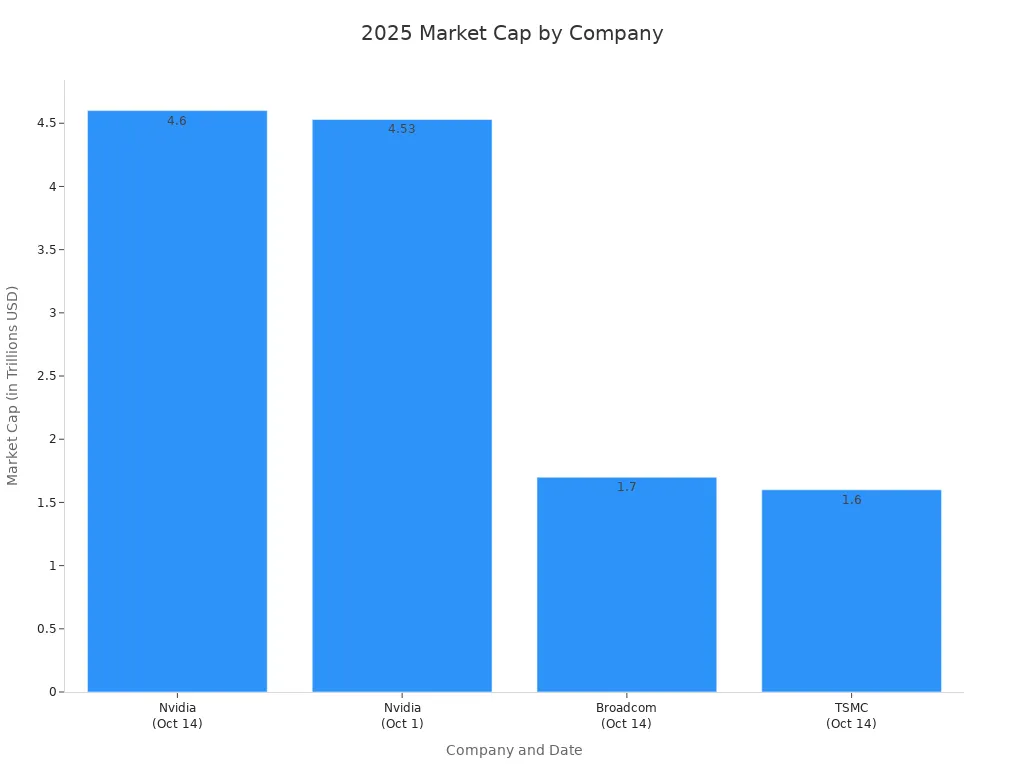
NVIDIA's valuation reached an incredible $4.6 trillion as of October 14, 2025. Following behind are other top semiconductor companies, with Broadcom at $1.7 trillion and TSMC at $1.6 trillion, making them some of the largest semiconductor companies worldwide. These firms produce the essential semiconductors that power modern technology.
Key Takeaways
- AI demand makes some chip companies very valuable. NVIDIA is the top company because its chips are important for AI.
- Companies like TSMC and ASML are very important. They make the special tools and factories needed to build advanced chips.
- The biggest chip companies are from different countries. This shows that making chips is a worldwide effort.
- Many top chip companies make different kinds of chips. These chips power everything from phones to cars.
The Biggest Semiconductor Companies by Market Cap in 2025
The semiconductor industry is the backbone of our digital world. The biggest semiconductor companies design and build the chips that power everything from smartphones to massive data centers. Below, we explore the top 10 players shaping the market, ranked by their market capitalization in 2025.
#1: NVIDIA - Leader of the Top Semiconductor Companies
- Market Cap: ~$4.6 Trillion
- Key Business/Products: Artificial Intelligence (AI) GPUs, data center accelerators, and high-end gaming graphics cards.
- Why They're a Giant: NVIDIA dominates the AI chip market. Its powerful GPUs are essential for training and running complex AI models. This leadership gives the company immense pricing power and a central role in the current technology boom. The company's strategic focus on creating a full ecosystem of hardware and software makes it a leader among the top semiconductor companies.
NVIDIA's data center products are designed for specific, high-value tasks. This specialization helps them lead the market.
| Product Category | Primary Applications in Data Centers |
|---|---|
| NVIDIA Data Center GPUs | Accelerating HPC, deep learning, and running large simulations. |
| NVIDIA HGX-T Platforms | Training increasingly complex AI models. |
| NVIDIA HGX-I Platforms | Inference for AI services like image and speech recognition. |
| NVIDIA SCX Platforms | Supercomputing applications for scientific research. |
This focus has resulted in near-total market control. NVIDIA's market share in the discrete GPU market shows its powerful position.
| Market Segment | Q2 2025 Market Share |
|---|---|
| Discrete GPU (AIB shipments) | 94% |
#2: Broadcom - One of the Largest Semiconductor Companies
- Market Cap: ~$1.7 Trillion
- Key Business/Products: Networking and connectivity chips, infrastructure software.
- Why They're a Giant: Broadcom is a critical supplier of semiconductor and infrastructure software solutions. The company's acquisition of VMware solidified its push into the hybrid cloud market. This move combined its hardware strength with a powerful software stack, creating a comprehensive platform for enterprise customers. Broadcom's revenue is well-balanced between its two main segments.
| Segment | Revenue (B USD) | Percentage of Total |
|---|---|---|
| Infrastructure Software | 21.48 | 41.6% |
| Semiconductor Solutions | 30.10 | 58.4% |
Broadcom's hardware portfolio includes a wide range of essential networking components:
- Networking devices and optical technologies
- Network interface controllers (NICs)
- Programmable chips like Tomahawk 5, designed for AI networks
The VMware acquisition shifted Broadcom's business model significantly. The company moved from perpetual software licenses to a subscription-only model. This change forced many customers to re-evaluate their cloud strategies, cementing Broadcom's influence over the enterprise software landscape.
#3: TSMC
- Market Cap: ~$1.6 Trillion
- Key Business/Products: Pure-play semiconductor foundry services.
- Why They're a Giant: TSMC (Taiwan Semiconductor Manufacturing Company) does not design its own chips. Instead, it manufactures chips for nearly every major fabless semiconductor company in the world. Its manufacturing technology is the most advanced available, making it an indispensable partner for top companies in the semiconductor space like Apple, NVIDIA, and AMD. TSMC holds a commanding 71% of the global foundry market.
- 3nm and 5nm nodes are major revenue drivers today.
- 2nm Process (N2) is planned for mass production in late 2025.
- 1.6nm Process (A16) is scheduled for launch by the end of 2026.
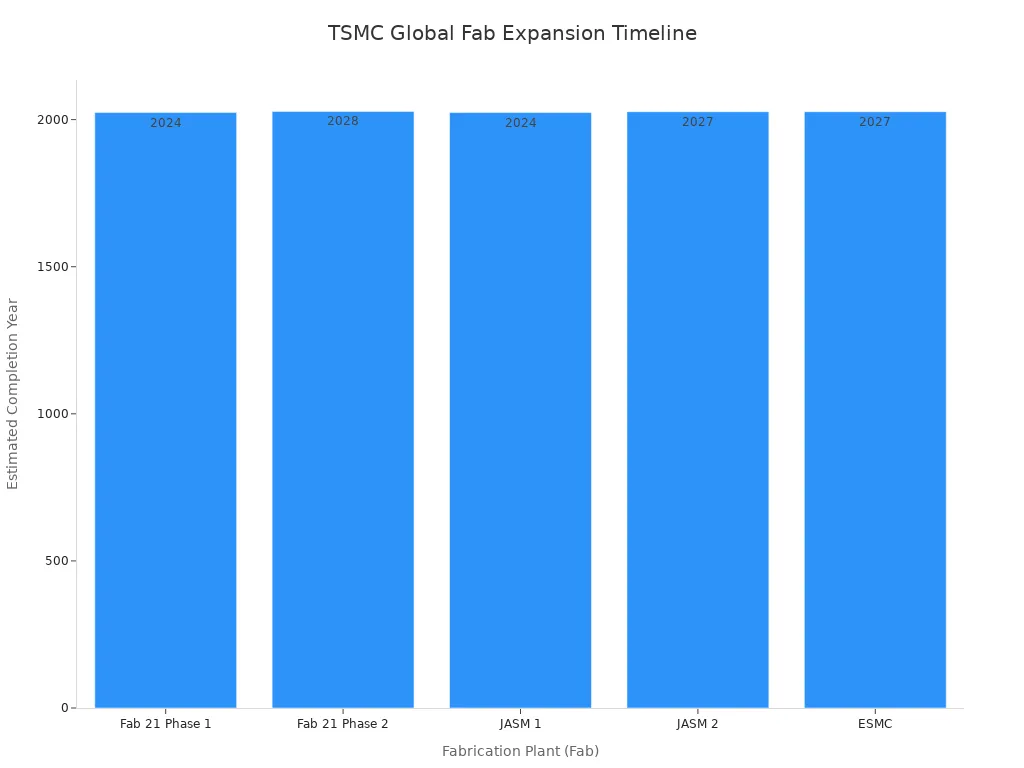
To secure its global supply chain, TSMC is building new fabs worldwide. 🌍
#4: ASML
- Market Cap: ~$1.1 Trillion
- Key Business/Products: Lithography systems for the semiconductor industry.
- Why They're a Giant: ASML has a monopoly on Extreme Ultraviolet (EUV) lithography machines. These massive, complex machines are the only tools capable of printing the patterns for the most advanced semiconductor chips. Without ASML's technology, companies like TSMC, Samsung, and Intel could not produce their leading-edge processors. This unique position makes ASML one of the most critical and influential of the top semiconductor companies.
EUV lithography uses extremely short-wavelength light to create intricate layers on a silicon wafer. The entire process happens inside a vacuum, as even air absorbs EUV light. This technology is essential for making chips at the 7nm, 5nm, 3nm, and smaller nodes.
#5: AMD (Advanced Micro Devices)
- Market Cap: ~$980 Billion
- Key Business/Products: CPUs, GPUs, FPGAs, and adaptive SoCs.
- Why They're a Giant: Advanced Micro Devices (AMD) is a fierce competitor to both NVIDIA and Intel. The company offers a broad portfolio of high-performance computing products. Its acquisition of Xilinx added powerful adaptive computing technologies like FPGAs, expanding its reach into data centers, networking, and embedded systems. This makes AMD one of the most versatile of the top semiconductor companies.
"AMD will offer the strongest portfolio of high performance and adaptive computing products in the industry, spanning leadership CPUs, GPUs, FPGAs, and Adaptive SOCs," said AMD CEO Lisa Su.
AMD has made significant gains in the x86 CPU market, challenging its main rival.
| Metric | AMD Q2 2025 Share |
|---|---|
| Desktop x86 Unit | 32.2% |
| Desktop CPU Revenue | 39.3% |
#6: Samsung
- Market Cap: ~$750 Billion
- Key Business/Products: Memory (DRAM, NAND), foundry services, and consumer electronics.
- Why They're a Giant: Samsung is a unique player among the biggest semiconductor companies. It is a world leader in memory chips and also operates a major foundry business, competing directly with TSMC. Its vast manufacturing scale and integrated business model, which spans from components to finished products like smartphones, give it significant stability and market power. Key semiconductor products include:
- Memory: High-speed LPDDR5 DRAM and next-generation V-NAND flash memory.
- Foundry: Advanced process nodes for manufacturing custom chips.
#7: Qualcomm
- Market Cap: ~$690 Billion
- Key Business/Products: Mobile processors (Snapdragon), modems, and automotive SoCs.
- Why They're a Giant: Qualcomm is the undisputed leader in smartphone processors and cellular modems. Its Snapdragon SoCs power a majority of the world's premium Android devices. The company is now leveraging its expertise in low-power, high-performance computing to expand into new markets, including automotive digital cockpits and PCs with its new Snapdragon 8 Elite chip. This expansion solidifies its position as one of the top semiconductor companies.
#8: Texas Instruments
- Market Cap: ~$310 Billion
- Key Business/Products: Analog and embedded processing chips.
- Why They're a Giant: Texas Instruments (TI) focuses on analog and embedded chips, which are essential components in nearly every electronic device. These chips manage power, convert signals, and perform control functions. TI's strength lies in its massive portfolio of over 80,000 products and its strategic focus on the industrial and automotive markets. The company's control over its manufacturing gives it a key advantage.
#9: Micron Technology
- Market Cap: ~$295 Billion
- Key Business/Products: DRAM and NAND flash memory.
- Why They're a Giant: Micron is a leading provider of memory and storage solutions. The company has successfully pivoted to meet the massive demand from the AI industry. AI servers require huge amounts of high-speed memory, and Micron's High-Bandwidth Memory (HBM) is a critical component. This has transformed Micron from a traditional PC memory supplier into a key enabler of the AI revolution, making it one of the leading semiconductor companies. The demand for its HBM products is so high that its capacity is sold out through 2026. 💡
#10: Arm Holdings
- Market Cap: ~$280 Billion
- Key Business/Products: Semiconductor IP licensing.
- Why They're a Giant: Arm does not make or sell any physical chips. Instead, it designs processor architectures and licenses this intellectual property (IP) to other companies. Its power-efficient designs are the foundation for virtually all smartphone processors and are rapidly expanding into data centers, PCs, and IoT devices. This unique business model allows Arm's technology to be everywhere, making it one of the most influential of the top semiconductor companies. The company's market cap 2025 reflects its central role in the mobile ecosystem and its growing importance in other markets.
The 2025 rankings for the top semiconductor companies reveal a clear trend. The demand for AI has reshaped the industry, boosting global semiconductor sales. This surge created a massive valuation gap, with NVIDIA leading the biggest semiconductor companies. The chart below shows this difference in market cap in 2025.

This list also highlights the importance of specialized leaders. Companies like TSMC and ASML are essential. Their work in semiconductor manufacturing enables all other top semiconductor companies to produce advanced semiconductors. While US firms dominate, the critical roles of TSMC (Taiwan) and ASML (Netherlands) show the global nature of the semiconductor supply chain. This semiconductor ecosystem relies on every player.
FAQ
### Why is NVIDIA's market cap so much higher than others?
NVIDIA's market cap is incredibly high because it dominates the AI chip market. Its powerful GPUs are essential for training and running advanced AI models. This leadership gives the company a massive advantage and a central role in the current technology boom.
### What does a semiconductor foundry do?
A semiconductor foundry manufactures chips for other companies.
For example, TSMC is a pure-play foundry. It does not design its own branded chips. Instead, it builds chips for fabless companies like Apple, NVIDIA, and AMD, using its world-leading manufacturing technology.
### What is the difference between a CPU and a GPU?
CPUs and GPUs are both processors, but they handle tasks differently.
- CPU (Central Processing Unit): It is the "brain" of a computer. It handles a wide variety of general tasks one by one. 🧠
- GPU (Graphics Processing Unit): It excels at handling many tasks at the same time. This makes it perfect for graphics and AI.
### Are all top semiconductor companies based in the US?
No, the semiconductor industry is global. While many top companies like NVIDIA and Broadcom are US-based, other key players are not. TSMC is from Taiwan, and ASML is from the Netherlands. These companies play critical roles in the worldwide supply chain.